
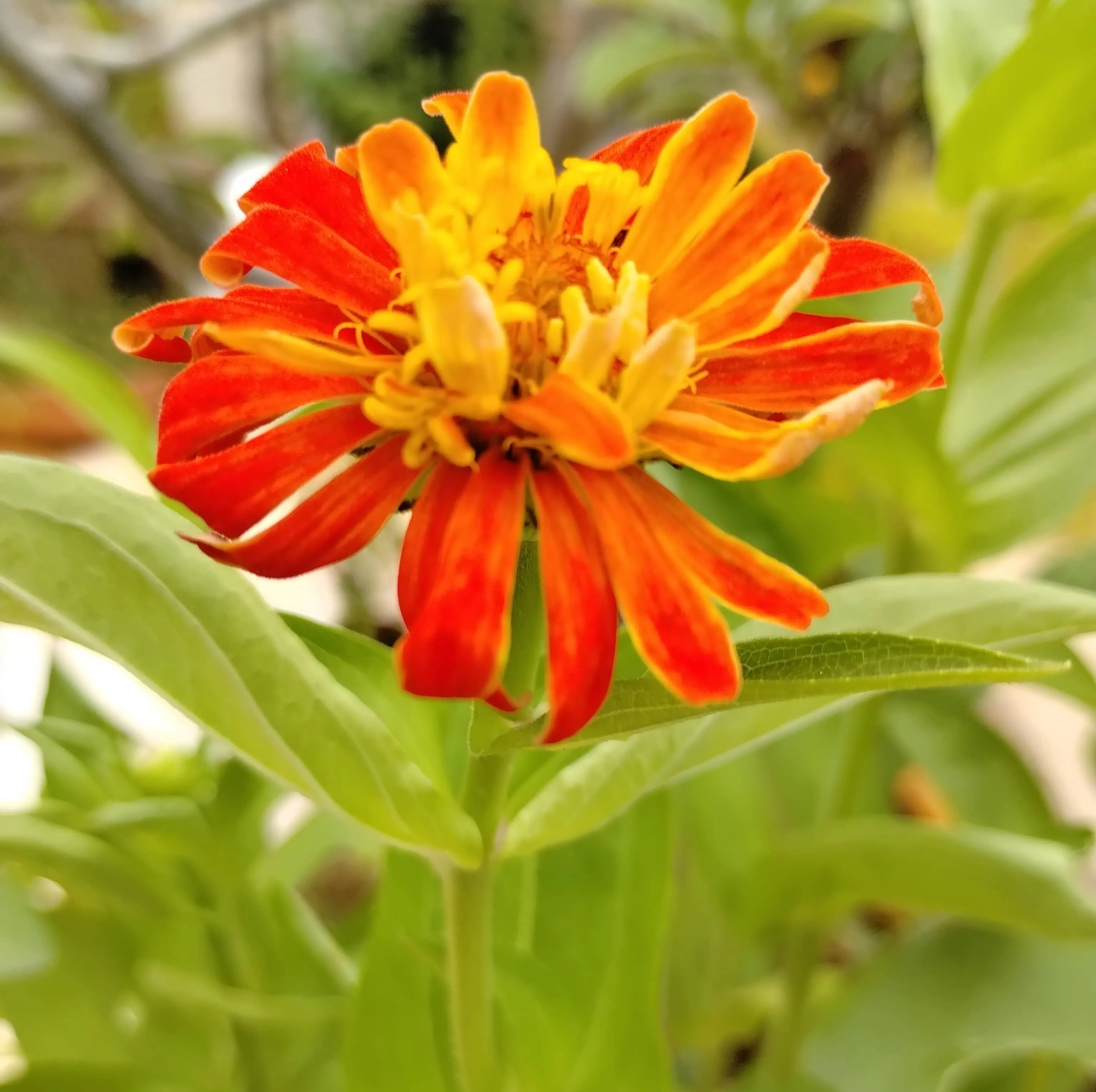
Zinnia
Zinnia elegans
How to Identify Zinnia
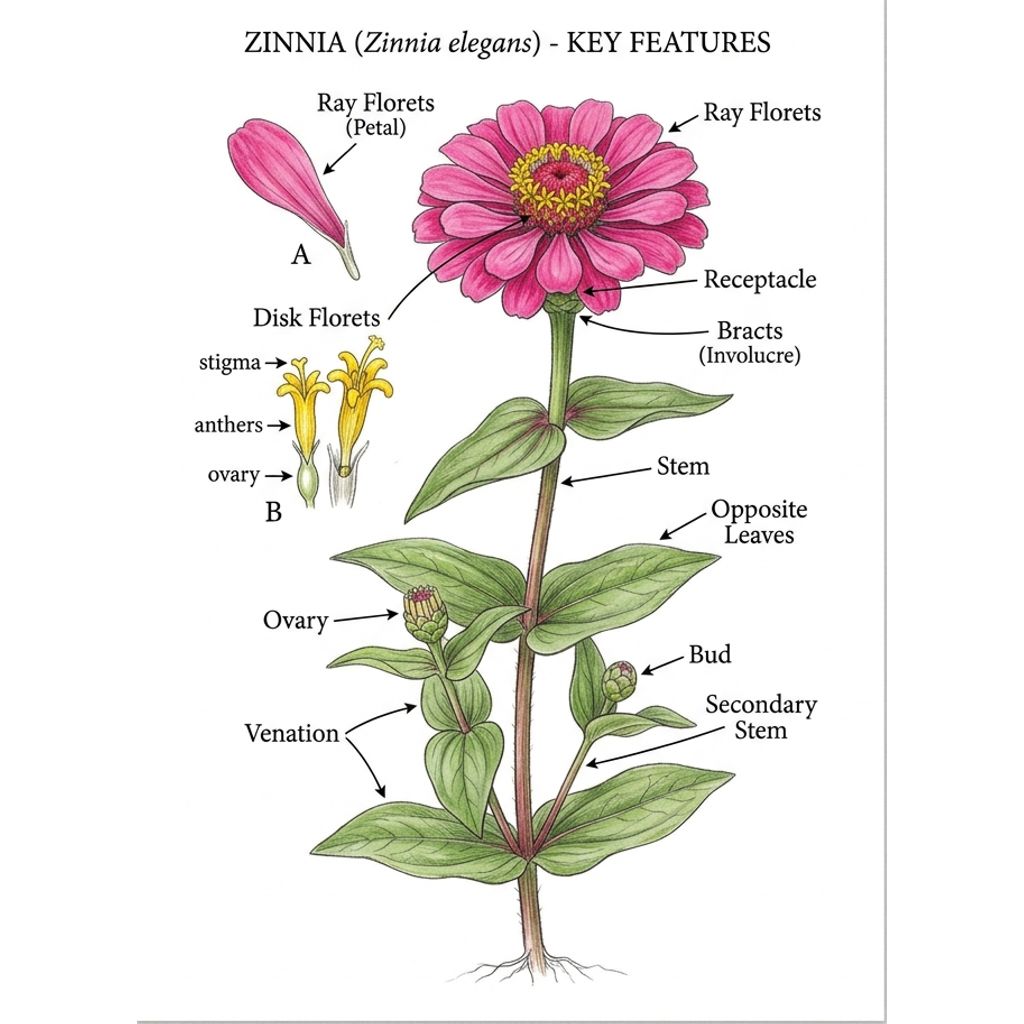
A detailed guide to identifying Zinnias (Zinnia elegans) by its key features:
- Daisy-Like Composite Head: Vibrant flower heads up to 4 inches across with sterile ray florets surrounding fertile disc florets.
- Opposite, Sessile Leaves: Lance-shaped, slightly rough leaves that attach directly to the stem without stalks.
- Stiff, Hairy Stems: Rigid, hollow upright stems covered in coarse, stiff hairs.
- Layered Petals: Available in single, semi-double, or double rows of petals in a vast spectrum of bright colors.
Care & Growing Guide
Seasonal Blooming & Hardiness
Seasonal Blooming Calendar:
- Peak Bloom: Spring to early summer (typically April through June).
- Planting Time: Sow seeds directly outdoors in early spring after the last frost, or transplant nursery starts in late spring.
Bloom Timeline
About Zinnia
Zinnias (Zinnia elegans), belonging to the Heliantheae tribe within the massive Asteraceae family, are among the most colorful, resilient, and popular warm-season annual flowers in modern horticulture. Native to the scrublands and dry grasslands of Mexico and Central America, these sun-loving plants have travelled from their humble wild origins to become an indispensable staple of summer gardens worldwide. Historically, the Aztecs regarded wild zinnias as weeds due to their dull colors and harsh look, naming them 'mal de ojos' (hard on the eyes). However, intensive breeding programs since the 19th century have transformed them into dazzling garden royalty, celebrated for their spectacular diversity of forms and ease of cultivation.
The botanical architecture of the Zinnia is beautifully adapted for maximum sun absorption and pollinator attraction. Zinnias feature sturdy, hairy, hollow stems that support oppositely arranged, sessile (stalkless) leaves. These lance-shaped or ovate grey-green leaves form a texturally rich backdrop for the main attraction: the vibrant flower heads. Zinnias exhibit a phenomenal range of bloom types, categorized by their petal arrangements. Single-flowered zinnias display a single row of ray florets around a prominent central disc of yellow star-shaped flowers; semi-doubles feature several rows of petals; and double-flowered varieties boast packed, dome-like whorls of petals that completely obscure the central disc, resembling pompoms or dahlias. Their color spectrum is virtually boundless, encompassing bright yellows, electric oranges, fiery reds, deep purples, soft pinks, pure whites, and even chartreuse green.
Cultivating these cheerful annuals is remarkably straightforward, making them an ideal choice for beginner gardeners and experts alike. Zinnias thrive in full, direct sunlight (requiring at least 6 to 8 hours daily) and prefer fertile, humus-rich, well-draining soil with a neutral to slightly acidic pH (5.5 to 7.5). Because they are highly sensitive to frost, they are typically sown directly into the warm soil in late spring after all danger of frost has passed. While they are moderately drought-tolerant once established, they perform best with regular, deep watering at the root level. Overhead watering should be strictly avoided, as the dense foliage of zinnias is particularly susceptible to powdery mildew—a fungal disease that presents as a white powdery coating on the leaves.
Beyond their incredible ornamental value, Zinnias play a vital ecological role in the garden landscape. They are absolute magnets for beneficial pollinators, especially butterflies, bumblebees, and hummingbirds, who feast on the nectar-rich florets throughout the hot summer months. Furthermore, they are highly regarded as one of the finest cut flowers available, lasting up to ten days in a vase if harvested early. In the language of flowers, Zinnias carry a beautiful emotional resonance, symbolizing lasting friendship, endurance, daily remembrance, and affectionate thoughts of absent friends. Their non-toxic status makes them a perfectly safe choice for household gardens shared with curious pets.
For more botanical profiles and flower identification features, see our guides on Primrose (Cowslip) and Zinnia.
For more botanical profiles and flower identification features, see our guides on Zinnia and Alpine Sea Holly.
Floral Formula & Features
Bract present, Radially symmetrical, bisexual, 5 fused sepals, 5 fused petals, Many stamens that are free, 2 fused carpels and an inferior ovary
- Scientific Name & Classification: Zinnia elegans (also classified as Zinnia violacea) belongs to the Asteraceae family. It is a warm-season herbaceous annual native to Mexico and Central America.
- Identification Markers: Characterized by hairy, hollow stems and opposite, sessile (stalkless) lance-shaped leaves. Flower heads may be single, semi-double, or double, appearing in a vast array of vibrant colors (excluding true blue).
- Floral Formula (Br ⊕ ⚥ K(5) C(5) A∞ G(2)): Possesses bracts, radially symmetrical (actinomorphic), bisexual, with a 5-lobed calyx, 5-lobed corolla, numerous stamens, and a 2-carpellate inferior ovary.
- Growing Requirements: Annual in USDA zones 2-11. Demands full sun (6-8 hours daily), fertile, well-draining soil, and good air circulation to prevent foliage diseases. Water at the base of the plant.
- Regional & Cultural Names: Known as 'Youth-and-Age' or 'Old Maid' in English. Regionally called 'Bangala Banti' or 'Jinnia' in Telugu, 'Niravādavappū' in Tamil, and 'Hyakunichisou' (hundred-day herb) in Japanese.
- Pet Safety & Toxicity: NON-TOXIC. Safe for dogs, cats, and horses. Zinnias do not contain any harmful chemical compounds, making them excellent, worry-free choices for pet-friendly landscapes.
- Common Look-Alikes: Often confused with Dahlias, Marigolds, or Chrysanthemums. Dahlias are grown from tubers and have divided leaves; Marigolds have a highly pungent scent and dissected foliage; Chrysanthemums are cold-hardy perennials that bloom in late autumn.
- Internal Links: For more bright composite blooms, check our Flower Identifier. Explore related favorites like the Marigold, the Sunflower, and the Orange Dahlia to build a vibrant garden.
- Internal Links: Compare key differences in our Dahlia vs Zinnia comparison, or try our instant Flower Identifier.
- Internal Links: Compare key differences in our Cosmos vs Zinnia comparison, or try our instant Flower Identifier.
Names in Different Languages
Botanical Classification: Zinnia belongs to the Asteraceae family. Learn how to identify its floral symmetry, stamen arrangement, and structural formulas in our Botanical Family Classification Guide.
Toxicity & Safety
Frequently Asked Questions
What is Floral Formula?
A floral formula is a symbolic representation of a flower's structure using letters, numbers, and special symbols. It provides a concise way to describe the arrangement and number of floral parts.
This formula describes the flower's symmetry, sepals, petals, stamens, and carpels in a standardized format.
Formula Sequence
- Bract: Br or Ebr
- Bracteole: Brl or Ebrl
- Symmetry: % (Radial) or ⊕ (Bilateral)
- Sex: ♀ (Female), ♂ (Male), or ⚥ (Bisexual)
- Calyx/Sepal: K<number> (Free or Fused)
- Corolla/Petal: C<number> (Free or Fused)
- Androecium: A<number> (Free or Fused)
- Gynaecium: G<number> (Superior or Inferior Ovary)
Symbol Meanings
- Numbers: Indicate quantity of parts
- Parentheses (): Parts are fused together
- Plus (+): Parts in different whorls
- Underline: Superior ovary position
- Overline: Inferior ovary position
- ∞: Numerous parts (too many to count)
Understanding floral formulas helps botanists quickly identify and classify flowers based on their structural characteristics.
Similar Flowers
Discover flowers that share botanical characteristics
Same Family
4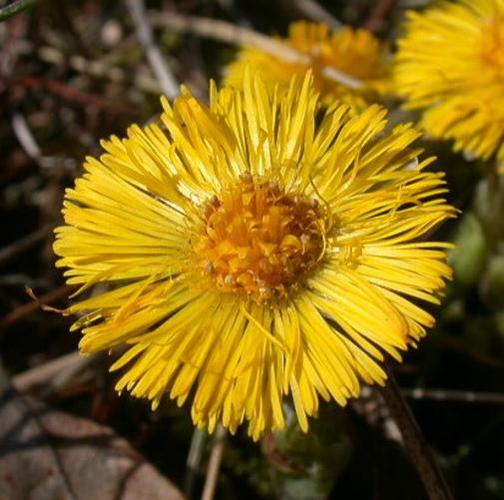
Coltsfoot
Tussilago farfara
Coltsfoot, botanically classified as Tussilago farfara, is an intriguing and highly specialized perennial wildflower belonging to the Asteraceae (sunflower) family. Native to the damp clay-rich soils, disturbed riverbanks, and limestone cliffs of Europe, western and central Asia, and parts of Nor...
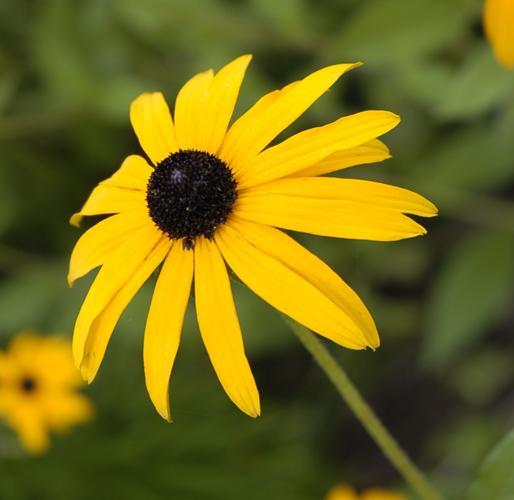
Black eyed Susan
Rudbeckia hirta
Rudbeckia hirta, famously known as the "Black-Eyed Susan" or "Yellow Ox-Eye Daisy," is a quintessentially American wildflower that brings a burst of radiant sunshine to North American landscapes. A member of the Asteraceae (Daisy) family, this resilient species is native to much of the central an...
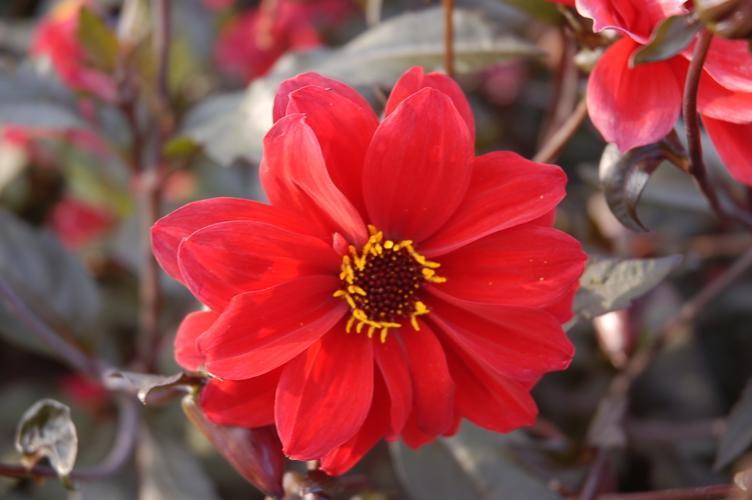
Dahlia 'Bishop of Llandaff'
Dahlia 'Bishop of Llandaff'
The Dahlia 'Bishop of Llandaff', a stunning member of the Asteraceae family, is a highly prized tuberous perennial native to the mountainous regions of Mexico. First introduced in the 1920s, it remains one of the most famous and beloved Dahlia cultivars in the world. It is renowned not just for i...
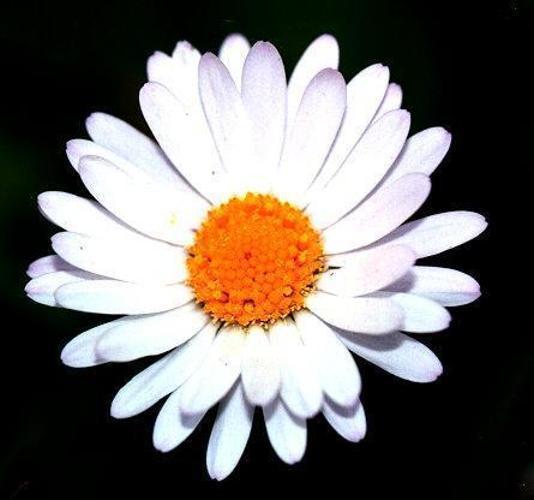
Oxeye Daisy
Leucanthemum vulgare
The Oxeye Daisy, botanically classified as Leucanthemum vulgare and historically celebrated as the Moon Daisy or Dog Daisy, is an exceptionally cheerful, rhizomatous herbaceous perennial belonging to the Asteraceae (daisy or composite) family. Native to the sweeping fields, dry pastures, and sunn...
Similar Characteristics
4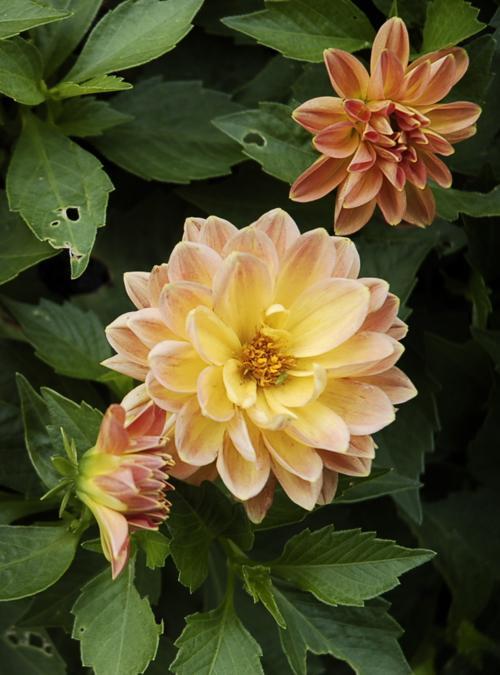
Pink-Yellow Dahlia
Dahlia pinnata (Hybrid)
The Pink-Yellow Dahlia is a spectacular, tuberous herbaceous perennial belonging to the vast Asteraceae family. Native to the mountainous highlands of Mexico and Central America, Dahlias have been heavily hybridized by botanists to produce an astonishing variety of geometric forms and vivid color...
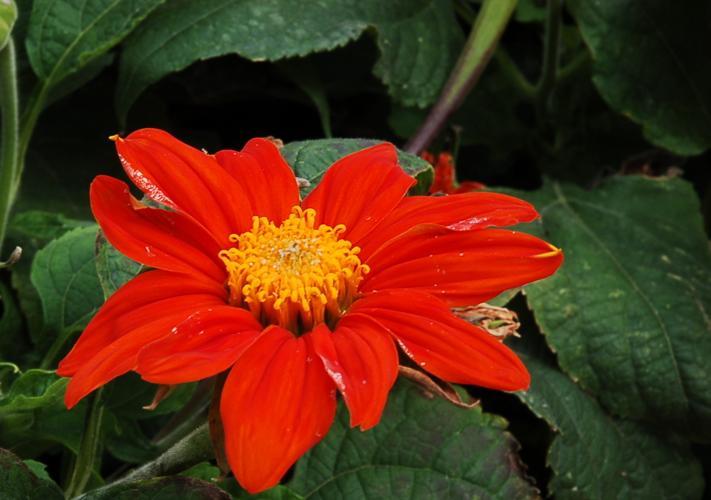
Orange Dahlia
Dahlia × hortensis
The Orange Dahlia, botanically designated under the genus *Dahlia* (particularly hybrids of *Dahlia pinnata*), is an exceptionally spectacular, highly vibrant tuberous perennial. Belonging to the family Asteraceae (the daisy or sunflower family, tribe Coreopsideae), this high-color classic is nat...
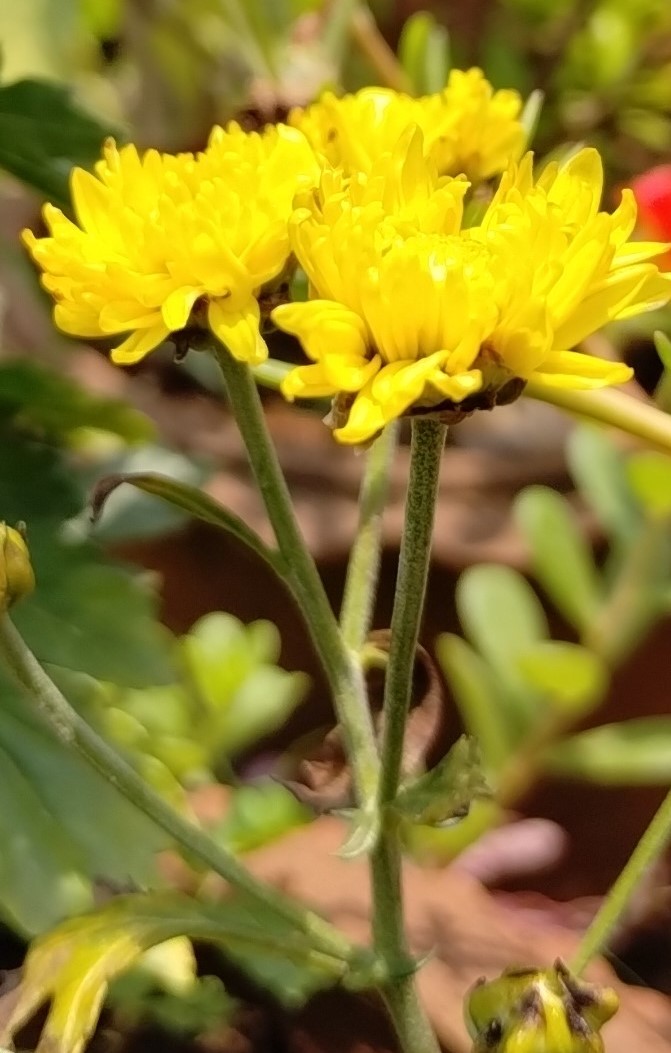
Chrysanthemum
Chrysanthemum morifolium
The Chrysanthemum, botanically classified as Chrysanthemum morifolium and affectionately known as the 'Mum,' is a magnificent, late-season flowering perennial belonging to the Asteraceae (sunflower) family. Native to East Asia, primarily China, where it has been cultivated and revered for over 3,...
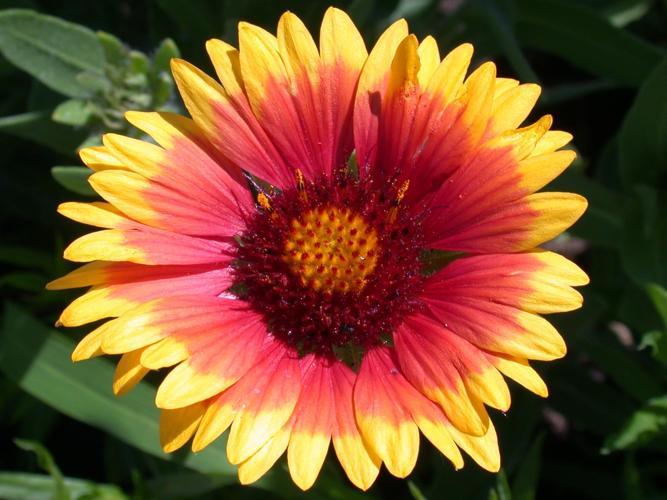
Gaillardia
Gaillardia
Gaillardia, botanically classified within the genus Gaillardia in the Asteraceae (sunflower) family and popularly known as the Blanket Flower or Indian Blanket, is a group of exceptionally cheerful, sun-loving annuals and short-lived perennials. Native to the dry prairies, sandy plains, and pine...