The Language of Flowers in India
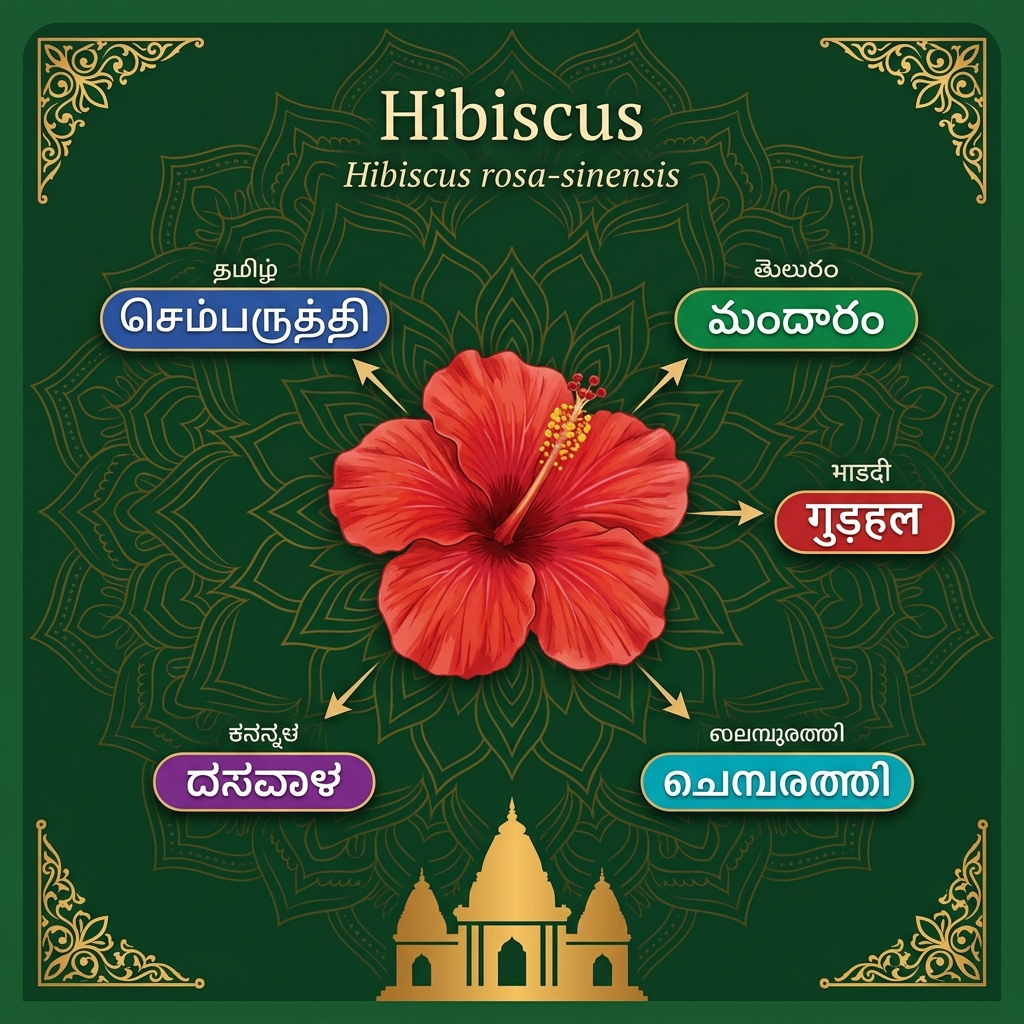
India is not one botanical world — it is five, ten, twenty overlapping worlds, each with its own flower vocabulary built over millennia. The same Hibiscus that a Tamil home worships as Sembaruthi is the Dasavala of Malayalam and Kannada prayers, and the Gudhal of Hindi garland makers. Knowing a flower's name in the local language is not just linguistic courtesy — it is the key to finding it in bustling flower markets (poo market), understanding its ritual uses, and connecting with its deep cultural identity.
This guide covers 38 common and traditional flowers found across South India, mapping each one across Tamil, Telugu, Hindi, Kannada, and Malayalam. We have included the scientific name for botanical precision, dual navigation links to jump directly to detailed spotlights or explore full species profiles on BioLens, and visual cards with exact regional pronunciations.
The Master Reference: 38 Flowers in 5 Languages
| Common Name | Scientific Name | Quick Links | Tamil | Telugu | Hindi | Kannada | Malayalam |
|---|---|---|---|---|---|---|---|
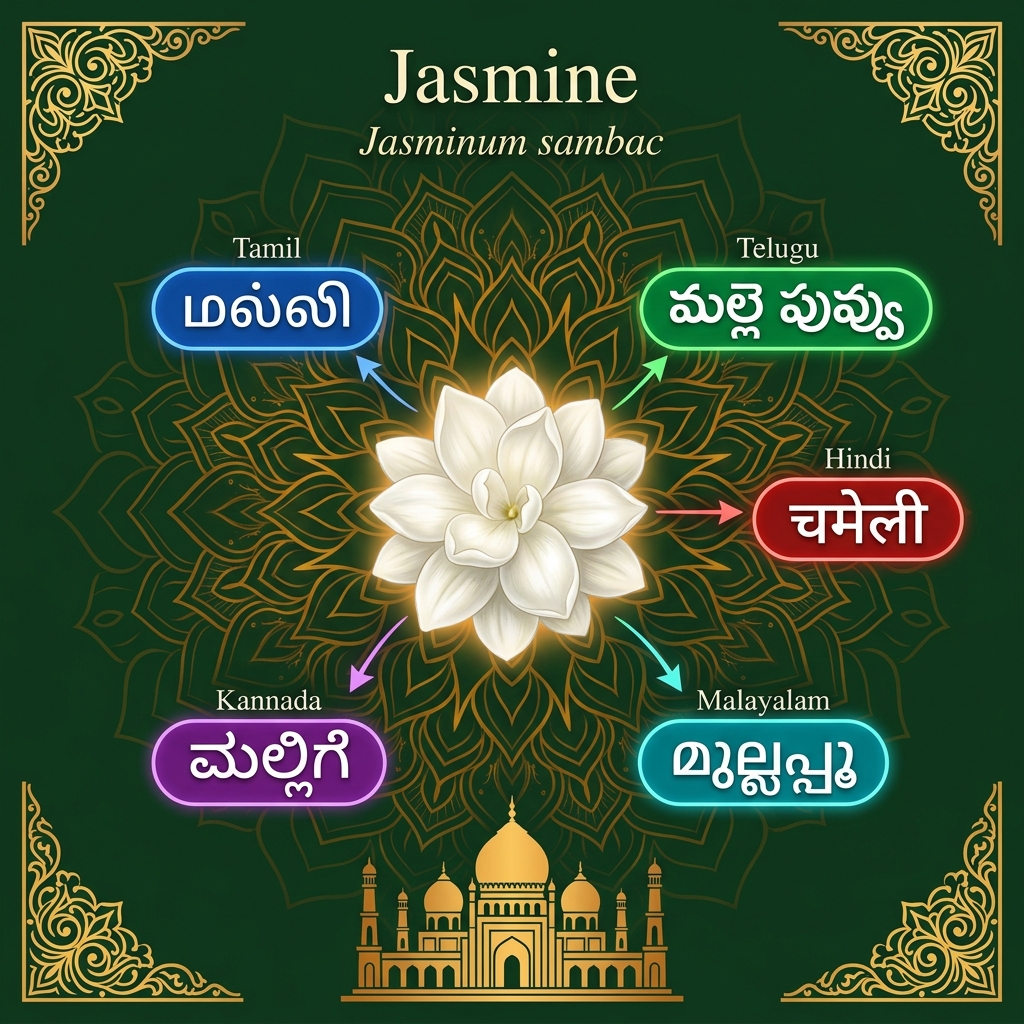
| Jasmine | Jasminum sambac | ↓ Spotlight · ↗ Species Page | மல்லி (Malli) | మల్లె పువ్వు (Malle Puvvu) | चमेली (Chameli) | ಮಲ್ಲಿಗೆ (Mallige) | മുല്ലപ്പൂ (Mullappoo) |
| Hibiscus | Hibiscus rosa-sinensis | ↓ Spotlight · ↗ Species Page | செம்பருத்தி (Sembaruthi) / விருச்சி (Viruchi) | మందారం (Mandaram) | गुड़हल (Gudhal) | ದಾಸವಾಳ (Dasavala) | ചെമ്പരത്തി (Chembarathi) |
| Marigold | Tagetes erecta | ↓ Spotlight · ↗ Species Page | துலுக்க சாமந்தி (Thulukka Samandhi) | బంతి పువ్వు (Banthi Puvvu) | गेंदा (Genda) | ಚೆಂಡು ಹೂ (Chendu Hoo) | ചെണ്ടുമല്ലി (Chendumalli) |
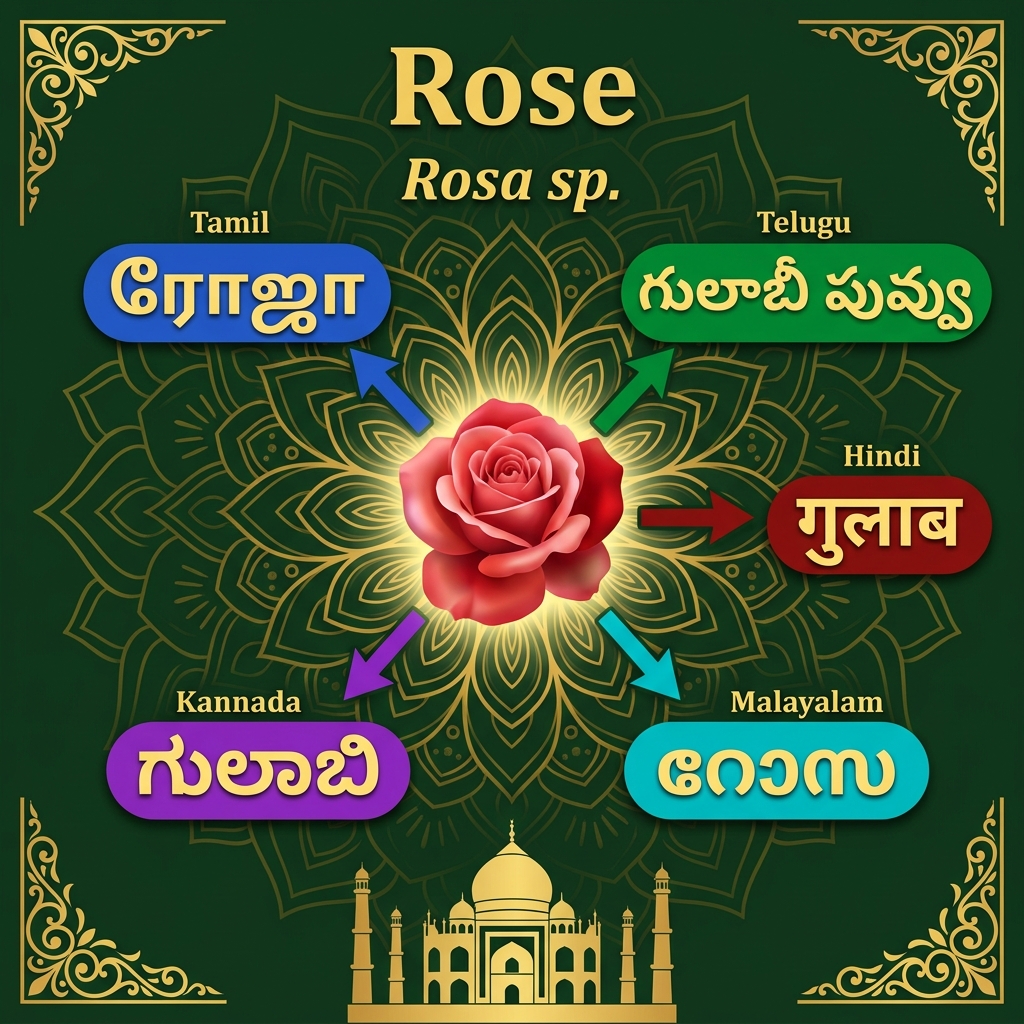
| Rose | Rosa sp. | ↓ Spotlight · ↗ Species Page | ரோஜா (Roja) | గులాబీ పువ్వు (Gulaabi Puvvu) | गुलाब (Gulab) | ಗುಲಾಬಿ (Gulabi) | റോസ് (Roja) |
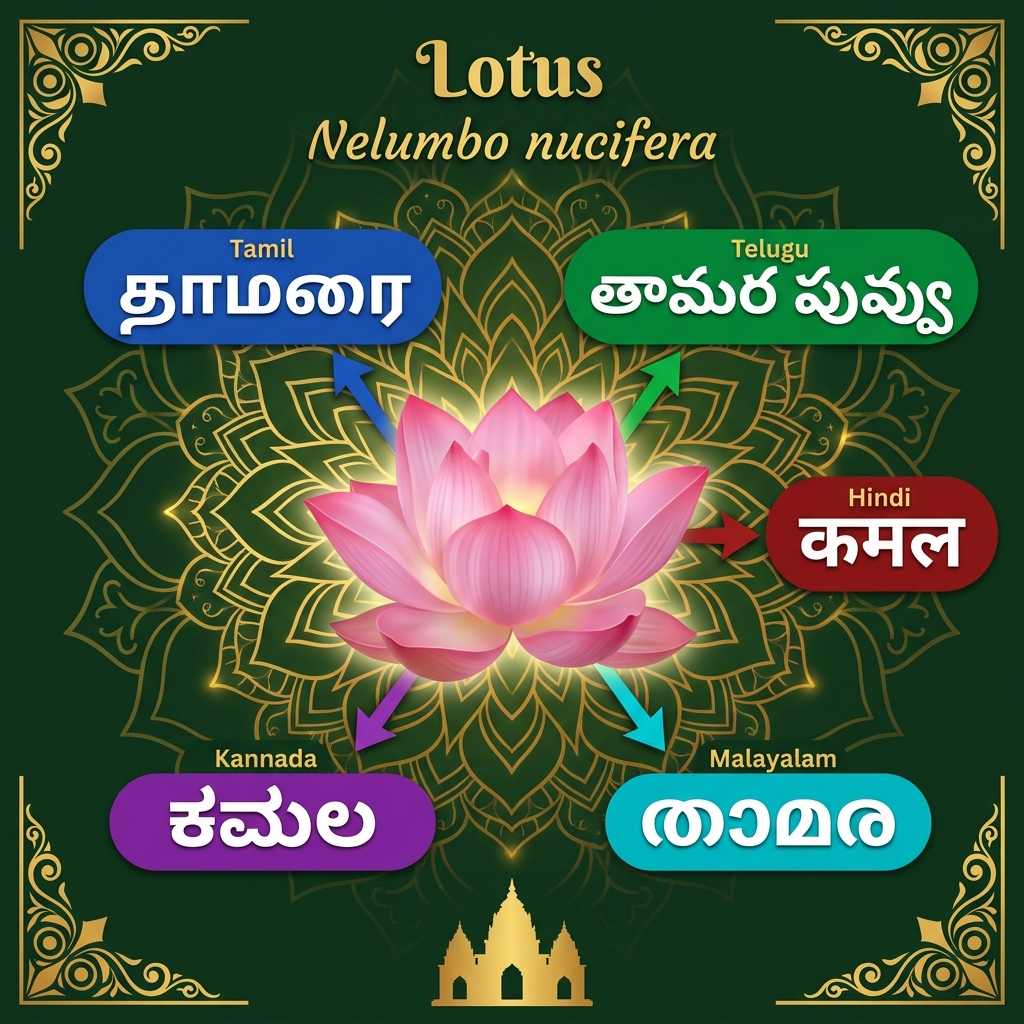
| Lotus | Nelumbo nucifera | ↓ Spotlight · ↗ Species Page | தாமரை (Thamarai) | తామర పువ్వు (Tamara Puvvu) | कमल (Kamal) | ಕಮಲ (Kamala) | താമര (Thamara) |
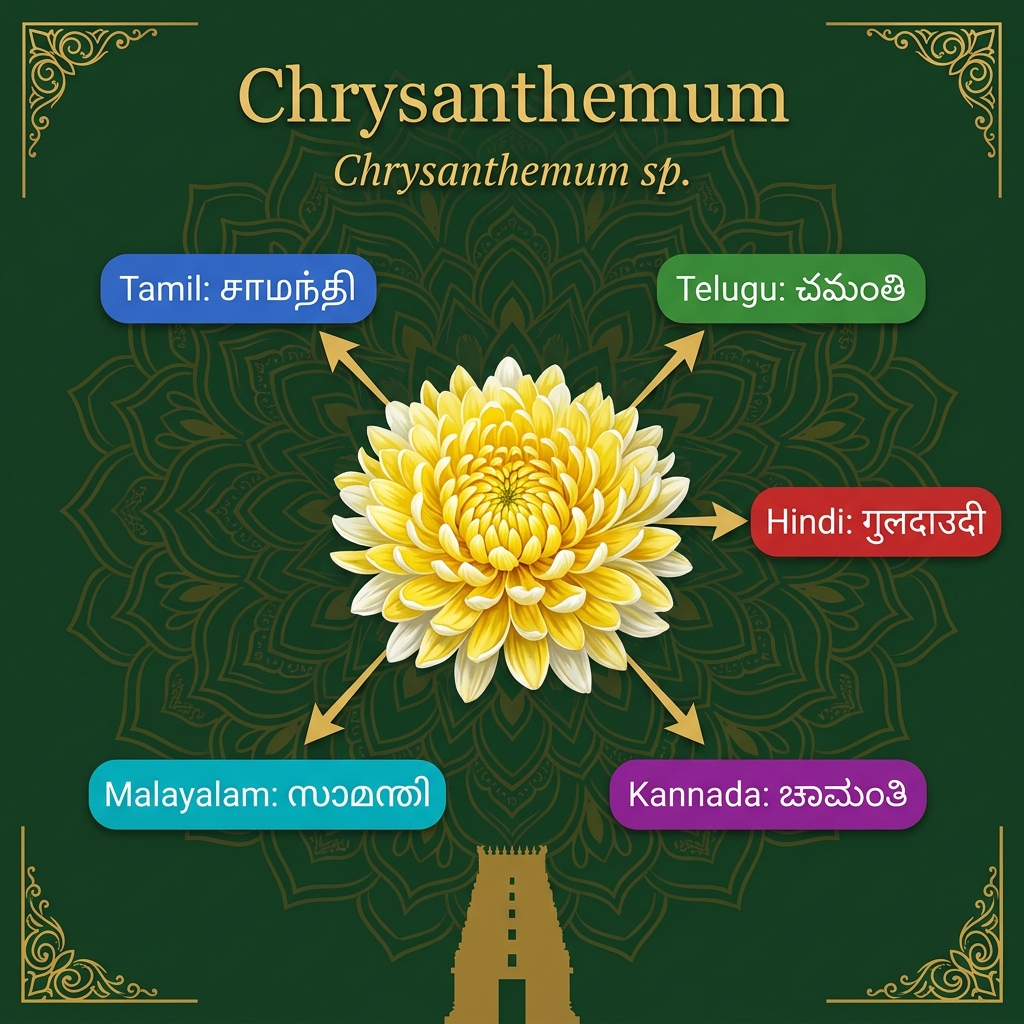
| Chrysanthemum | Chrysanthemum indicum | ↓ Spotlight · ↗ Species Page | சாமந்தி (Saamandhi) | చామంతి (Chamanthi) | गुलदाउदी (Guldaudi) | ಸೇವಂತಿಗೆ (Sevantige) | സാമந்தி (Saamandhi) |
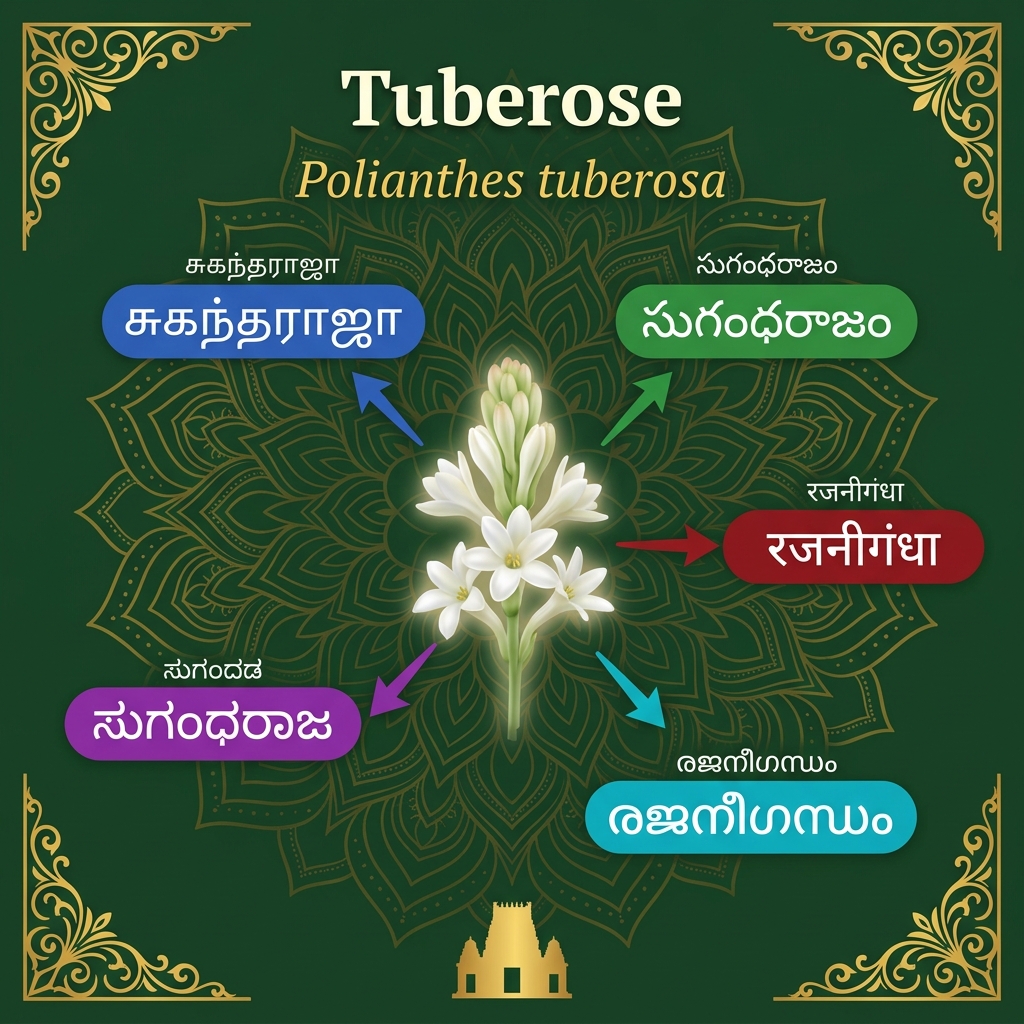
| Tuberose | Polianthes tuberosa | ↓ Spotlight · ↗ Species Page | சுகந்தராஜா (Sugandaraja) / சம்பங்கி | సుగంధరాజం (Sugandarajam) | रजनीगंधा (Rajnigandha) | ಸುಗಂಧರಾಜ (Sugandaraja) | രജനീഗന്ധം (Rajnigandham) |
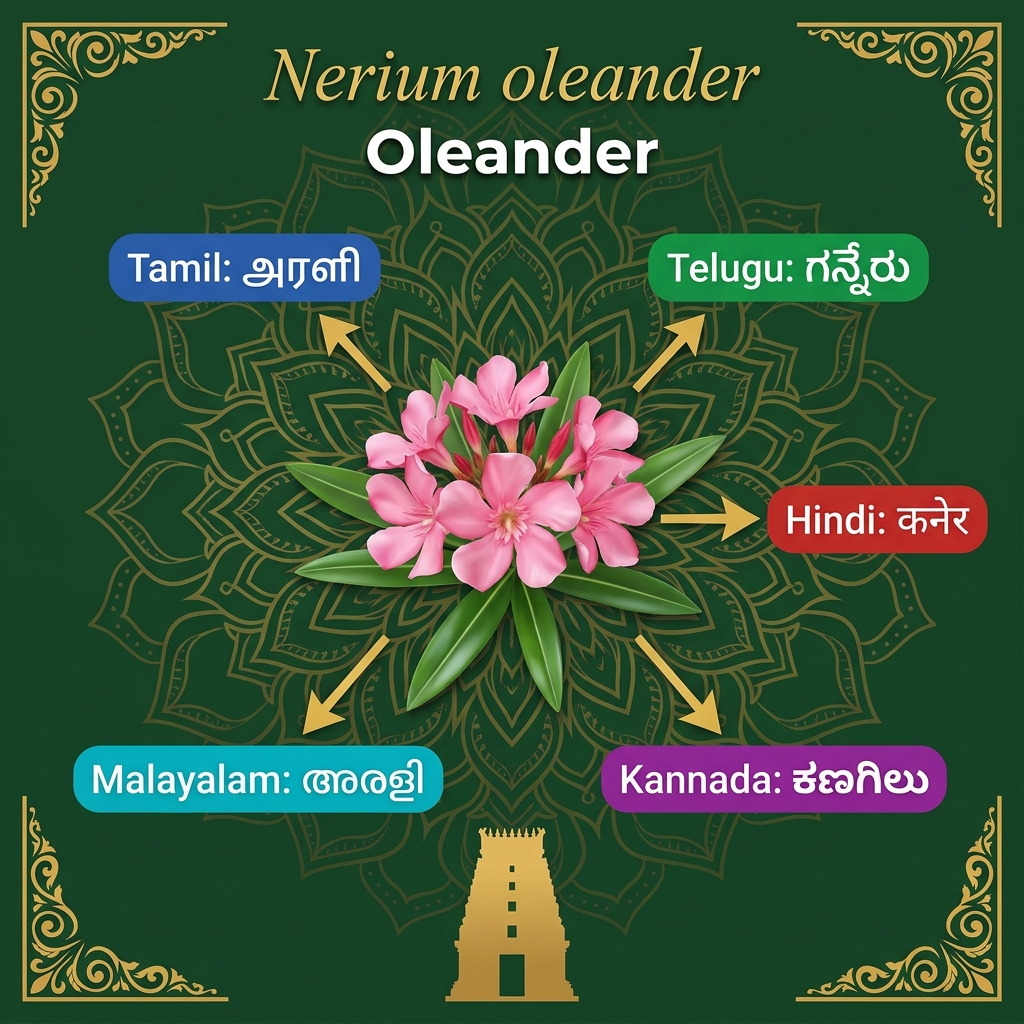
| Oleander | Nerium oleander | ↓ Spotlight · ↗ Species Page | அரளி (Arali) | గన్నేరు (Ganneru) | कनेर (Kaner) | ಕಣಗಿಲೆ (Kanagile) | அரளி (Arali) |
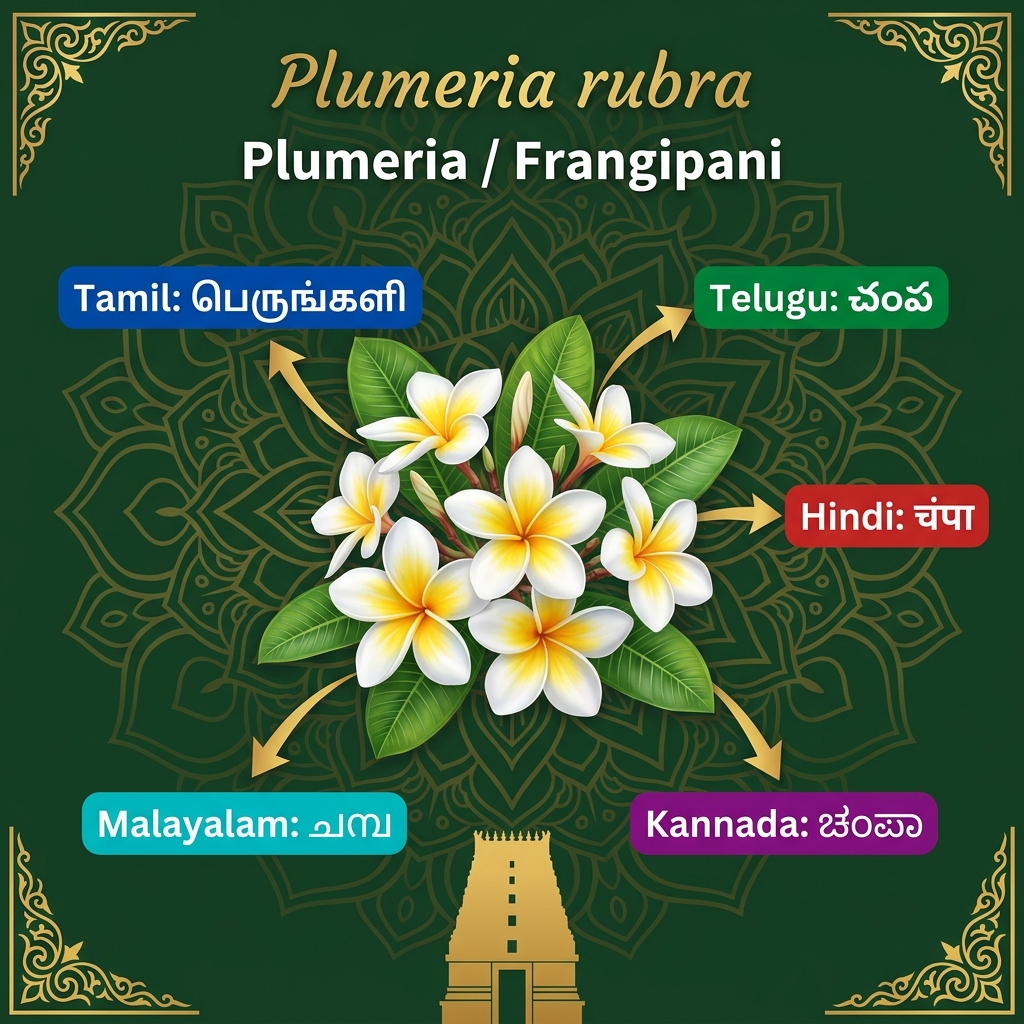
| Plumeria (Frangipani) | Plumeria rubra | ↓ Spotlight · ↗ Species Page | பெருங்கள்ளி (Perunkalli) | దేవగన్నేరు (Deva Ganneru) | चम्पा (Champa) | ದೇವಕಣಗಿಲೆ (Deva Kanagile) | പാലപ്പൂ (Paalappoo) / ചെമ്പകം |
| Ixora (Jungle Flame) | Ixora coccinea | ↓ Spotlight · ↗ Species Page | விருச்சி (Vritchi) / இட்லிப்பூ | నూరువరహాలు (Nooru Varahaalu) | रुक्मिणी (Rukmini) | ಕೇಪಳ (Kepala) | തെച്ചി (Thecchi) |
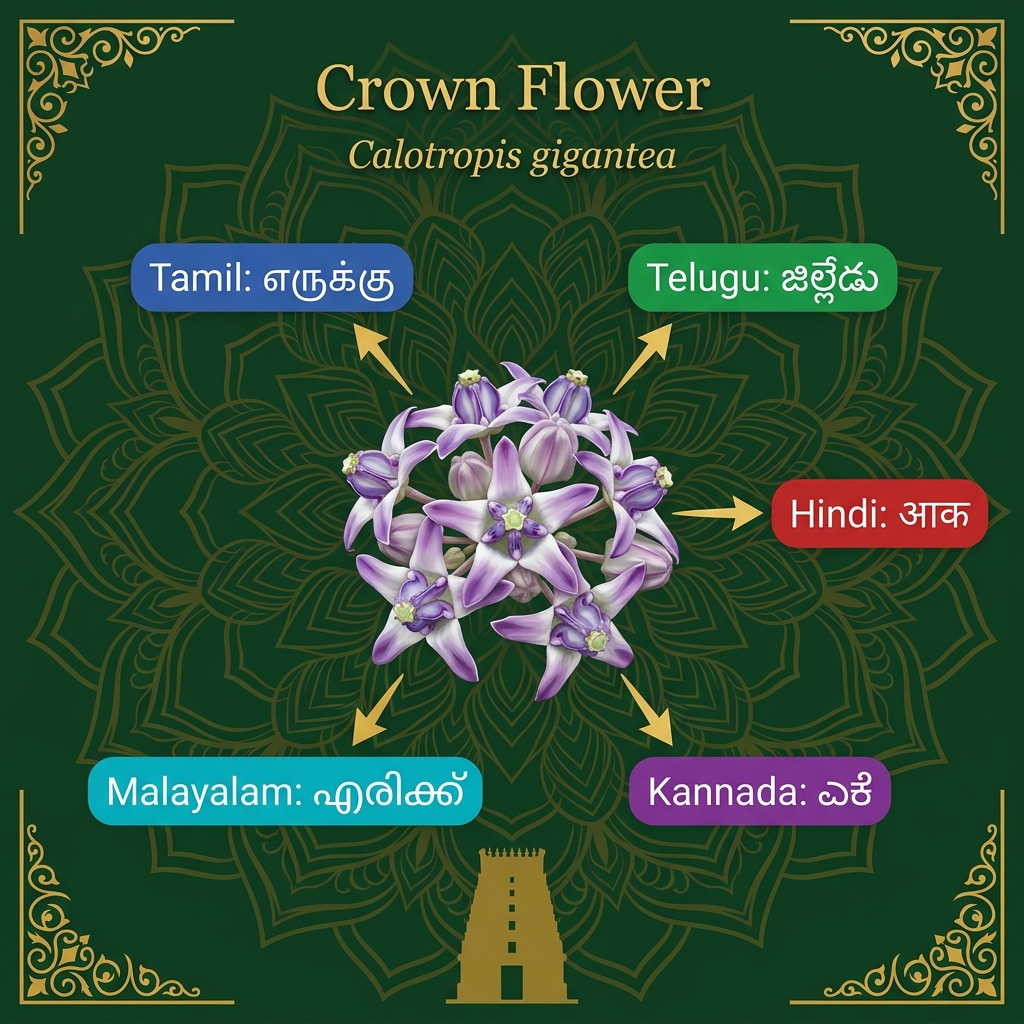
| Crown Flower | Calotropis gigantea | ↓ Spotlight | எருக்கு (Erukku) | జిల్లేడు (Jilledu) | आक (Aak) / मदार | ಎಕ್ಕದ ಹೂ (Ekkada Hoo) | എരുക്ക് (Erikku) |
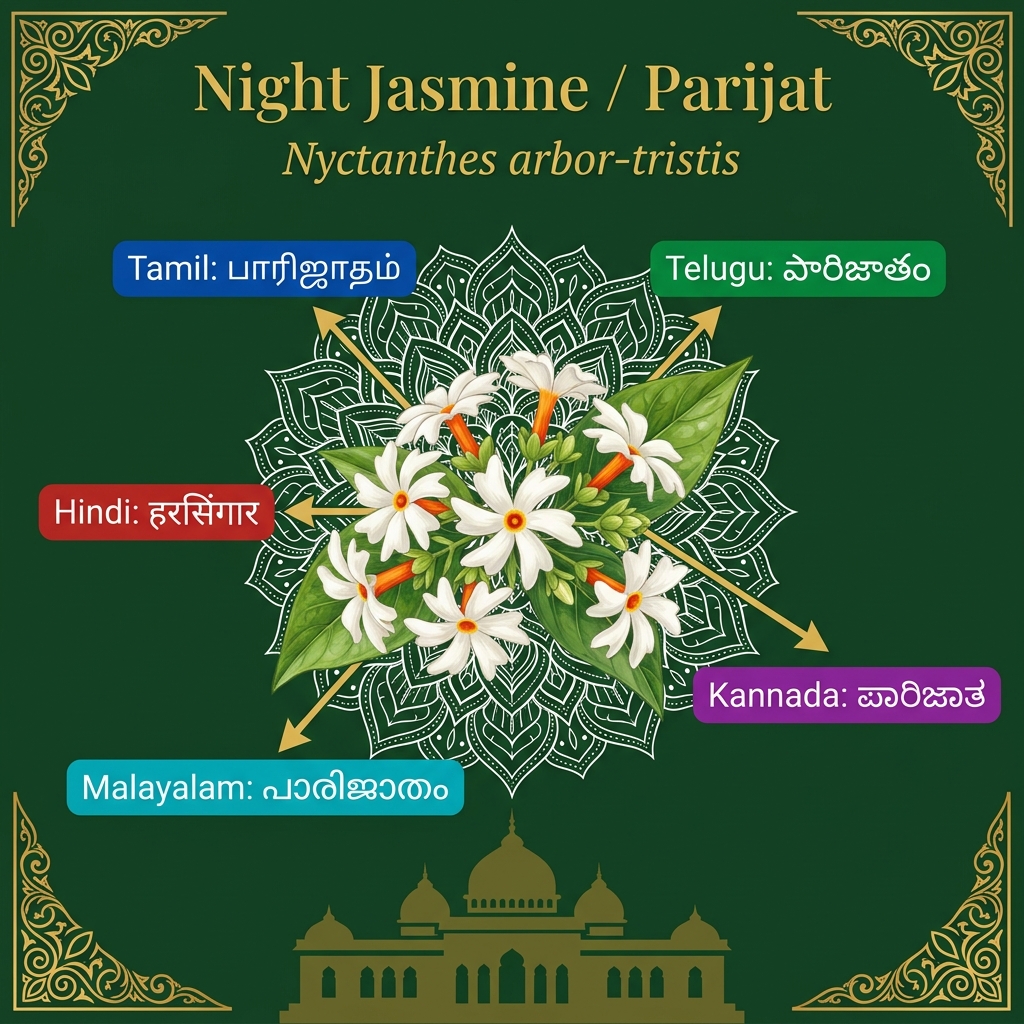
| Night Jasmine (Parijat) | Nyctanthes arbor-tristis | ↓ Spotlight · ↗ Species Page | பவழமல்லி (Pavazhamalli) / பாரிஜாதம் | పారిజాతం (Parijatam) | हरसिंगार (Harsingar) | ಪಾರಿಜಾತ (Parijata) | പാരിജാതം (Parijatham) |
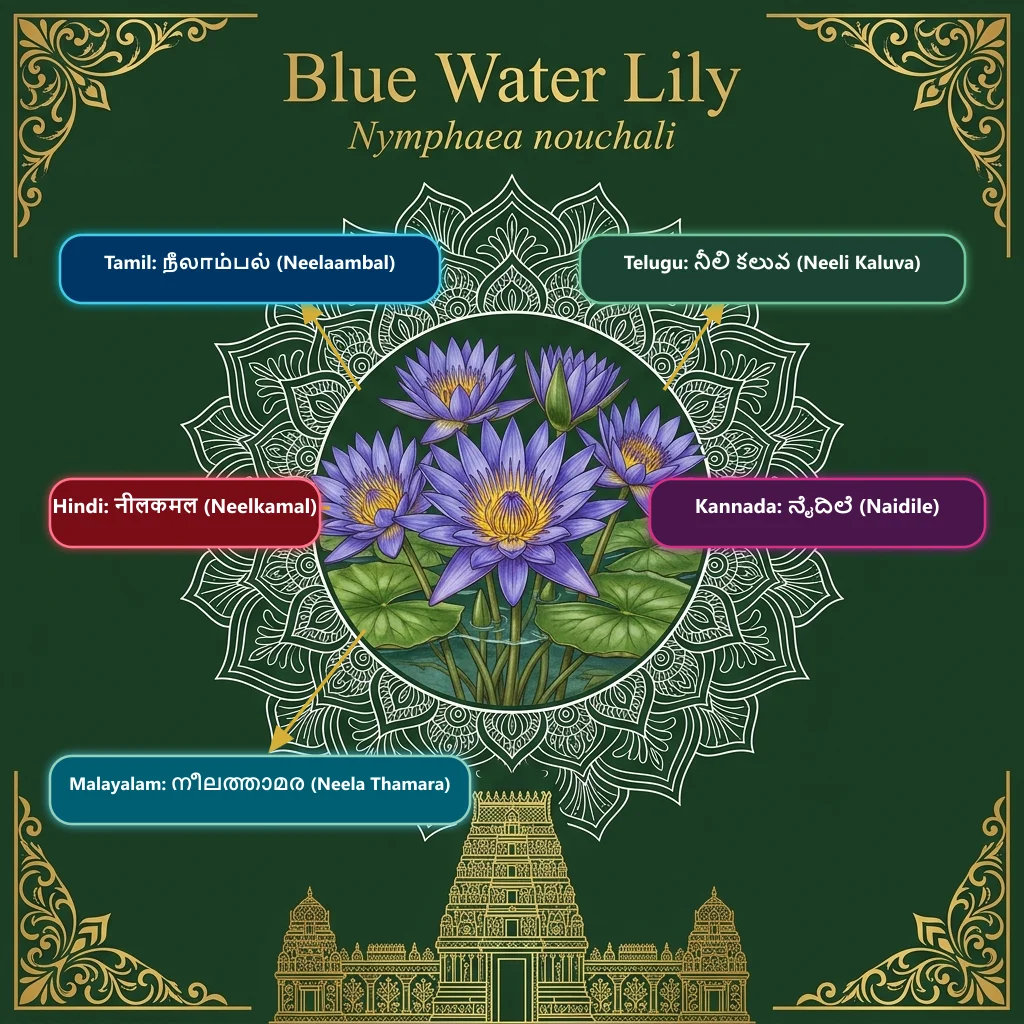
| Blue Water Lily | Nymphaea nouchali | ↓ Spotlight · ↗ Species Page | நீலாம்பல் (Neelaambal) / அல்லி | నీలి కలువ (Neeli Kaluva) | नीलकमल (Neelkamal) | ನೈದಿಲೆ (Naidile) | നീലത്താമര (Neela Thamara) |
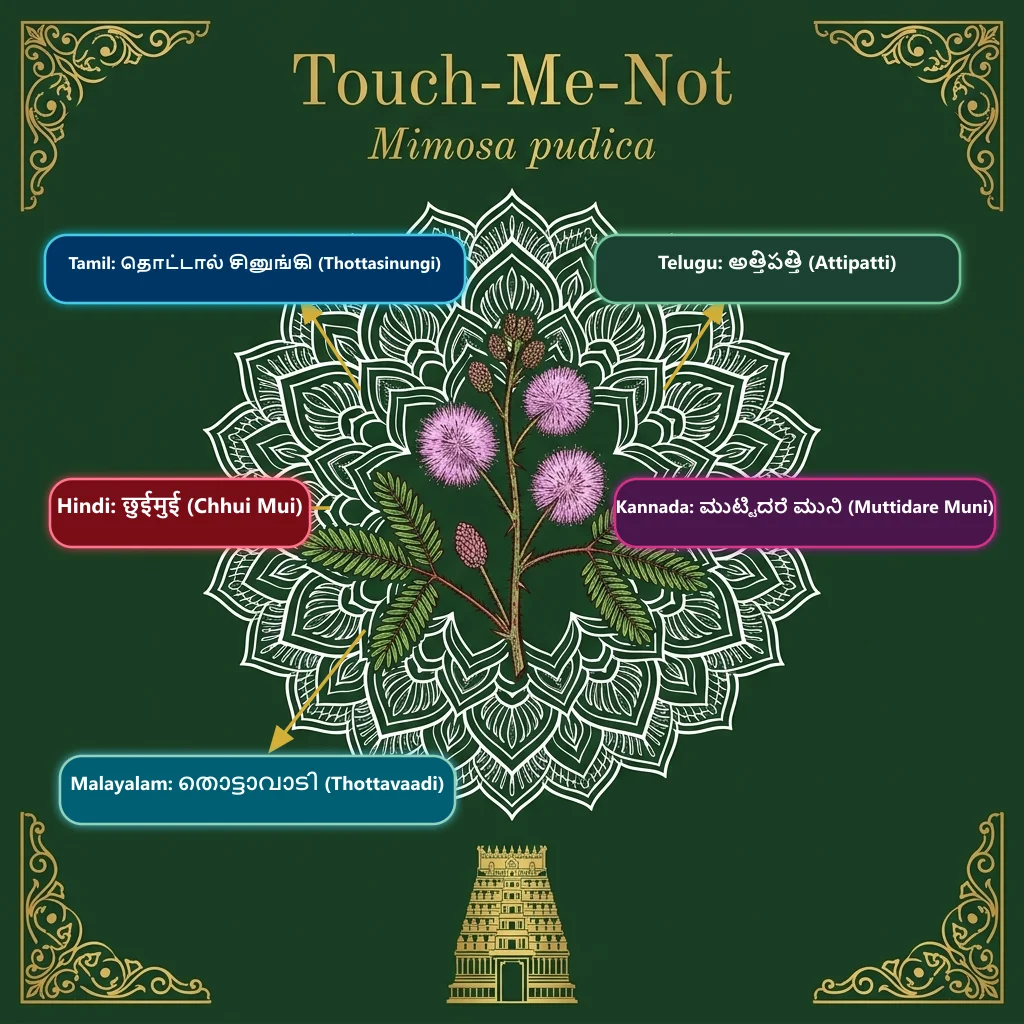
| Touch-Me-Not | Mimosa pudica | ↓ Spotlight · ↗ Species Page | தொட்டால் சினுங்கி (Thottasinungi) | అత్తిపత్తి (Attipatti) | छुईमुई (Chhui Mui) | ಮುಟ್ಟಿದರೆ ಮುನಿ (Muttidare Muni) | തൊട്ടാവാടി (Thottavaadi) |
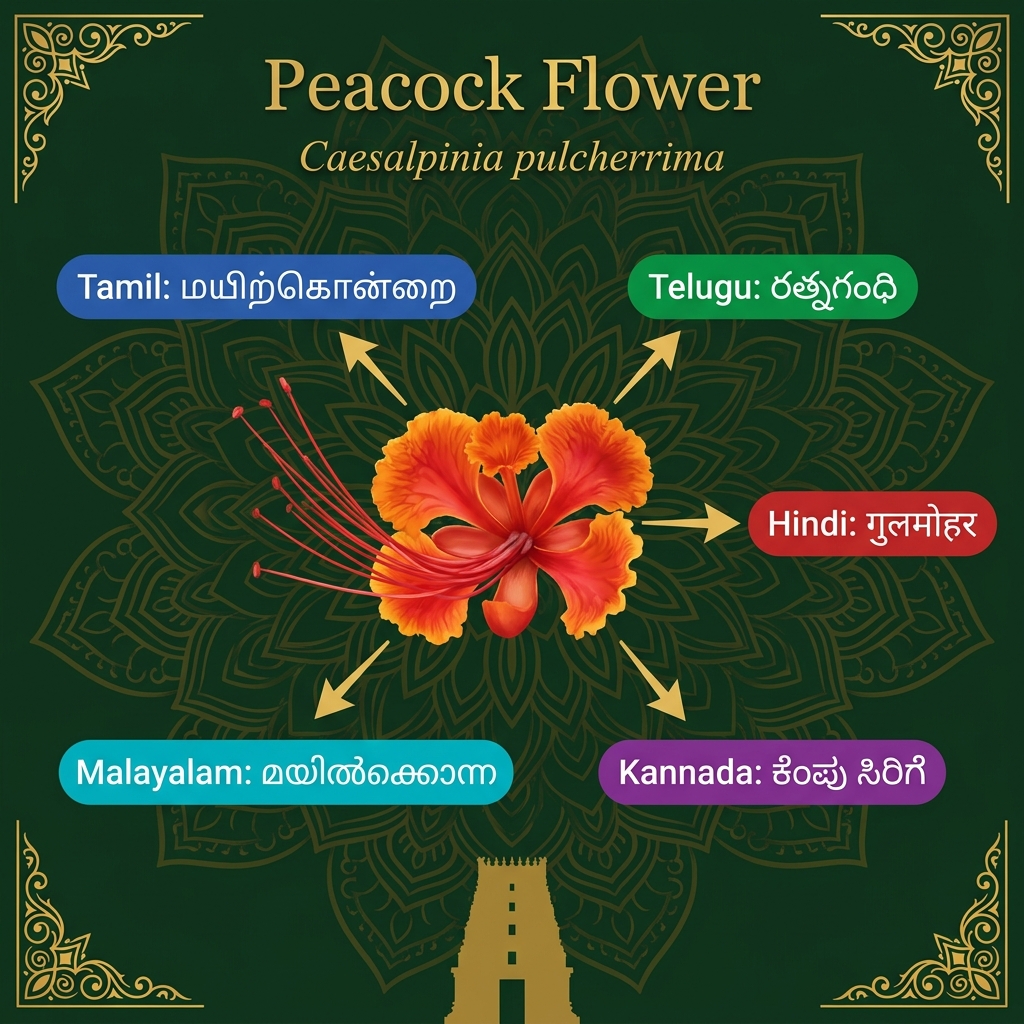
| Peacock Flower | Caesalpinia pulcherrima | ↓ Spotlight · ↗ Species Page | மயில் கொன்றை (Mayil Konnai) | రత్నగంధి (Ratnagandhi) | छोटा गुलमोहर (Chhota Gulmohar) | ಕೆಂಪು ಸಿರಿಗೆ (Kempu Sirige) | മയിൽക്കൊന്ന (Mayilkkonna) |
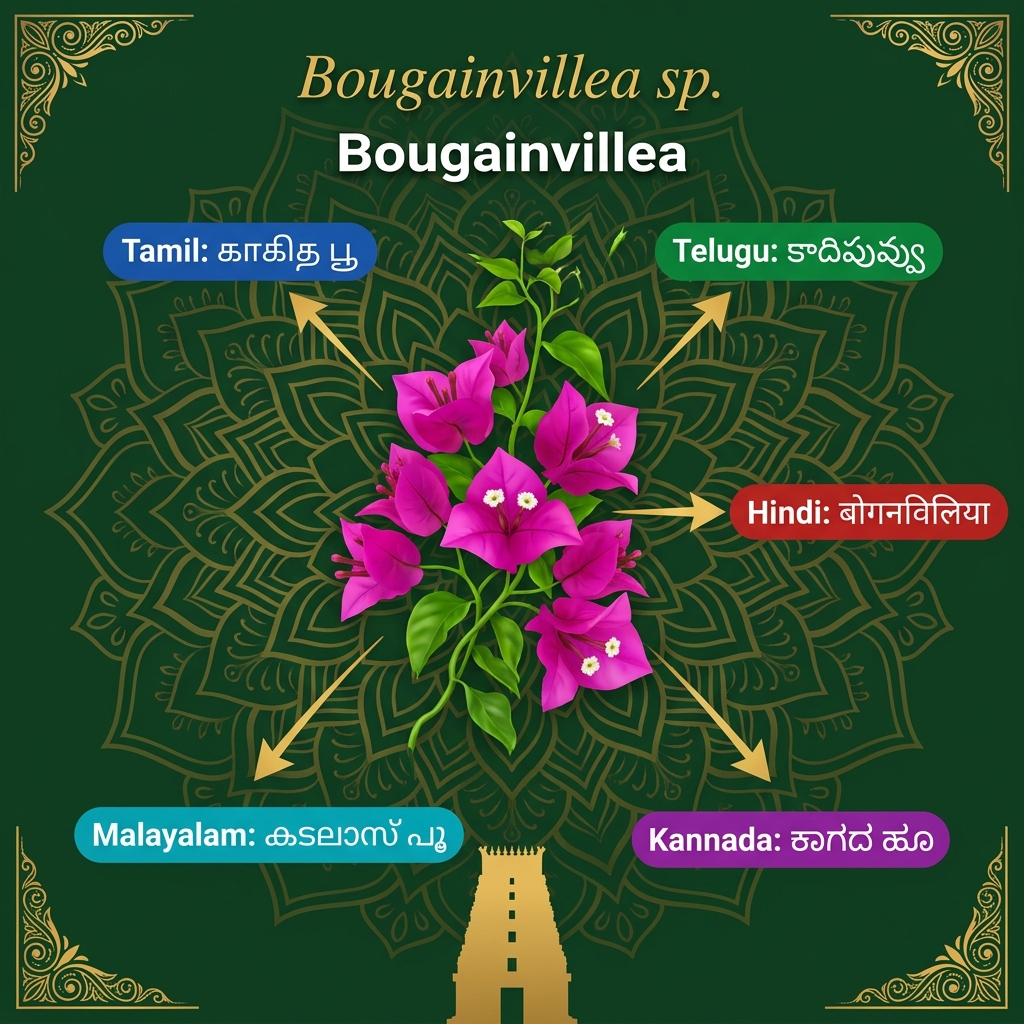
| Bougainvillea | Bougainvillea spectabilis | ↓ Spotlight · ↗ Species Page | காகிதப்பூ (Kaagithapoo) | కాగితం పూలు (Kaagitham Poolu) | बोगनवेलिया (Bougainvillea) | ಕಾಗದದ ಹೂ (Kagadada Hoo) | கடலாஸ் பூவு (Kadalaas Poovu) |
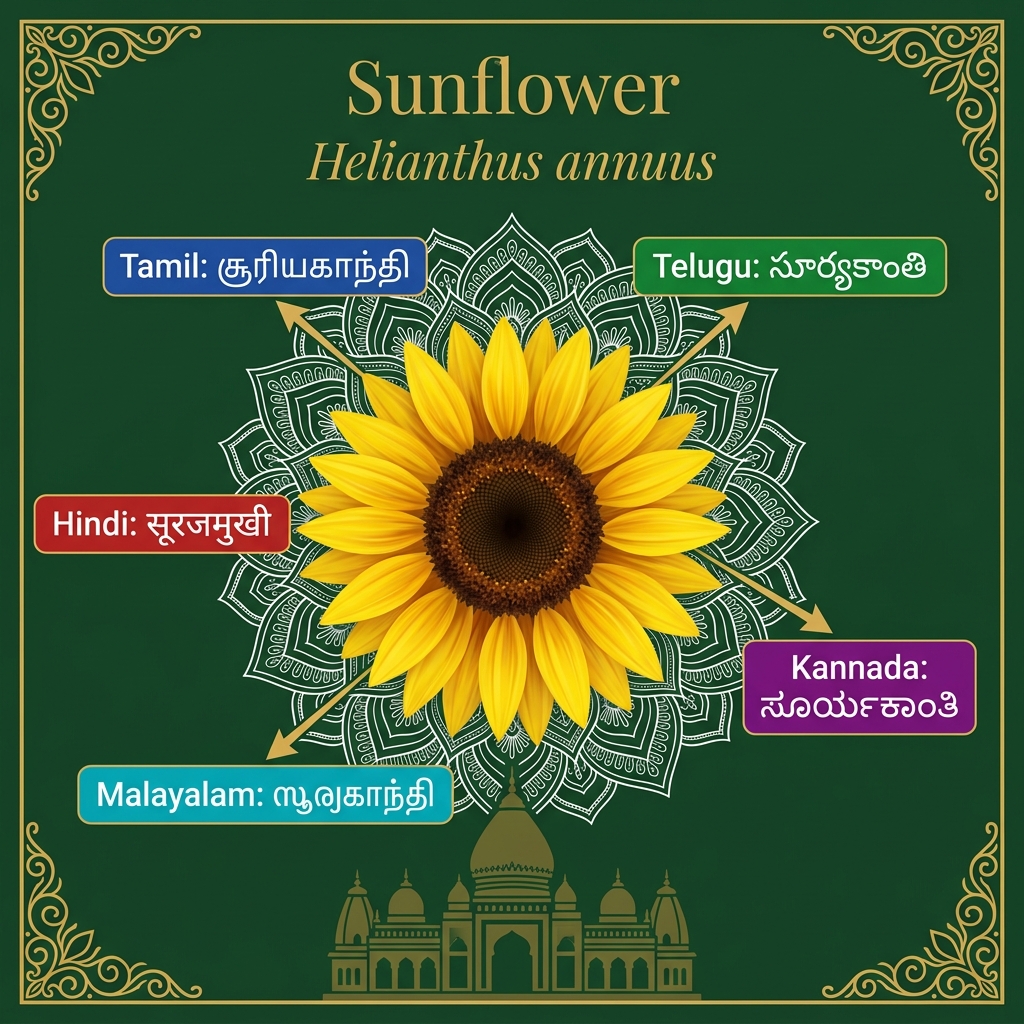
| Sunflower | Helianthus annuus | ↓ Spotlight · ↗ Species Page | சூரியகாந்தி (Suryakanthi) | పొద్దుతిరుగుడు (Poddu Thirugudu) | सूरजमुखी (Surajmukhi) | ಸೂರ್ಯಕಾಂತಿ (Suryakanthi) | സൂര്യകാந்தி (Suryakanthi) |
| Lavender | Lavandula angustifolia | ↓ Spotlight · ↗ Species Page | லாவெண்டர் (Lavender) | లావెండర్ (Lavender) | लैवेंडर (Lavender) | ಲ್ಯಾವೆಂಡರ್ (Lavender) | ലാവെണ്ടർ (Lavender) |
| Tulsi (Holy Basil) | Ocimum tenuiflorum | ↓ Spotlight | துளசி (Thulasi) | తులసి (Tulasi) | तुलसी (Tulsi) | ತುಳಸಿ (Tulasi) | തുളസി (Thulasi) |
| Indian Coral Tree | Erythrina variegata | ↓ Spotlight | கல்யாண முருங்கை (Kalyana Murungai) | బాడిద (Badida) | पंगारा (Pangara) | ಹವಳದ ಮರ (Havalada Mara) | മുരിക്ക് (Murikku) |
| Crossandra (Firecracker) | Crossandra infundibuliformis | ↓ Spotlight · ↗ Species Page | கனகாம்பரம் (Kanakambaram) | కనకాంబరం (Kanakambaram) | अबोली (Aboli) | ಕನಕಾಂಬರ (Kanakambara) | കനകാംബരം (Kanakambaram) |
| Crape Jasmine (Pinwheel) | Tabernaemontana divaricata | ↓ Spotlight · ↗ Species Page | நந்தியாவட்டை (Nandhiyavattai) | నందివర్ధనం (Nandi Vardhanam) | चाँदनी (Chandni) | ನಂದಿ ಬಟ್ಟಲು (Nandi Battalu) | നന്ത്യാർവട്ടം (Nanthyarvattom) |
| Tanner's Cassia (Senna) | Senna auriculata | ↓ Spotlight · ↗ Species Page | ஆவாரம்பூ (Avarampoo) | తంగేడు పువ్వు (Tangedu Puvvu) | तरवर (Tarwar) | ಆವರಿಕೆ (Avarike) | ആവாரம் (Avaram) |
| Globe Amaranth | Gomphrena globosa | ↓ Spotlight · ↗ Species Page | வாடாமல்லி (Vadamalli) | రుద్రాక్షింత (Rudrakshinta) | गुल-ए-मखमल (Gul-e-makhmal) | ಬಟಾಣಿ ಹೂ (Batani Hoo) | വാടാമല്ലി (Vadamalli) |
| Butterfly Pea (Blue Pea) | Clitoria ternatea | ↓ Spotlight · ↗ Species Page | சங்கு புஷ்பம் (Sangu Pushpam) | శంఖ పుష్పం (Shankha Pushpam) | अपराजिता (Aparajita) | ಶಂಖ ಪುಷ್ಪ (Shanka Pushpa) | ശംഖുപുഷ്പം (Shankhu Pushpam) |
| Leucas Aspera (Thumbai) | Leucas aspera | ↓ Spotlight · ↗ Species Page | தும்பை (Thumbai) | తుమ్మి పువ్వు (Thummi Puvvu) | छोटा हलकुसा (Chhota Halkusa) | ತುಂಬೆ ಹೂ (Thumbe Hoo) | തുമ്പ (Thumba) |
| Madagascar Periwinkle | Catharanthus roseus | ↓ Spotlight · ↗ Species Page | நித்யகல்யாணி (Nithyakalyani) | బిళ్ళ గన్నేరు (Billa Ganneru) | सदाबहार (Sadabahar) | ಸದಾಪುಷ್ಪ (Sadapushpa) | നിത്യകല്യാണി (Nithyakalyani) |
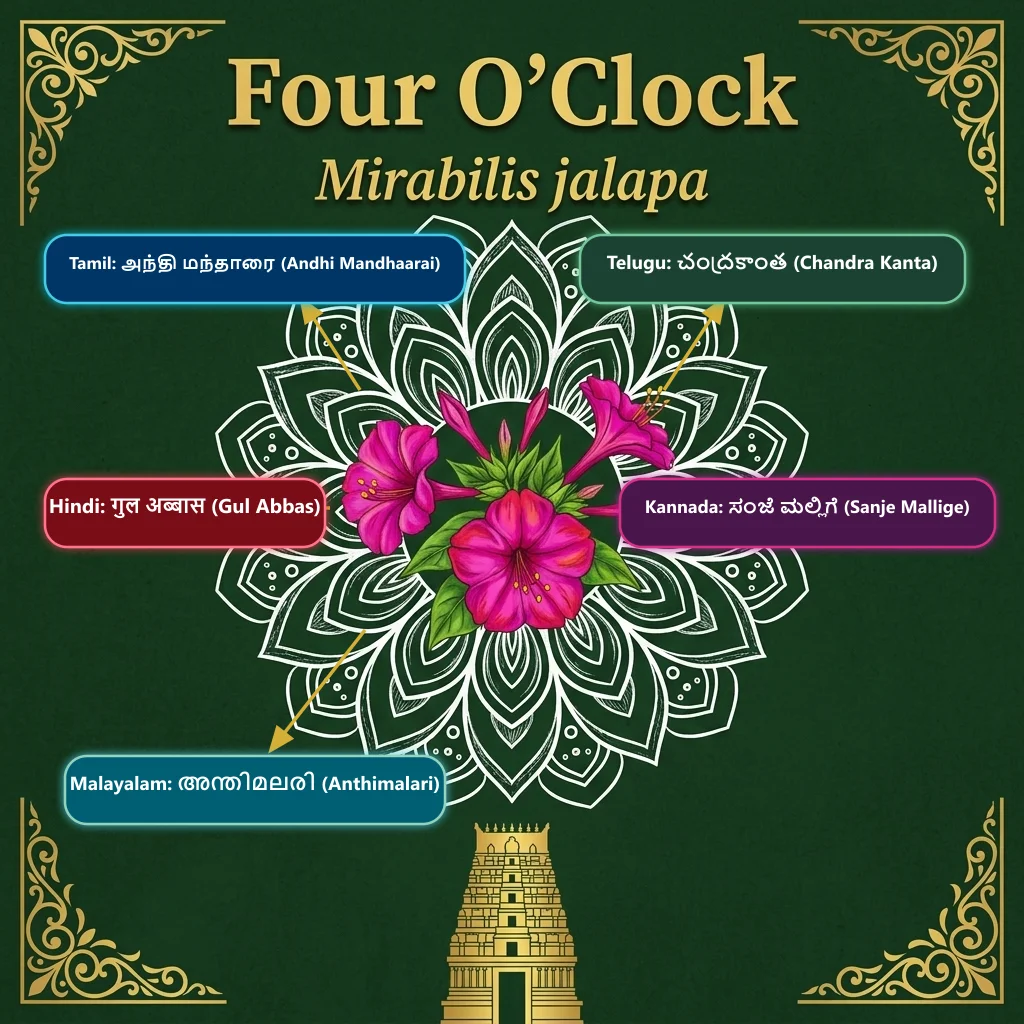
| Four O'Clock (Marvel of Peru) | Mirabilis jalapa | ↓ Spotlight · ↗ Species Page | அந்தி மந்தாரை (Andhi Mandhaarai) | చంద్రకాంత (Chandra Kanta) | गुल अब्बास (Gul Abbas) | ಸಂಜೆ ಮಲ್ಲಿಗೆ (Sanje Mallige) | അന്തിമലരി (Anthimalari) |
| Flame Lily (Glory Lily) | Gloriosa superba | ↓ Spotlight · ↗ Species Page | செங்காந்தள் (Sengandhal) | అడవి నాభి (Adavi Nabhi) | कलिहारी (Kalihari) | ಅಗ್ನಿಶಿಖೆ (Agnisikhe) | മേത്തോന്നി (Metthondi) |
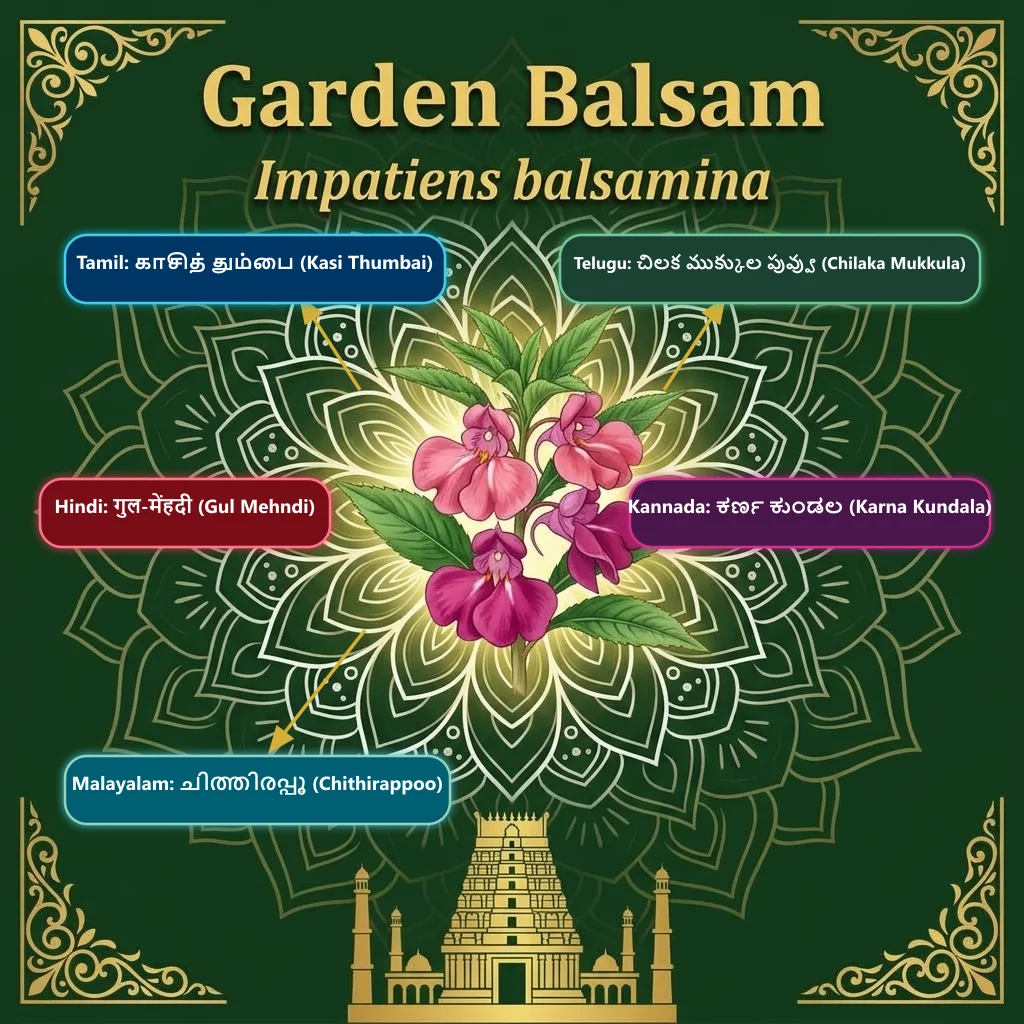
| Garden Balsam (Rose Balsam) | Impatiens balsamina | ↓ Spotlight · ↗ Species Page | காசித் தும்பை (Kasi Thumbai) | చిలక ముక్కుల పువ్వు (Chilaka Mukkula) | गुल-मेंहदी (Gul Mehndi) | ಕರ್ಣ ಕುಂಡಲ (Karna Kundala) | ചിത്തിരப்பൂ (Chithirappoo) |
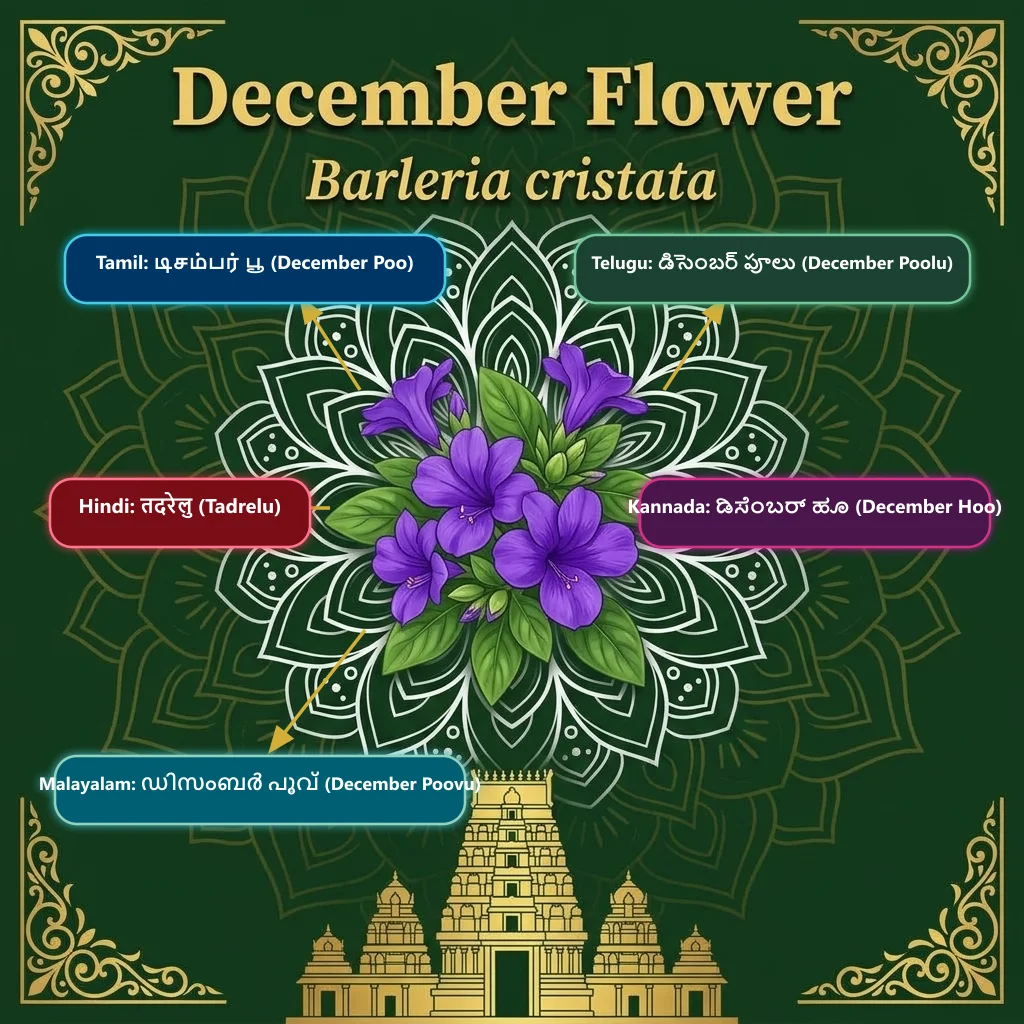
| December Flower | Barleria cristata | ↓ Spotlight · ↗ Species Page | டிசம்பர் பூ (December Poo) | డిసెంబర్ పూలు (December Poolu) | तदरेலு (Tadrelu) | ಡಿಸೆಂಬರ್ ಹೂ (December Hoo) | ഡിസംബർ പൂവ് (December Poovu) |
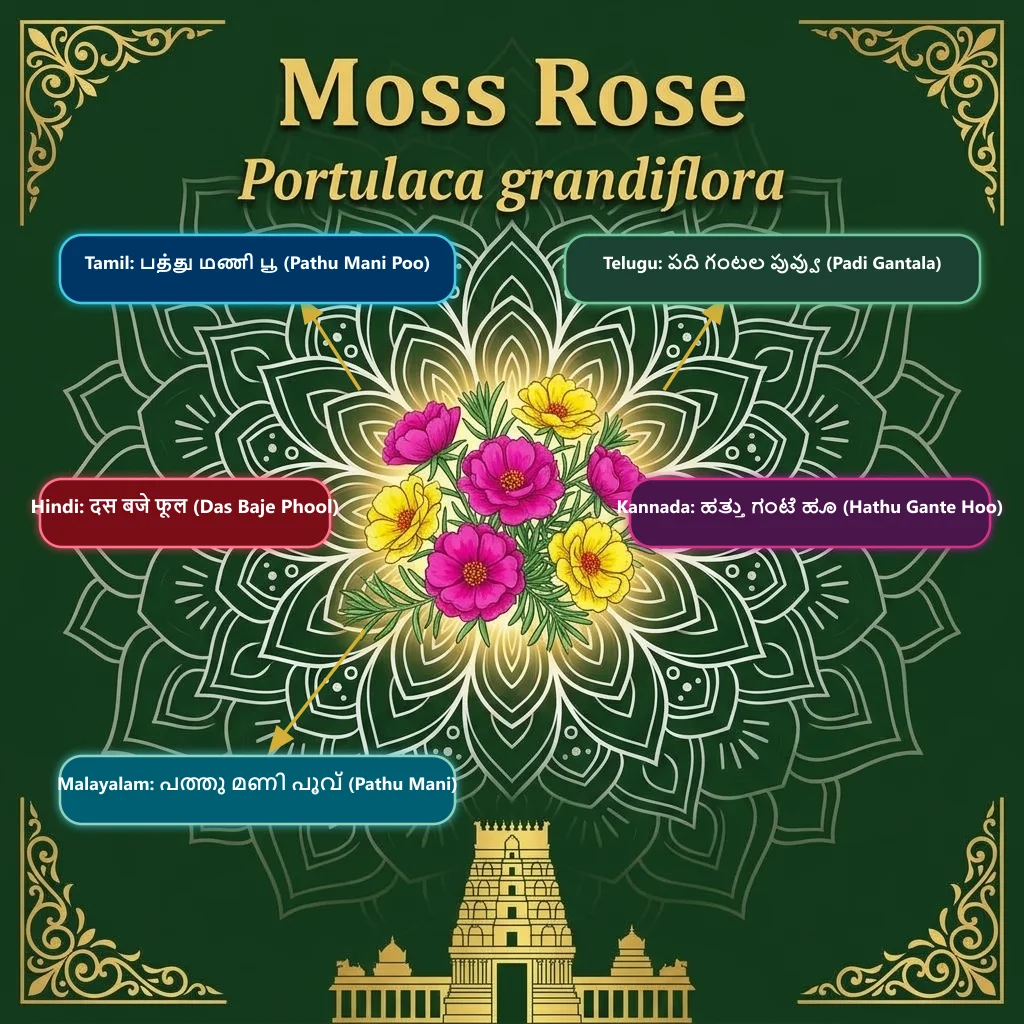
| Moss Rose (Portulaca) | Portulaca grandiflora | ↓ Spotlight · ↗ Species Page | பத்து மணி பூ (Pathu Mani Poo) | పది గంటల పువ్వు (Padi Gantala) | दस बजे फूल (Das Baje Phool) | ಹತ್ತು ಗಂಟೆ ಹೂ (Hathu Gante Hoo) | പത്തു മണി പൂവ് (Pathu Mani) |
| Juhi (Wild Jasmine / Mullai) | Jasminum auriculatum | ↓ Spotlight · ↗ Species Page | முல்லை (Mullai) | అడవి మల్లె (Adavi Malle) | जूही (Juhi) | ಅಡವಿ ಮಲ್ಲಿಗೆ (Adavi Mallige) | മുല്ല (Mulla) |
| Spanish Jasmine (Jathimalli) | Jasminum grandiflorum | ↓ Spotlight · ↗ Species Page | ஜாதிமல்லி (Jathimalli) | జాజి పువ్వు (Jaji Puvvu) | चमेली (Chameli) | ಜಾಜಿ ಮಲ್ಲಿಗೆ (Jaji Mallige) | പിച്ചിപ്പൂ (Pichippoo) |
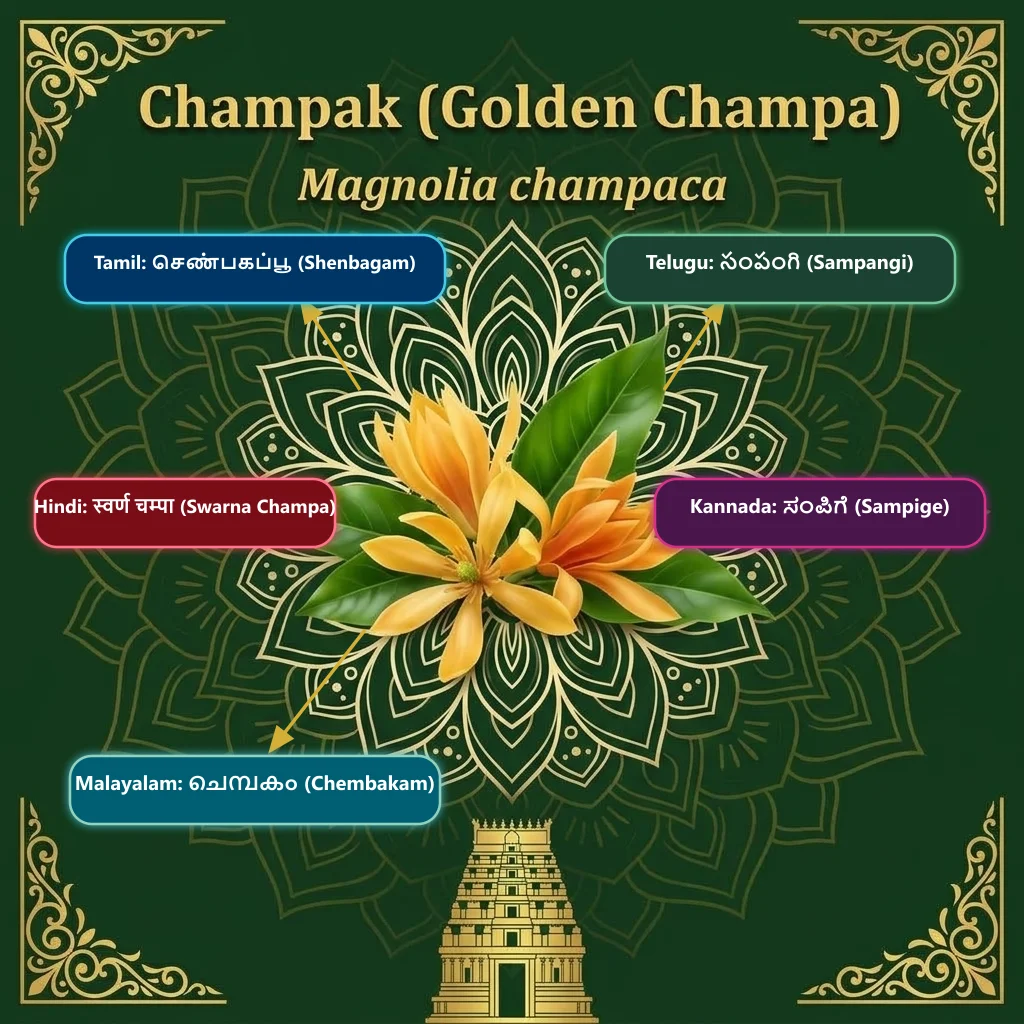
| Champak (Golden Champa) | Magnolia champaca | ↓ Spotlight · ↗ Species Page | செண்பகப்பூ (Shenbagam) | సంపంగి (Sampangi) | स्वर्ण चम्पा (Swarna Champa) | ಸಂಪಿಗೆ (Sampige) | ചെമ്പകം (Chembakam) |
| Golden Shower Tree | Cassia fistula | ↓ Spotlight | சரக்கொன்றை (Sarakkondrai) | రేల పువ్వు (Rela Puvvu) | अमलतास (Amaltas) | ಕೊನ್ನೆ ಹೂ (Konne Hoo) | കണിക്കൊന്ന (Kanikkonna) |
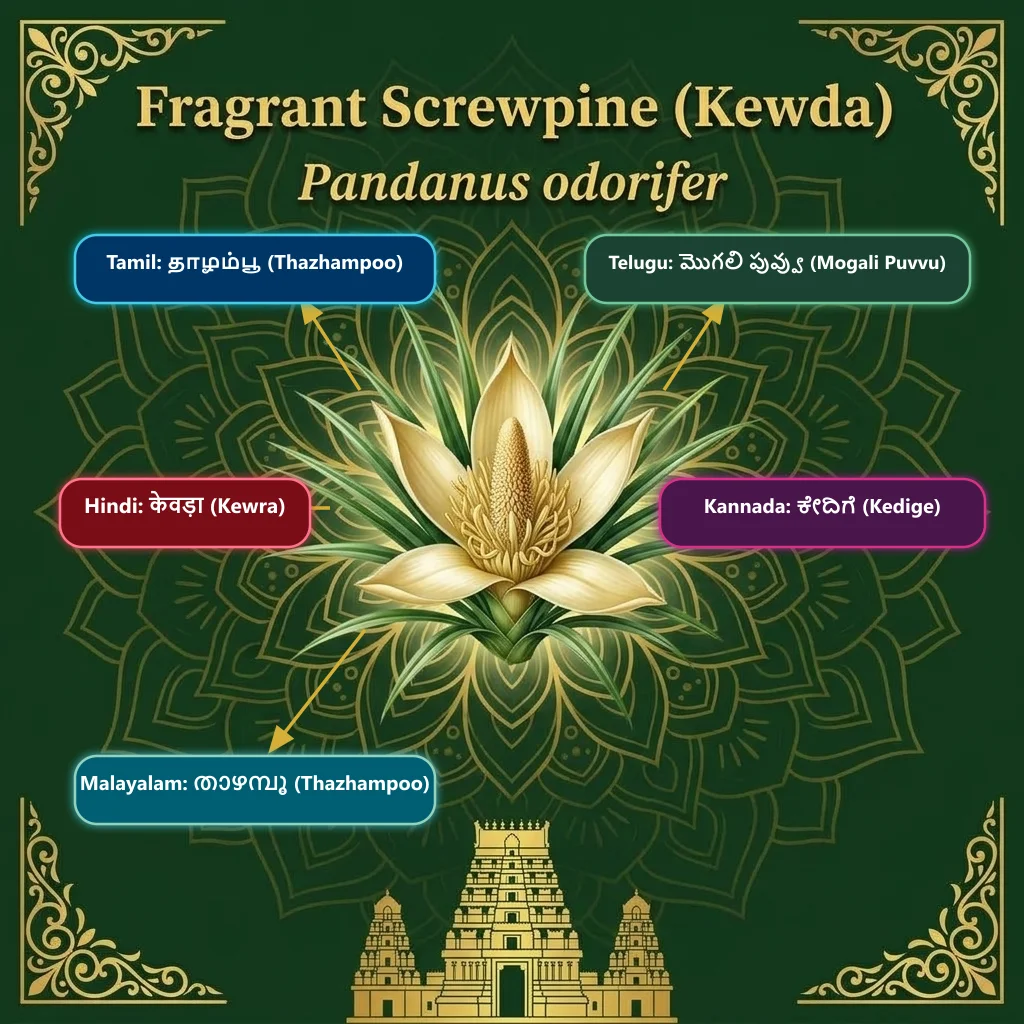
| Fragrant Screwpine (Kewda) | Pandanus odorifer | ↓ Spotlight | தாழம்பூ (Thazhampoo) | మొగలి పువ్వు (Mogali Puvvu) | केवड़ा (Kewra) | ಕೇದಿಗೆ (Kedige) | താഴம்பூ (Thazhampoo) |
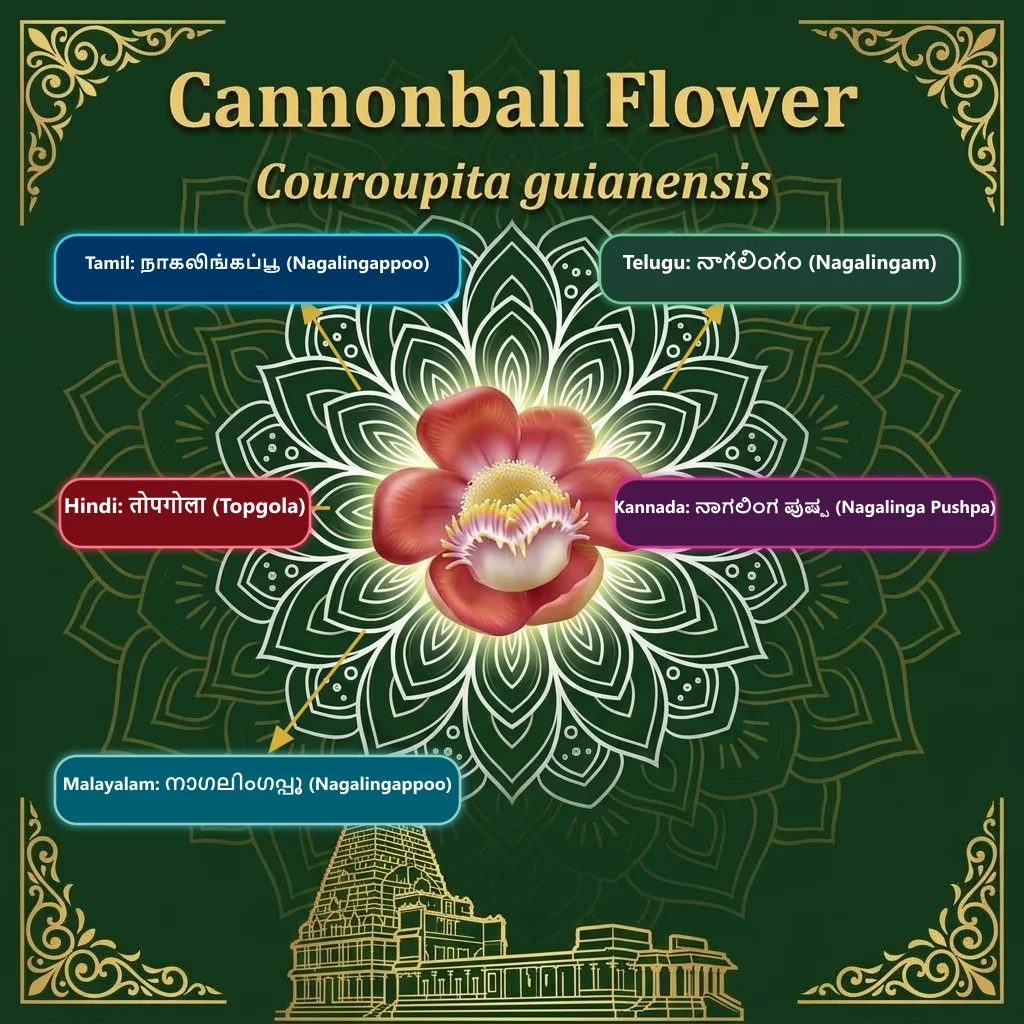
| Cannonball Flower | Couroupita guianensis | ↓ Spotlight | நாகலிங்கப்பூ (Nagalingam) | మల్లికార్జుன పువ్వు / నాగలింగం | तोपगोला / नाग चम्पा | ನಾಗಲಿಂಗ ಪುಷ್ಪ (Nagalinga Pushpa) | നാഗലിംഗപ്പൂ (Nagalingappoo) |
Spotlight: Regional Names & Cultural Significance
1. Jasmine — India's Most Loved Flower
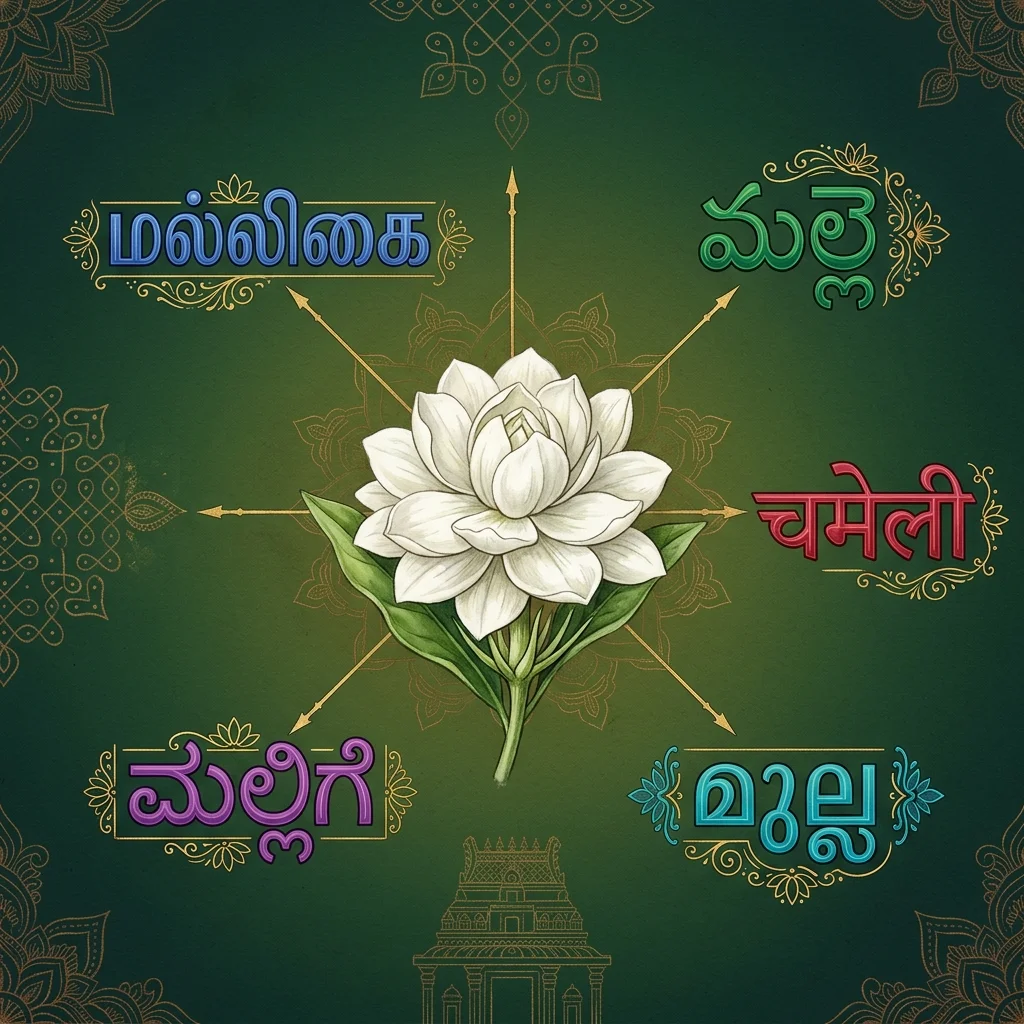
No flower carries more cultural weight in India than jasmine. The general Tamil term Mullai encompasses several jasmine species, but the most prized — Jasminum sambac — is specifically called Malli in everyday Tamil speech. In Telugu, it is Malle Puvvu (puvvu = flower). Kerala's wedding market calls it Mullappoo and uses it almost exclusively for bridal hair decorations. Hindi-speaking North India knows it simply as Chameli, the inspiration for countless songs and fragrances. In Karnataka, the same bloom becomes Mallige, the default temple offering woven into long garlands.
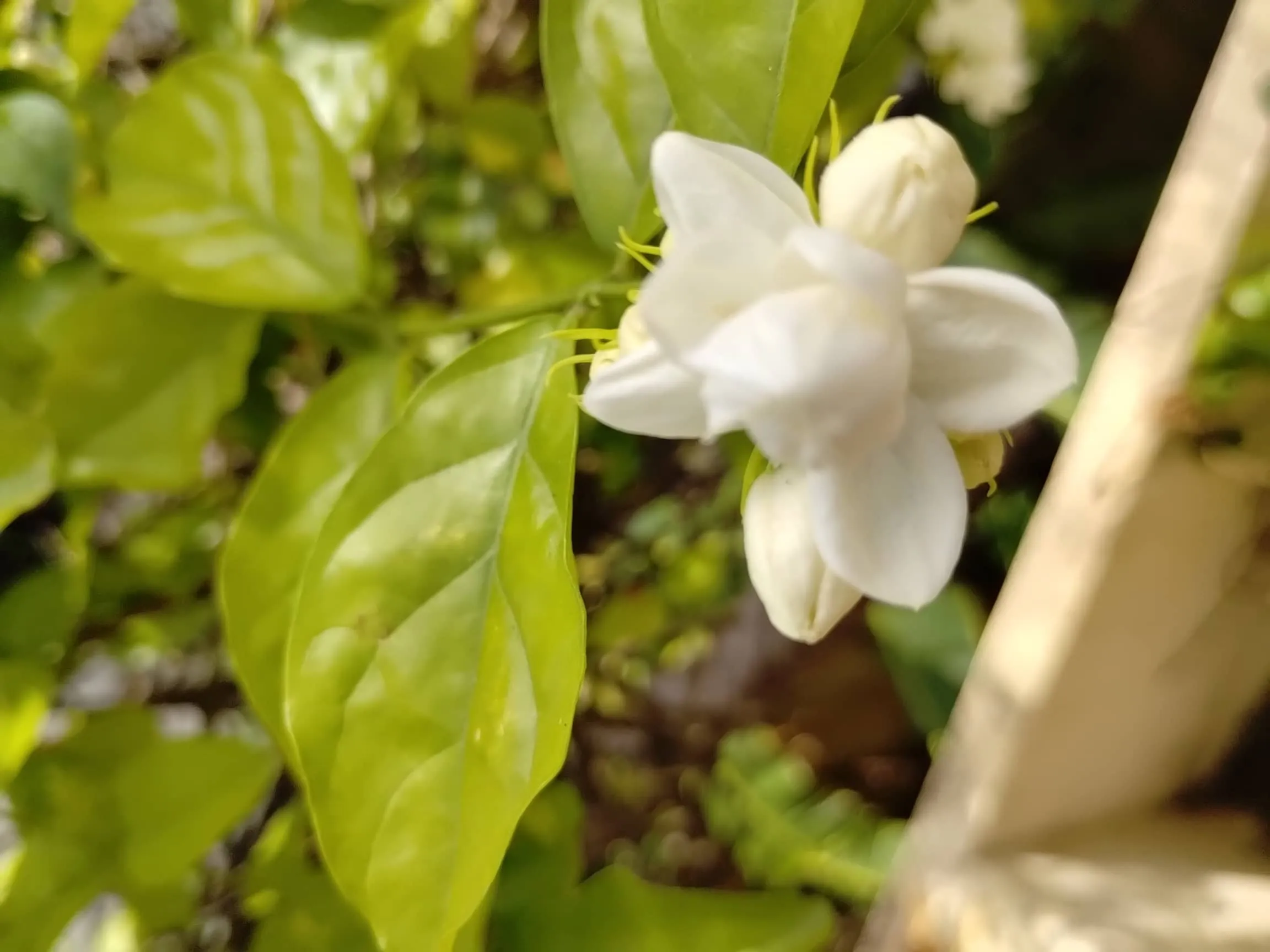
Quick Identification: Small, waxy white flowers with 5–9 petals and an intense night fragrance. Look for oval, dark green leaves and a sprawling, vine-like habit.
2. Hibiscus — The Temple Flower
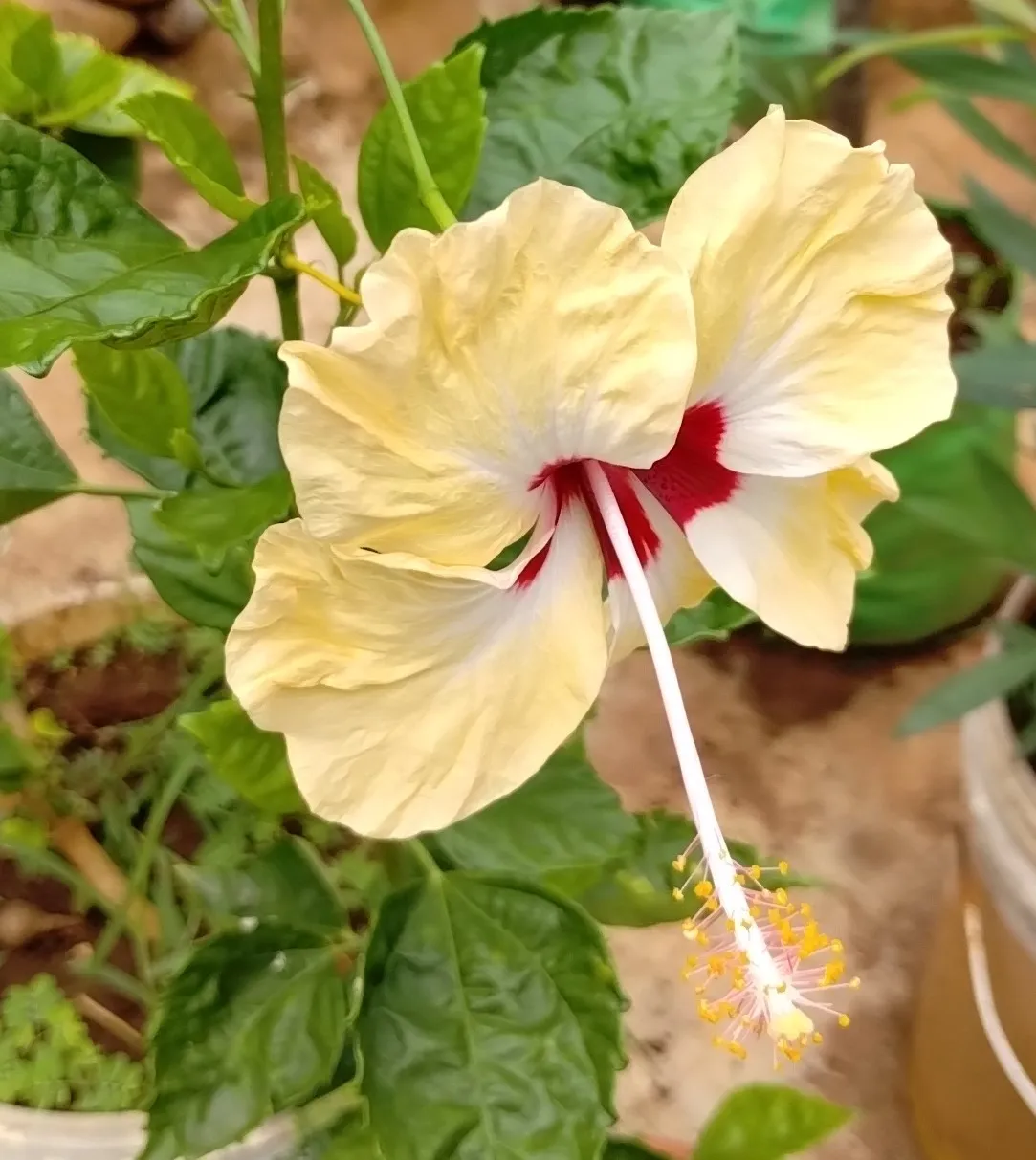
Hibiscus (Hibiscus rosa-sinensis) is perhaps the most widely planted ornamental in South India. The Tamil Sembaruthi (sem = red, paruthi = cotton flower) tells you exactly what it looks like; in classical Tamil temple tradition it is also known as விருச்சி (Viruchi), while dense, multi-layered domestic varieties are colloquially termed இட்லிப் பூ (Idli Poo) due to their resemblance to soft steamed idlis. The Malayalam Chembarathi is a phonetic cousin. In Kannada, it becomes Dasavala, a reference to the five-petalled form. Hindi speakers call it Gudhal — a word that appears consistently in Ayurvedic texts as a medicinal herb for hair and scalp health. In Telugu, the name Mandaram is used across domestic gardens and temple compounds alike.
The red Hibiscus is specifically used in Ganesha puja and Kali worship. The flower head is offered fresh daily, which is why hibiscus plants are found in nearly every Indian household garden.
Quick Identification: Large, trumpet-shaped flowers up to 10 cm across with a prominent staminal column. Leaves are glossy and slightly serrated. Available in red, pink, yellow, and coral varieties.
3. Marigold — The Festival Flower
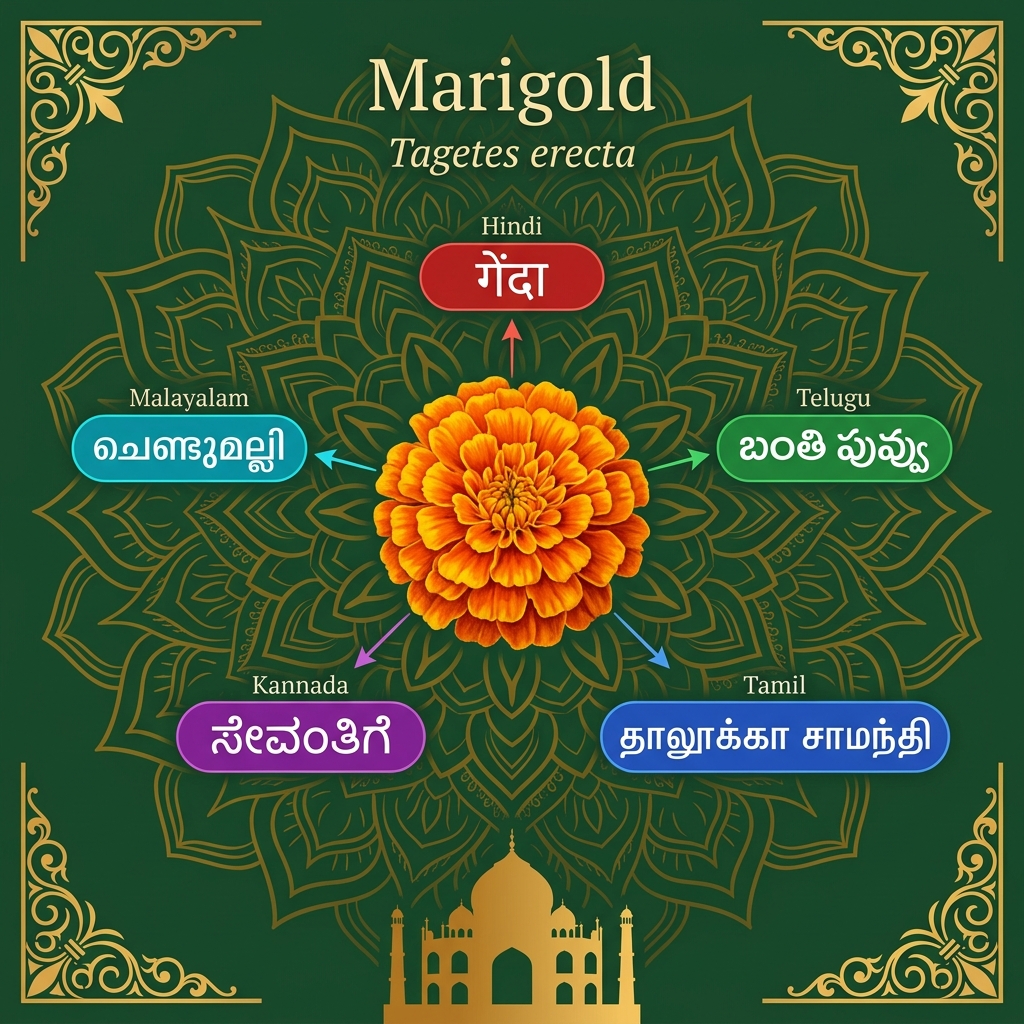
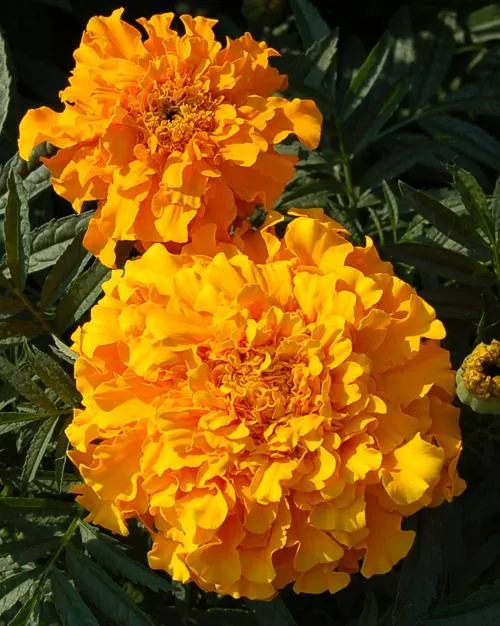
No Indian festival is complete without marigold garlands. Botanically Tagetes erecta, marigold was brought by the Portuguese from the Americas in the 16th century yet was so thoroughly adopted that most Indians consider it native. In Tamil Nadu it is Thulukka Samandhi — the 'Turkish Chrysanthemum' — a name that hints at its foreign origins. Telugu calls it Banthi Puvvu (ball flower). Hindi's Genda is the most widely known name across North India. In Kannada it is Chendu Hoo (ball flower, distinctly separate from Sevantige which refers to Chrysanthemums); in Malayalam, Chendumalli.
Marigolds bloom profusely in winter (October–February), which is why they dominate the festival season from Navaratri through Pongal. They are also the easiest flower to grow in India's diverse climates.
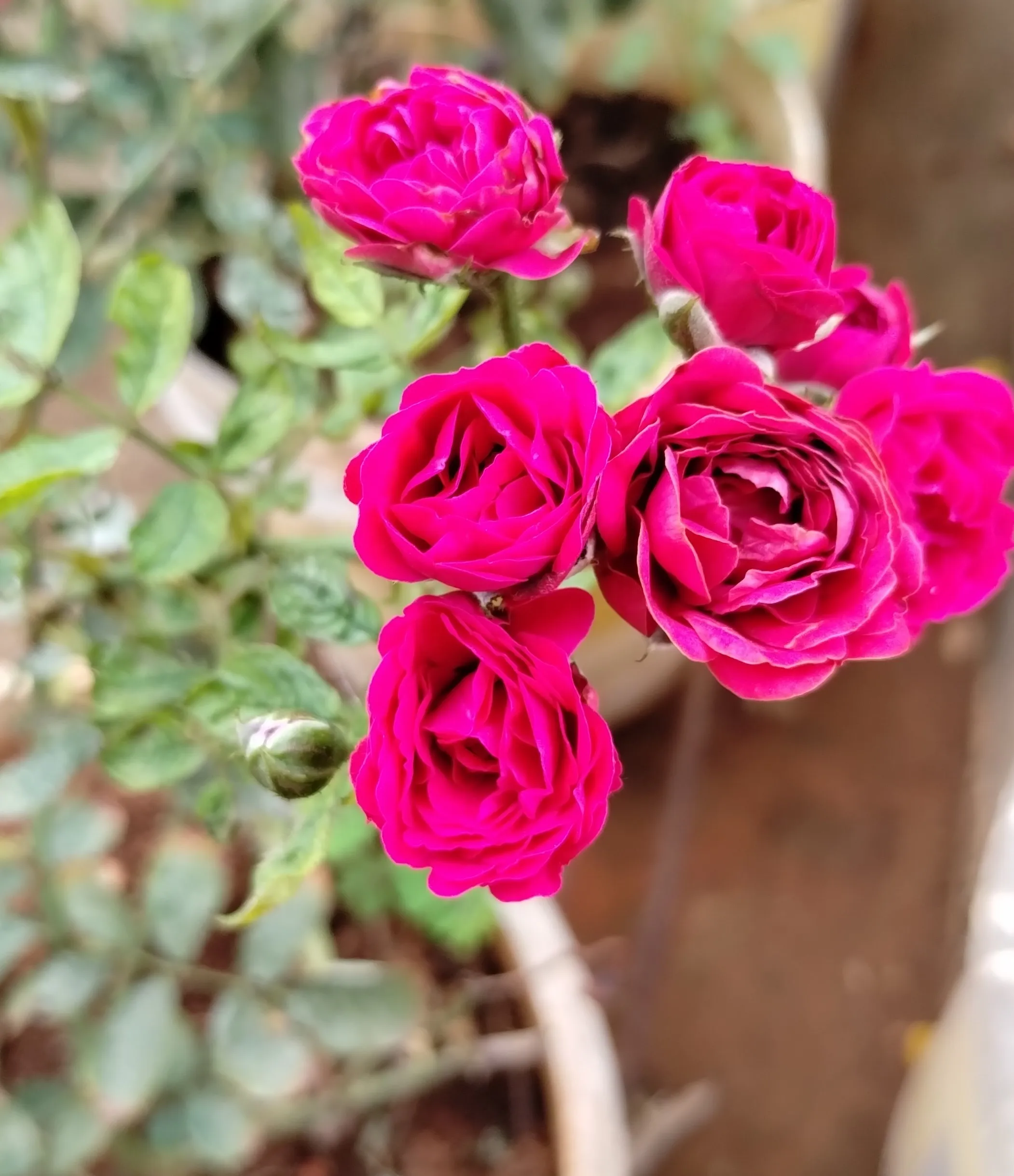
4. Rose — The Universal Romantic
The rose is the one flower whose name barely changes across India's languages — a testament to how universally it was received when introduced from Persia through Mughal gardens. In Tamil it is simply Roja, directly borrowed from the Portuguese rosa. Telugu calls it Gulaabi Puvvu (gulaabi = pink, puvvu = flower). Hindi and Kannada share Gulab, from the Persian gul-ab (flower water — as in rose water). Malayalam also uses Roja, completing a neat phonetic circle back to Tamil.
The Mughal emperors, especially Babur and Jahangir, were obsessed with roses and helped establish extensive rose gardens across the subcontinent. The rose water (Gulab Jal) industry in Kannauj, Uttar Pradesh, is still active today, producing some of the finest distilled rose extracts in the world.
Quick Identification: Compound leaves with serrated leaflets, prominent thorns on the stem, and layered petals with a soft, sweet fragrance. Available in hundreds of cultivated varieties.
5. Lotus — The Sacred National Flower
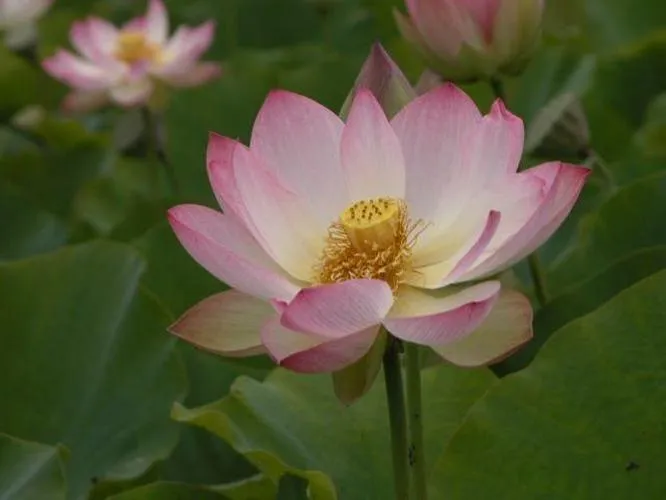
The lotus (Nelumbo nucifera) is India's national flower and perhaps the most symbolically loaded bloom in the entire subcontinent. The Tamil Thamarai and Malayalam Thamara share a root in the Dravidian word for water flower. Telugu uses Tamara Puvvu, and Kannada simply Kamala — the Sanskrit name that also gives rise to the popular feminine name. Hindi uses Kamal, from the same Sanskrit root, which also appears in the Bhagavad Gita as a metaphor for spiritual non-attachment.
The lotus grows with its roots submerged in mud yet blooms immaculately above the water — a physical metaphor that every Indian religion has used to describe enlightenment. It appears in Buddhist iconography, Jain cosmology, and Hindu devotional art with equal authority.
Quick Identification: Large round leaves (up to 80 cm) that repel water completely. Pink or white flowers rise on a single stem above the water surface. Seed pods resemble a shower head after bloom.
6. Tuberose — The Fragrance Queen
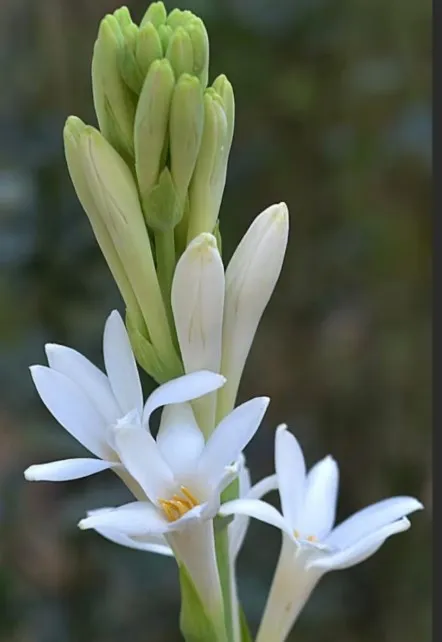
Tuberose (Polianthes tuberosa) is the undisputed queen of night fragrance in South India. Tamil calls it Sugandaraja (fragrance king) or Sampangi, a name Kannada mirrors as Sugandaraja. Telugu uses Sugandarajam. Hindi's Rajnigandha (night-fragrant) is the most poetic name — it specifically captures the flower's habit of intensifying its scent after sunset. Malayalam uses Rajnigandham, drawing from the same Sanskrit/Hindi root.
In Tamil Nadu and Karnataka, tuberose is commercially grown on an enormous scale to supply garland markets for weddings and temple festivals. A single flower spike can produce up to 50 individual blooms, making it extremely cost-effective for garland weaving. The perfume industry uses tuberose absolute as one of the most expensive natural fragrance components in luxury perfumery.
Quick Identification: Long upright spikes of waxy white tubular flowers with a sweet, heavy, and distinctly nocturnal fragrance. Narrow, grass-like leaves at the base.
7. Chrysanthemum — The Winter Market Flower
Chrysanthemum is called Saamandhi in Tamil — a corruption of the Sanskrit Shatapatra (hundred-petalled). Telugu uses Chamanthi, and Kannada calls it Sevantige (frequently confusing visitors who hear Chendu Hoo for marigolds). Malayalam uses Saamandhi, completing a phonetic loop back to Tamil. Hindi speakers across North India call it Guldaudi — a combination of gul (flower) and daudi (type).
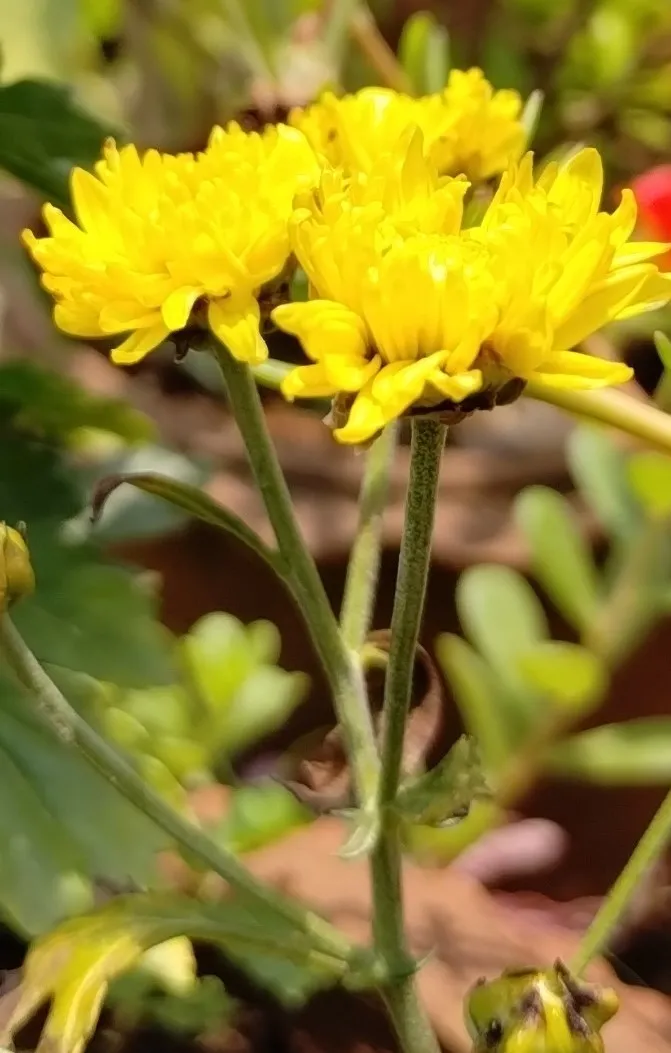
Chrysanthemums are the backbone of the winter garland economy across India. They bloom from October to February in a wide range of colours — white, yellow, orange, and deep burgundy — and are heavily used in festival decorations, temple offerings, and garlands during the cooler months.
Quick Identification: Dense, multi-petalled blooms in a dome or pompom shape. Leaves are deeply lobed with a distinctive aromatic scent when crushed. Stems are rigid and erect.
8. Oleander — The Roadside Warning
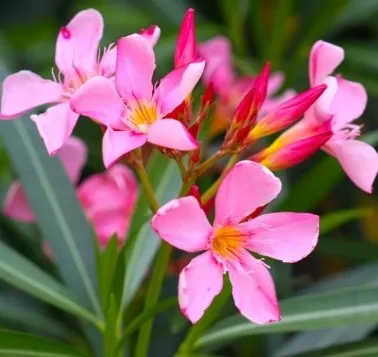
Oleander (Nerium oleander) is one of the most commonly planted roadside shrubs in South India — and also one of the most toxic plants in the garden. Tamil and Malayalam share the same name: Arali. Telugu calls it Ganneru, Kannada Kanagile (or Kanagilu), and Hindi Kaner. Despite the name variation, one fact remains uniform: every part of the oleander plant — flowers, leaves, stems, and sap — is poisonous to humans and livestock.
Its toxicity notwithstanding, oleander holds important ritual value. White oleander (Vellai Arali) is offered in Shiva temples across Tamil Nadu, and it appears in classical Tamil Sangam poetry as a symbol of devotion.
Quick Identification: Long, leathery, lance-shaped leaves in whorls of three. Flowers in clusters at branch tips — white, pink, or red. Milky sap when stem is broken. WARNING: Toxic if ingested.
9. Plumeria (Frangipani) — The Temple Tree Bloom
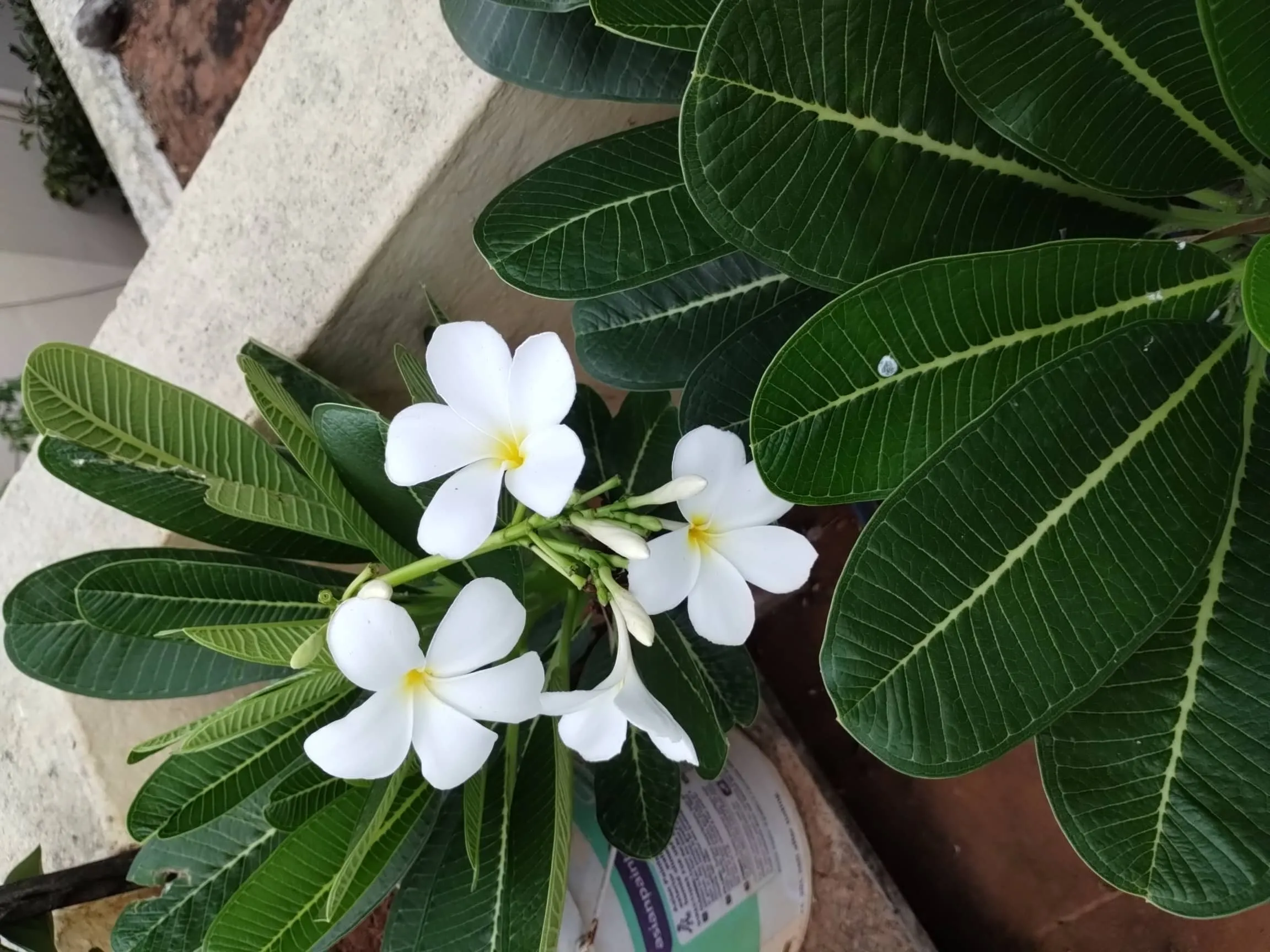
Plumeria (Plumeria rubra) is the flower of temple courtyards across South India. Tamil calls it Perunkalli or Champa, and in temple contexts Sembagapaalai. In Telugu, it is specifically Deva Ganneru (divine oleander, distinguishing it from Champa which refers to Magnolia), and in Kannada Deva Kanagile. Hindi uses Champa, while Malayalam uses Paalappoo (milky flower) or Chembakam.
Its waxy, spiral-petalled blooms are offered to temple deities and are celebrated for their thick, sweet perfume that intensifies at twilight.
Quick Identification: Thick, fleshy succulent-like branches with milky sap. Leaves clustered at branch tips, large and elongated. Flowers are five-petalled in white-yellow, pink or deep red, with an intoxicating sweet fragrance.
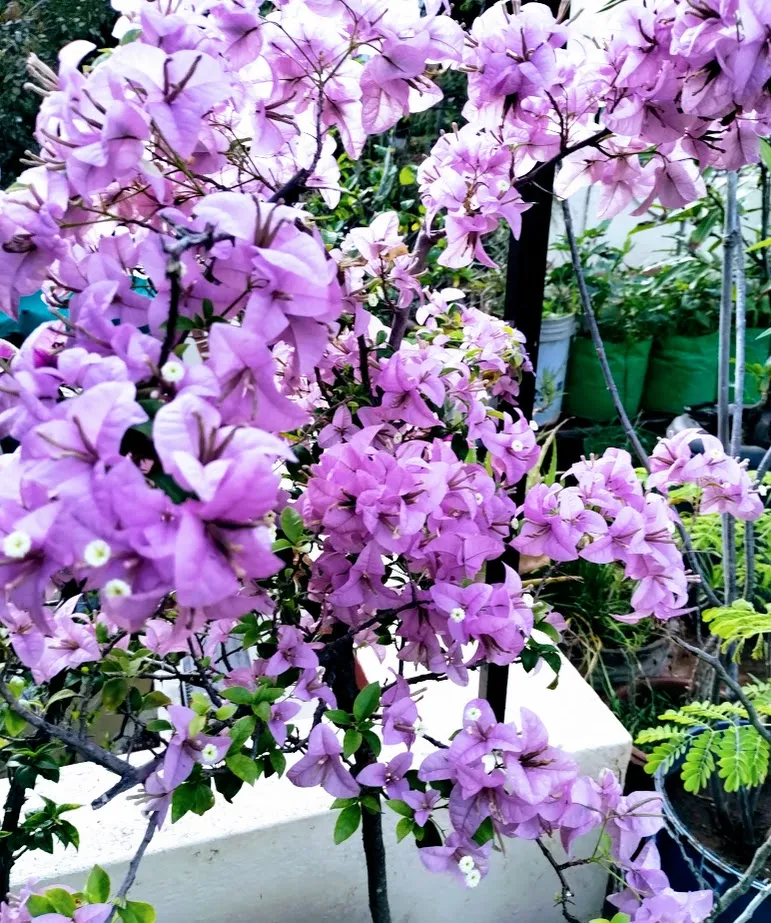
10. Bougainvillea — The Paper Flower
Bougainvillea is one of the most visually dramatic plants in Indian gardens, covering walls and archways in blazing magenta, orange, and white bracts. In Tamil it is delightfully called Kaagithapoo — literally 'paper flower', referring to the papery texture of its bracts. Malayalam calls it Kadalaas Poovu (same meaning), and Kannada uses Kagadada Hoo — all three independently arriving at the same paper metaphor. Telugu calls it Kaagitham Poolu, while Hindi simply uses the Anglicised Bougainvillea.
Introduced to India from Brazil in the 19th century through the Calcutta Botanical Garden, bougainvillea adapted aggressively to the Indian climate. The brightly coloured 'petals' are actually bracts (modified leaves); the actual flower is the tiny cream-coloured tube at the centre.
Quick Identification: Woody thorny vine with oval leaves. The colourful papery 'petals' (bracts) come in sets of three, surrounding tiny white true flowers. Thrives in dry heat and full sun.
11. Night Jasmine (Parijat) — The Fallen Star Flower
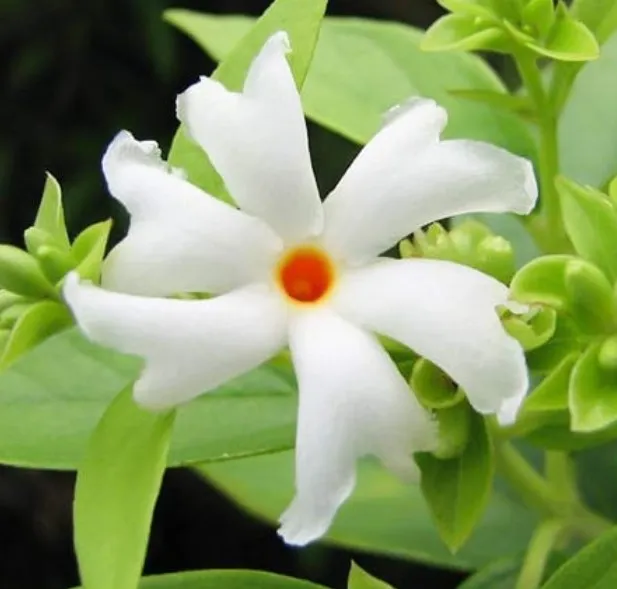
The Parijat (Nyctanthes arbor-tristis) is unique: it blooms only at night and falls at dawn, carpeting the ground below the tree in a fragrant orange-and-white mosaic. Its scientific name arbor-tristis means 'tree of sorrow' — a nod to its habit of dropping blossoms at sunrise. In Tamil it is lovingly called Pavazhamalli (coral jasmine, referring to its bright coral-orange tube) or Parijatham, in Malayalam Parijatham, in Telugu Parijatam, in Kannada Parijata, and in Hindi Harsingar ('adornment of the gods'). It is the only flower in Hindu ritual that can be gathered from the clean ground and offered to deities.
Quick Identification: Small white star-shaped flowers with a distinctive bright orange stem (like a matchstick). The flowers fall at dawn and retain their intoxicating fragrance even after falling.
12. Sunflower — The Modern Addition
Across all five languages, the name is an intuitive reflection of 'sun-tracker': Tamil Suryakanthi, Telugu Poddu Thirugudu (turning toward the sun) or Suryakanthi, Hindi Surajmukhi (sun-faced), Kannada Suryakanthi, and Malayalam Suryakanthi. This remarkable linguistic consistency reflects how intuitively the plant's heliotropic behaviour was recognised and named.
Today sunflower is a major oilseed crop across Karnataka, Andhra Pradesh, and Maharashtra, with large ornamental blooms heavily featured in South Indian temple decorations and wedding floral arrangements.
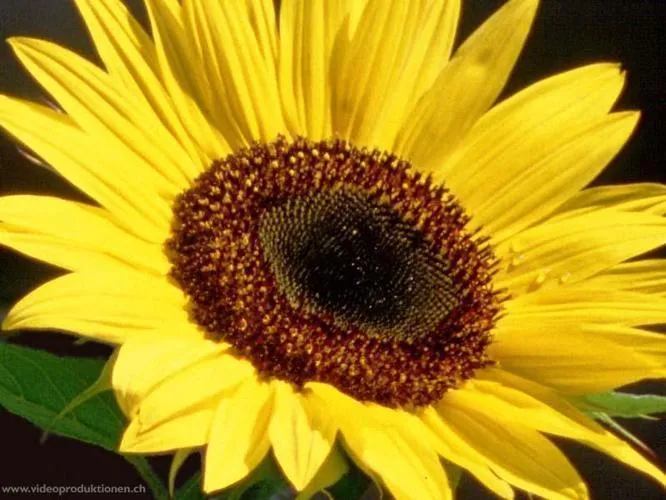
Quick Identification: Large, rough-hairy leaves and sturdy stems. Flower head is a composite of hundreds of tiny central disc florets surrounded by bright yellow ray petals.
13. Crown Flower — The Sacred Shiva Bloom
Crown flower (Calotropis gigantea) is one of the few wildflowers that is also a sacred offering. In Tamil it is Erukku, in Telugu Jilledu, in Kannada Ekkada Hoo, in Malayalam Erikku, and in Hindi Aak or Madar. Despite growing wild along roadsides, it holds the highest ritual status in Shaivite and Ganesha worship — the crown-shaped white and violet flowers are strung into garlands exclusively for Lord Shiva and Pillayar.
Quick Identification: Large, oval, powdery grey-green leaves. Flowers in clusters — five reflexed petals with a crown-like central corona. Milky white sap exudes when damaged.
14. Peacock Flower — The Vibrant Garden Shrub
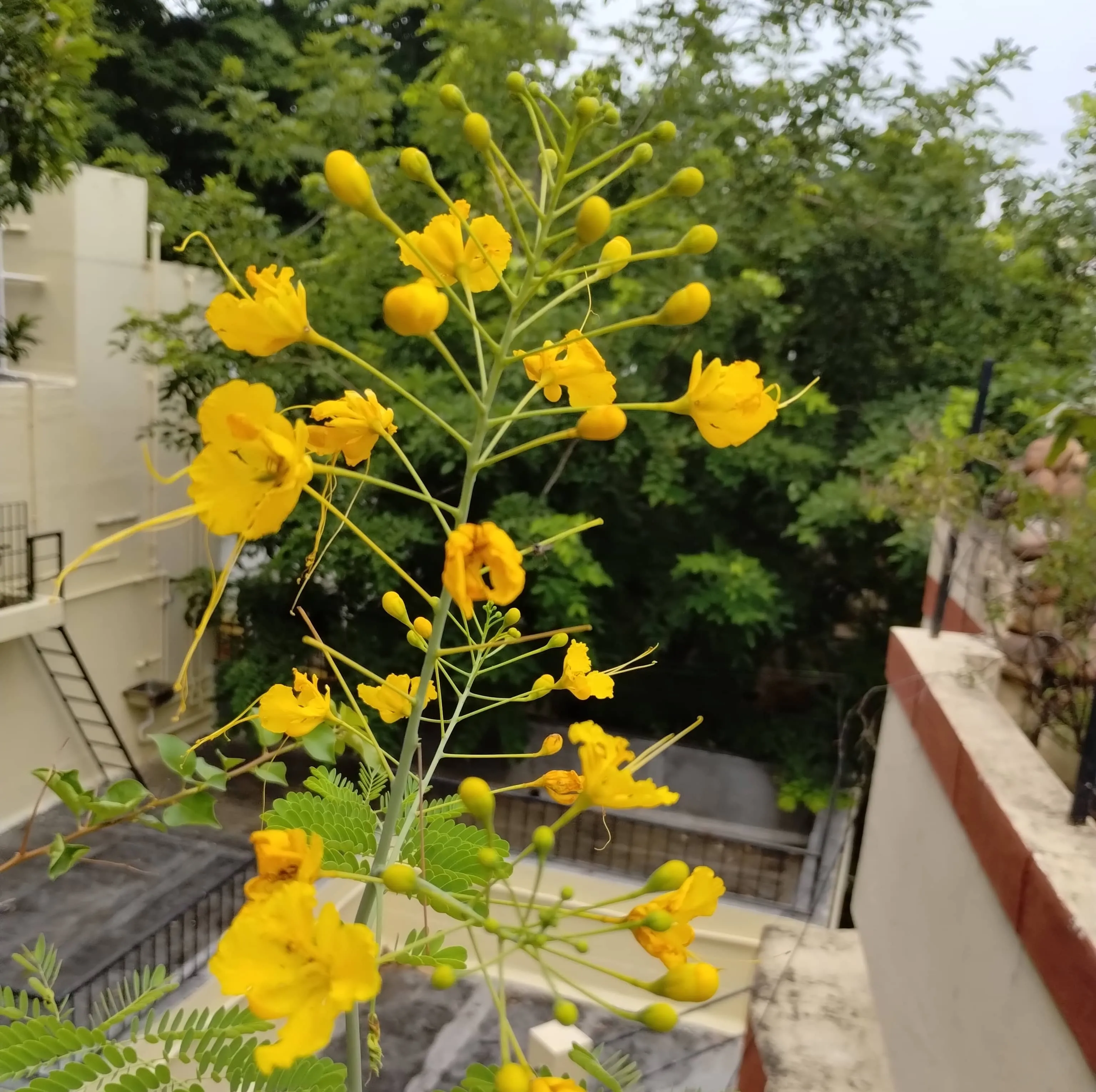
The peacock flower (Caesalpinia pulcherrima) is one of the most visually striking shrubs in South Indian gardens — its fringed orange and scarlet petals with long, dramatic stamens are unmistakable. Tamil calls it Mayil Konnai or Mayilkondrai (peacock's crest — referring to the regal plumage-like petals; not to be confused with the erroneous phonetic misspelling 'Mayir Konnai'), Malayalam Mayilkkonna, and Telugu Ratnagandhi (jewel-scented). Kannada uses Kempu Sirige (red fringe). The Hindi name Gulmohar (or Chhota Gulmohar) is often used colloquially, though true Gulmohar is the giant canopy tree Delonix regia.
Quick Identification: Bipinnate feathery leaves, shrubby growth to 3–4 metres. Flowers in upright racemes — five crinkled petals in fiery orange-red with one yellow-bordered petal, and 10 extraordinarily long red stamens.
15. Ixora (Jungle Flame) — The Sacred Hedgerow Classic
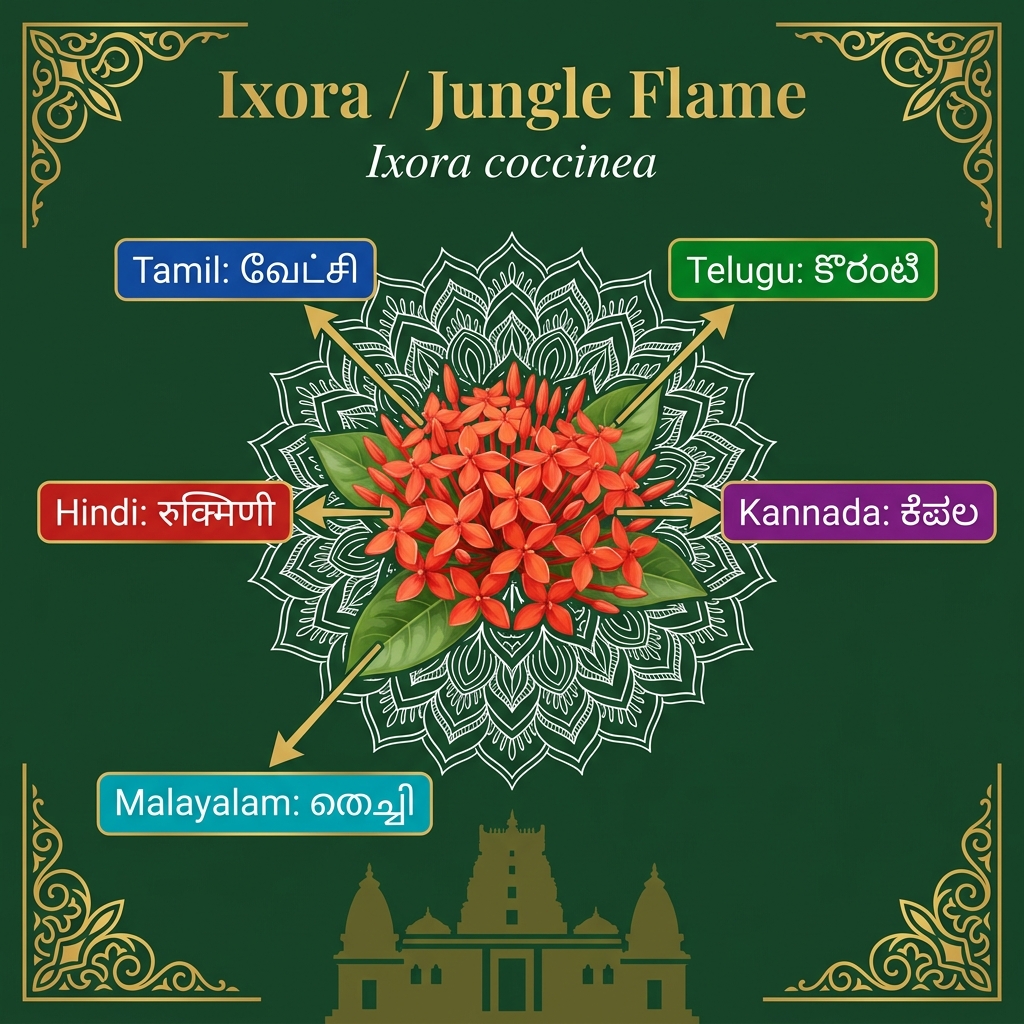
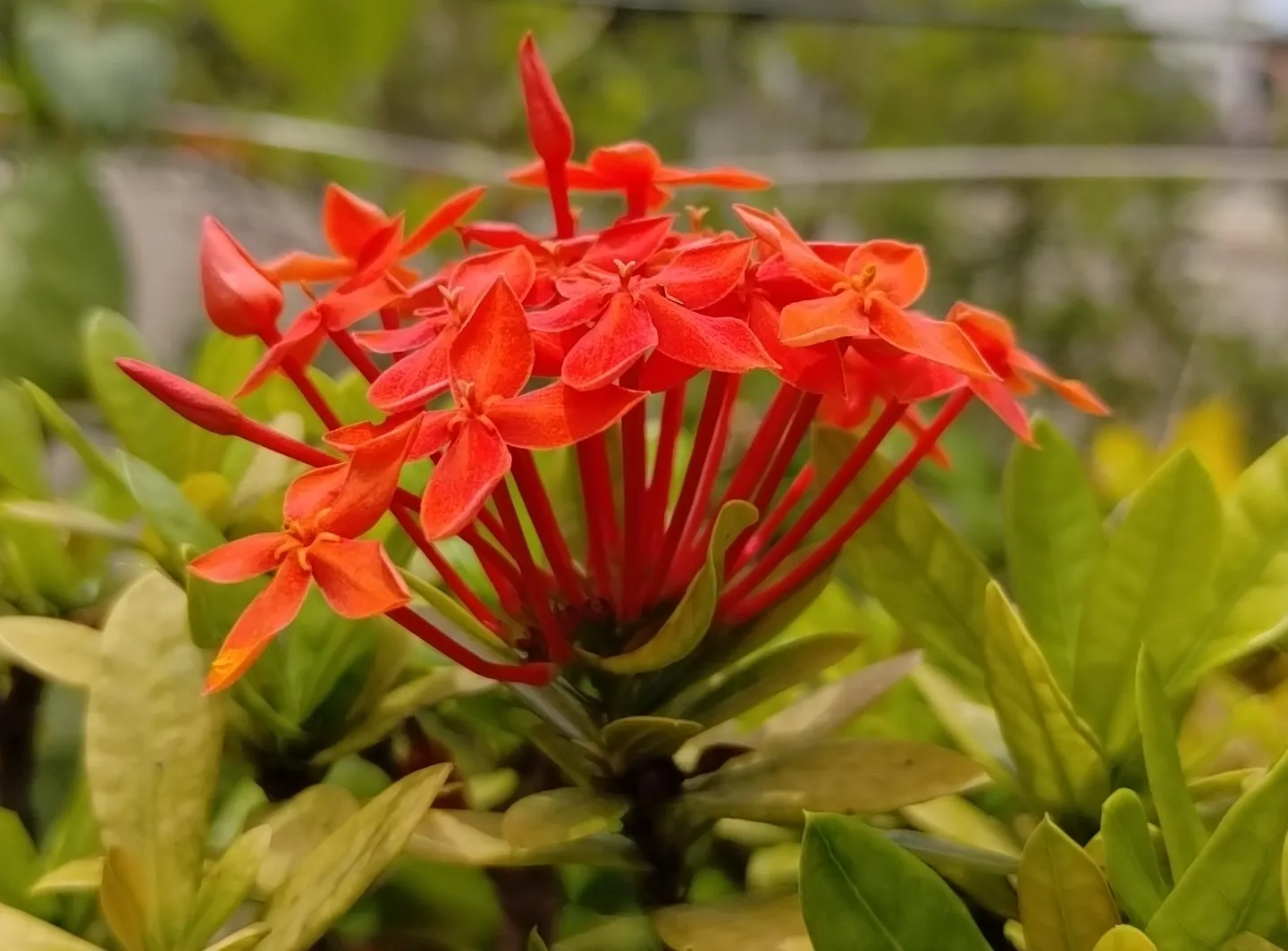
Ixora (Ixora coccinea) is ubiquitous across South India. Tamil calls it Vritchi (celebrated in classical Sangam literature as a symbol of valor) and colloquially Idli Poo (because the dense round clusters resemble steamed idlis). In Telugu, it is famous as Nooru Varahaalu (hundred gold coins) or Koranti. Malayalam's Thecchi is the definitive temple flower of Kerala, while Kannada uses Kepala. In Hindi, it is known as Rukmini.
Quick Identification: Compact, evergreen shrub with stiff, glossy dark green leaves. Dense, ball-shaped terminal clusters of hundreds of small, four-petalled tubular flowers in scarlet, orange, pink, or white.
16. Crossandra (Firecracker Flower) — South India's Premier Hair Flower
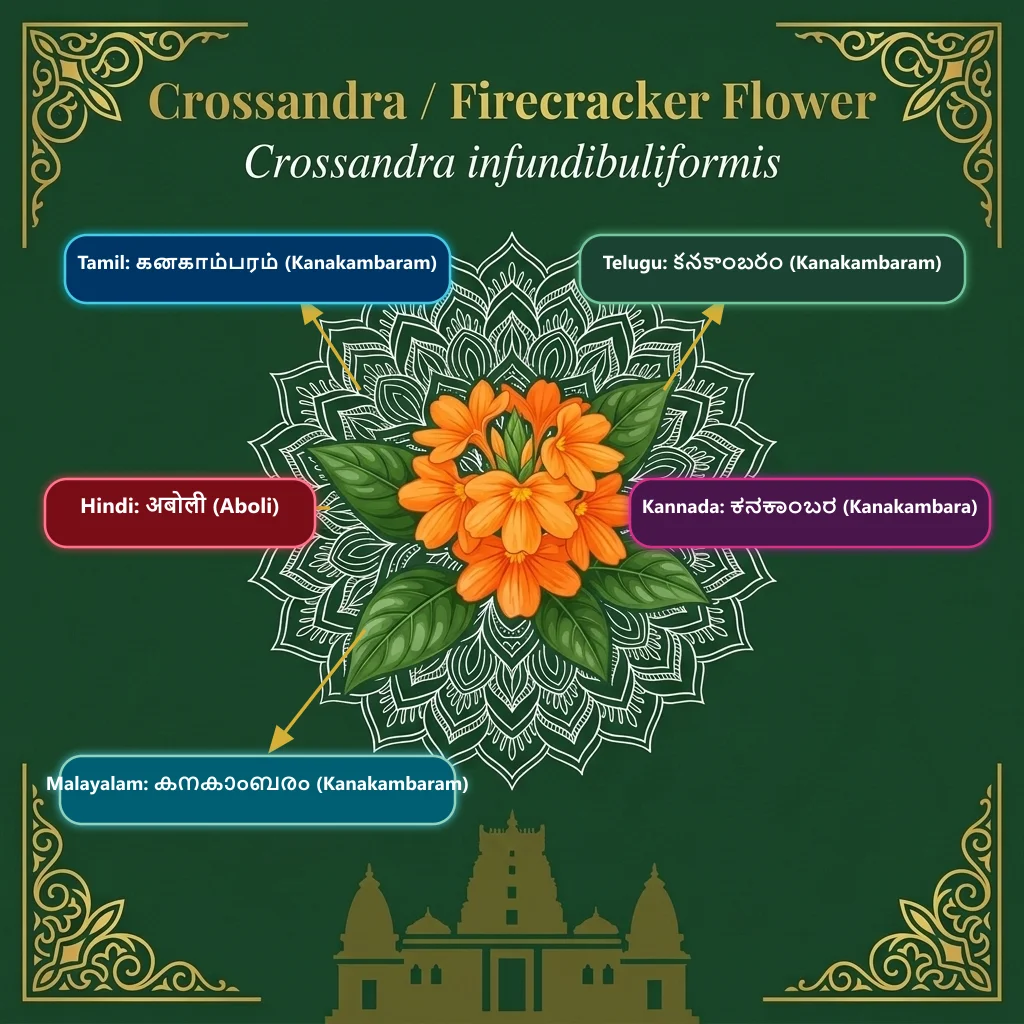
No floral market in South India is complete without vibrant strings of salmon-orange Kanakambaram. In Tamil, Telugu, and Malayalam, it is uniformly known as Kanakambaram (derived from Sanskrit kanaka = gold + ambara = sky/apparel), while Kannada calls it Kanakambara. Hindi-speaking garland markets call it Aboli. Strung in alternating bands with pure white Jasmine (Malli), the famous Malli-Kanakambaram garland combination is an iconic sight across Chennai, Madurai, Bangalore, and Hyderabad.
Unlike jasmine, Crossandra flowers are completely scentless, but their papery, translucent coral-orange fan petals last for multiple days without wilting, making them the ultimate flower for hair adornment.
Quick Identification: Compact subshrub with glossy, dark green leaves with wavy margins. Flowers emerge from dense four-sided overlapping terminal spikes with asymmetric, fan-shaped apricot-orange petals.
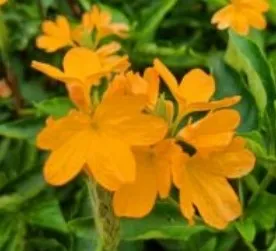
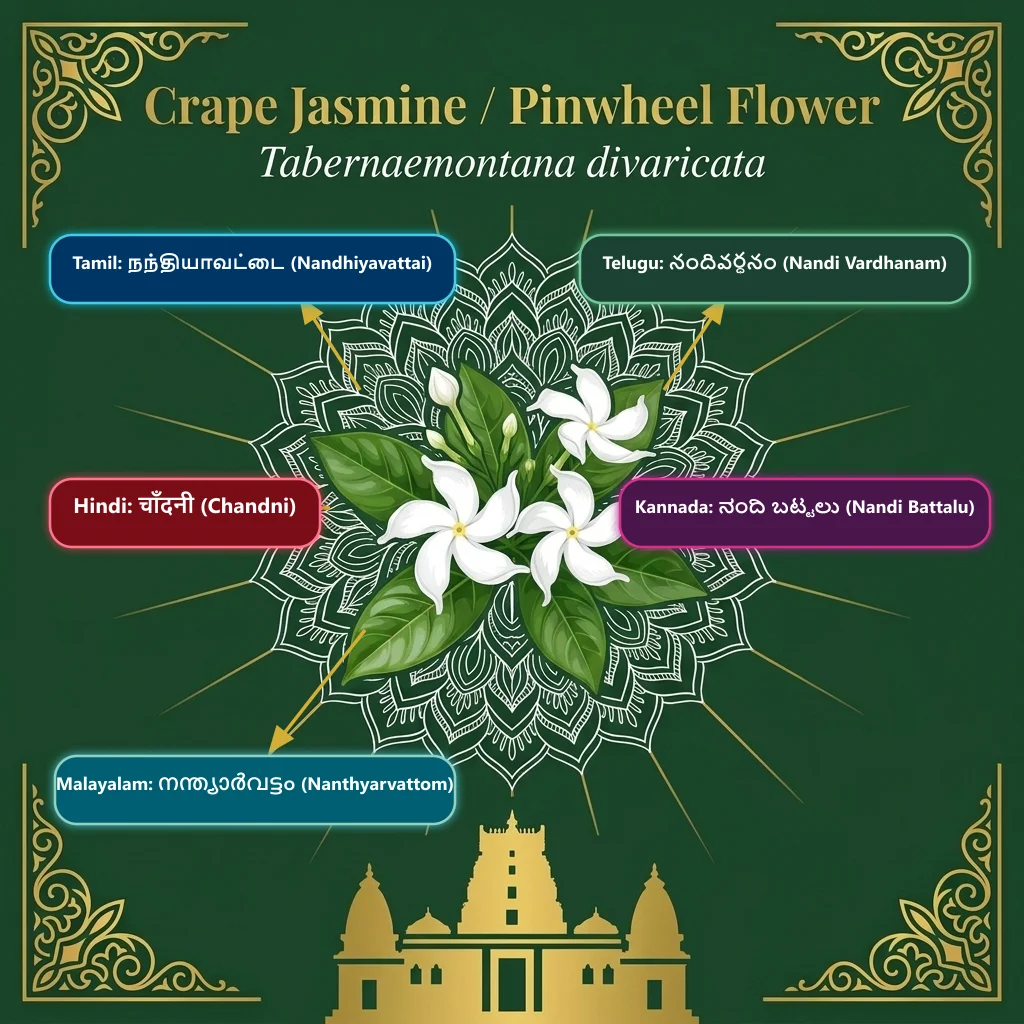
17. Crape Jasmine (Pinwheel Flower) — The Everyday Morning Puja Bloom
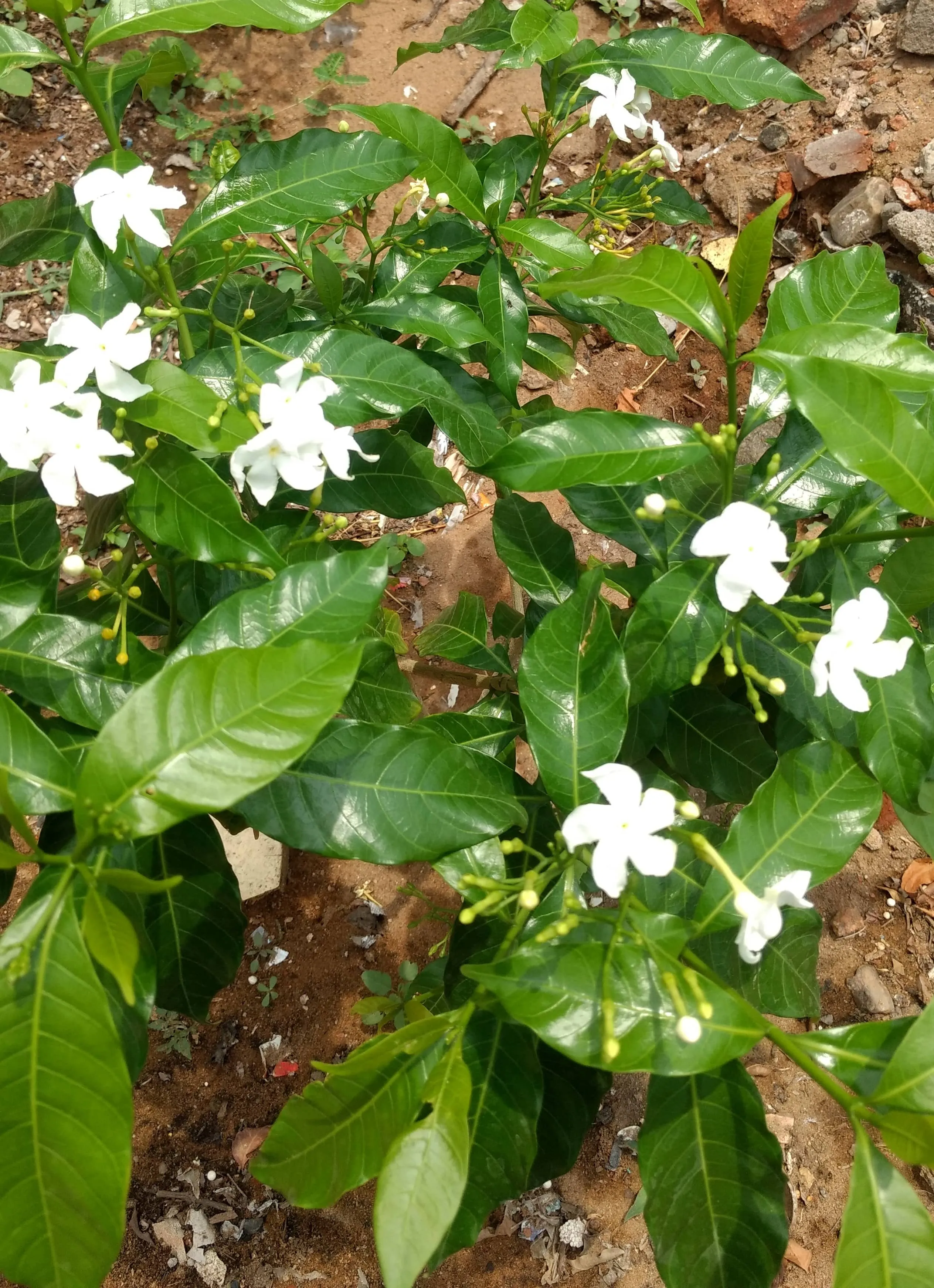
Every morning across South India, fresh milk-white pinwheel blossoms are gathered in brass plates for domestic deity worship. Botanically Tabernaemontana divaricata, it is known in Tamil as Nandhiyavattai, in Telugu as Nandi Vardhanam (bringer of prosperity), in Kannada as Nandi Battalu (Nandi's offering cup), and in Malayalam as Nanthyarvattom. In Hindi, it is poetically called Chandni (moonlight).
Unlike true jasmine (Jasminum), Crape Jasmine has five pinwheel-curled petals and emits little to no scent, but its immaculate white color and resistance to browning make it the staple temple archana flower.
Quick Identification: Rounded evergreen bush exuding milky sap from stems. Five-petalled pinwheel flowers with curved petal margins, paired with dark green glossy opposite leaves.
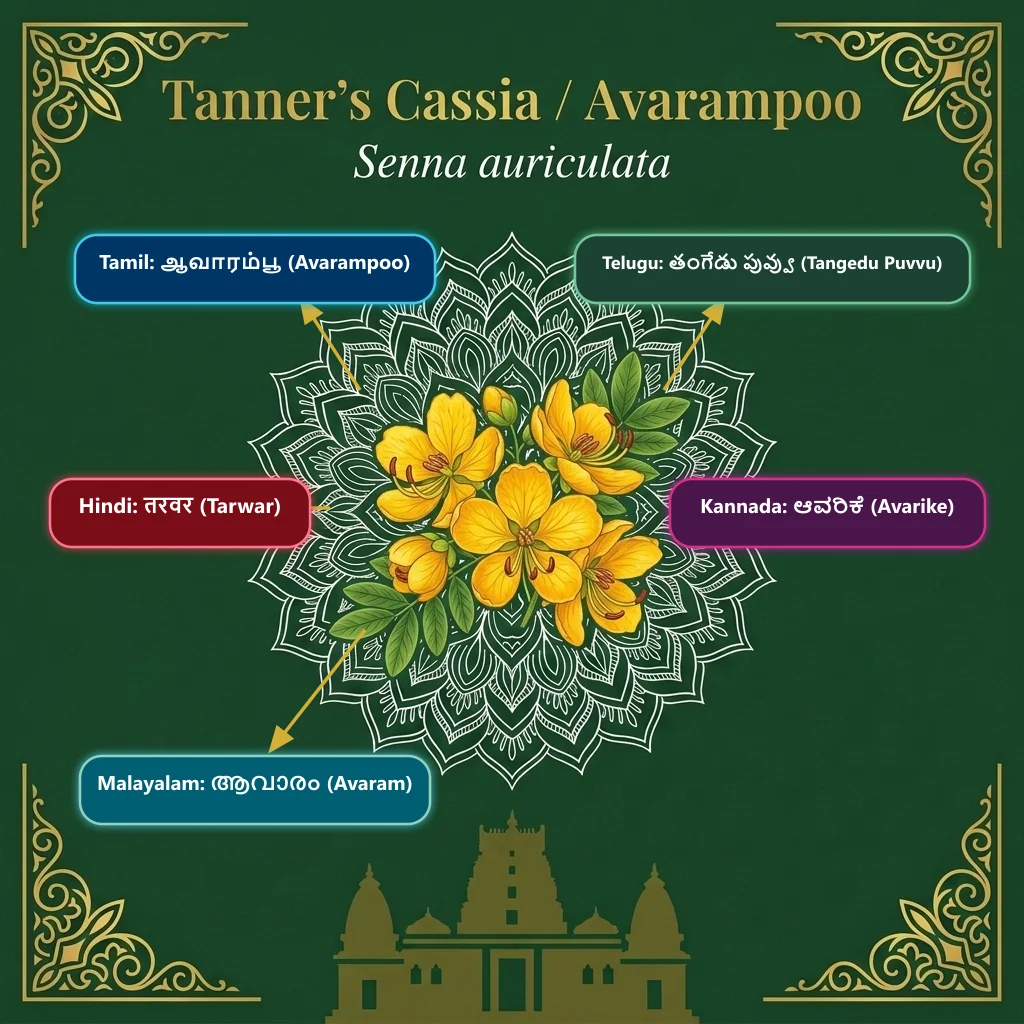
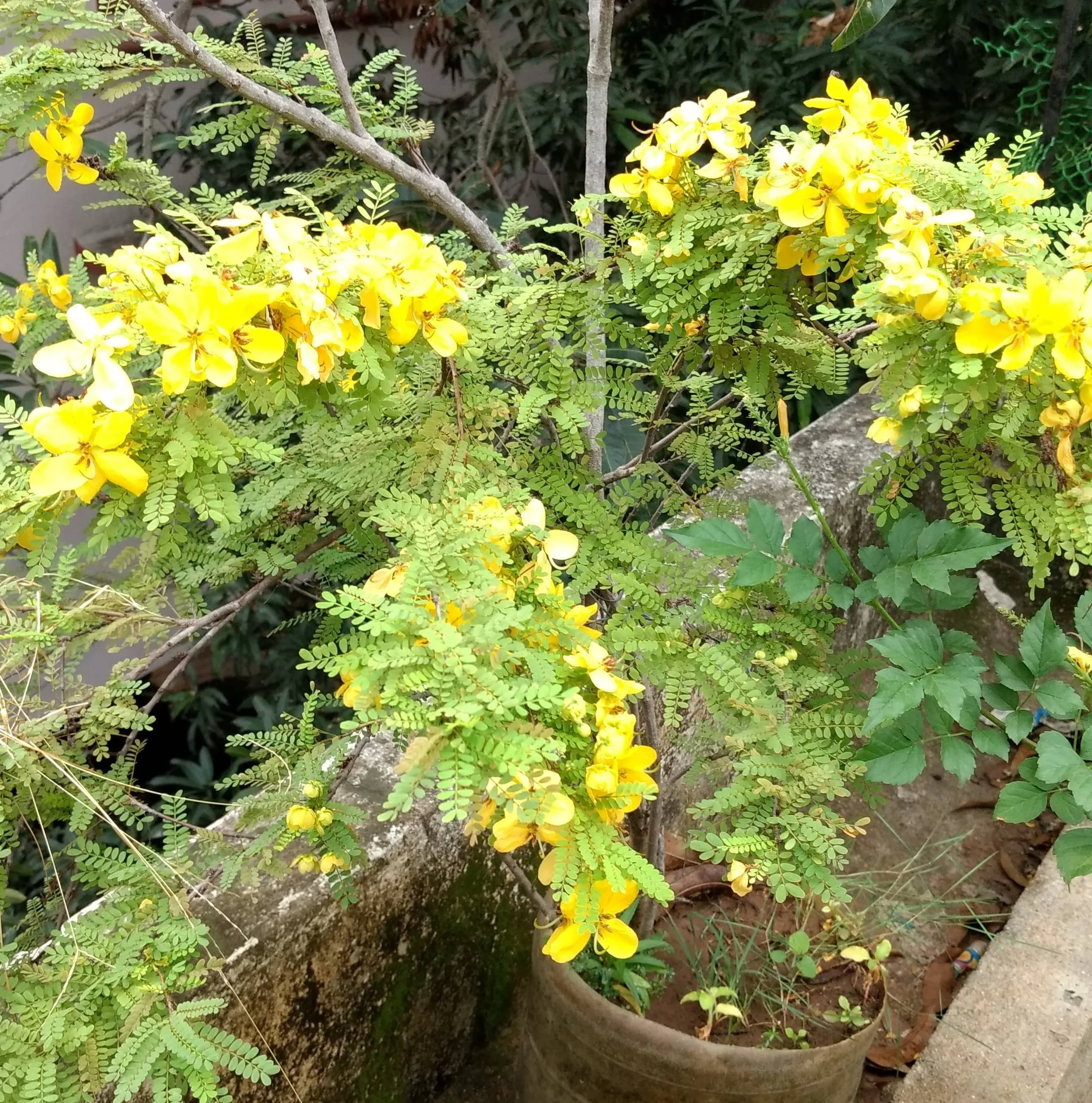
18. Tanner's Cassia (Senna) — The Golden Herbal Flower of Bathukamma & Pongal
Celebrated as the official State Flower of Telangana, Tanner's Cassia (Senna auriculata) is known as Tangedu Puvvu in Telugu and forms the sacred golden core of the Bathukamma festival. In Tamil Nadu, it is revered as Avarampoo — immortalized in the ancient Siddha proverb: "Avarampoo thindraal saavaarai kaanbamo" (if one consumes Avaram tea, can disease ever claim them?). Kannada knows it as Avarike, Malayalam as Avaram, and Hindi as Tarwar.
During Pongal festivities, branches of flowering Avarampoo are tied to thresholds and cattle horns to celebrate agrarian fertility and solar vitality.
Quick Identification: Spreading shrub with velvety branches and pinnate leaves bearing large ear-shaped stipules. Large, brilliant golden-yellow flowers with five unequal petals and prominent brown-tipped anthers.
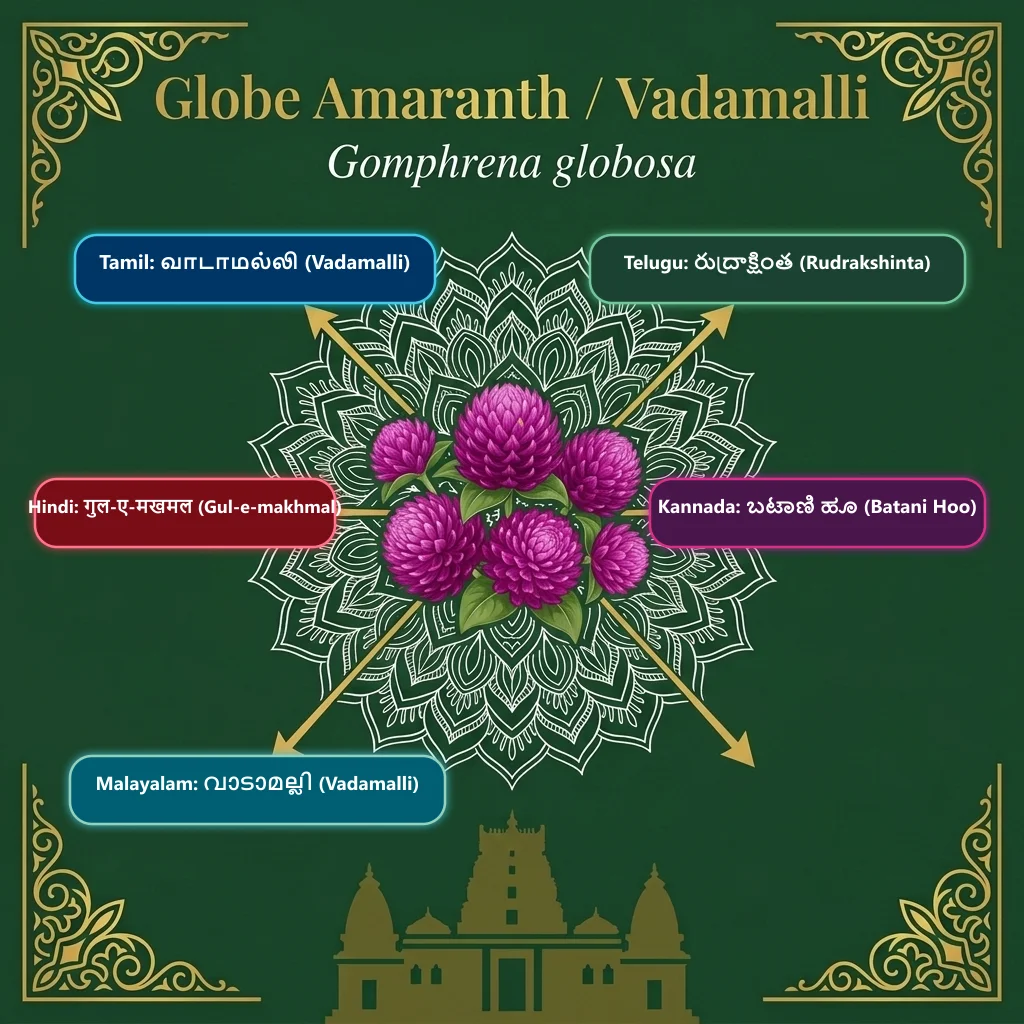
19. Globe Amaranth — The Everlasting Purple Star of Onam Pookkalam
The name reveals its greatest virtue: in Tamil and Malayalam, Gomphrena globosa is called Vadamalli — literally 'the flower that never wilts'. Telugu calls it Rudrakshinta, Kannada Batani Hoo, and Hindi Gul-e-makhmal (velvet bloom). The vivid magenta-purple clover-like flower heads retain their jewel tone for weeks even after drying, making Vadamalli an irreplaceable flower in Kerala's Onam Pookkalam carpets and wedding garlands.
Quick Identification: Branching annual with hairy stems. The rounded flower globes consist of stiff, papery magenta, purple, or white bracts surrounding tiny inconspicuous true flowers.
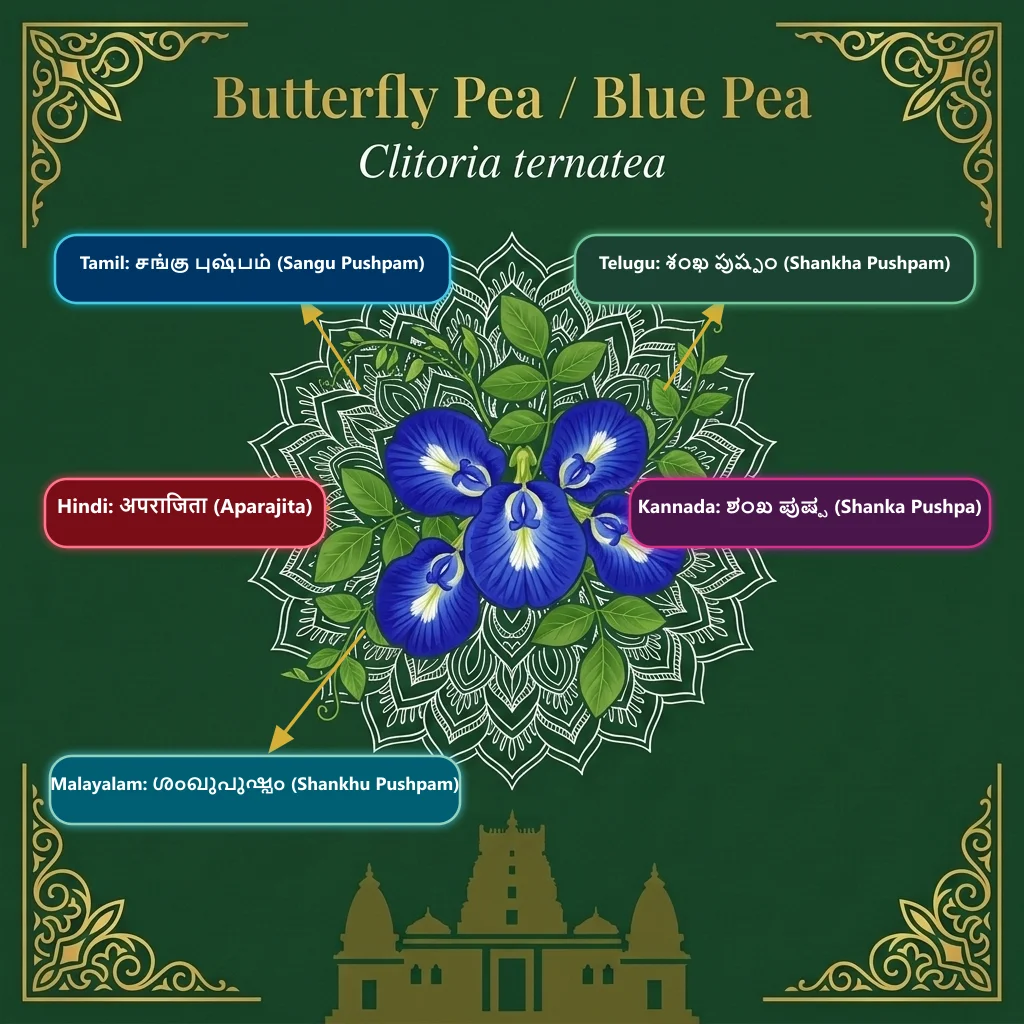
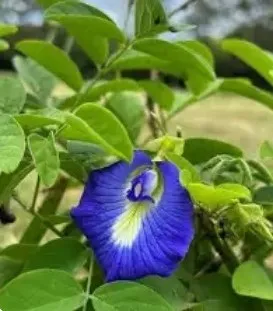
20. Butterfly Pea (Blue Pea) — The Sacred Conch Bloom of Shiva & Devi
Shaped like a delicate conch shell, Clitoria ternatea is called Sangu Pushpam or Sangu Poo in Tamil, Shankha Pushpam in Telugu and Kannada, and Shankhupushpam in Malayalam (from Shankha, the divine conch). In Hindi it is celebrated as Aparajita (the unconquered). Dedicated in rituals to Lord Shiva and Durga, its brilliant cobalt-blue petals are rich in anthocyanins and are traditionally brewed into therapeutic blue tea.
Quick Identification: Slender herbaceous climber with compound leaflets. Solitary, vivid deep blue (or white) flowers with a luminous yellow throat patch.
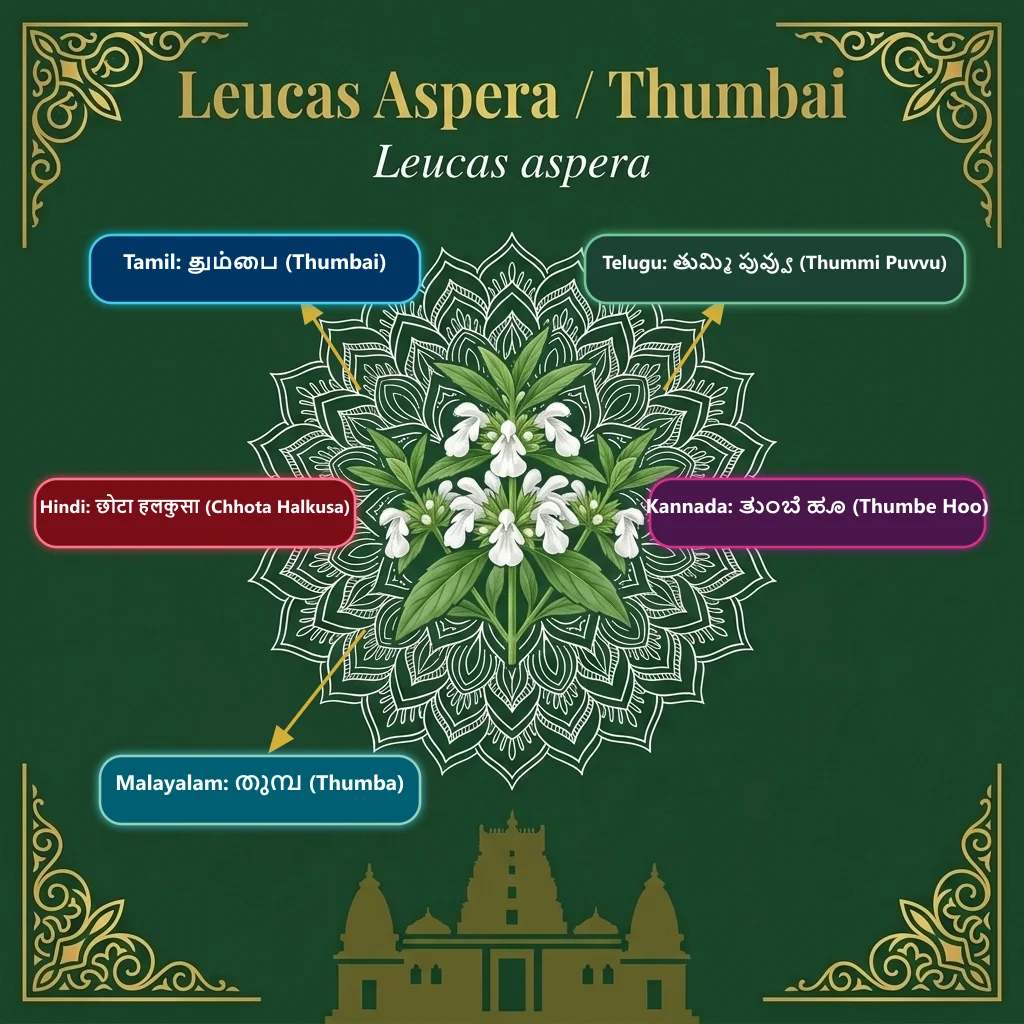
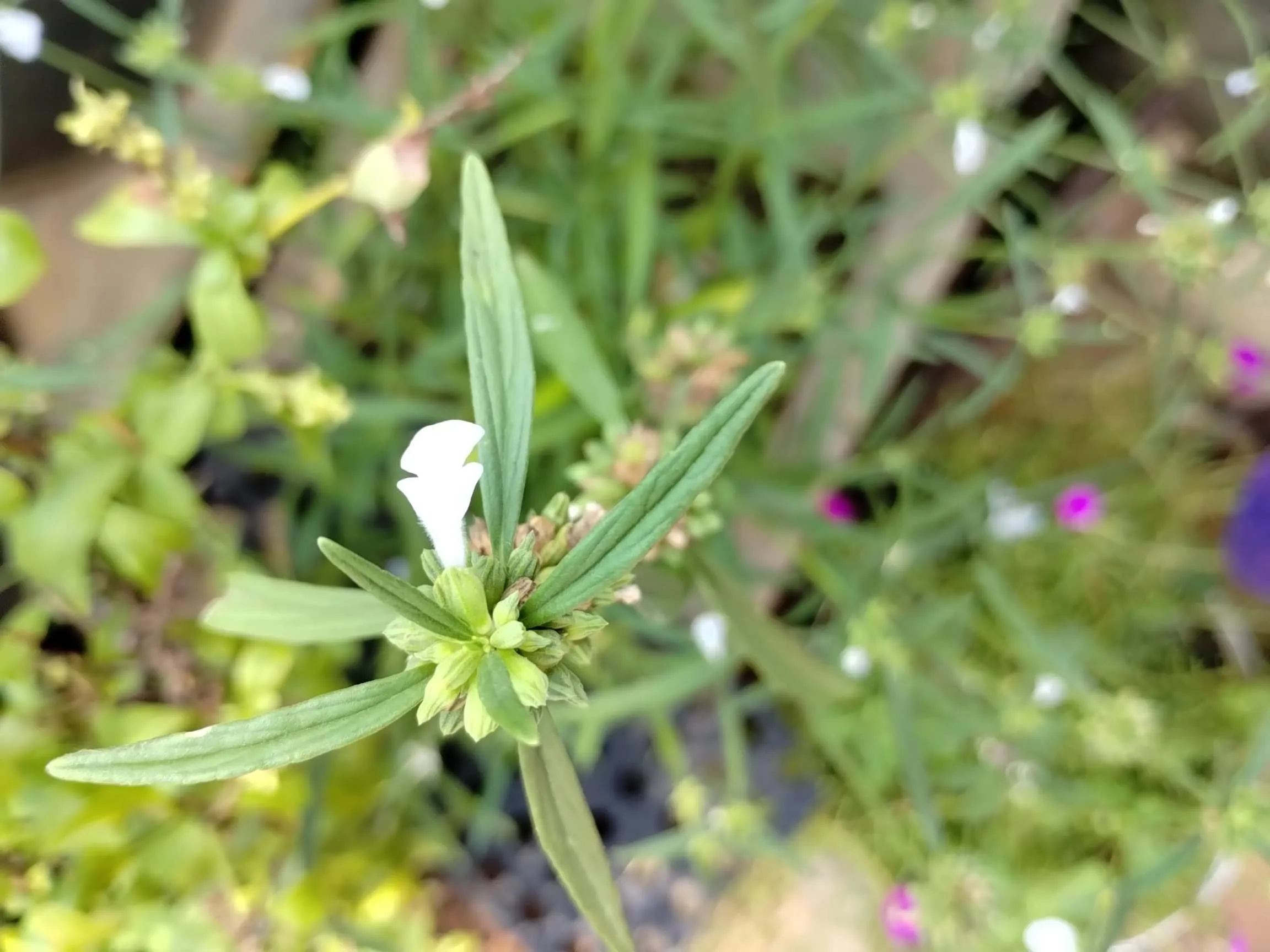
21. Leucas Aspera — The White Soul of Onam and Sacred Shiva Offering
No wildflower holds greater sanctity in Kerala and Tamil Nadu than Leucas aspera. In Malayalam and Tamil, it is simply Thumba or Thumbai. Telugu calls it Thummi Puvvu, Kannada Thumbe Hoo, and Hindi Chhota Halkusa. Tradition mandates that the very first white circle of the Onam Pookkalam must be formed with pristine Thumba blossoms. In Shaivite tradition, it is among the highest-grade offerings to Lord Shiva.
Quick Identification: Aromatic upright wildflower with square stems (mint family). Dense spherical whorls of tiny, snow-white two-lipped flowers with a woolly upper hood.
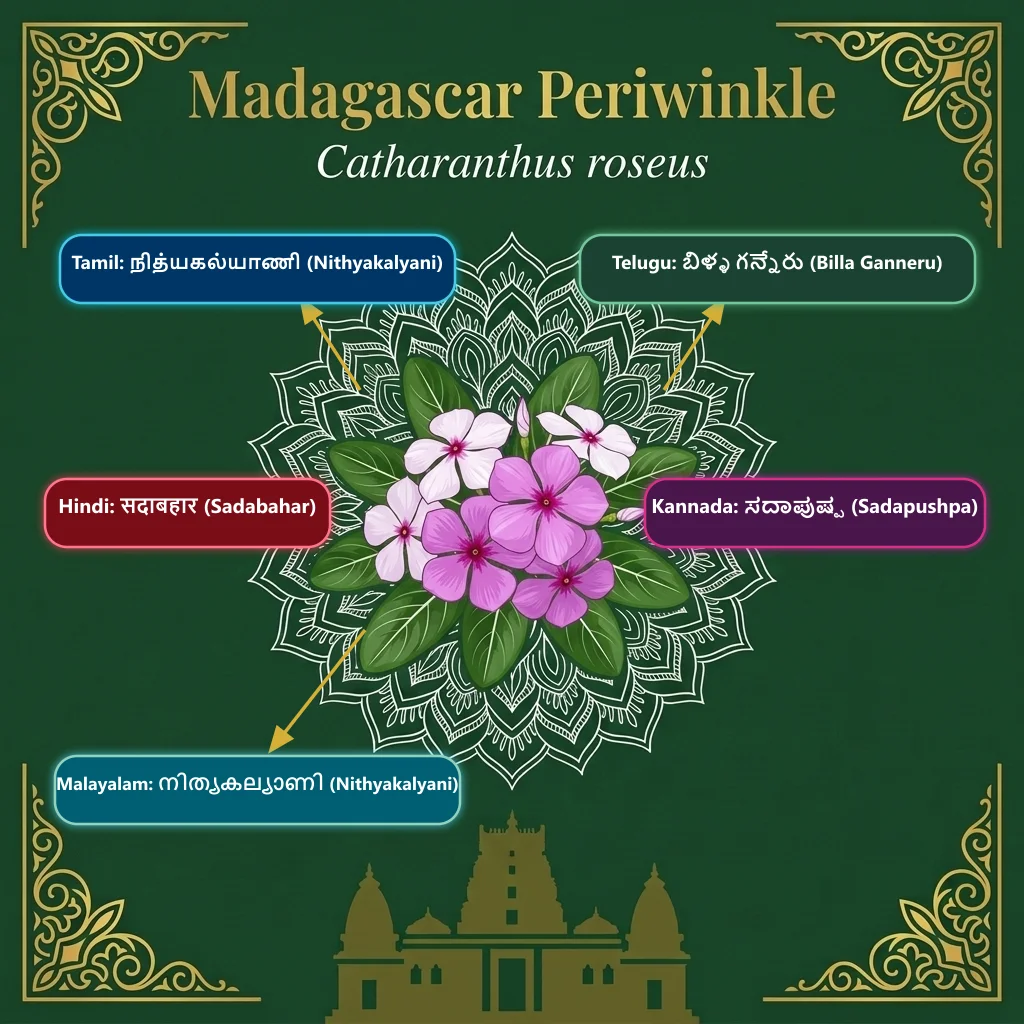
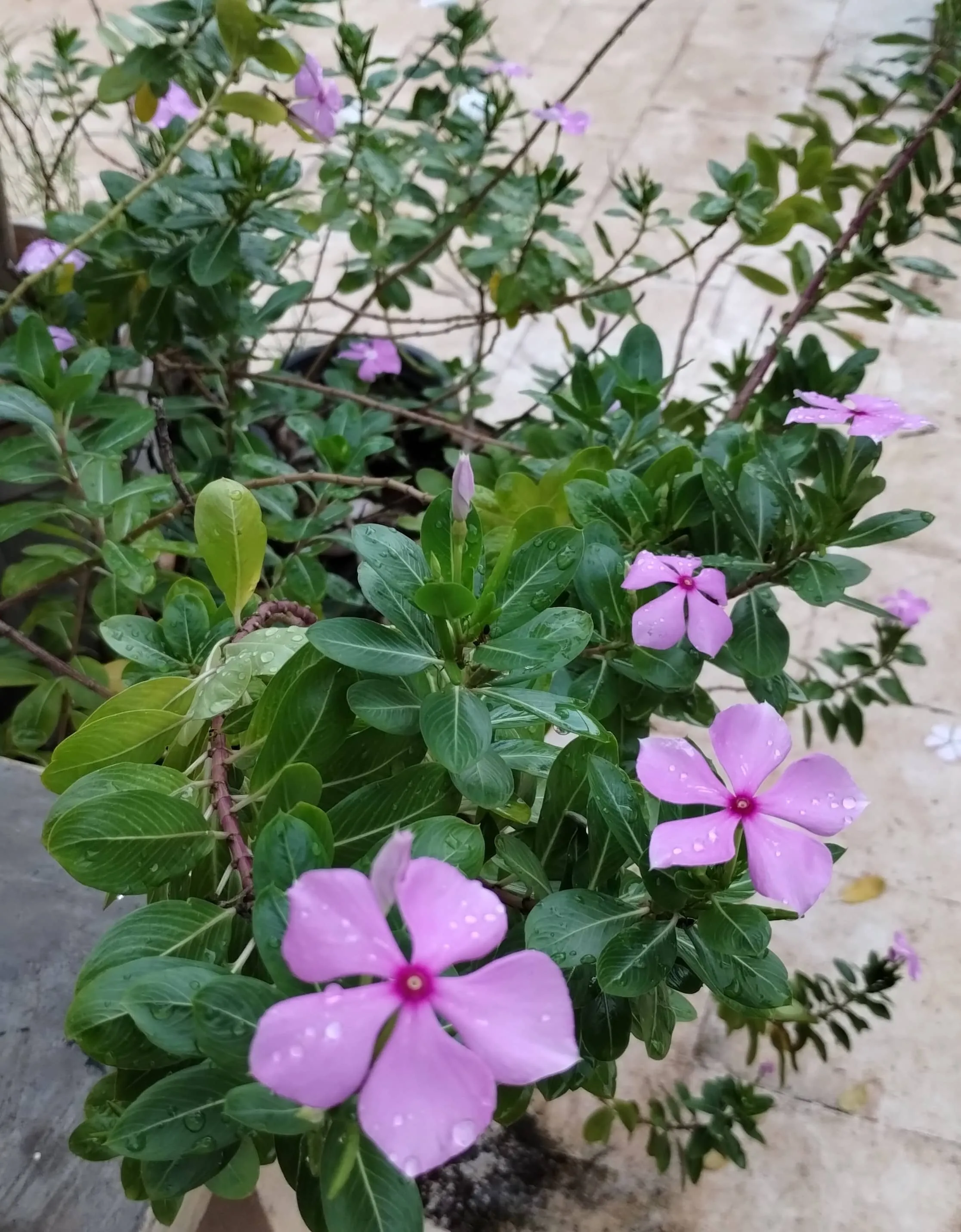
22. Madagascar Periwinkle — The Auspicious Ever-Blooming Courtyard Plant
In Tamil Nadu, this hardy shrub is known as Nithyakalyani ('she who blooms every single day without fail'), mirroring its remarkable resilience across hot courtyards. Telugu calls it Billa Ganneru, Kannada Sadapushpa (always in flower), Malayalam Nithyakalyani, and Hindi Sadabahar. Beyond its ornamental presence, it is famous worldwide for producing anti-cancer vinca alkaloids.
Quick Identification: Low subshrub with glossy oval leaves having a prominent white central vein. Five-petalled flat flowers in pure white with a yellow eye, or vibrant magenta-rose with a dark center.
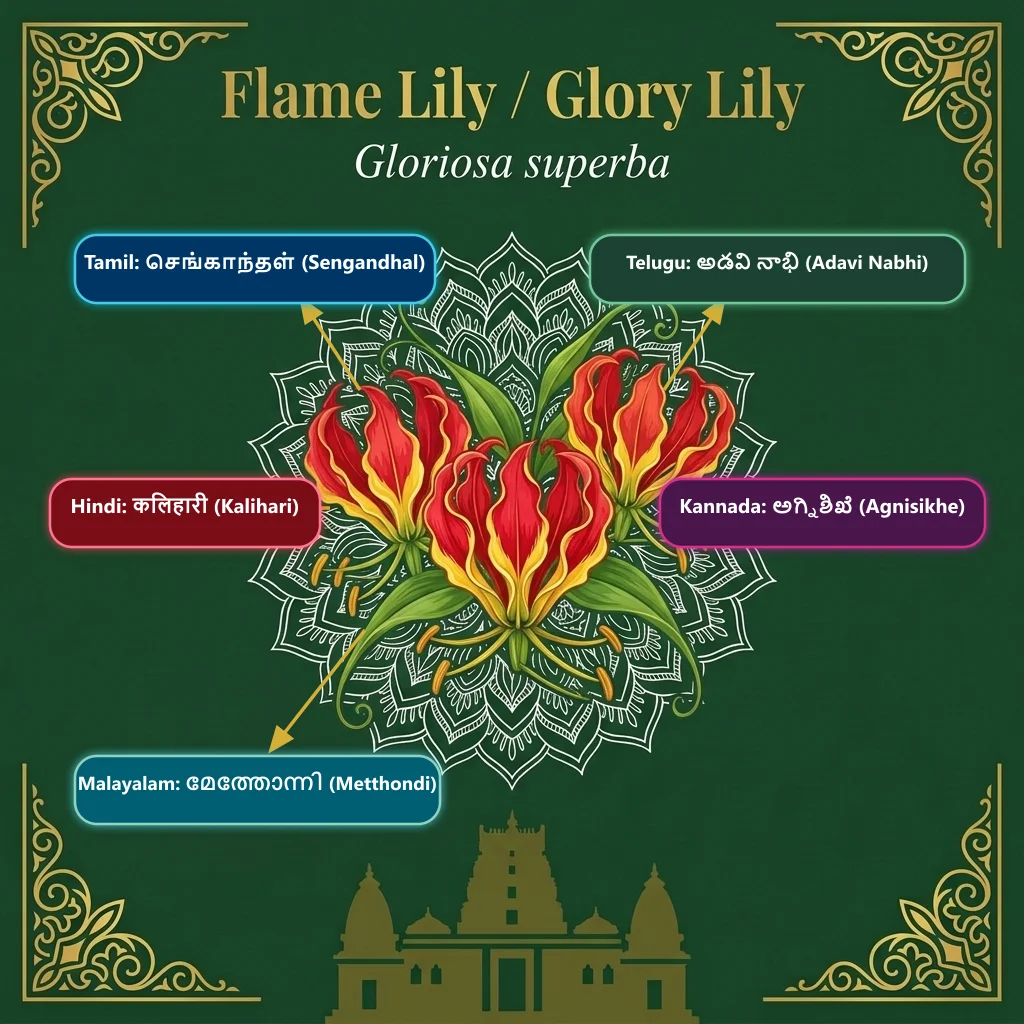
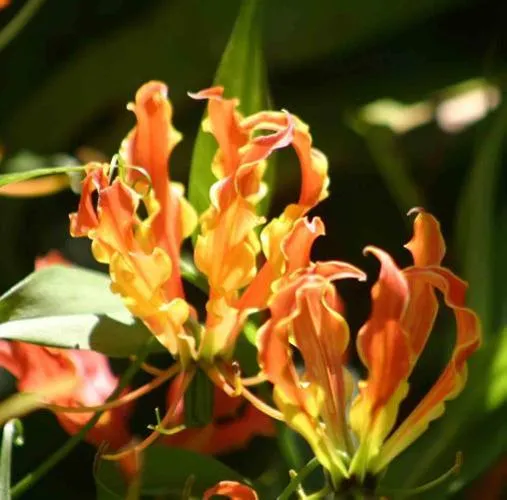
23. Flame Lily (Glory Lily) — Tamil Nadu's State Flower & Sangam Classic
The official State Flower of Tamil Nadu, Gloriosa superba is known throughout Sangam literature as Sengandhal (red flame). Telugu calls it Adavi Nabhi, Kannada Agnisikhe (fire crest), Malayalam Metthondi, and Hindi Kalihari. Ancient Tamil bards celebrated Sengandhal as an emblem of monsoon fertility and royal battlefield valor.
Quick Identification: Tendril-climbing vine. Spectacular flowers have six reflexed, wavy-margined petals pointing straight up like leaping flames, shifting from chartreuse yellow to brilliant scarlet.
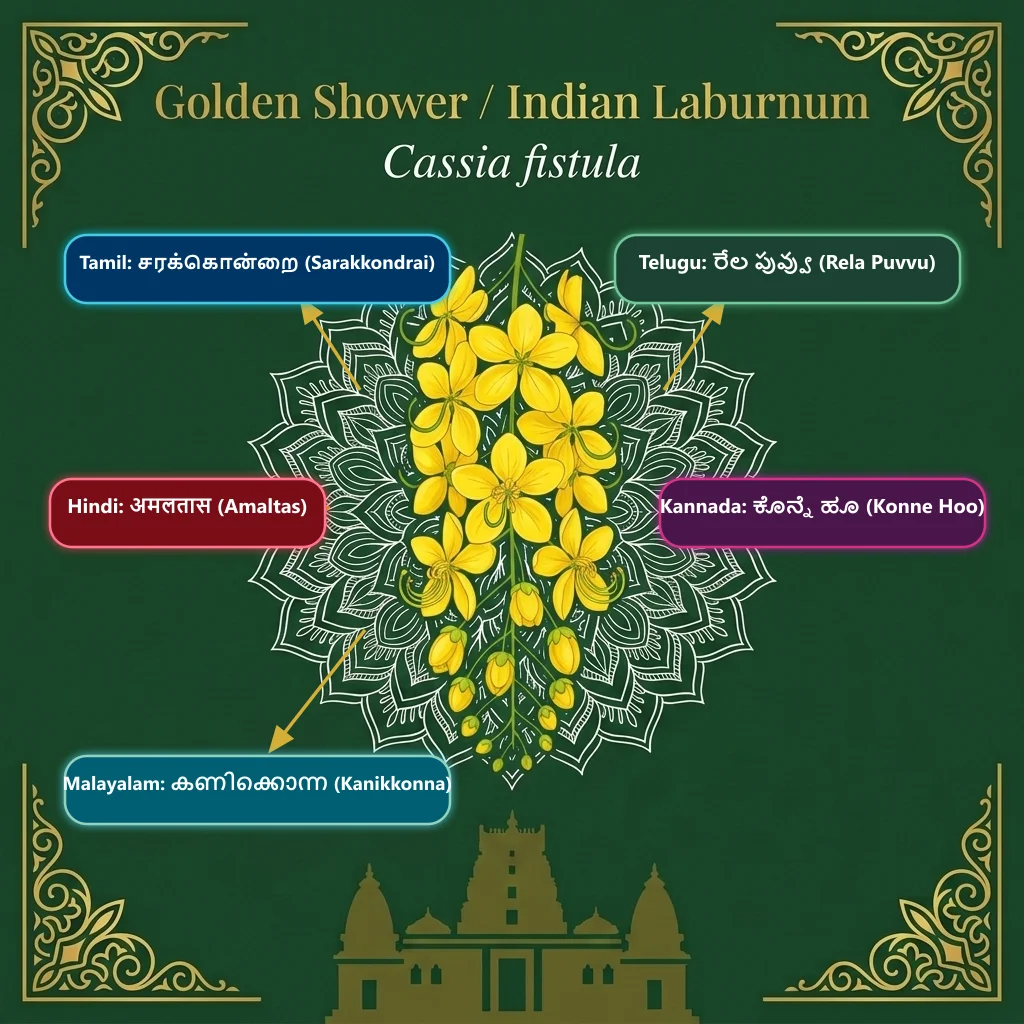
24. Golden Shower (Indian Laburnum) — Kerala's Auspicious Vishu Kani Star
The official State Flower of Kerala, Cassia fistula is celebrated statewide as Kanikkonna. In Tamil it is Sarakkondrai (immortalized across Sangam poetry), in Telugu Rela Puvvu, in Kannada Konne Hoo, and in Hindi Amaltas. During the Malayalam New Year festival of Vishu, the traditional ritual of Vishu Kani begins by gazing upon cascades of golden Kanikkonna blossoms arranged alongside brass lamps and seasonal fruits.
Quick Identification: Deciduous tree flowering in April–May. Branches become weeping canopies of dangling pendulous sprays (30–40 cm) of radiant butter-yellow flowers.
Identify Cassia Fistula
Snap or upload any bloom from your morning walk, temple garden, or floriculture nursery. Get accurate botanical names, growing requirements, and vernacular translations across Indian and international languages with 98%+ precision.
25. Blue Water Lily — The Sacred Nymphaea of South Indian Temple Tanks
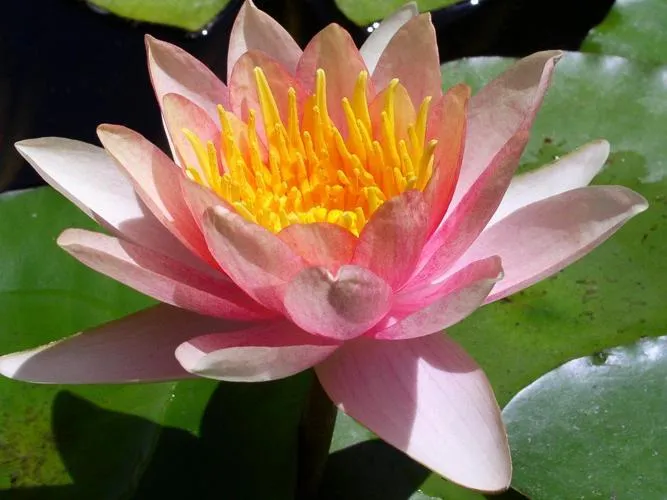
Floating gracefully across ancient temple tanks (Theppakkulam) and Kerala's meandering backwaters, the Blue Water Lily holds a revered position in South Indian literature and spirituality. In Tamil it is known as நீலாம்பல் (Neelaambal) or simply அல்லி (Alli), immortalized in Sangam poetry as the cool, night-opening counterpart to the solar lotus. Telugu culture celebrates it as నీలి కలువ (Neeli Kaluva), Kannada honors it as ನೈದಿಲೆ (Naidile), and Malayalam refers to it as നീലത്താമര (Neela Thamara). In Hindi-speaking regions, it is celebrated as the mystical नीलकमल (Neelkamal).
Unlike the sacred lotus (Nelumbo nucifera), whose leaves and blooms rise high above the waterline on stout stalks, the water lily's glossy, notched leaves float directly upon the liquid surface. Its starry violet-blue blossoms open in the gentle dawn light and close by midday, symbolizing tranquility, meditation, and pure spiritual devotion.
Quick Identification: Aquatic rhizomatous herb with floating orbicular leaves featuring deep V-notches. Solitary, star-shaped blossoms with 13–15 pointed violet-blue petals radiating from a vibrant golden-yellow staminal core.
26. Touch-Me-Not — The Shy Sensitive Herb of Village Pathways
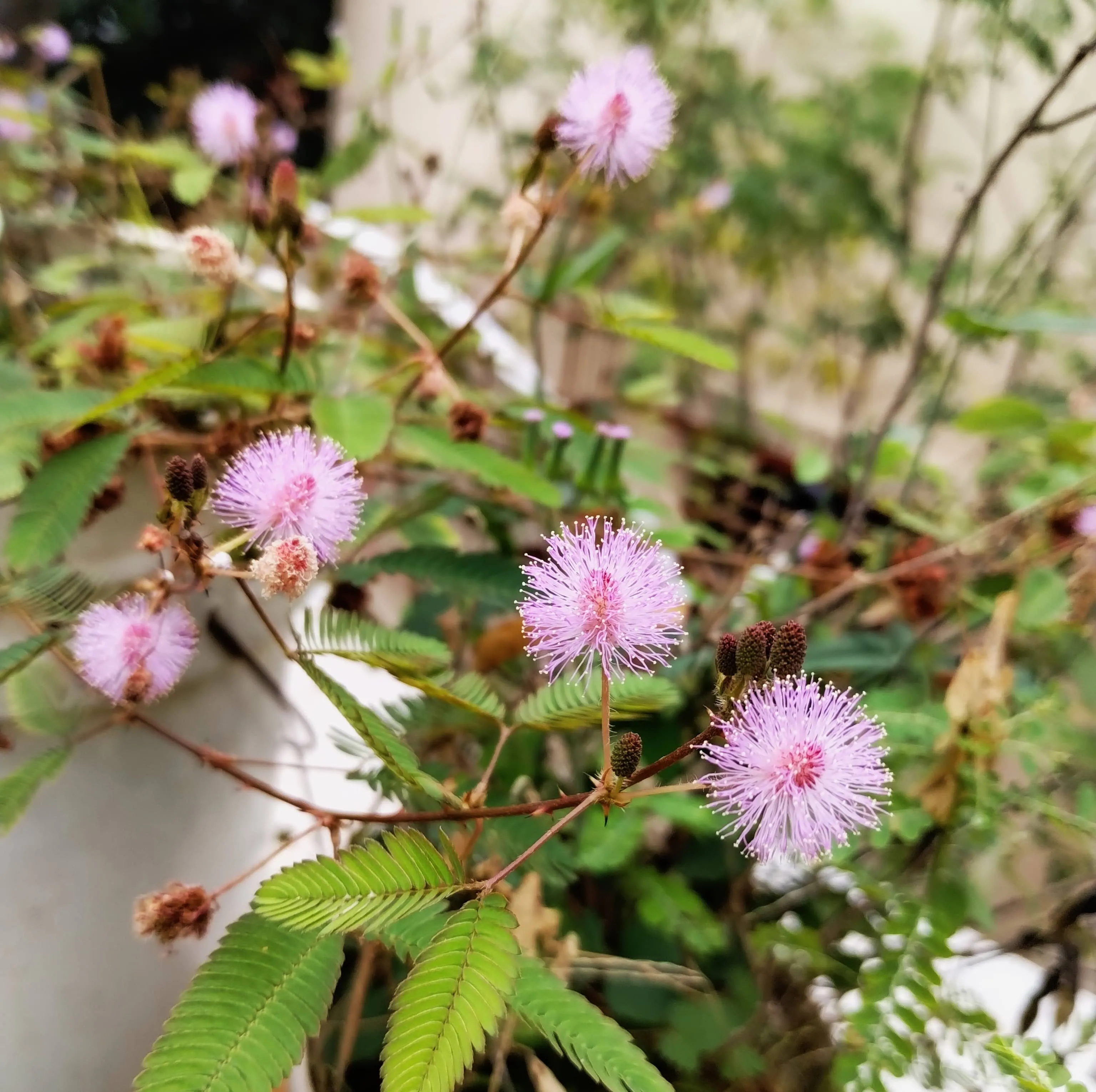
Known everywhere for its rapid thigmonastic leaf-folding reflex, Mimosa pudica is an unforgettable plant of South Indian childhoods and village footpaths. In Tamil, its evocative name is தொட்டால் சினுங்கி (Thottasinungi) or தொட்டால் வாடி (Thottalvaadi)—literally meaning "she who sulks when touched." Telugu affectionately calls it అత్తిపత్తి (Attipatti) or లజ్జావతి (Lajjavathi) (the shy maiden), Kannada terms it ಮುಟ್ಟಿದರೆ ಮುನಿ (Muttidare Muni) (angered upon touching), and Malayalam names it തൊട്ടാവാടി (Thottavaadi). In Hindi, it is known throughout the nation as छुईमुई (Chhui Mui) or लाजवंती (Lajwanti).
Beyond its botanical sensitivity, Touch-Me-Not is a foundational medicinal herb in both Siddha and Ayurvedic medicine (Lajjalu). Its cooling, astringent properties are prescribed for wound healing, soothing skin rashes, and mitigating burning sensations. Its soft, spherical lilac-pink flower globes resemble whimsical miniature fireworks dancing along the edges of green monsoonal gardens.
Quick Identification: Low-growing prostrate subshrub with spiny, branching reddish-brown stems and bipinnate compound leaves. Pinnae fold shut within seconds of physical contact or darkness. Produces fluffy, spherical lavender-pink pom-pom flower heads on slender peduncles.
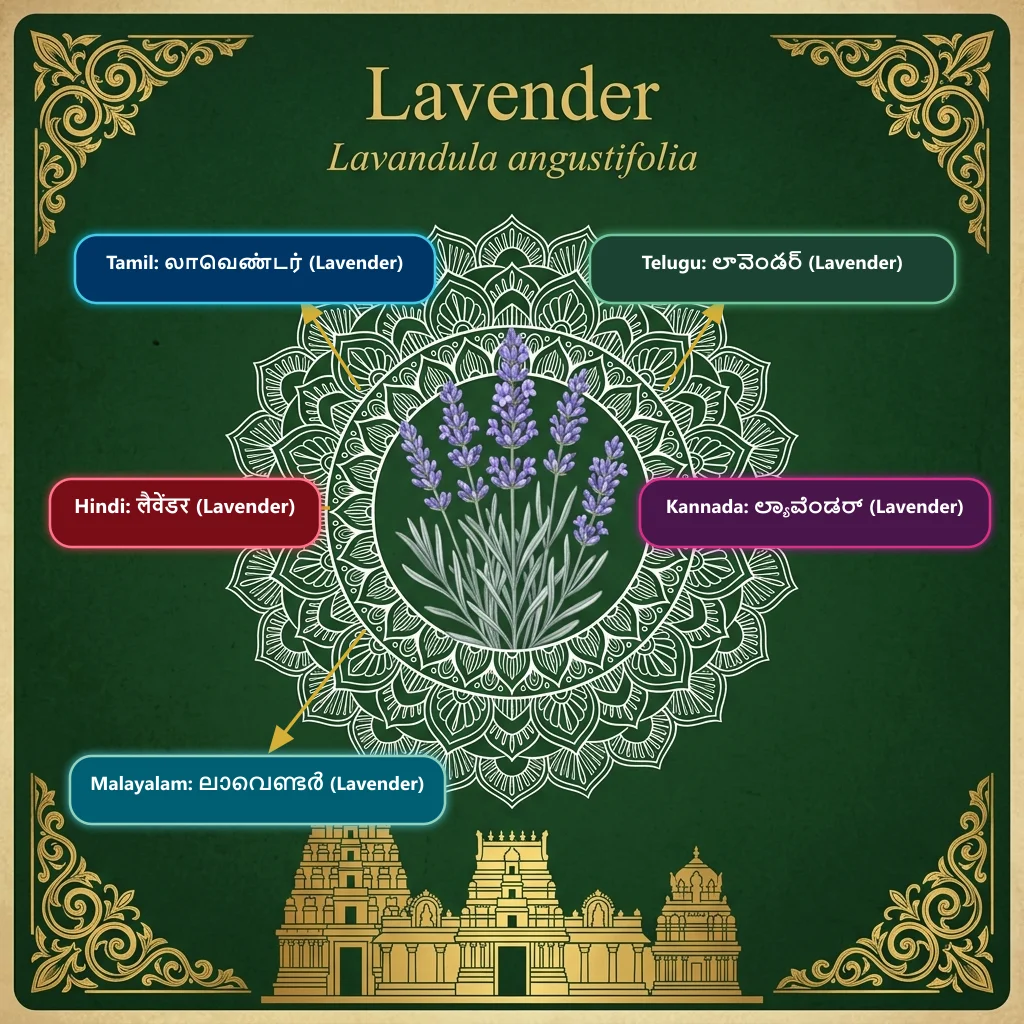
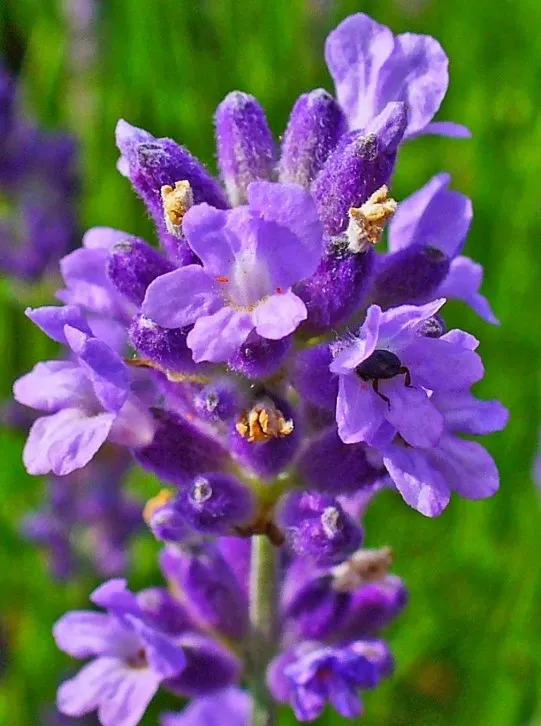
27. Lavender — The Aromatic European Herb in South Indian Hill Gardens
Thriving in the cool, misty, high-altitude climes of South India's Western Ghats—particularly the hill stations of Ooty, Coonoor, Kodaikanal, and Munnar—Lavender has captured the admiration of South Indian gardeners and visitors alike. Across Tamil, Telugu, Hindi, Kannada, and Malayalam, it is recognized uniformly by its universal phonetic title: லாவெண்டர் (Lavender) in Tamil, లావెండర్ (Lavender) in Telugu, लैवेंडर (Lavender) in Hindi, ಲ್ಯಾವೆಂಡರ್ (Lavender) in Kannada, and ലാവെണ്ടർ (Lavender) in Malayalam.
Introduced during the colonial era to British estate gardens, lavender plants flourish in well-drained volcanic slopes where morning dew and crisp mountain air recreate Mediterranean conditions. Today, Nilgiri cottage industries distill pure lavender essential oil, formulating artisan soaps, calming pillow mists, and herbal teas that are prized souvenirs of the Blue Mountains.
Quick Identification: Woody perennial subshrub with aromatic, needle-like narrow grey-green leaves. Slender upright flower spikes bearing whorls of intensely fragrant, tubular two-lipped flowers in soothing lavender-violet shades.
28. Tulsi (Holy Basil) — The Queen of Herbs in Every South Indian Courtyard
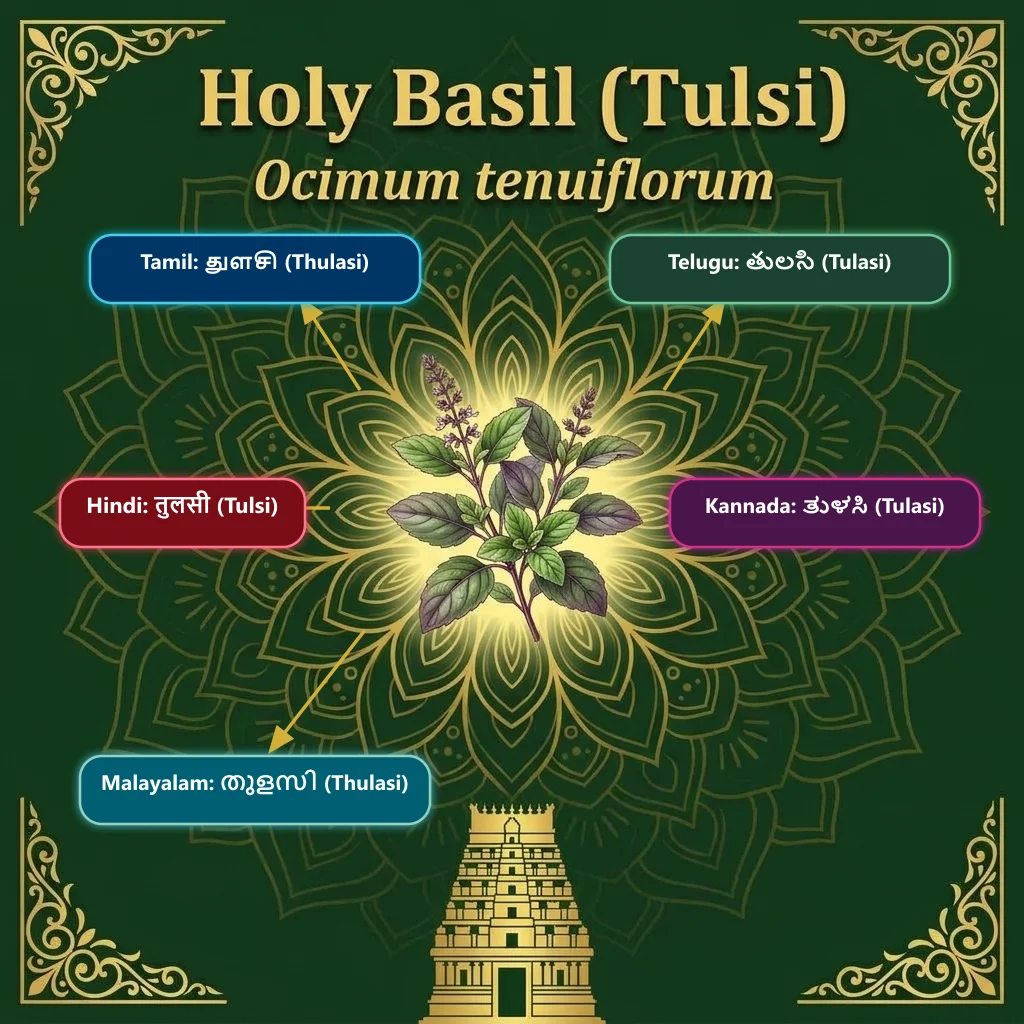
No plant in South India commands deeper veneration than Tulsi (Ocimum tenuiflorum). Held as the living earthly incarnation of the goddess Vrinda, an avatar of Lakshmi, almost every traditional home across Tamil Nadu, Andhra Pradesh, Karnataka, and Kerala maintains a consecrated masonry pedestal called the Thulasi Maadam in the sunlit open courtyard (Muttam or Nadumuttam). Revered uniformly across Southern tongues—துளசி (Thulasi) in Tamil and Malayalam, తులసి (Tulasi) in Telugu, ತುಳಸಿ (Tulasi) in Kannada, and तुलसी (Tulsi) in Hindi—it is saluted each dawn with brass lamps and water offerings.
The auspicious purple-green flower spikes (Manjari) are indispensable in the worship of Lord Vishnu and Krishna, as sacred scriptures declare that Lord Narayana accepts no offering devoid of a Tulsi leaf. In daily household life, fresh leaves are brewed with black pepper, dry ginger, and honey (Kashayam) to bolster immunity, clear respiratory congestion, and promote holistic vitality.
Quick Identification: Highly aromatic erect subshrub growing 30–60 cm tall with hairy stems and green or dark purple-flushed ovate leaves with serrated margins. Slender terminal floral spikes bearing whorls of minute, two-lipped white to purplish blossoms.
29. Indian Coral Tree — The Fiery Red Bloom of Village Living Fences
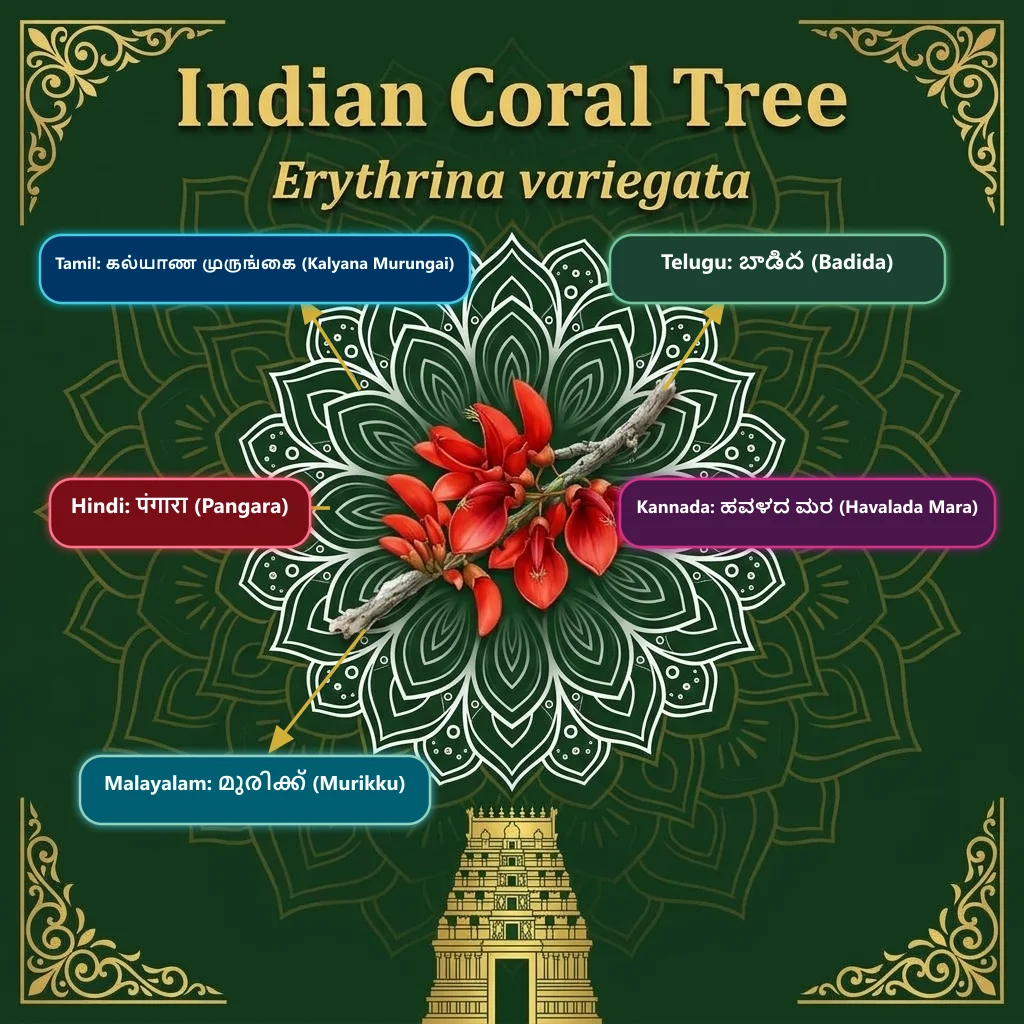
A majestic botanical landmark of rural South Indian farming landscapes, Erythrina variegata is a fast-growing, nitrogen-fixing tree widely used to construct resilient living fences around village homesteads and provide shady support trellises for black pepper and betel vines. In Tamil Nadu, it is cherished as கல்யாண முருங்கை (Kalyana Murungai) or முள்ளு முருங்கை (Mullu Murungai), where its nutritious, medicinal leaves are traditionally folded into restorative postpartum Thuvaiyal and steamed herbal fritters. In Telugu it is బాడిద (Badida), in Kannada ಹವಳದ ಮರ (Havalada Mara) (Coral Tree), in Malayalam മുരിക്ക് (Murikku), and in Hindi पंगारा (Pangara).
In the late winter months of February and March, the tree sheds all its trifoliate leaves, transforming its bare canopy into an astonishing explosion of brilliant scarlet-red curved pea-like flowers. These fiery blooms produce copious nectar, attracting an energetic menagerie of sunbirds, parakeets, drongos, and honeybees that enliven South Indian countrysides.
Quick Identification: Deciduous medium tree with smooth, grey-green bark armed with small conical black prickles. Drops foliage completely before blossoming. Displays dense horizontal terminal racemes of dramatic, claw-like scarlet-coral blossoms with prominent banner petals.
30. Four O'Clock (Marvel of Peru) — The Twilight Courtyard Wonder
Renowned throughout South India for its astonishingly punctual circadian rhythm, Mirabilis jalapa unfurls its trumpet-shaped flowers precisely in the late afternoon around four o'clock, releasing a sweet fragrance that drifts into courtyard verandas as the tropical heat subsides. Its regional names celebrate this twilight magic: in Tamil it is அந்தி மந்தாரை (Andhi Mandhaarai) (Twilight Hibiscus) or அந்திப்பூ (Andhipoo), in Telugu చంద్రకాంత (Chandra Kanta) (Loved by the Moon), in Kannada ಸಂಜೆ ಮಲ್ಲಿಗೆ (Sanje Mallige) (Evening Jasmine), in Malayalam അന്തിമലരി (Anthimalari) or നാലുമണിപ്പೂവ് (Naalumanippoovu), and in Hindi गुल अब्बास (Gul Abbas).
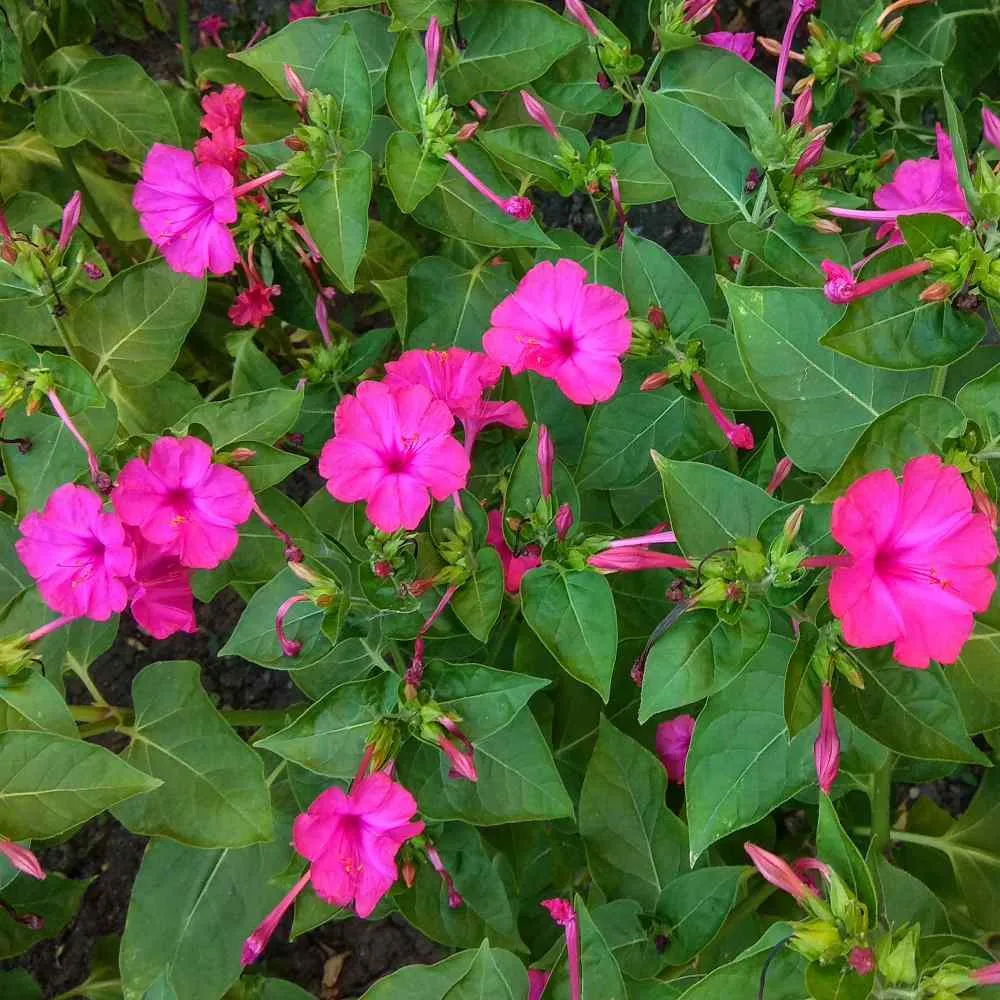
A unique biological marvel of the Four O'Clock plant is its genetic plasticity: a single bush can simultaneously produce flowers of completely different colors—rich magenta, bright canary yellow, and stark white—or even petals delightfully striped with bi-color splash patterns. Village children harvest the mature spherical black seeds, which contain a fine cosmetic starch traditionally used as cooling face powder.
Quick Identification: Bushy, multi-branched perennial herb with opposite, deep green cordate leaves. Slender, trumpet-like tubular flowers with 5 flared petal lobes opening exclusively in late afternoon and dusk. Produces hard, wrinkled black spherical seeds resembling miniature hand grenades.
31. Garden Balsam — The Vibrant Monsoon Flower of Onam & Bathukamma
Bursting into vivid jewel tones across the monsoon-soaked soil of the Western Ghats and Deccan Plateau, Garden Balsam is an essential festive flower across South India. In Kerala, it is the cherished ചിത്തിരപ്പൂ (Chithirappoo) or കാശിത്തുമ്പ (Kashithumba), diligently gathered by village children into woven bamboo baskets to craft the foundational outer rings of the Onam Athapookkalam. In Telangana, the bloom is known as చిలక ముక్కుల పువ్వు (Chilaka Mukkula) (Parrot-Beak Flower) or బాణం పువ్వు (Banam Puvvu), woven in layers into the majestic floral mountains of the Bathukamma festival. Tamil refers to it as காசித் தும்பை (Kasi Thumbai) or வண்ணப்பூ (Vannappoo), Kannada as ಕರ್ಣ ಕುಂಡಲ (Karna Kundala) (Earring Flower), and Hindi as गुल-मेंहदी (Gul Mehndi).
The Hindi name Gul-Mehndi recalls an age-old rural tradition: before Lawsonia henna became universally available, South Indian and North Indian village maidens crushed fresh balsam petals and succulent leaves with a dash of lime juice to stain their fingernails and palms a brilliant crimson-orange.
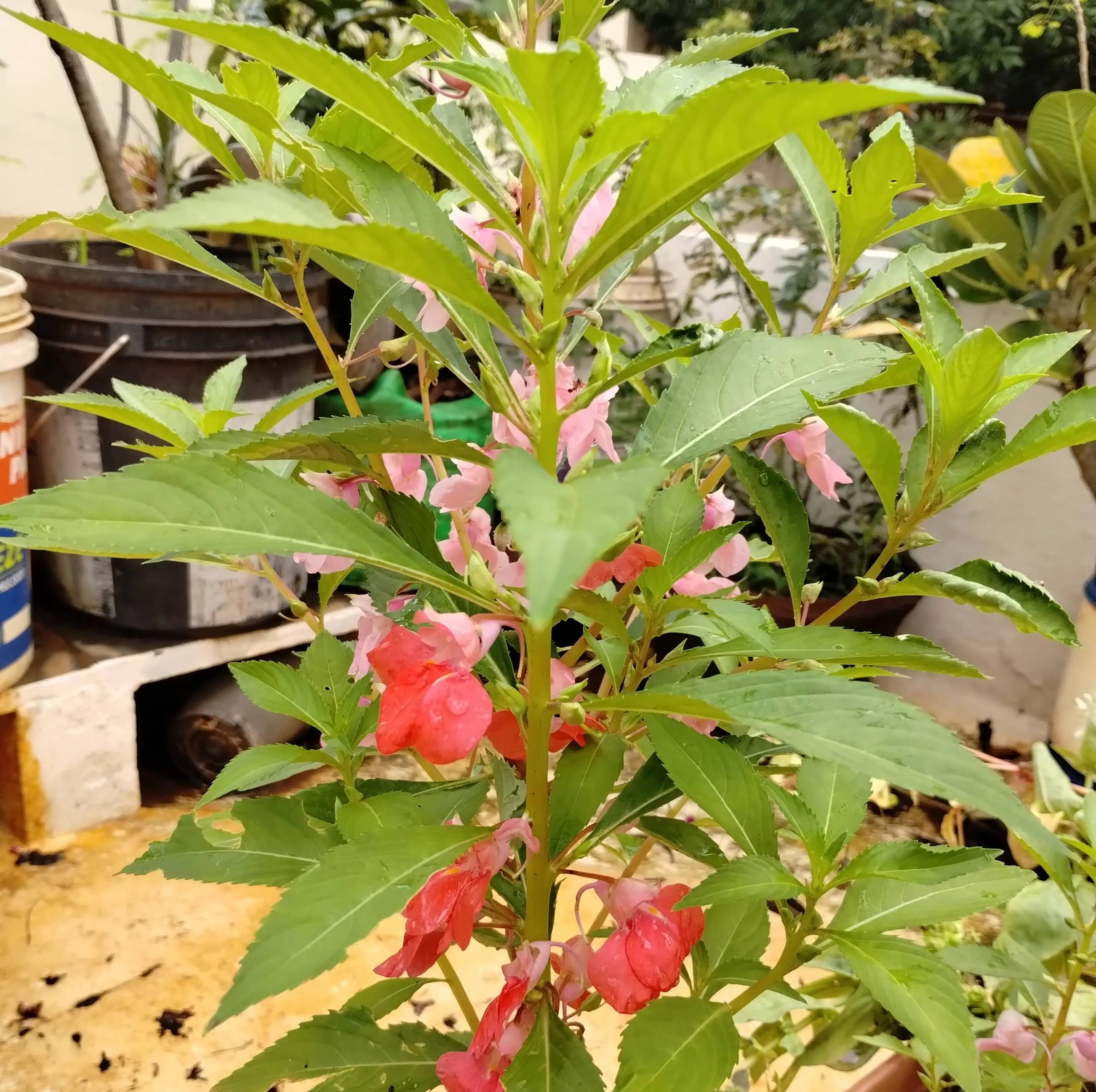
Quick Identification: Succulent, erect annual herb with translucent fleshy stems and lance-shaped leaves with serrate margins. Asymmetrical, spurred blossoms in radiant shades of rose, crimson, violet, and white. Swollen seed pods burst explosively (touch-me-not mechanism) at the slightest squeeze when ripe.
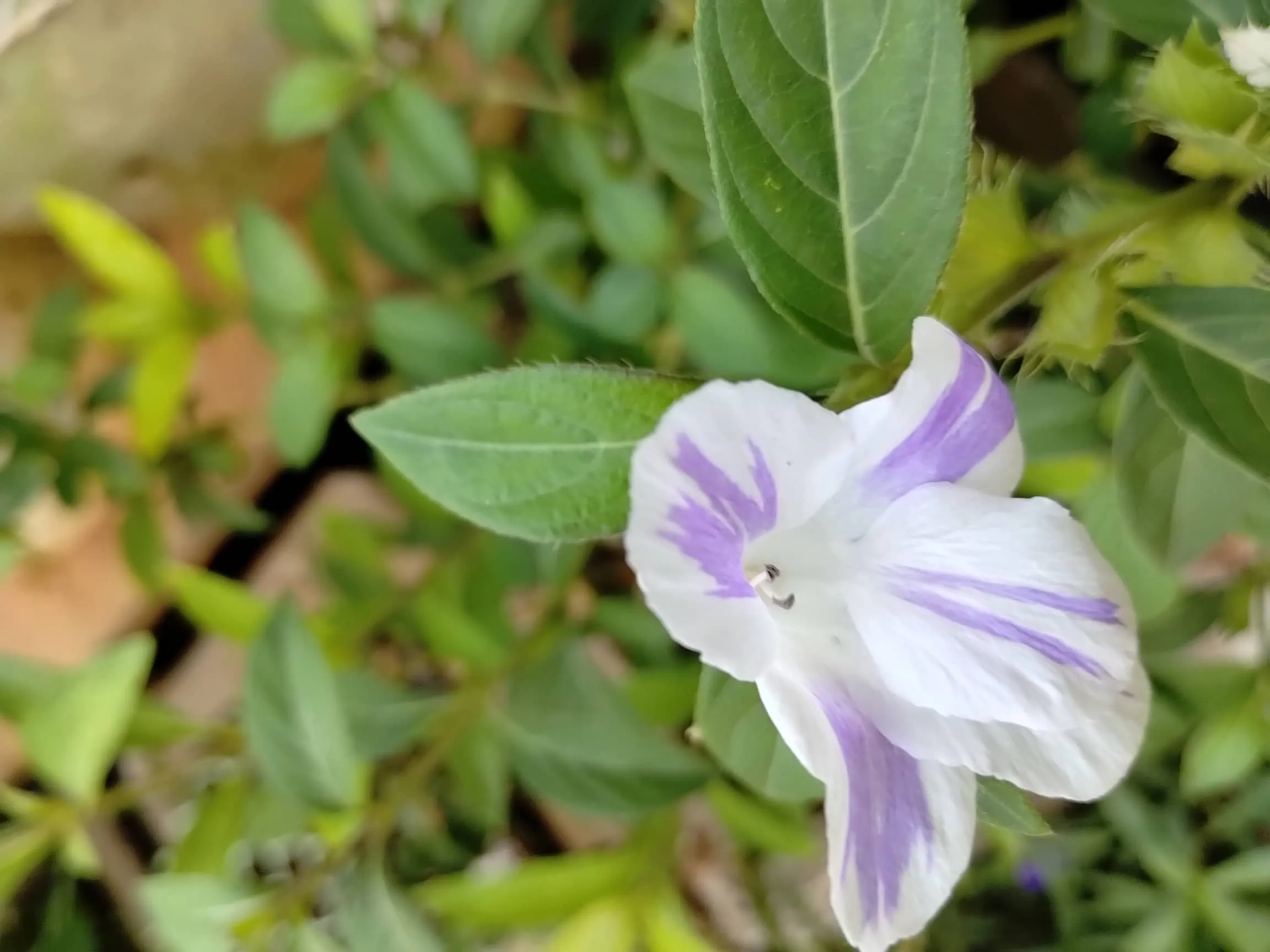
32. December Flower — The Cool Winter Adornment of Margazhi
Few botanical blossoms are as intrinsically tied to a specific calendar season as the beloved December Flower (Barleria cristata). As the cool morning mist settles across Tamil Nadu during the auspicious Tamil month of Margazhi (mid-December to mid-January), markets from Chennai to Madurai brim with freshly picked baskets of this bloom. Known almost uniformly across South Indian languages by its seasonal moniker: டிசம்பர் பூ (December Poo) in Tamil, డిసెంబర్ పూలు (December Poolu) in Telugu, ಡಿಸೆಂಬರ್ ಹೂ (December Hoo) in Kannada, and ഡിസംബർ പൂവ് (December Poovu) in Malayalam (and तदरेலு (Tadrelu) / झिण्टी (Jhinti) in Hindi).
Women and young girls walking to temple sanctums at dawn for Margazhi Bhajanai weave strings of soft lavender-violet December flowers intertwined with fragrant winter jasmines into their braids. The flower has virtually no scent, but its pastel violet, lilac, and striped blooms retain their crisp shape and delicate color for days, serving as the quintessential floral crown of South India's winter music and dance festival season.
Quick Identification: Low, bushy perennial subshrub with dark green, opposite elliptic-oblong leaves. Produces tubular, two-lipped funnel flowers with five broad lobes, occurring predominantly in lavender-violet, pure white, and striking violet-striped cultivars.
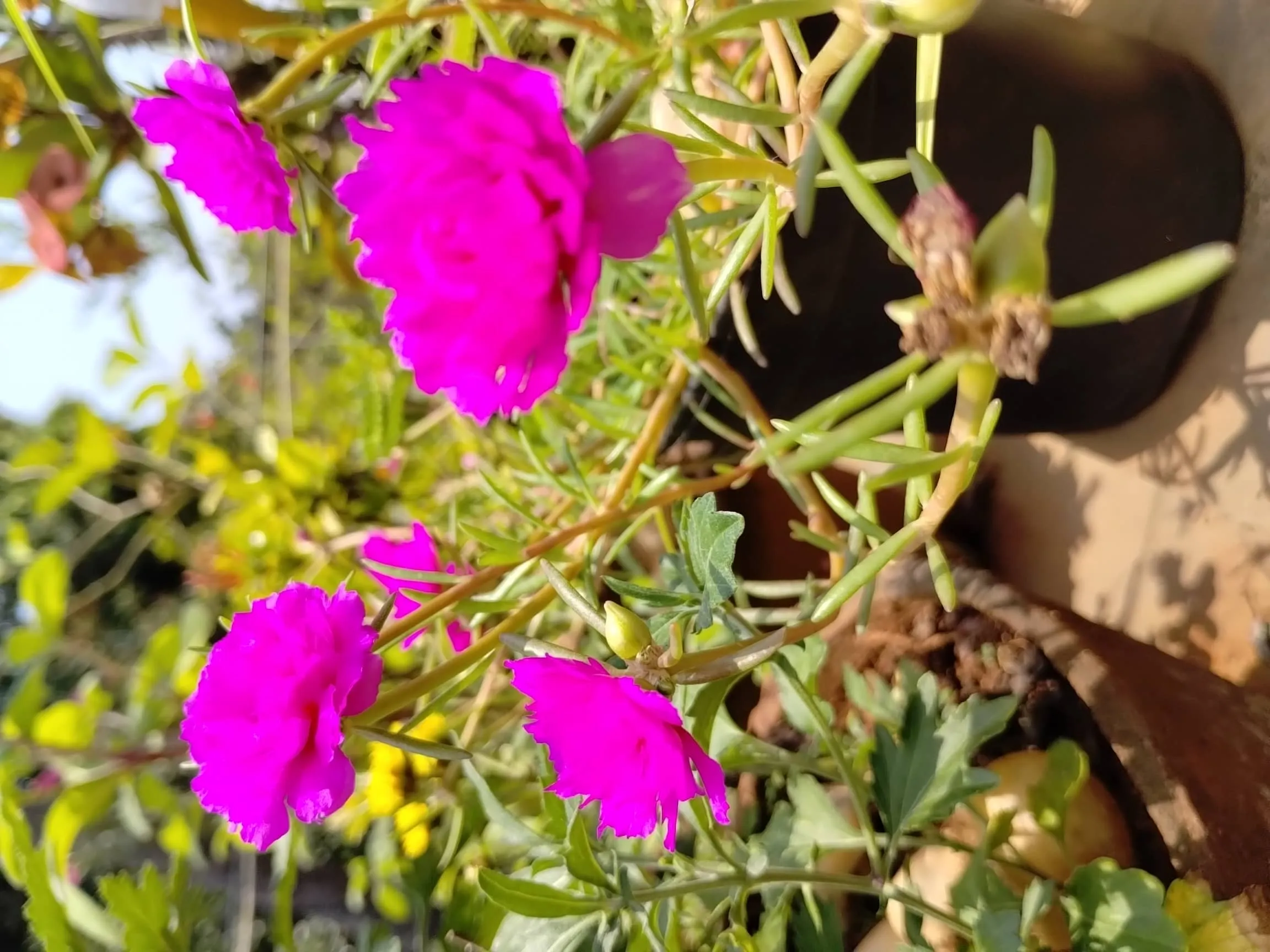
33. Moss Rose (Portulaca) — The Sun-Loving Ten O'Clock Courtyard Carpet
Greeting the tropical day with unbridled optimism, Portulaca grandiflora is the universal "clock flower" of the Indian subcontinent. Because its buds open exclusively when the mid-morning sun reaches peak brilliance around 10:00 AM and close as the twilight dims, it is affectionately dubbed across virtually every Indian language as the "10 O'Clock Flower": பத்து மணி பூ (Pathu Mani Poo) in Tamil, పది గంటల పువ్వు (Padi Gantala Puvvu) in Telugu, ಹತ್ತು ಗಂಟೆ ಹೂ (Hathu Gante Hoo) in Kannada, പത്തു മണി പൂവ് (Pathu Mani Poovu) in Malayalam, and दस बजे फूल (Das Baje Phool) in Hindi.
Possessing succulent, needle-like foliage that stores moisture effortlessly, Moss Rose thrives in roadside rockeries, terracotta veranda pots, and sun-drenched terrace gardens where harsher heat wilts delicate annuals. Its paper-thin crinkly petals bloom in blazing neon shades of magenta, cherry red, sunny yellow, salmon orange, and pristine white, transforming barren garden borders into dazzling living tapestries.
Quick Identification: Prostrate, sprawling succulent groundcover with fleshy, cylindrical needle-shaped leaves. Crinkled, cup-shaped flowers (2–3 cm across) with prominent golden-yellow stamens in the center, blooming profusely under direct sunlight from 10 AM onward.
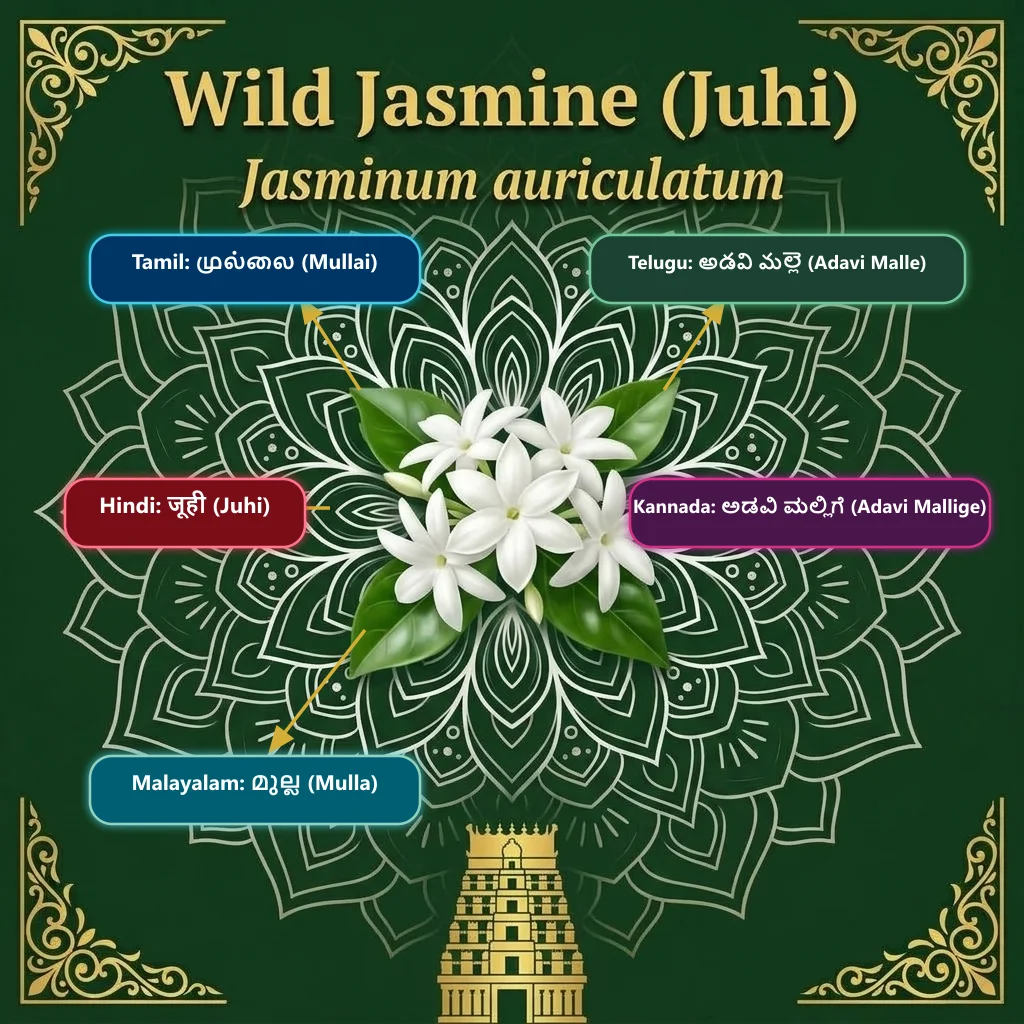
34. Juhi (Wild Jasmine / Mullai) — The Sweetly Scented Garland Classic of Sangam Poetry
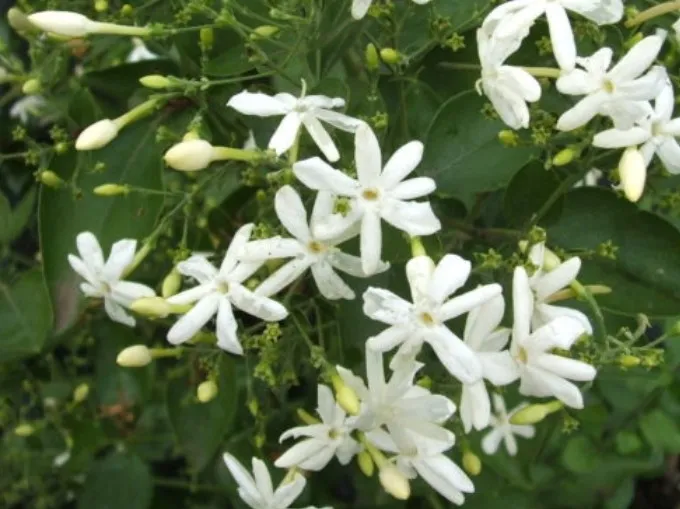
Few flowers are as deeply rooted in classical South Indian poetic aesthetics as Mullai (Jasminum auriculatum). In ancient Sangam literature, Mullai was chosen to represent one of the five primordial landscapes (Ainthinai), symbolizing the pastoral forest woodlands and the tender emotional theme of faithful, patient waiting for the beloved's return. In Tamil it is known simply and reverently as முல்லை (Mullai), in Telugu as అడవి మల్లె (Adavi Malle), in Kannada as ಅಡವಿ ಮಲ್ಲಿಗೆ (Adavi Mallige), in Malayalam as മുല്ല (Mulla), and in Hindi as जूही (Juhi).
Possessing an intensely sweet, heady honey-floral aroma that is richer and more concentrated than standard sambac jasmine, Mullai flowers are picked as firm, pointed white buds early in the morning. Garland weavers in Madurai and Tirunelveli expertly knot these slender buds into compact, heavy floral cords (Mullai Jadai) that brides entwine through their plaits, perfuming wedding halls with an unforgettable natural fragrance.
Quick Identification: Robust climbing woody shrub with trifoliate leaves, characterized by a large ovate central leaflet flanked by two minute lateral leaflets. Produces dense cymes of star-shaped, pointed white flowers with exceptionally slender corolla tubes and a powerful, sweet scent.
35. Spanish Jasmine (Jathimalli) — The Fragrant Royal Star of Evening Garlands
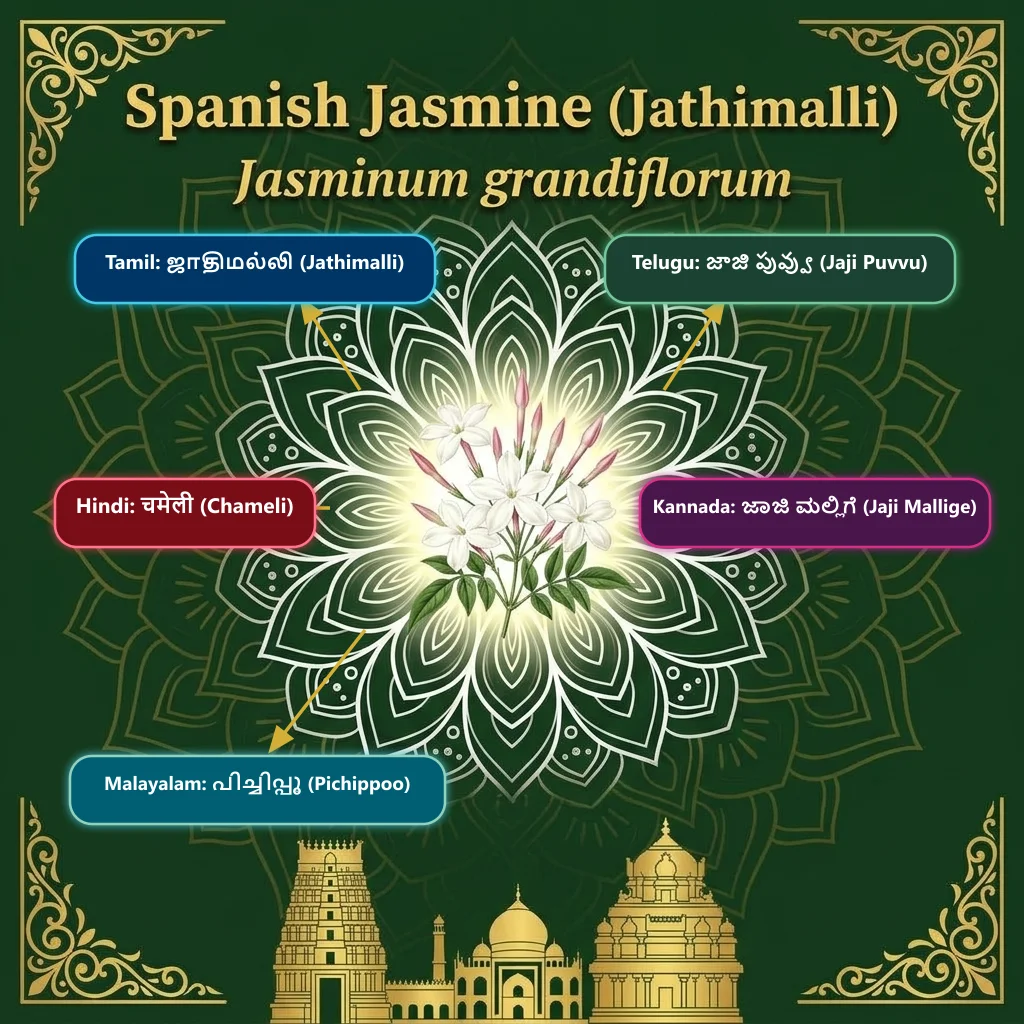
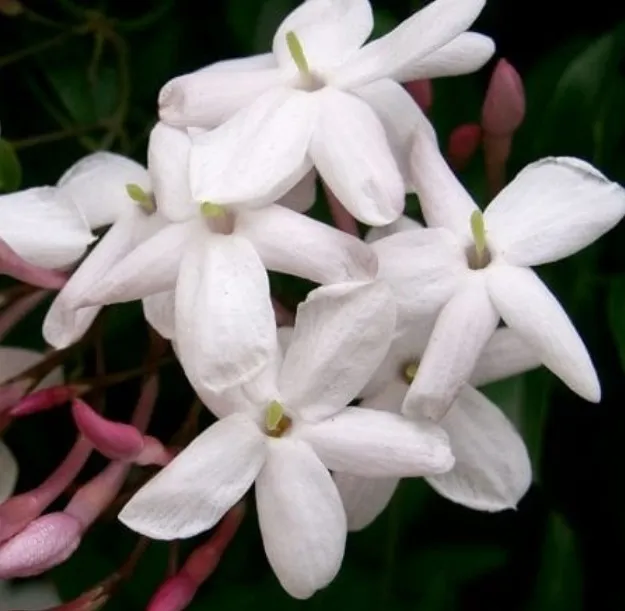
Considered the absolute pinnacle of aristocratic elegance in the jasmine family, Jasminum grandiflorum is distinguished by its star-shaped blossoms and subtle purplish-pink bud tips. In Tamil Nadu, it is universally prized as ஜாதிமல்லி (Jathimalli) or பிச்சிப்பூ (Pichipoo). In Telugu culture, it is celebrated as జాజి పువ్వు (Jaji Puvvu), in Kannada as ಜಾಜಿ ಮಲ್ಲಿಗೆ (Jaji Mallige), in Malayalam as പിച്ചിപ്പൂ (Pichippoo), and in Hindi as the grand चमेली (Chameli).
Unlike morning-opening jasmines, Jathimalli blossoms unfurl in late afternoon and dusk, releasing an ethereal, intoxicating aroma that lingers through the night. In Kerala, thick strands of pristine Pichippoo garlands are the iconic hair adornment for classical Mohiniyattam and Kathakali recitals. In aromatherapy and high perfumery, J. grandiflorum is the premier species extracted to produce world-renowned floral absolutes.
Quick Identification: Scrambling vine or arched shrub with imparipinnate compound leaves bearing 5 to 9 deep green oval leaflets. Produces loose clusters of pure white star-like flowers with 5 slender, pointed spreading lobes, often showing delicate pinkish-maroon shading on the exterior of unclosed buds.
36. Champak (Golden Champa) — The Heavenly Scented Tree of Temple Courtyards
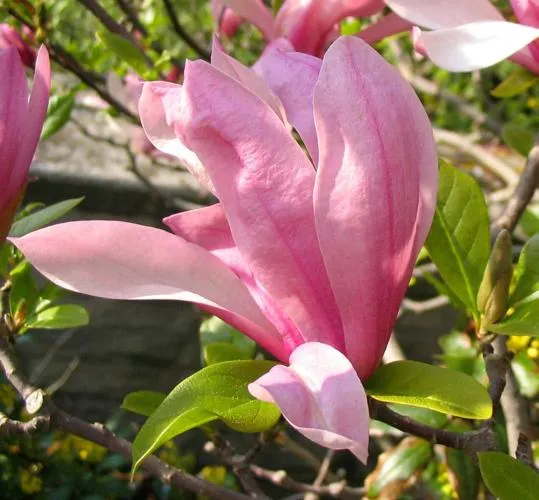
Rising grandly above traditional temple compounds and ancestral manors throughout Southern India, Champak (Magnolia champaca, formerly Michelia champaca) is famous for producing one of the most intensely fragrant floral scents on Earth. Its warm, fruity-floral perfume is so powerful that a solitary tree in full bloom can fragrance an entire neighborhood block. In Tamil it is known as செண்பகப்பூ (Shenbagam), in Telugu as సంపంగி (Sampangi), in Kannada as ಸಂಪಿಗೆ (Sampige), in Malayalam as ചെമ്പകം (Chembakam), and in Hindi as स्वर्ण चम्पा (Swarna Champa).
The historical prominence of Champak in Karnataka is legendary: Bangalore's famous Sampige Road in Malleshwaram was named after the ancient avenue of golden champak trees that once shaded commuters. In Hindu worship, Champak flowers are uniquely sacred to both Lord Shiva and Lord Vishnu. Because their delicate golden petals bruise easily, garland artists thread each petal with great care, fashioning golden crown garlands that adorn deities during annual temple Brahmotsavams.
Quick Identification: Large evergreen tree with grey bark and oblong-lanceolate leaves with wavy margins. Axillary solitary blossoms composed of 15–20 elongated, velvety tepals varying in color from creamy yellow to luminous golden-orange, emitting an intoxicating, rich honey-floral aroma.
37. Fragrant Screwpine (Kewda) — The Intoxicating Aroma of South Indian Coasts & Festivities
Flourishing wild along coastal waterways, sandy estuarine banks, and backwater lagoons across Southern India, Pandanus odorifer is renowned for its extraordinarily potent and lingering fragrance. In Tamil and Malayalam, it is celebrated as தாழம்பூ (Thazhampoo), in Telugu as మొగలి పువ్వు (Mogali Puvvu), in Kannada as ಕೇದಿಗೆ (Kedige), and in Hindi as the famed केवड़ा (Kewra).
The male inflorescence of the screwpine is enveloped by large, creamy-yellow boat-shaped floral leaves (spathes) that produce an opulent, deeply exotic floral aroma. In traditional South Indian wedding adornment, strips of fresh Thazhampoo are meticulously braided into bridal hair ornaments (Thazhampoo Jadai), filling marriage halls with their signature perfume. Coastal cottage distilleries capture this divine fragrance via water distillation to produce Kewra Jal and precious Kewda attar, used to flavor festive desserts and scent temple waters.
Quick Identification: Palm-like, heavily branched small tree supported by strong, stilt-like aerial prop roots emerging from the lower trunk. Long, sword-shaped arching leaves arranged in spirals, armed with sharp spines along the margins and midrib. Male trees bear dense, drooping flower spikes enclosed in fragrant, velvety ivory-cream floral bracts.
38. Cannonball Flower (Nagalingam) — The Sacred Shiva Lingam Bloom of Temple Grounds
Gracing temple courtyards dedicated to Lord Shiva across Tamil Nadu, Karnataka, Andhra Pradesh, and Kerala, Couroupita guianensis is widely revered as a living botanical icon of Shaivism. The structural anatomy of the flower is regarded as divine geometry: the curved central hood formed by fused sterile stamens resembles the sheltering multi-headed serpent (Sheshanaga), poised protectively above the central ovary which mirrors the sacred Shiva Lingam. In Tamil it is known as நாகலிங்கப்பூ (Nagalingappoo), in Telugu as మల్లికార్జున పువ్వు (Mallikarjuna Puvvu) or నాగలింగం (Nagalingam), in Kannada as ನಾಗಲಿಂಗ ಪುಷ್ಪ (Nagalinga Pushpa), in Malayalam as നാഗലിംഗപ്പൂ (Nagalingappoo), and in Hindi as तोपगोला (Topgola) or नाग चम्पा (Nag Champa).
A unique botanical characteristic of the Cannonball Tree is cauliflory—the spectacular flower clusters do not emerge from branches, but directly from the massive woody trunk in sprawling woody tangles up to 3 meters long. Devotees collect the freshly fallen fragrant blossoms each morning to place directly upon the Shiva Lingam during sacred Pradosham and Maha Shivaratri abhishekam ceremonies.
Quick Identification: Towering tropical tree with thick trunk covered in sprawling, woody flowering racemes emerging directly from the bark. Flowers are large (up to 10 cm wide), waxy, and intensely fragrant, featuring 6 curved reddish-pink petals and an overarching white-and-yellow staminal hood that shelters a central lingam-like pistil. Followed by large, spherical, heavy woody cannonball-like fruits.
How to Identify Flowers Using BioLens
If you encounter an unfamiliar bloom in a bustling floral bazaar, sacred temple courtyard, morning nature walk, or your home terrace garden, you no longer need to guess its identity or flip through dense botanical floras. BioLens's AI Flower Identifier recognizes hundreds of botanical species instantly from a single smartphone photograph.
Key Scanner Features:
- Instant 1-Click Visual Diagnosis: Simply snap a live photo of the flower or upload any image from your phone's gallery. The multimodal vision model analyzes petal architecture, stamen morphology, sepals, and foliage within seconds.
- Multilingual Vernacular & Botanical Nomenclature: Instantly uncovers authentic vernacular and classical names across Indian and international languages for every flower:
- Regional South Indian Languages: Tamil (தமிழ்), Telugu (తెలుగు), Kannada (ಕನ್ನಡ), and Malayalam (മലയാളം).
- Pan-Indian & Classical Languages: Hindi (हिन्दी), Sanskrit (संस्कृतम्), Bengali (বাংলা), alongside English common & alternate folk names.
- Global Botanical Names: French (Français), German (Deutsch), Spanish (Español), Russian (Русский), along with exact Latin scientific taxonomy.
- Cultivar Discrimination & Look-Alike Elimination: Accurately distinguishes between notoriously tricky look-alikes—such as true sacred Jasmine (Jasminum sambac) versus Crape Pinwheel Jasmine (Tabernaemontana divaricata), Sacred Lotus (Nelumbo) versus Blue Water Lily (Nymphaea), or distinct Hibiscus cultivars.
- Pet Safety Alerts (Toxicity Check): Instantly know whether the flower or its foliage is toxic to cats and dogs, protecting your curious pets from dangerous blooms like Oleander, Castor Bean, or Gloriosa Lily.
- Holistic Botanical & Cultural Dossiers: Access detailed growing conditions, blooming calendars, medicinal preparations, and sacred deity associations for temple worship.
Identify Any Flower Instantly
Snap or upload any bloom from your morning walk, temple garden, or floriculture nursery. Get accurate botanical names, growing requirements, and vernacular translations across Indian and international languages with 98%+ precision.
Diagnose Plant Health Issues & Nutrient Deficiencies
Are your garden flowers or balcony plants suffering from mysterious yellowing foliage, stunted buds, brown rust spots, or powdery white leaf coating? Don't let fungal blights, insect pests, or unseen soil mineral deficiencies compromise your prized blooms.
BioLens features a dedicated Plant Doctor AI Scanner trained to diagnose over 120+ botanical diseases, microscopic pests, and abiotic nutritional deficiencies:
- Infectious Disease vs. Abiotic Deficiency: Pinpoints whether leaf chlorosis is caused by an infectious fungal/bacterial blight (like Powdery Mildew, Anthracnose, or Leaf Spot) or an abiotic soil deficiency (such as Iron chlorosis, Nitrogen deficit, Magnesium deficiency, or Zinc shortages).
- Forensic Visual Evidence: Outlines exact leaf tissue symptoms, margin scorching, and vein discoloration with confidence diagnostic ratings.
- Organic & Chemical Prescription: Offers immediate, eco-friendly organic home solutions (cold-pressed neem sprays, biological Trichoderma soil drenches, compost tea) alongside targeted horticultural treatments to restore your plants to full health.
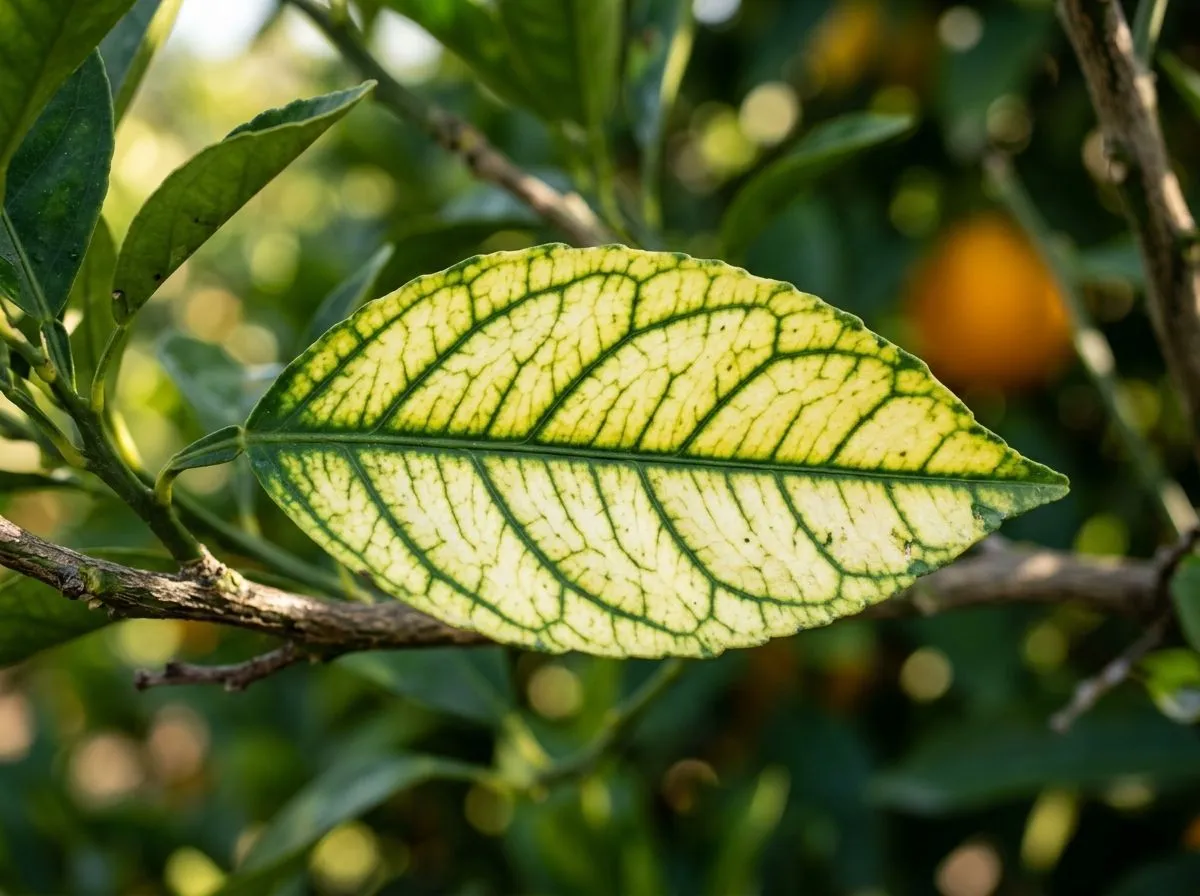
Diagnose Plant Diseases & Deficiencies
Snap or upload a clear photo of infected leaves, stems, or crop panicles to receive an instant AI disease diagnosis, severity score, and organic treatment recommendations.
A Note on Pronunciation and Scripts
Regional flower names in this guide are provided with both native scripts (Tamil, Telugu, Hindi, Kannada, Malayalam) and English phonetic pronunciations. Click on any flower's Species Page link in the Master Reference Table above to explore comprehensive botanical profiles, growing calendars, pet-safety verdicts, and cultural uses.
Global Floral Etiquette & Cultural Traditions
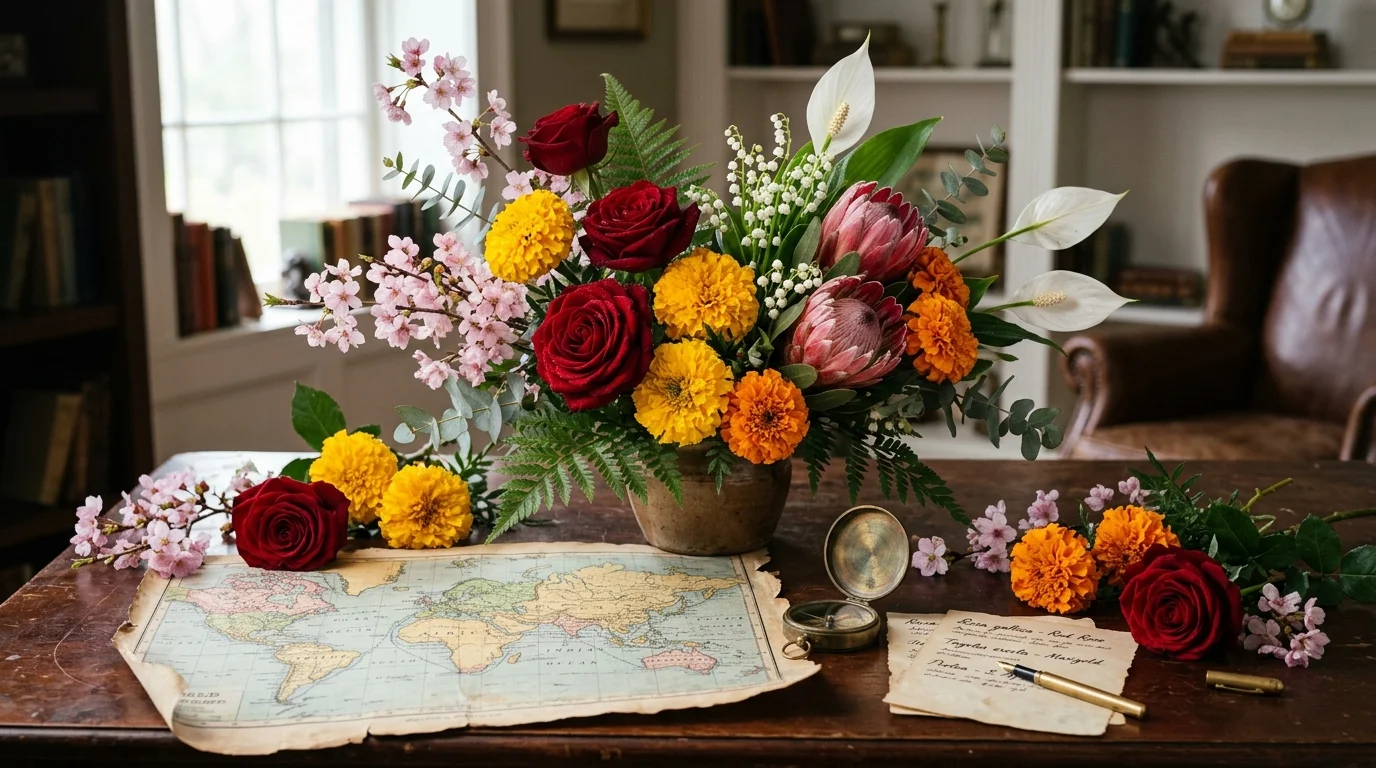
Beyond South Indian names and rituals, how are these flowers perceived across the world? Discover the festive roles, mourning customs, and crucial floral faux pas of marigolds, lotuses, jasmines, and chrysanthemums across 20+ countries:
Scientific Classification: Botanical Families of Indian Blooms
While vernacular names reflect regional folklore and sacred temple traditions, the botanical taxonomy of these flowers connects them to universal evolutionary lineages. For instance, sacred Thumbai belongs to the aromatic mint family (Lamiaceae), Mogra and Parijatham to the fragrant olive family (Oleaceae), Chembarathi (Hibiscus) to the mallow family (Malvaceae), and Samanthi (Chrysanthemum) to the composite family (Asteraceae).
To learn how botanists and the BioLens AI engine categorize flowers using floral symmetry, reproductive anatomy, and floral formulas, read our master guide: