
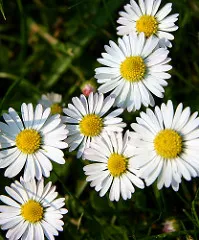
Daisy
Bellis perennis
How to Identify Daisy
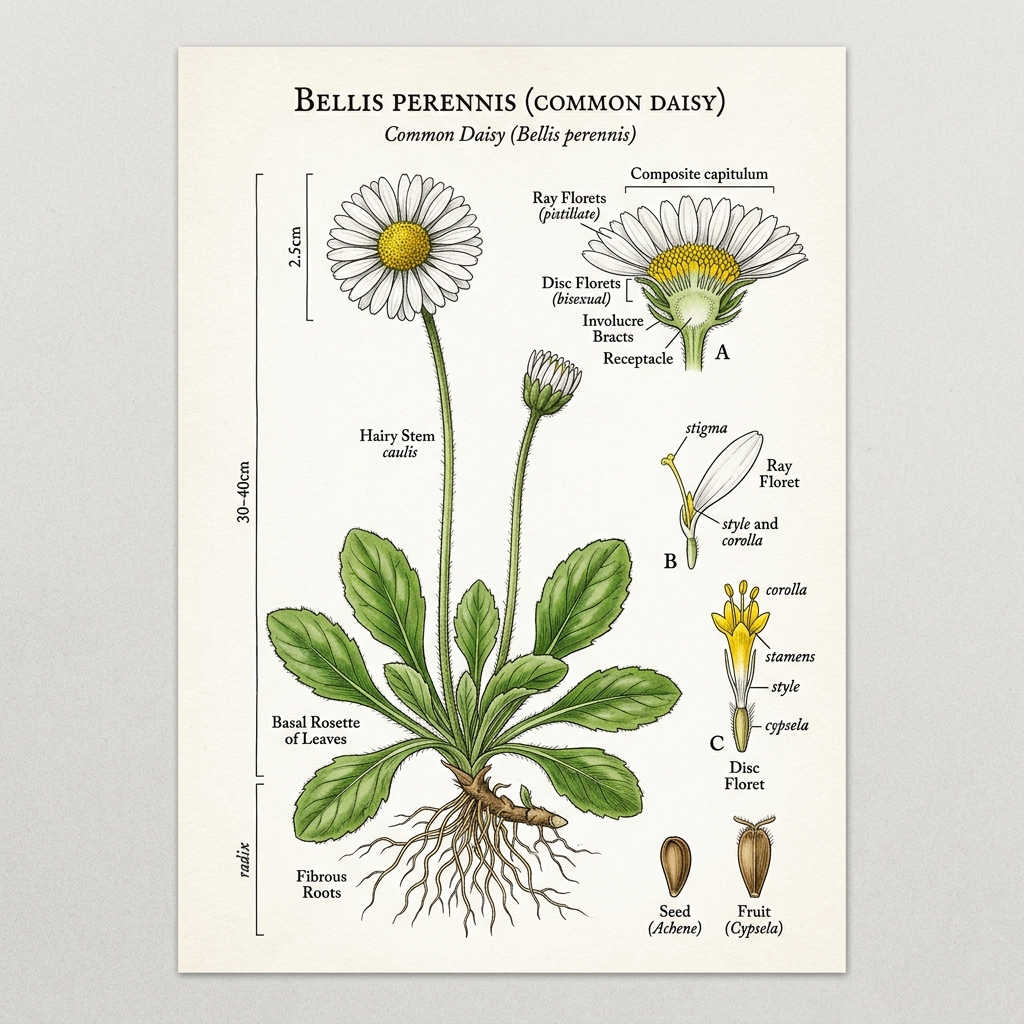
A detailed guide to identifying Daisies (Bellis perennis) by its key features:
- Composite Ray & Disc Head: Small flower heads measuring 1 to 2 inches across, featuring a flat outer collar of white or pink petals surrounding a central golden disc.
- Spoon-Shaped Scalloped Leaves: Low-growing green leaves forming a tight basal rosette flat against the ground, displaying a spoon-like shape and lightly scalloped margins.
- Slender Hairy Flower Stalks: Leafless, round, and slightly hairy stalks rising 4 to 8 inches high, supporting a single bloom.
- Fibrous Matting Root System: Shallow, dense, spreading fibrous roots that form thick clumps or mats in lawns and garden borders.
Types & Sub-types of Daisies
Daisies belong to the Asteraceae family and are distinguished based on growth scale, lifecycle, and floral mutations:
- By Horticultural Group & Bloom Type:
- Single English Daisies: Classic wild look containing a single row of white outer ray petals and a flat yellow center.
- Double/Pomponette English Daisies: Cultivated varieties with densely layered, tightly packed tubular petals that form rounded ball-like flower heads (e.g., 'Pomponette').
- Shasta Daisies (Leucanthemum × superbum): Tall, robust hybrid garden perennials (2-3 feet tall) with large 3-4 inch flower heads.
- By Lifecycle & Cultivation:
- Perennial Lawn Daisies (Bellis perennis): Long-lived, low-growing wild plants that spread aggressively through lawns, blooming almost year-round in mild climates.
- Biennial/Garden Cultivars: Grown as biennials or short-lived perennials in colder zones, producing larger, double flower heads in spring.
Care & Growing Guide
Seasonal Blooming & Hardiness
Seasonal Blooming Calendar:
- Peak Bloom: Spring to early summer (typically April through June).
- Planting Time: Sow seeds directly outdoors in early spring after the last frost, or transplant nursery starts in late spring.
Bloom Timeline
About Daisy
The Common Daisy, botanically designated as Bellis perennis (and including related garden favorites like the English Daisy or Lawn Daisy), is an exceptionally cheerful, highly resilient herbaceous perennial. Belonging to the family Asteraceae (the daisy or sunflower family, tribe Astereae), this classic wildflower is native to western, central, and northern Europe, and has naturalized globally across temperate lawns, open pastures, and roadsides.
Standing 2 to 8 inches (5 to 20 cm) tall, this compact, mat-forming perennial features low-growing, ground-hugging basal rosettes of spoon-shaped, slightly hairy, and bright green leaves. In spring through autumn (often blooming year-round in mild climates), slender, leafless, and hairy flower stalks arise from the center of the rosette, each topped by a single, iconic composite flower head measuring 1 to 2 inches across.
The flower head features a central disc of dozens of tiny, bright golden-yellow tubular florets, beautifully ringed by 20 to 30 white or pink-tipped outer ray florets. The radially symmetrical reproductive morphology is summarized by the family formula EBr ⊕ ⚿ K0 C(5) A(5) G̅(2). This states that the flower heads are ebracteate, actinomorphic, and bisexual (for disc florets). The calyx is reduced to K0, and the corolla has 5 fused petals. The 5 stamens have fused anthers, and the 2 fused carpels form an inferior ovary.
Cultivating Common Daisies is incredibly easy, as they are exceptionally tough and tolerate a wide range of conditions. They thrive in full, direct sun to light partial shade and prefer average, consistently moist, well-draining soils. They are highly cold-hardy across USDA zones 4 through 9 and tolerate frequent mowing, foot traffic, and poor soils with ease, spreading gently via short underground runners (stolons).
The poetic name 'Daisy' is a corruption of the Old English daeges eage (day's eye), directly celebrating the flower's habit of opening at dawn and closing at dusk. Famed in Sanskrit as Bhrngaraja (भृङ्गराज) and in Hindi as Gulbahaar (गुलबहार), it is the ultimate global symbol of innocence, purity, new beginnings, and loyal love, famously used in the traditional game of 'he loves me, he loves me not.'
For pet owners and veterinarians, the Common Daisy is an exceptionally safe and non-toxic selection. Bellis perennis is classified as completely safe for dogs, cats, and horses by veterinary poison control databases. If a pet grazes on lawn daisies or brushes against them, there is absolutely no danger of toxic chemical poisoning. For comprehensive safety tips, visit our general Pet Guard page. It is easily distinguished from Aster by its ground-hugging leaf rosette. It pairs beautifully with Pansy-viola or Dandelion. To explore more daisy-family cultivars, browse our Flower Identifier.
For more botanical profiles and flower identification features, see our guides on Cyclamen and Gaura.
Floral Formula & Features
Composite flower head (capitulum). Ray florets - Bracteate, bilaterally symmetrical, female, no sepals (modified to pappus or absent), numerous fused petals forming strap-shaped ray, no stamens, 2 fused carpels with inferior ovary. Disk florets - Bracteate, radially symmetrical, bisexual, no sepals, 5 fused petals forming tube, 5 fused stamens, 2 fused carpels with inferior ovary
- Name 'daisy' from Old English 'dæges eage' (day's eye) because flowers close at night and open at dawn. 'Bellis' from Latin 'bellus' (beautiful). 'Perennis' means perennial (long-lasting). Also called 'bruisewort' for traditional use treating bruises. One of most recognized flowers worldwide
- Flowers 0.75-1.25 inches (2-3 cm) across with composite head (capitulum). White ray florets (often tinged pink underneath) surround yellow disc florets in center. Cultivated varieties include double forms with all ray florets, and pink or red forms. Flowers borne singly on leafless stems 2-8 inches tall
- Perennial forming low rosettes of leaves. Blooms early spring through fall (March-November), most prolific in spring. Individual flowers last 7-10 days. Spreads by seed and short stolons. Often considered lawn weed but valued in wildflower meadows and cottage gardens
- Grows 2-8 inches (5-20 cm) tall with low, spreading habit. Forms rosettes 3-6 inches across. Lifespan of several years. Propagated by seed (self-seeds readily), division of rosettes, or separating stolons. Germinates easily, can become invasive in lawns
- Native to Europe, western Asia, and North Africa. Now naturalized worldwide in temperate regions including North America, Australia, and New Zealand. Found in lawns, meadows, pastures, roadsides, and disturbed areas. Thrives in short grass and mowed areas
- Young leaves edible in salads (slightly bitter). Flowers used in herbal medicine for coughs, wounds, and skin conditions. Attracts bees and beneficial insects. Deer resistant. Popular for daisy chains and children's games. Considered weed in manicured lawns but valued in naturalized settings. Symbol of innocence, purity, and new beginnings
- Internal Links: Compare key differences in our Daisy vs Aster or Daisy vs Sunflower comparison, or try our instant Flower Identifier.
Names in Different Languages
Botanical Classification: Daisy belongs to the Asteraceae family. Learn how to identify its floral symmetry, stamen arrangement, and structural formulas in our Botanical Family Classification Guide.
Toxicity & Safety
Frequently Asked Questions
What is Floral Formula?
A floral formula is a symbolic representation of a flower's structure using letters, numbers, and special symbols. It provides a concise way to describe the arrangement and number of floral parts.
This formula describes the flower's symmetry, sepals, petals, stamens, and carpels in a standardized format.
Formula Sequence
- Bract: Br or Ebr
- Bracteole: Brl or Ebrl
- Symmetry: % (Radial) or ⊕ (Bilateral)
- Sex: ♀ (Female), ♂ (Male), or ⚥ (Bisexual)
- Calyx/Sepal: K<number> (Free or Fused)
- Corolla/Petal: C<number> (Free or Fused)
- Androecium: A<number> (Free or Fused)
- Gynaecium: G<number> (Superior or Inferior Ovary)
Symbol Meanings
- Numbers: Indicate quantity of parts
- Parentheses (): Parts are fused together
- Plus (+): Parts in different whorls
- Underline: Superior ovary position
- Overline: Inferior ovary position
- ∞: Numerous parts (too many to count)
Understanding floral formulas helps botanists quickly identify and classify flowers based on their structural characteristics.
Similar Flowers
Discover flowers that share botanical characteristics
Same Family
4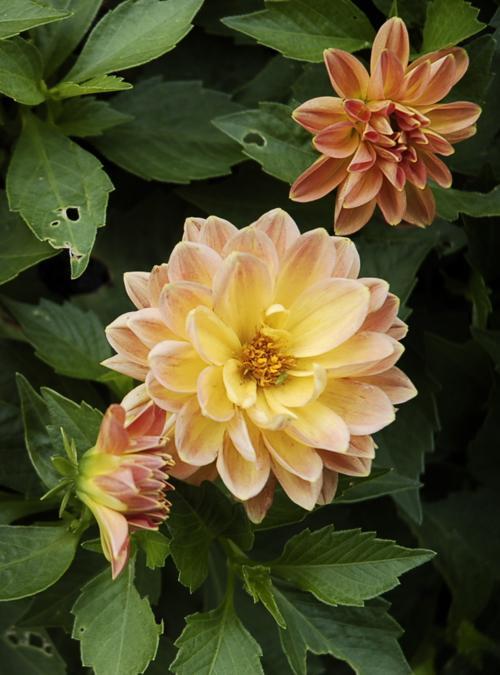
Pink-Yellow Dahlia
Dahlia pinnata (Hybrid)
The Pink-Yellow Dahlia is a spectacular, tuberous herbaceous perennial belonging to the vast Asteraceae family. Native to the mountainous highlands of Mexico and Central America, Dahlias have been heavily hybridized by botanists to produce an astonishing variety of geometric forms and vivid color...
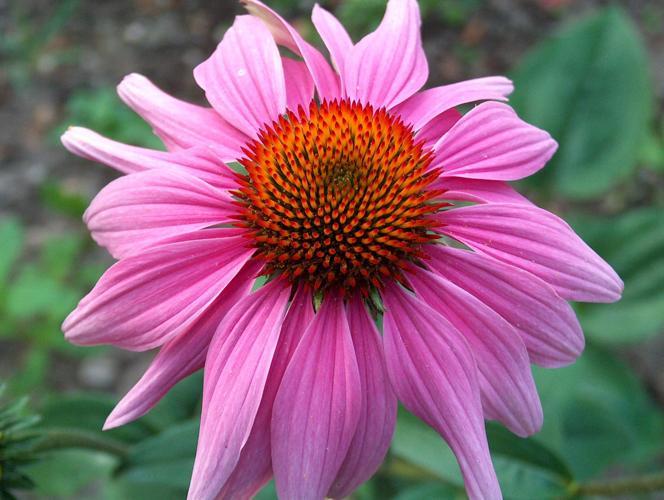
Purple Coneflower (Echinacea)
Echinacea purpurea
The Purple Coneflower (Echinacea purpurea) is a robust, iconic native North American perennial belonging to the Asteraceae family. Found thriving naturally in the prairies, open woods, and dry plains of the central and eastern United States, it has become a global favorite in both ornamental land...
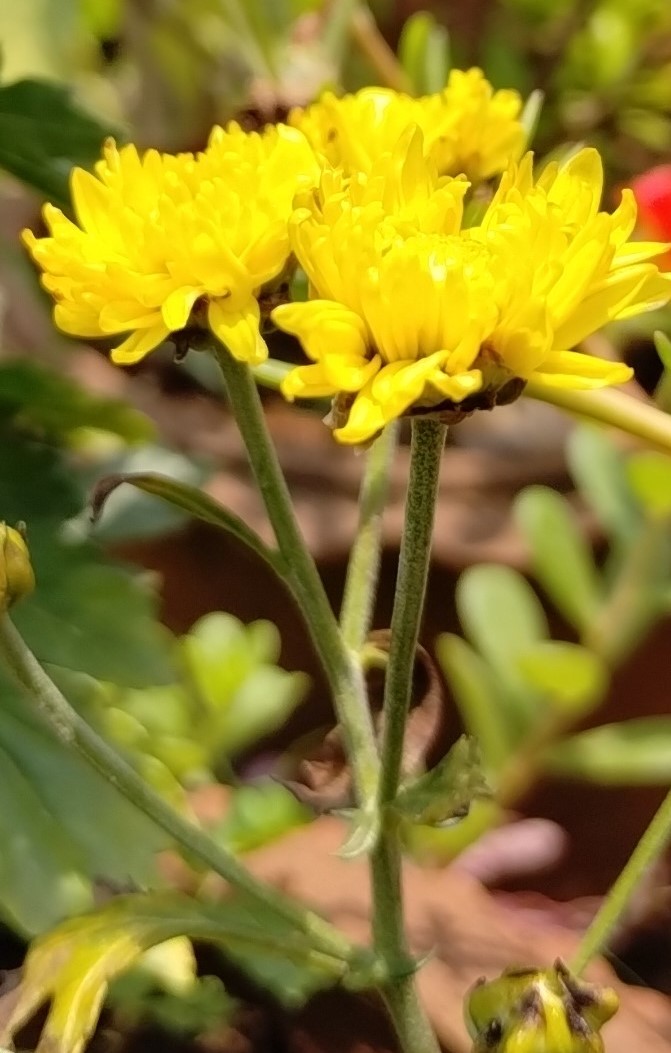
Chrysanthemum
Chrysanthemum morifolium
The Chrysanthemum, botanically classified as Chrysanthemum morifolium and affectionately known as the 'Mum,' is a magnificent, late-season flowering perennial belonging to the Asteraceae (sunflower) family. Native to East Asia, primarily China, where it has been cultivated and revered for over 3,...
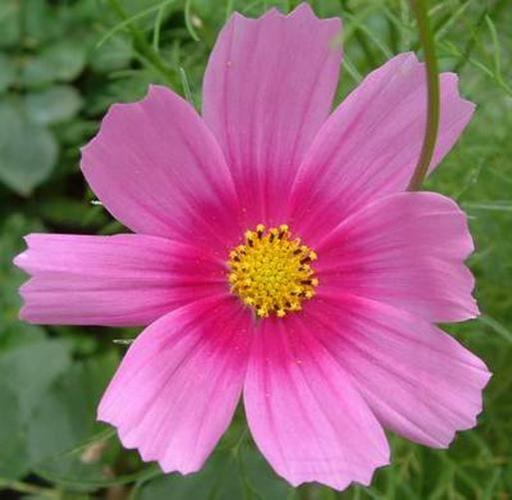
Mexican Aster
Cosmos bipinnatus
The Mexican Aster, botanically designated as Cosmos bipinnatus and commonly referred to as Garden Cosmos or simply Cosmos, is an exceptionally graceful, fast-growing, and heavy-blooming annual. Belonging to the family Asteraceae (the daisy or composite family), this beautiful plant is native to t...
Similar Characteristics
4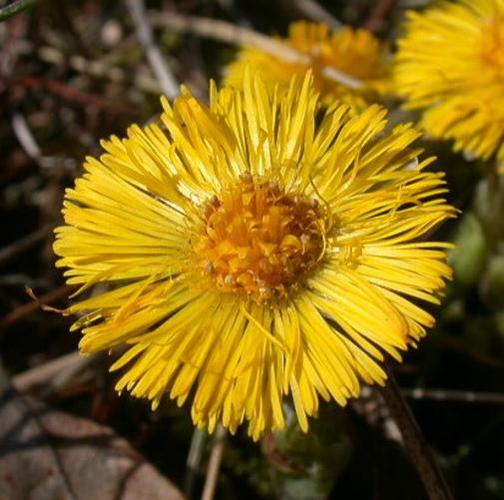
Coltsfoot
Tussilago farfara
Coltsfoot, botanically classified as Tussilago farfara, is an intriguing and highly specialized perennial wildflower belonging to the Asteraceae (sunflower) family. Native to the damp clay-rich soils, disturbed riverbanks, and limestone cliffs of Europe, western and central Asia, and parts of Nor...
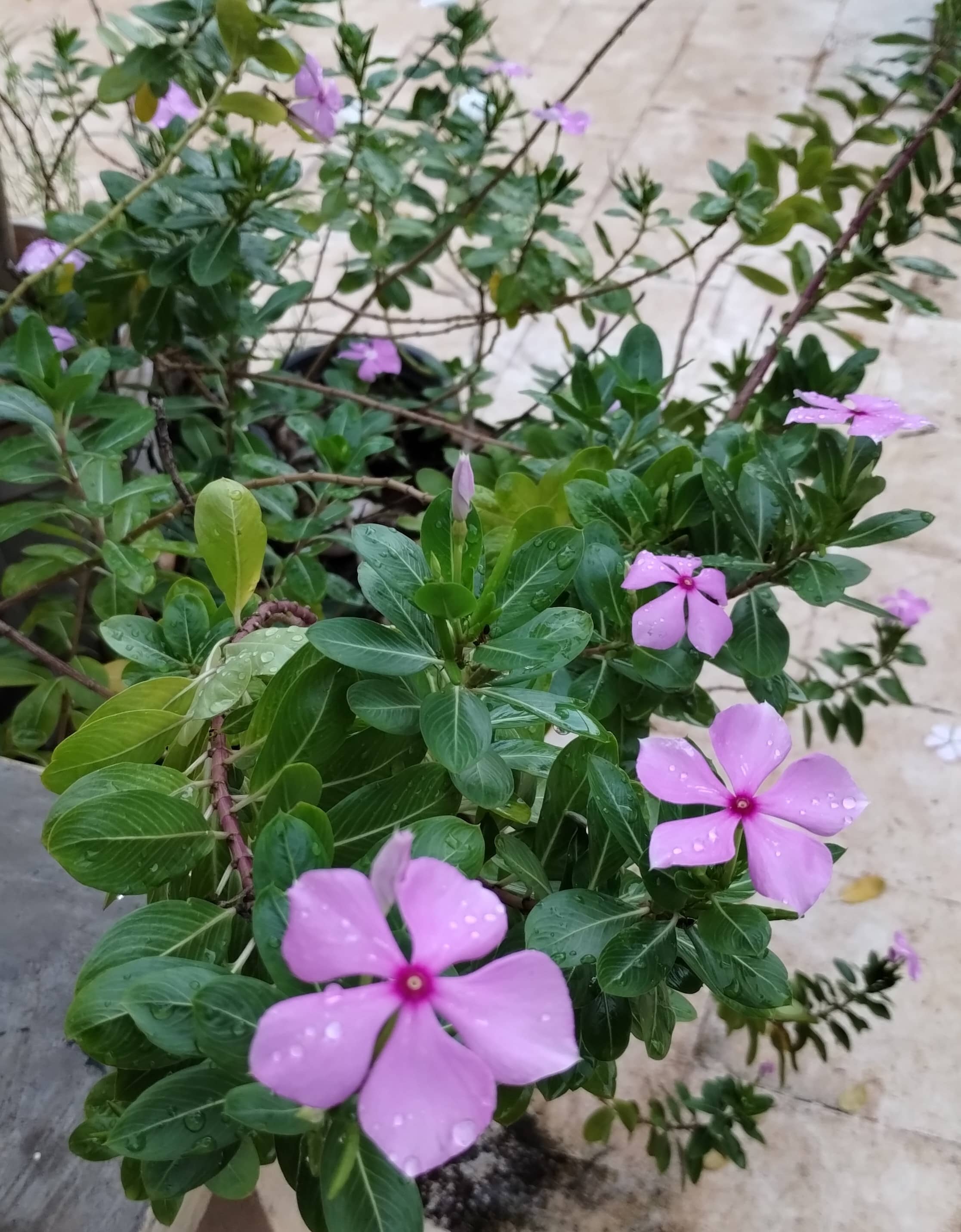
Vinca Rosea
Catharanthus roseus
Vinca Rosea (Catharanthus roseus), widely known as the Madagascar Periwinkle, is a plant of profound duality—equally celebrated as a resilient ornamental and a life-saving pharmaceutical powerhouse. Native to the dry forests of Madagascar but now naturalized across tropical regions worldwide, thi...
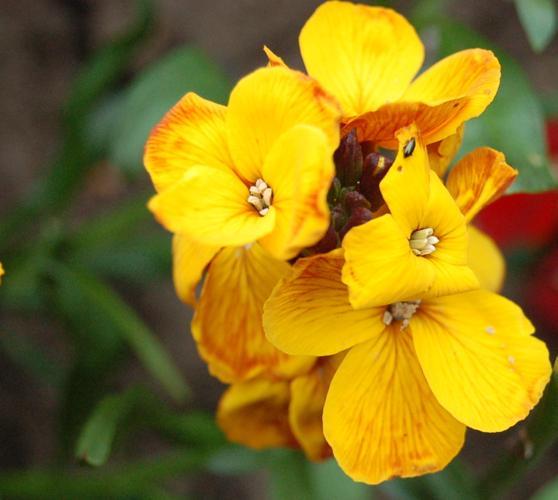
Wallflower
Erysimum cheiri
The Wallflower, botanically known as Erysimum cheiri (formerly classified as Cheiranthus cheiri), is a charming and historic woody-based biennial or short-lived perennial flower belonging to the Brassicaceae (mustard or cabbage) family. Native to the rocky cliffs, coastal regions, and warm sunny...
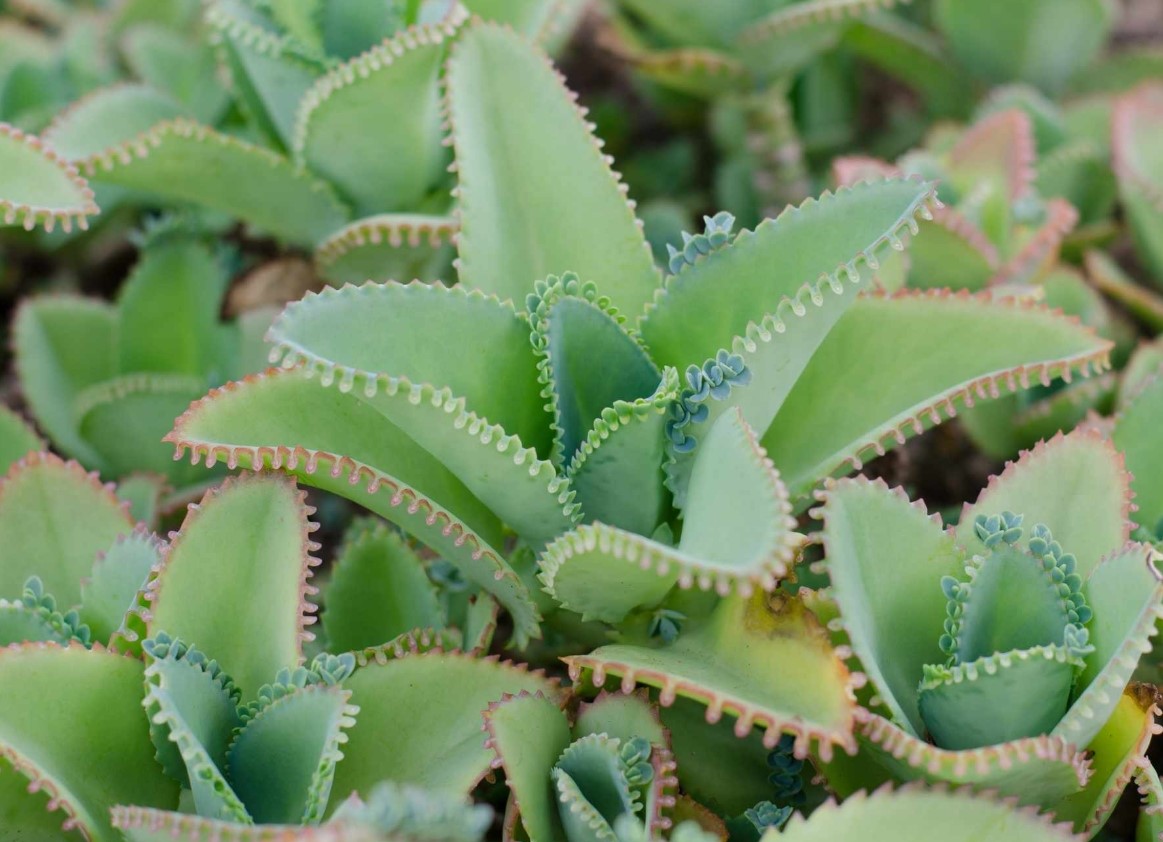
Kalanchoe
Kalanchoe
Kalanchoe, belonging to the Crassulaceae (stonecrop) family, is a highly popular and stunning genus of tropical flowering succulent plants. Comprising approximately 125 distinct species, this genus is predominantly native to the dry, arid, sun-baked landscape of Madagascar, with a few species ori...