
Wheat
Wheat is one of the world's most essential cereal crops, supplying a major source of vegetable protein and starch. Key yield-limiting threats include aerodynamic rust pathogens (Yellow/Stripe and Stem rust), Loose Smut, and local climatic stresses.
Nitrogen Deficiency
Nitrogen Deficientia
Key Visual Symptoms
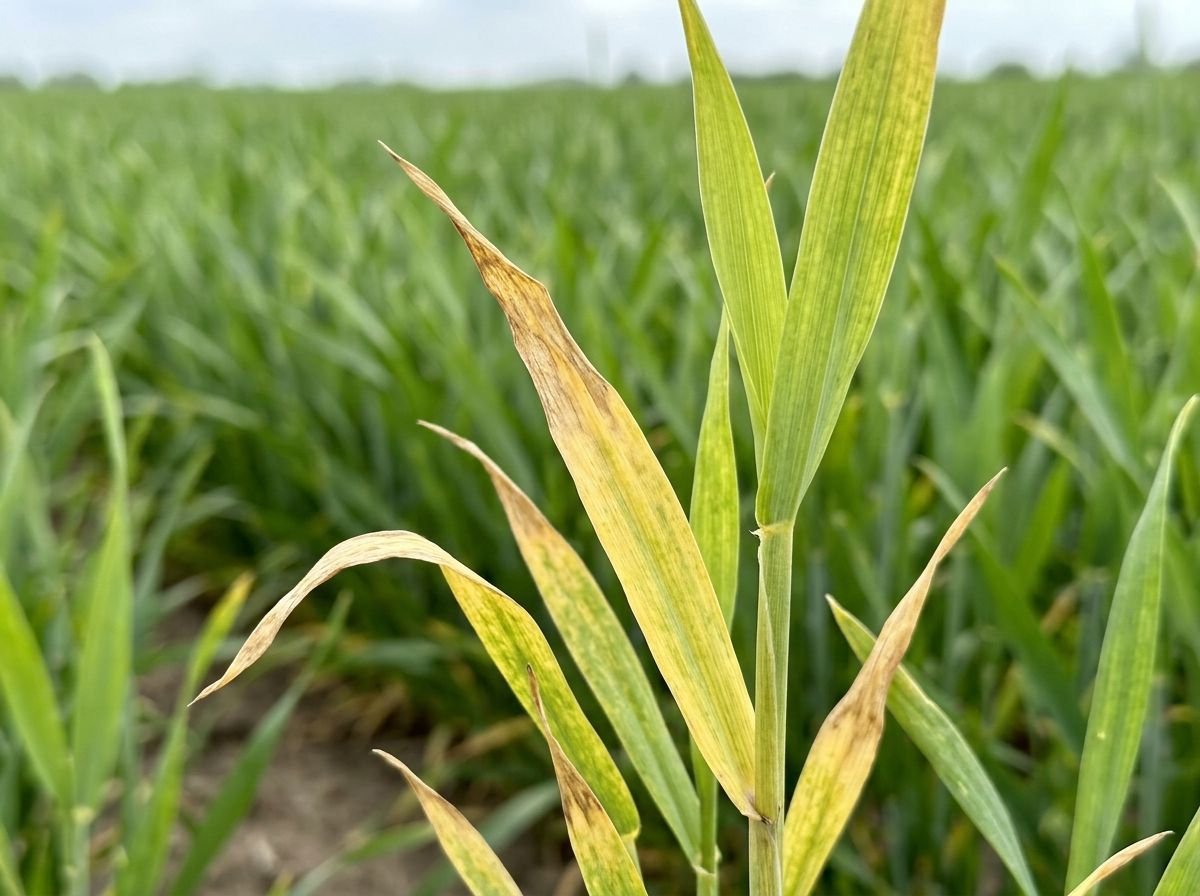
Pale yellowish-green chlorosis progressing uniformly from older basal leaves upward. Leaf yellowing initiates at the leaf tips and travels down the midrib in a V-shaped pattern, with older leaves turning brown and withering prematurely. Wheat stands exhibit stunted height, sparse tillers, thin spindly stems, and reduced head size.
- Basal Leaf Chlorosis: Pale yellowing appears first on the lowest mature leaves while younger upper leaves stay pale green.
- Sparse Tillering & Thin Stems: Stems remain spindly and erect with a drastic reduction in the number of productive tillers per plant.
- Small Spikes & Reduced Protein: Produces short, lightweight grain spikes with shriveled kernels and significantly reduced grain protein concentration.
Organic Remedy
- Incorporate 4–5 tons/acre well-rotted farmyard manure or vermicompost during final land preparation to establish baseline soil nitrogen.
- Treat wheat seed with Azotobacter chroococcum biofertilizer (200 g/10 kg seed) to fix atmospheric nitrogen and promote early seedling root development.
- Include summer leguminous green manures (Sesbania or cowpea) in the crop rotation to add 50–60 kg of organic nitrogen per hectare.
- Avoid over-irrigation during early tillering; waterlogged soils leach soluble nitrate below the shallow crown root zone.
Chemical Correction
- Apply Neem-Coated Urea in three splits: 50% basal at sowing, 25% at Crown Root Initiation (CRI stage, 20–25 DAS with first irrigation), and 25% at late tillering/jointing (45 DAS with second irrigation).
- Top-dress urea when the field soil is moist after irrigation; avoid broadcasting on dry soil or in standing surface water to minimize ammonia volatilization.
- To improve grain protein and baking quality, foliar spray 2% low-biuret urea (20 g/L) at boot leaf or early heading stage during cool morning hours.
Phosphorus Deficiency
Phosphorus Deficientia
Key Visual Symptoms
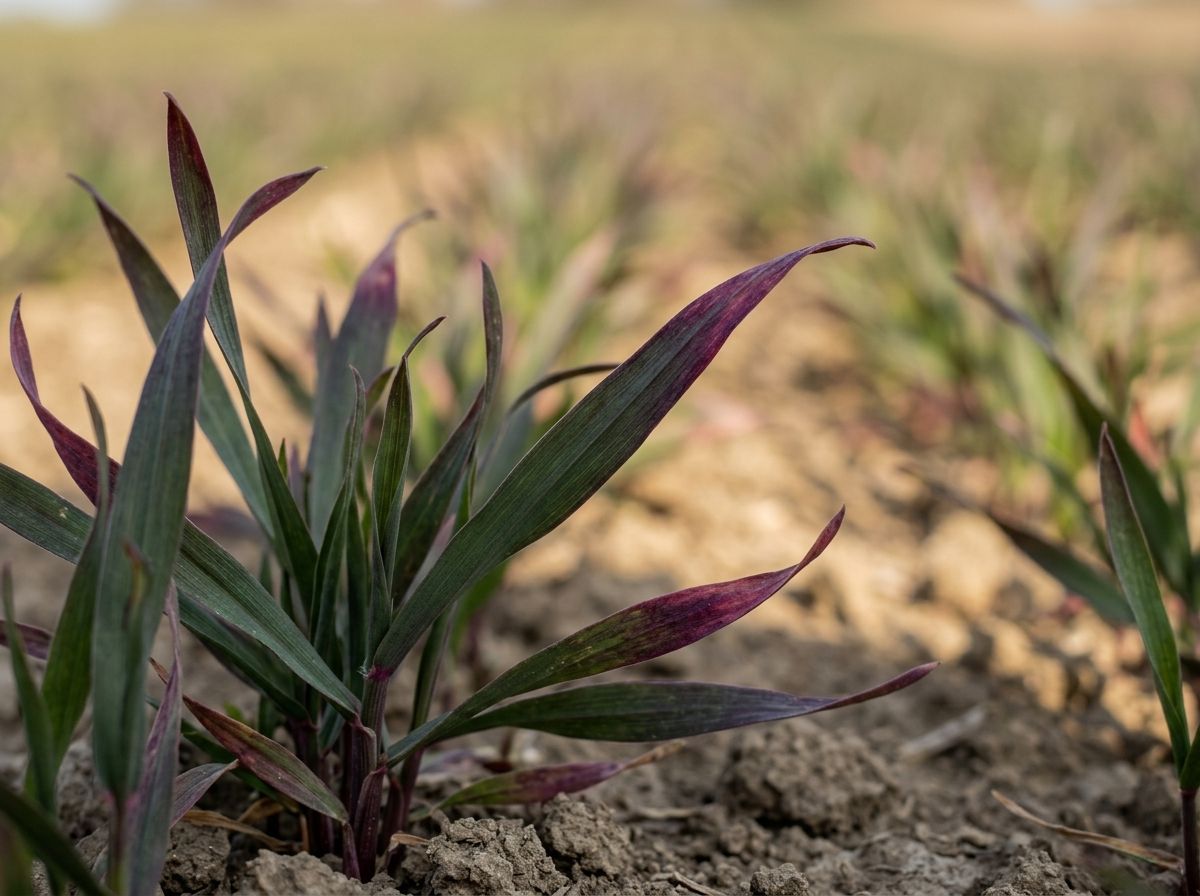
Stunted seedling growth accompanied by abnormally dark, dull-green foliage. Leaves develop distinct purple or bronze discolorations starting at the tips and margins of older basal leaves due to anthocyanin accumulation. Poor crown root anchoring leaves plants vulnerable to drought stress.
- Purpling of Leaf Sheaths: Older leaves and lower stem sheaths exhibit a pronounced reddish-purple coloration under phosphorus stress.
- Restricted Root Architecture: Seminal and nodal root branching is severely stunted, impairing water and nutrient absorption.
- Delayed Heading & Maturity: Spike emergence is delayed by 1-2 weeks, causing uneven ripening and reduced grains per spikelet.
Organic Remedy
- Incorporate rock phosphate (100–150 kg/acre) pre-composted with manure in slightly acidic or neutral soils to provide slow-release orthophosphate.
- Inoculate wheat seeds with Phosphate-Solubilizing Bacteria (PSB, 200 g/10 kg seed) to dissolve fixed calcium and aluminum phosphates.
- Apply mycorrhizal VAM culture at sowing to expand the root foraging network, which is critical for accessing immobile phosphorus in cold winter soils.
- Avoid delayed sowing; early sowing into warm autumn soil allows crown roots to establish before winter cold halts phosphorus diffusion.
Chemical Correction
- Drill 100% of required phosphorus (50–60 kg DAP/acre or 125 kg SSP/acre) 2 to 3 cm below and to the side of the seed using a seed-cum-fertilizer drill.
- Never broadcast phosphorus on the surface; top-dressed phosphate binds to surface soil colloids and remains out of reach of active root zones.
- If winter cold induces purple leaf discolouration, foliar spray water-soluble Monopotassium Phosphate (0:52:34 MKP at 4–5 g/L) twice at 10-day intervals to deliver phosphorus directly into leaf tissues.
Potassium Deficiency
Potassium Deficientia
Key Visual Symptoms
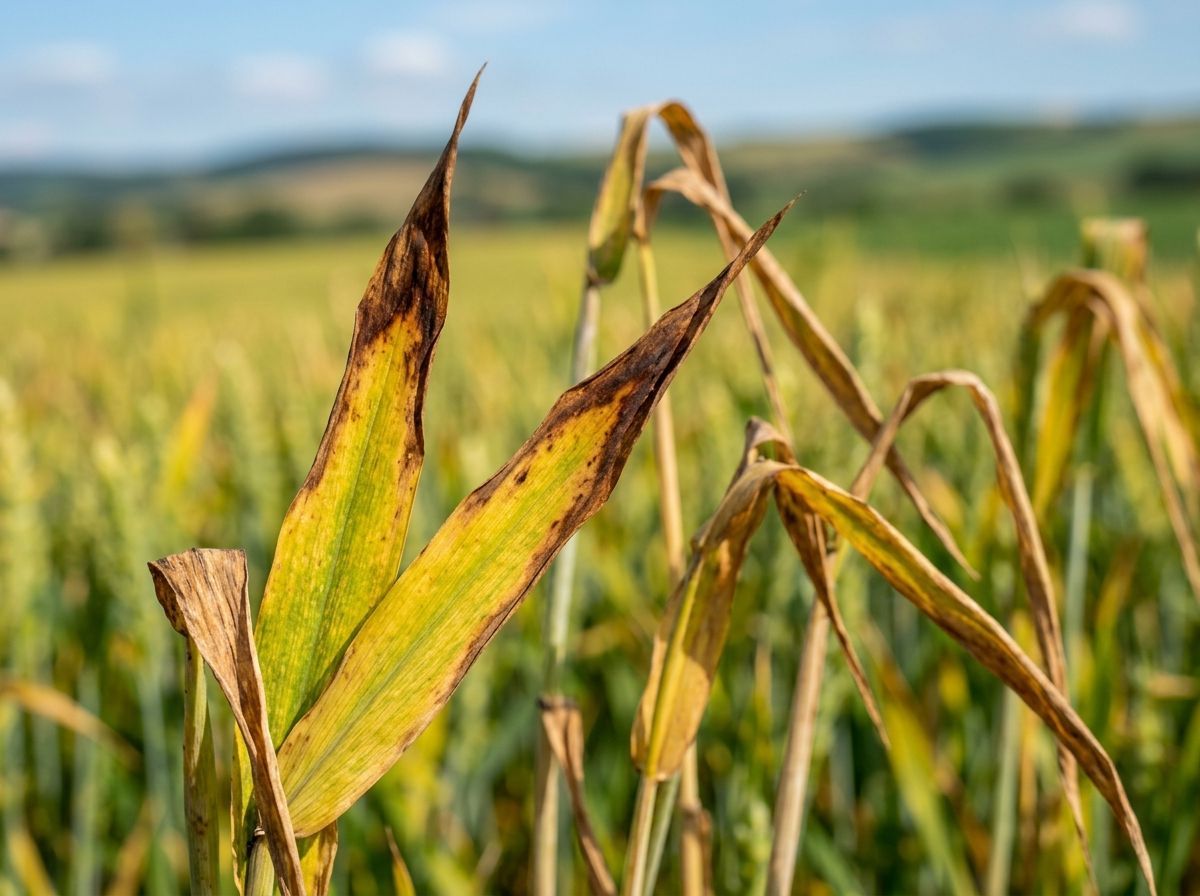
Chlorosis and marginal leaf scorch (firing) on older leaves, where the leaf tips and edges turn yellow and then necrotic brown while the center of the leaf remains green. Stems are thin and brittle, and plants exhibit a limp, wilted posture even in moist soils.
- Marginal Leaf Firing: Leaf tips and outer margins of older leaves turn yellow, brown, and dry up with a scorched appearance.
- Weak Straw & High Lodging: Thin stem walls and weak nodal joints cause crops to fall flat on the ground during grain filling.
- Poor Grain Filling: Kernels remain small, shriveled, and have low test weight due to impaired starch translocation to the head.
Organic Remedy
- Retain crop residues on the soil surface using zero-tillage or Happy Seeder; crop straw returns over 75% of absorbed potassium back to the soil.
- Apply screened wood ash (150–200 kg/acre) in neutral or acid soils before sowing to supply potassium carbonate along with calcium and magnesium.
- Inoculate wheat seed with Potassium-Mobilizing Bacteria (Frateuria aurantia, 200 g/10 kg seed) to liberate mineral potassium locked in clay lattices.
- Maintain optimal soil moisture during grain filling; dry soil restricts potassium diffusion to roots, triggering premature leaf firing.
Chemical Correction
- Apply Muriate of Potash (MOP, 60% K2O) at 20 to 25 kg/acre drilled at sowing; on coarse sandy soils, apply 50% basal and 50% with first irrigation at CRI.
- In saline soils or areas where canal water has high salinity, substitute MOP with Sulfate of Potash (0:0:50 at 25 kg/acre) to avoid chloride toxicity.
- Foliar spray 1% Potassium Nitrate (13:0:45 at 10 g/L) at the boot leaf stage and early milk stage to prevent terminal heat stress and plump up grains.
Iron Deficiency
Ferrum Deficientia
Key Visual Symptoms
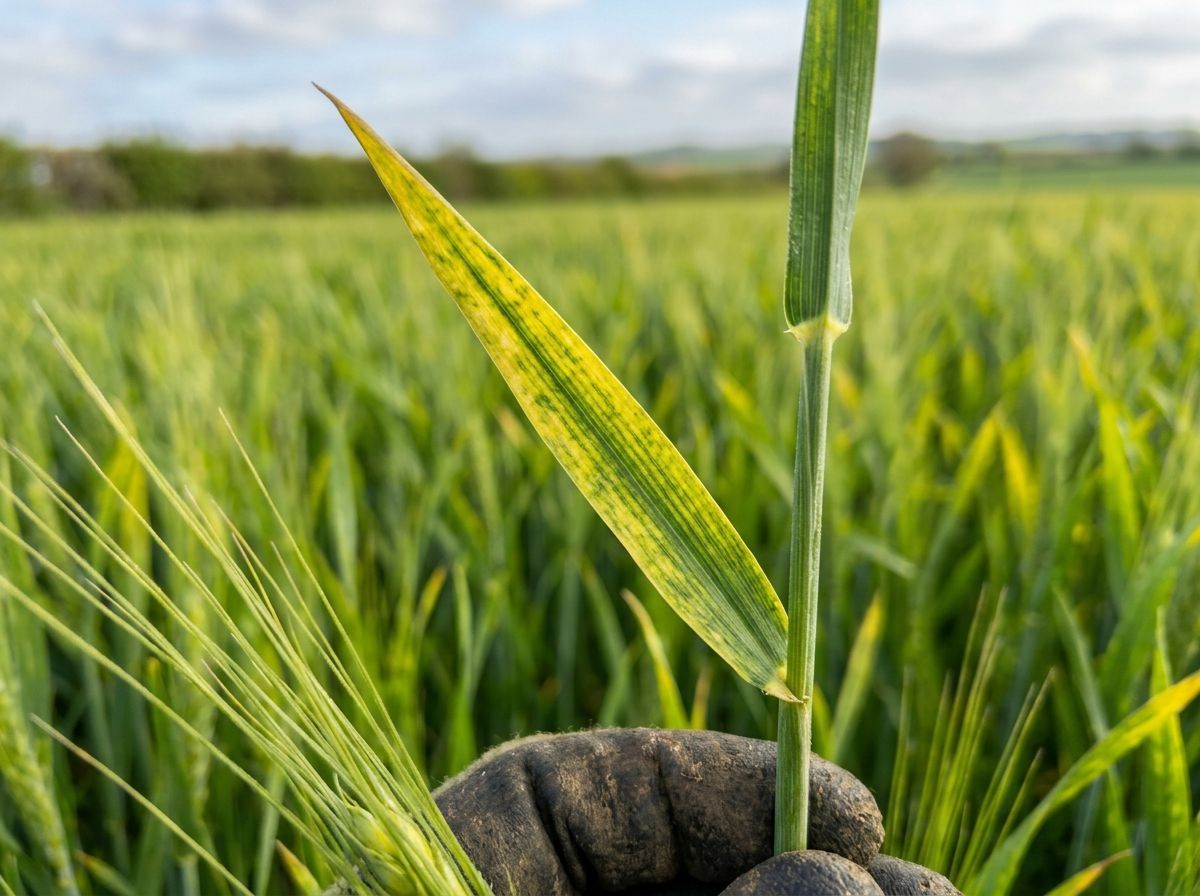
Sharply defined interveinal chlorosis on the youngest upper leaves, where the tissue between the parallel leaf veins turns bright yellow while the veins remain green. In acute cases, newly emerging leaves turn ivory-white or bleached, and leaf tips develop necrotic brown patches.
- Interveinal Chlorosis on Young Leaves: Bright yellowing strictly between parallel veins on youngest top leaves while veins stay green.
- Bleached Upper Canopy: Severe iron starvation causes entire new leaves to turn completely ivory-white with no chlorophyll.
- Stunted Vegetative Growth: Drastically reduces photosynthetic output, leading to delayed development and poor tiller production.
Organic Remedy
- Incorporate well-rotted farmyard manure (4–5 t/acre) pre-incubated with ferrous sulfate in calcareous soils to create localized acidic microsites that protect iron from fixation.
- Apply elemental sulfur (20–25 kg/acre) on high-pH soils (pH > 7.5) to biologically acidify the root zone and liberate native insoluble iron.
- Improve field drainage and avoid over-compacting soil during seedbed preparation; anaerobic compacted soil generates bicarbonates that block iron uptake.
- Use humic acid soil drenches (1 L/acre) at first irrigation to naturally chelate trace minerals and stimulate fine feeder root hairs.
Chemical Correction
- Foliar spray 0.5% Ferrous Sulfate (5 g/L) buffered with 0.1% Citric Acid (1 g/L) on affected wheat crops; repeat 7–10 days later for complete canopy re-greening.
- For precision spraying on valuable seed production crops, use Fe-EDTA (12% chelate at 1.0–1.5 g/L) with a non-ionic wetting agent during early morning hours.
- In severely calcareous fields (pH > 8.0), apply Fe-EDDHA (6% iron chelate) at 1.0–1.5 kg/acre through first irrigation water at Crown Root Initiation.
Wheat Diagnostic Guide: Diseases vs. Deficiencies
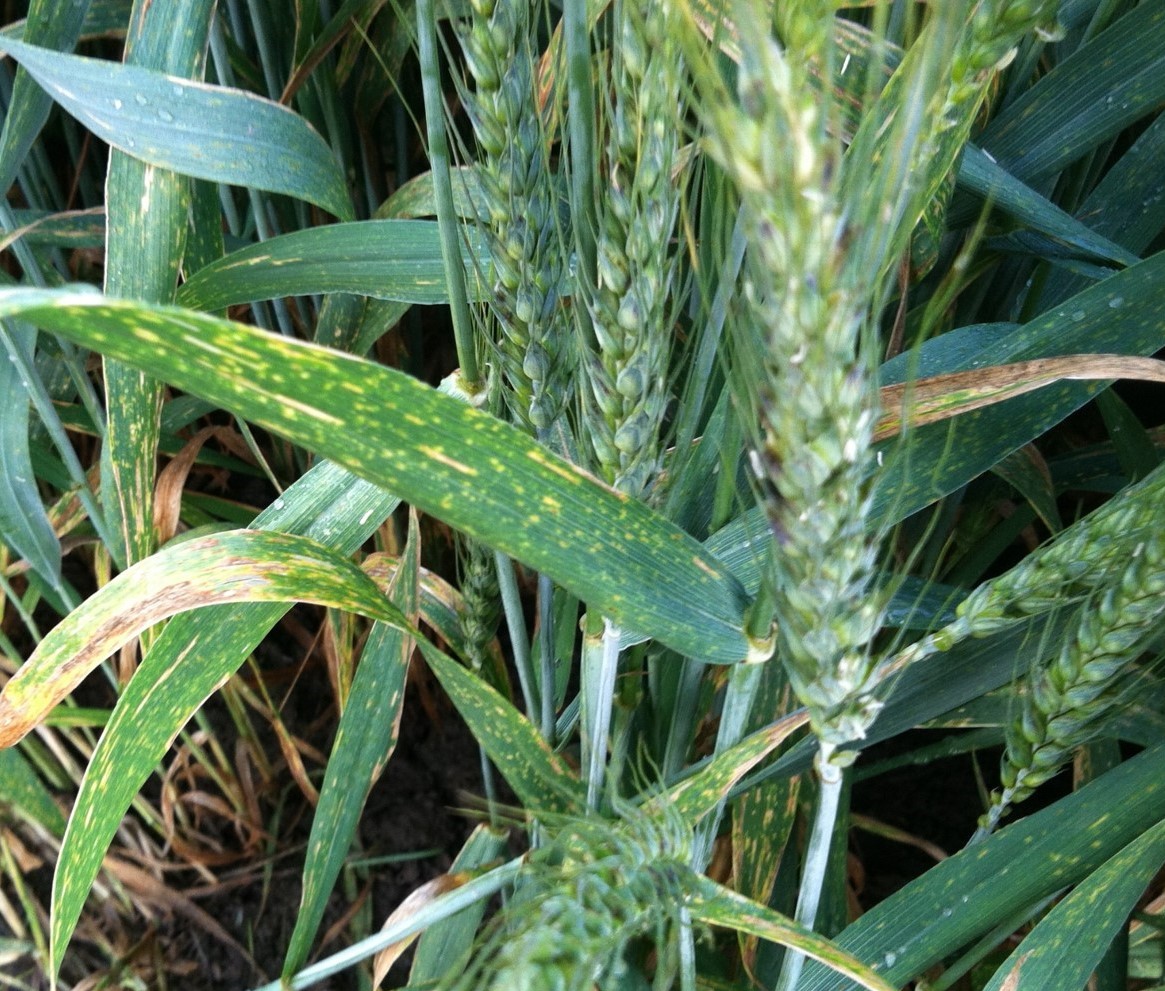
Yellowing leaves in wheat can indicate stripe rust or iron deficiency. Use this comparative checklist to distinguish them.
Yellow Rust Stripes
Iron Chlorosis
Key Indicators to Look For:
- Pattern: Stripe rust forms linear stripes of raised yellow spores that easily rub off on your fingers. Iron deficiency chlorosis is smooth and strictly interveinal (veins stay green).
- Leaf Age: Iron is immobile, so deficiencies show up on young, emerging top leaves first. Fungal rust spores can infect any green leaf, but heavily target the critical flag leaf.
- Texture: Fungal rust breaks the leaf skin, making it feel rough and powdery. Nutrient deficiency leaves remain smooth, flat, and structurally intact.
Diagnose Your Wheat Crop Instantly
Take or upload a photo of your leaf or field damage to let our AI model scan for diseases, insect pests, or nutritional deficiencies.
Seasonal Outbreak Calendar
Track peak infestation and disease risk months by geographic region. Access the interactive dashboard to see what diseases are active this month.
Explore Disease CalendarExplore Other Crop Hubs
Rice (Paddy) Hub
Grain health, blast management, and water guides.
Tomato Hub
Solanaceous care, fruit rots, and calcium fixes.
Coconut Hub
Palm care, potassium checks, and organic pest remedies.
Mango Hub
Mango variety guides, zinc sprays, and leaf curl tips.
Onion Hub
Allium health, bulb expansions, and sulfur timing.