How to Test Onion for Adulteration (Maleic Hydrazide, Chlorine Wash, Heavy Metals)
⚡ Quick 60-Second Onion Purity & Black Mold Verdict
Aspergillus niger & Chemical Sprout Inhibitors: Damp storage breeds toxic black mold (Aspergillus niger) whose mycotoxins penetrate inner scales. Old crops are treated with maleic hydrazide.
Pinch the neck right above the bulb. A tight, dry neck confirms proper curing. A soft, wet, or spongy neck indicates internal bacterial neck rot.
Rub dry outer scales. Black powdery streaks indicate Aspergillus niger mold. If spores penetrate beyond the papery dry skin, discard the bulb.
Slice vertically. Pure healthy onions have crisp, pearly white inner concentric rings. Brown, translucent, or watery rings indicate internal decay.
To learn more about food safety tests and home adulteration detection, read our guides on Brinjal (Eggplant) and Radish (Mooli), and check our guide to dangerous vegetable look-alikes.
Drop Onion photo here to test purity
or click to browse • Supports JPG, PNG, WEBP • Paste with Ctrl+V
Inspection Guide
Click to enlarge
Onion Purity & Safety Audit
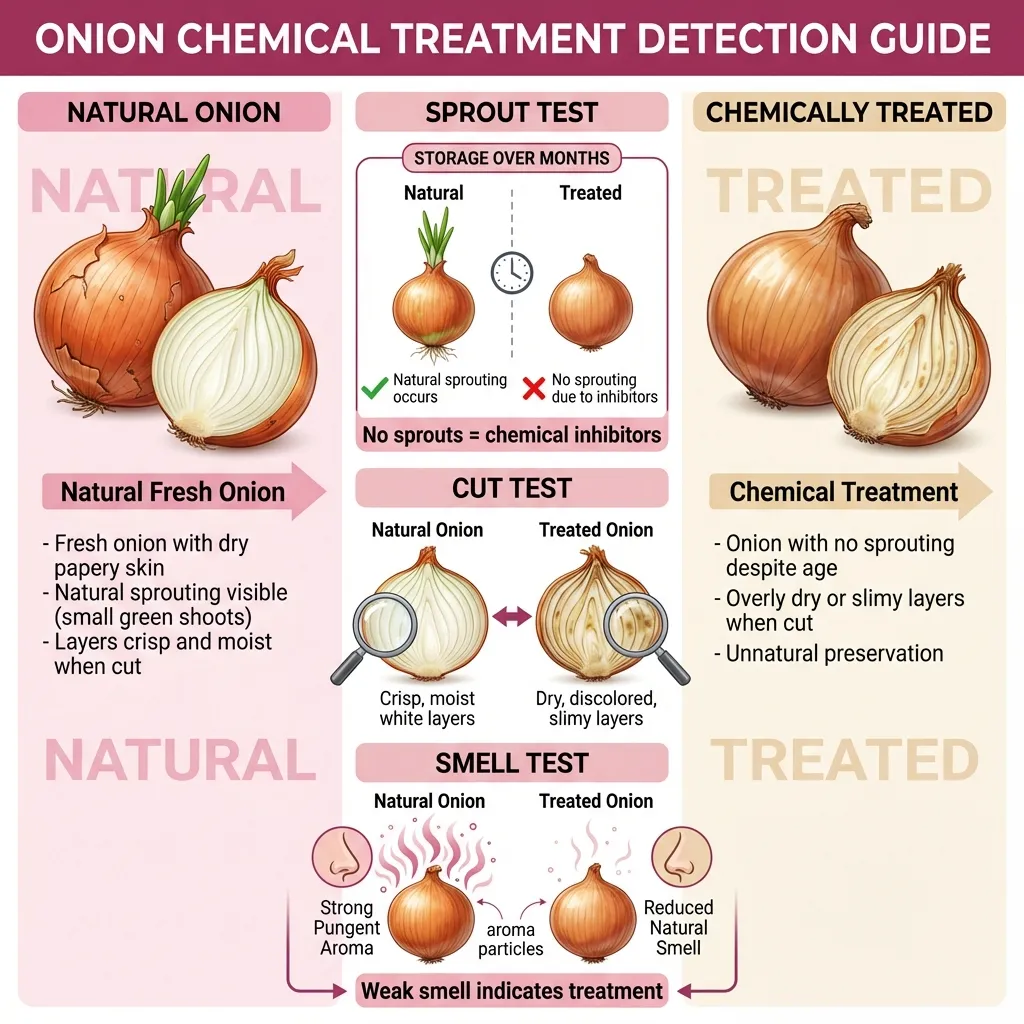
Onions are generally low-risk but can be treated with Maleic Hydrazide to prevent sprouting during storage or may harbor black mold (Aspergillus niger) which produces toxins.
1. The "Neck" Integrity Check:
Check the neck of the onion (where the leaves were attached). It should be tightly closed, dry, and hard. If the neck is soft, "spongy," or shows black powdery residue, the onion is either rotting or has a high concentration of fungal spores.
2. The Sprouting Test:
Naturally fresh onions will begin to sprout green shoots within 1-2 weeks at room temperature. If your onions never sprout even after months, they have been heavily treated with Maleic Hydrazide (a chemical growth inhibitor).
3. The Color and Skin Texture:
The outer papery skin should be crisp and have a natural, bright color (pink, red, or white). If the skin is "sticky," shriveled, or has an unnaturally "bleached" look, suspect chemical cleaning or sulfite treatment.
4. The Squeeze Test:
Gently squeeze the onion. It should be rock-hard. If it feels soft or has "liquid" under the skin, it is decaying from the inside out, often due to poor storage or chemical overdosing.
Quick Safety Tips
- Choose onions with a tight, dry neck and rock-hard body
- Avoid onions with visible black powder (Black Mold) under the skin
- If an onion never sprouts, it may have high levels of growth inhibitors
- Store in a cool, dark, well-ventilated place - avoid plastic bags
Primary Chemical Concerns
Health Risks & Impacts
Multilingual Local Names
Common Storage Pests
Onion Maggot
medium riskLarvae of the onion fly that tunnel into the bulb.
Detection
- Small entry holes at the base
- Internal browning and rotting
Prevention
- Store in a dry, ventilated area
- Avoid storing near moisture
Corrective Action: What to do?
Discard infested onions; the rot spreads quickly and affects the taste.
Regulatory Corner: FSSAI (Food Safety and Standards Authority of India) / Codex Alimentarius (CXS 296-2009)
Regulation: Food Safety and Standards (Contaminants, Toxins and Residues) Regulations 2011, Schedule 2: MRLs in Bulb Vegetables
Legal Limit:Maleic hydrazide (anti-sprouting agent): Max 15.0 ppm; Metalaxyl: Max 2.0 ppm; Aflatoxin / mold decay (Aspergillus niger black mold): Max 1.0% by weight; Artificial skin color wash: 0.0%
Report Adulteration to FSSAI (Food Safety and Standards Authority of India) / Codex Alimentarius (CXS 296-2009)