How to Test Radish for Adulteration (Rhodamine B, Excessive Nitrates, Silver Nitrate)
⚡ Quick 60-Second Radish Purity & Optical Brightener Verdict
Industrial Blueing Wash & Organophosphate Insecticides: Dirty, mud-stained radishes are washed with laundry blueing agents (optical brighteners) and synthetic bleaching powder to impart an artificial fluorescent white shine.
Shine a UV blacklight torch on the radish skin in a dark room. Natural radishes do not fluoresce. An eerie bright violet/blue glow indicates industrial optical brighteners or laundry blue washes.
Scrub radish under running water. Genuine root crops have natural, slight earthy scent and natural off-white skin. A stinging chlorine bleach aroma indicates post-harvest chemical decontamination.
Cut a cross-section 2 inches from the tip. Fresh radish is dense, succulent, and translucent. A hollow, spongy, or dry brown core indicates over-mature, dehydrated, or chemically forced crops.
To learn more about food safety tests and home adulteration detection, read our guides on Onion and Beetroot.
Drop Radish (Mooli) photo here to test purity
or click to browse • Supports JPG, PNG, WEBP • Paste with Ctrl+V
Inspection Guide
Click to enlarge
Radish (Mooli) Purity & Dye Audit
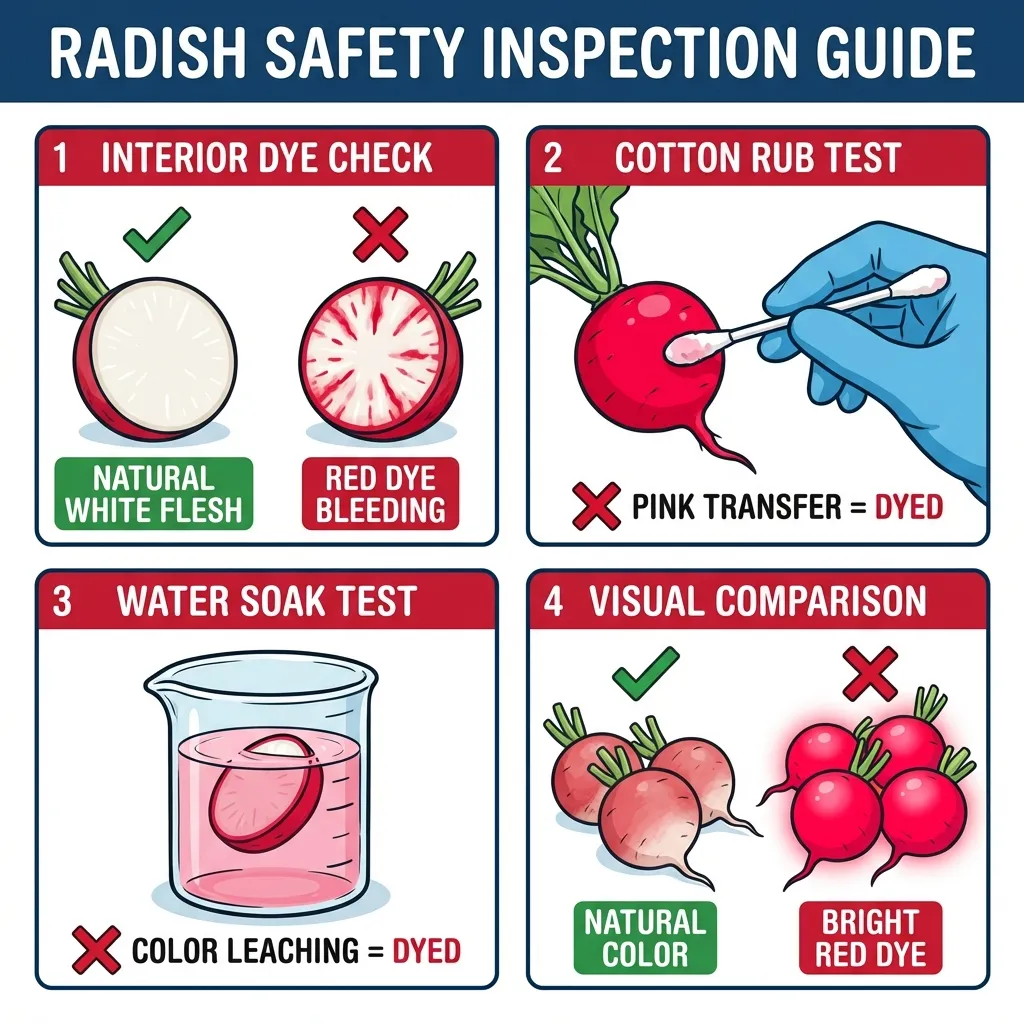
Radishes, especially the red varieties, are often treated with Rhodamine B dye to appear vibrant. White radishes may be bleached or treated for unnatural whiteness.
1. The Cotton Rub Test:
Take a cotton ball soaked in water or liquid paraffin and rub the outer skin of a red radish. If the cotton picks up a bright pink or red tint, it is artificially dyed.
2. The Internal Snap Test:
Snap the radish in half. A fresh radish should be crisp and uniformly white inside. If the color is "bleeding" from the skin into the core, or if the core looks translucent/greyish, it may be chemically treated.
3. The Leaf Freshness:
If leaves are attached, they should be vibrant green. Wilting, yellow leaves on a perfectly bright root indicate the root was chemically "refreshed" while the plant was old.
4. The Water Soak:
Soak sliced radishes in cold water for 15 minutes. If the water turns pink immediately, Rhodamine B is present. Natural pigments leach very slowly.
Quick Safety Tips
- Perform the cotton rub test for Rhodamine B on red radishes
- Avoid radishes with an unnaturally uniform, "bleached" white look
- Check for internal color bleeding from the skin
- Select medium-sized radishes - oversized ones often have high nitrate levels
Primary Chemical Concerns
Health Risks & Impacts
Multilingual Local Names
Common Storage Pests
Cabbage Maggot (Delia radicum)
medium riskSmall white larvae that tunnel through the root of the radish.
Detection
- Brown, winding tunnels inside the root
- Small entry holes on the skin
Prevention
- Store in a cool, ventilated crisper drawer
- Wash and scrub before storage
Corrective Action: What to do?
Cut away the affected parts; discard if tunnels are extensive.
Regulatory Corner: FSSAI (Food Safety and Standards Authority of India) / Codex Alimentarius (CXS 312-2013)
Regulation: Food Safety and Standards (Contaminants, Toxins and Residues) Regulations 2011, Schedule 2: Root Vegetables
Legal Limit:Optical brighteners / synthetic laundry blue: 0.0% (Strictly prohibited on food products); Dimethoate: Max 0.02 ppm; Chlorpyrifos: Max 0.1 ppm; Lead: Max 0.1 ppm; Decay / internal rot: Max 1.0%
Report Adulteration to FSSAI (Food Safety and Standards Authority of India) / Codex Alimentarius (CXS 312-2013)