Como Saber se o Abacate Está Maduro, Seguro e Puro — Guia Completo
O guia completo para comprar, testar e comer abacates com segurança. Abrange testes de maturação, a questão dos fios pretos, diferenças de variedade (Hass vs Florida vs Fuerte) e adulteração de óleo de abacate – as preocupações de segurança mais comuns do abacate nos EUA e no México. Embora classificada como a cultura 'Clean 15' número 1 nos EUA/UE devido à sua película espessa e protetora que protege a polpa dos pesticidas, apresenta elevados riscos de retalho a nível mundial devido à adulteração generalizada do óleo e à maturação química.
Para saber mais sobre testes de segurança alimentar e detecção de adulteração doméstica, leia nossos guias sobre camarão, Azeite e Lichia.
Drop Abacate photo here to test purity
or click to browse • Supports JPG, PNG, WEBP • Paste with Ctrl+V
Inspection Guide
Click to enlarge
Auditoria de maturação e pureza do abacate
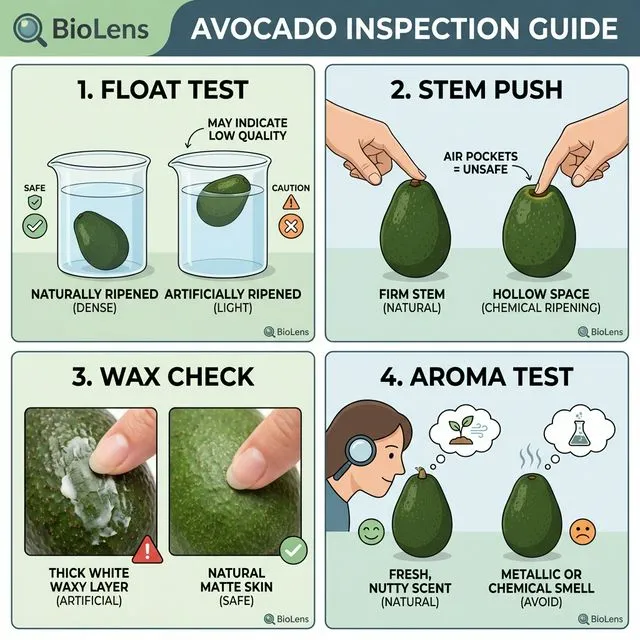
Os abacates estão entre as frutas mais amadurecidas artificialmente nas cadeias de abastecimento globais. Mais de 80% dos abacates vendidos comercialmente nos EUA são tratados com gás etileno após a colheita. Veja como detectá-lo – e como escolher sempre o abacate perfeito.
1. O teste Stem-Pop (verificação de maturação mais confiável):
Sacuda suavemente a pequena tampa do caule (botão) na parte superior do abacate. ✅ Verde por baixo = maduro e fresco. ❌ Marrom ou preto por baixo = maduro demais, provavelmente apresenta escurecimento interno. ❌ O caule não se move apesar da pele macia = gaseificação artificial – a casca amoleceu, mas a polpa não amadureceu naturalmente.
2. O Teste de Pressão da Palma (Firmeza vs Amadurecimento):
Coloque o abacate na palma da mão e aplique uma pressão suave e uniforme. NÃO pressione com as pontas dos dedos – isso causa hematomas. ✅ Rende um pouco, mas volta = perfeitamente maduro. ✅ Firme sem ceder = 2–3 dias antes de amadurecer. ❌ Mole, amassados permanecem = maduro demais. ❌ Suave em algumas partes, mas duro em outras partes = amadurecimento artificial irregular.
3. O teste de raspagem da pele (detecção de cera e revestimento):
Raspe suavemente a pele com uma unha limpa. ✅ A casca natural do abacate é levemente oleosa, mas não produz flocos. ❌ Flocos brancos e cerosos = revestimento de cera industrial aplicado pós-colheita. ❌ Pele excepcionalmente brilhante e espelhada = cera pesada ou camada de óleo.
4. O teste de imersão em água (verificação de fungicida):
Mergulhe o abacate em água morna por 10 minutos. ✅ Água limpa = tratamento mínimo. ❌ Brilho oleoso ou cheiro químico na água = tratamento com fungicida pesado (Tiabendazol / Imazalil). Sempre esfregue com bicarbonato de sódio e água antes de cortar – isso remove até 90% dos resíduos superficiais.

Click to enlarge
O interior preto é seguro? Guia de polpa de abacate
Uma das perguntas mais pesquisadas sobre abacate nos EUA: 'Meu abacate é seguro para comer se estiver preto por dentro?' Aqui está a resposta definitiva:
✅ Listras marrons claras na superfície de corte = SEGURO (oxidação)
Quando a polpa do abacate é exposta ao ar, ela escurece rapidamente devido a uma reação enzimática – o mesmo que uma maçã cortada. Isto é completamente inofensivo. Esprema o suco de limão no abacate cortado para evitar isso.
⚠️ Manchas marrons escuras = BORDERLINE (muito maduro)
A polpa muito dourada está madura demais e tem um sabor amargo desagradável. É tecnicamente seguro comer as partes não afetadas, mas a qualidade é baixa. Retire e descarte as seções escuras.
❌ Fios fibrosos pretos percorrendo a carne = DESCARTAR (doença vascular)
Fibras escuras, fibrosas e semelhantes a fios em toda a polpa indicam uma doença vascular fúngica (Lasiodiplodia ou Colletotrichum). NÃO é seguro comer – o micélio do fungo colonizou o tecido vascular da fruta. A fruta pode ter cheiro de fermentado ou azedo.
❌ Polpa cinzenta, aquosa e translúcida = DESCARTAR (dano por congelamento ou podridão profunda)
A polpa cinzenta, pastosa e translúcida geralmente indica danos por congelamento durante o transporte ou deterioração interna avançada. A estrutura celular foi quebrada. Descarte totalmente.
Tabela de resumo rápido:
| Aparência | Causa | Seguro? |
|---|---|---|
| Castanho claro na superfície de corte | Oxidação do ar | ✅ Sim |
| Estrias marrons perto da pele | Maduro demais | ⚠️ Corte |
| Cordas fibrosas pretas | Doença fúngica vascular | ❌ Descartar |
| Cinza, aguado, mole | Danos por congelamento / podridão profunda | ❌ Descartar |
| Verde brilhante/amarelo, cremoso | Fresco, ideal | ✅ Perfeito |
Quick Safety Tips
- Use primeiro o teste stem-pop – é o indicador de maturação mais preciso
- Pressione com a palma da mão inteira, nunca com a ponta dos dedos, para evitar machucar a fruta
- Evite abacates com brilho espelhado – um leve acabamento fosco é natural
- Sempre esfregue a pele do abacate com bicarbonato de sódio + água antes de fatiar
- Um abacate macio com o caule preso = gaseado artificialmente – evite-o
Primary Chemical Concerns
Health Risks & Impacts
Multilingual Local Names
Common Storage Pests
Avocado Thrips
low riskTiny insects that cause rusty, scarred patches on the skin surface — cosmetic damage only, does not affect flesh safety.
Detection
- Rusty brown or silver scarring on the outer skin
- Rough, sandpaper-like texture in patches
Prevention
- Cosmetic only — does not affect flesh quality or safety
- Inspect the stem-end; if clean and green inside, fruit is fine
Vascular Fungal Disease (Black Strings)
high riskLasiodiplodia or Colletotrichum infection causes dark, fibrous, thread-like strands running through the flesh.
Detection
- Black or very dark brown fibrous strings inside the flesh
- Sour or fermented smell when sliced
- Flesh may appear marbled with dark veins
Prevention
- Discard the entire fruit — do not eat any part
- Fungal mycelium spreads throughout the tissue
Regulatory Corner: US FDA / Codex Stan 197-1995 (Standard for Avocado)
Regulation: Codex Alimentarius Fresh Fruits Standards & USDA Grade 1 Avocado Specifications
Legal Limit:Minimum dry matter content (maturity index): Min 21.0% (Hass variety); Internal anthracnose decay / rot: Max 1.0%; Non-declared synthetic surface waxes: 0.0%
Report Adulteration to US FDA / Codex Stan 197-1995 (Standard for Avocado)