¿Cómo saber si un aguacate está maduro, seguro y real? — Guía Completa
La guía completa para comprar, probar y comer aguacates de forma segura. Cubre las pruebas de madurez, la cuestión del hilo negro en el interior, las diferencias de variedades (Hass vs Florida vs Fuerte) y la adulteración del aceite de aguacate, las preocupaciones de seguridad del aguacate más comunes en EE. UU. y México. Si bien está clasificado como el cultivo #1 'Clean 15' en los EE. UU. y la UE debido a su gruesa piel protectora que protege la pulpa de los pesticidas, conlleva altos riesgos minoristas a nivel mundial debido a la adulteración generalizada del aceite y la maduración química.
Para obtener más información sobre las pruebas de seguridad alimentaria y la detección de adulteración en el hogar, lea nuestras guías sobre camarones, aceite de oliva y lychee.
Drop Palta photo here to test purity
or click to browse • Supports JPG, PNG, WEBP • Paste with Ctrl+V
Inspection Guide
Click to enlarge
Auditoría de madurez y pureza del aguacate
Los aguacates se encuentran entre las frutas más maduradas artificialmente en las cadenas de suministro mundiales. Más del 80% de los aguacates que se venden comercialmente en Estados Unidos se tratan con gas etileno después de la cosecha. Aquí se explica cómo detectarlo y cómo elegir el aguacate perfecto en todo momento.
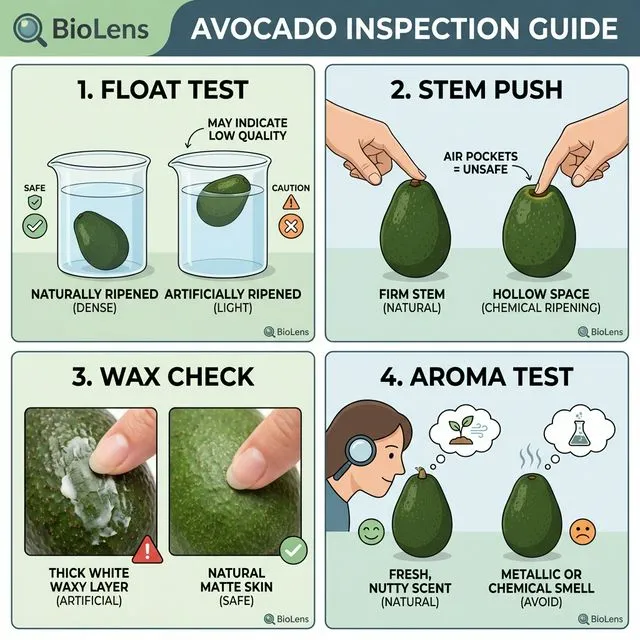
1. La prueba Stem-Pop (control de madurez más confiable):
Mueve suavemente la pequeña tapa del tallo (botón) en la parte superior del aguacate. ✅ Verde por debajo = maduro y fresco. ❌ Marrón o negro por debajo = demasiado maduro, probablemente tenga un color marrón interior. ❌ El tallo no se mueve a pesar de la piel suave = gasificación artificial: la cáscara se ablandó pero la pulpa no maduró de forma natural.
2. La prueba de Palm Press (firmeza versus madurez):
Coloque el aguacate en la palma de su mano y aplique una presión suave y uniforme. NO presione con las yemas de los dedos, ya que esto provocará hematomas. ✅ Rinde ligeramente pero vuelve a crecer = perfectamente maduro. ✅ Firme sin ceder = faltan entre 2 y 3 días para madurar. ❌ Blando, las abolladuras permanecen = demasiado maduro. ❌ Blanda en algunas zonas pero dura en otras partes = maduración artificial desigual.
3. Prueba de raspado de la piel (detección de cera y revestimiento):
Raspe suavemente la piel con una uña limpia. ✅La piel natural del aguacate es ligeramente grasa pero no produce escamas. ❌ Hojuelas blancas y cerosas = recubrimiento de cera industrial aplicado poscosecha. ❌ Piel inusualmente brillante, como un espejo = capa espesa de cera o aceite.
4. La prueba de remojo en agua (verificación de fungicida):
Remoja el aguacate en agua tibia durante 10 minutos. ✅ Agua limpia = tratamiento mínimo. ❌ Brillo aceitoso u olor químico en el agua = tratamiento con fungicida fuerte (tiabendazol/imazalil). Frote siempre con bicarbonato de sodio y agua antes de cortar; esto elimina hasta el 90 % de los residuos de la superficie.

Click to enlarge
¿Es seguro el interior negro? Guía de pulpa de aguacate
Una de las preguntas sobre el aguacate más buscadas en Estados Unidos: "¿Es seguro comer mi aguacate si está negro por dentro?" Aquí está la respuesta definitiva:
✅ Rayas de color marrón claro en la superficie cortada = SEGURO (oxidación)
Cuando la pulpa del aguacate se expone al aire, se dora rápidamente debido a una reacción enzimática, igual que una manzana cortada. Esto es completamente inofensivo. Exprime jugo de limón sobre el aguacate cortado para evitarlo.
⚠️ Manchas de color marrón oscuro en todas partes = LIMITE (demasiado maduro)
La pulpa muy dorada está demasiado madura y tiene un sabor amargo desagradable. Es técnicamente seguro comer las partes no afectadas, pero la calidad es mala. Saque y deseche las secciones oscuras.
❌ Hilos fibrosos negros que atraviesan la carne = DESECHAR (enfermedad vascular)
Las fibras oscuras, fibrosas y parecidas a hilos en toda la carne indican una enfermedad vascular fúngica (Lasiodiplodia o Colletotrichum). NO es seguro comerlo: el micelio del hongo ha colonizado el tejido vascular de la fruta. La fruta puede oler a fermentada o agria.
❌ Pulpa gris, acuosa y translúcida = DESECHAR (daño por congelación o podredumbre profunda)
La pulpa gris, blanda y translúcida generalmente indica daño por congelación durante el envío o descomposición interna avanzada. La estructura celular se ha roto. Deseche por completo.
Tabla de resumen rápido:
| Apariencia | Causa | ¿Seguro? |
|---|---|---|
| Marrón claro en la superficie cortada | Oxidación del aire | ✅ Sí |
| Rayas marrones cerca de la piel | demasiado maduro | ⚠️ Cortar |
| Hilos fibrosos negros | Enfermedad fúngica vascular | ❌ Descartar |
| Gris, acuoso, blando | Daños por congelación / podredumbre profunda | ❌ Descartar |
| Verde brillante/amarillo, cremoso | Fresco, ideal | ✅ Perfecto |
Quick Safety Tips
- Utilice primero la prueba de estallido del tallo: es el indicador de madurez más preciso
- Presione con la palma completa, nunca con las yemas de los dedos, para evitar magullar la fruta.
- Evite los aguacates con un brillo similar al de un espejo: un acabado ligeramente mate es natural
- Siempre frota la piel del aguacate con bicarbonato de sodio + agua antes de cortarla.
- Un aguacate blando con el tallo atascado = gaseado artificialmente; evítelo
Primary Chemical Concerns
Health Risks & Impacts
Multilingual Local Names
Common Storage Pests
Avocado Thrips
low riskTiny insects that cause rusty, scarred patches on the skin surface — cosmetic damage only, does not affect flesh safety.
Detection
- Rusty brown or silver scarring on the outer skin
- Rough, sandpaper-like texture in patches
Prevention
- Cosmetic only — does not affect flesh quality or safety
- Inspect the stem-end; if clean and green inside, fruit is fine
Vascular Fungal Disease (Black Strings)
high riskLasiodiplodia or Colletotrichum infection causes dark, fibrous, thread-like strands running through the flesh.
Detection
- Black or very dark brown fibrous strings inside the flesh
- Sour or fermented smell when sliced
- Flesh may appear marbled with dark veins
Prevention
- Discard the entire fruit — do not eat any part
- Fungal mycelium spreads throughout the tissue
Regulatory Corner: US FDA / Codex Stan 197-1995 (Standard for Avocado)
Regulation: Codex Alimentarius Fresh Fruits Standards & USDA Grade 1 Avocado Specifications
Legal Limit:Minimum dry matter content (maturity index): Min 21.0% (Hass variety); Internal anthracnose decay / rot: Max 1.0%; Non-declared synthetic surface waxes: 0.0%
Report Adulteration to US FDA / Codex Stan 197-1995 (Standard for Avocado)