
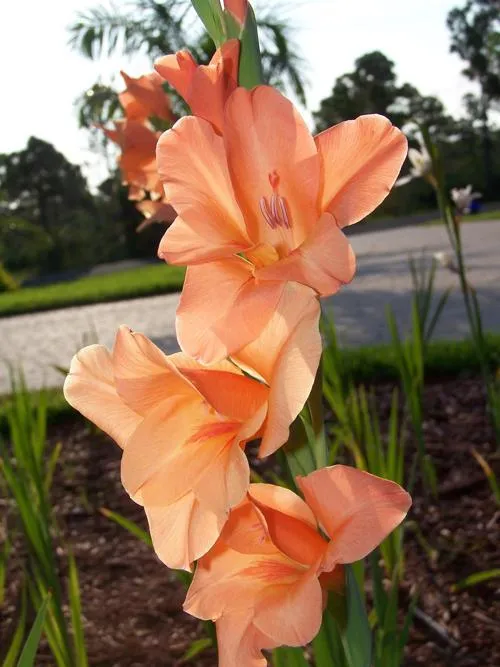
Sword Lily
Gladiolus
How to Identify Sword Lily
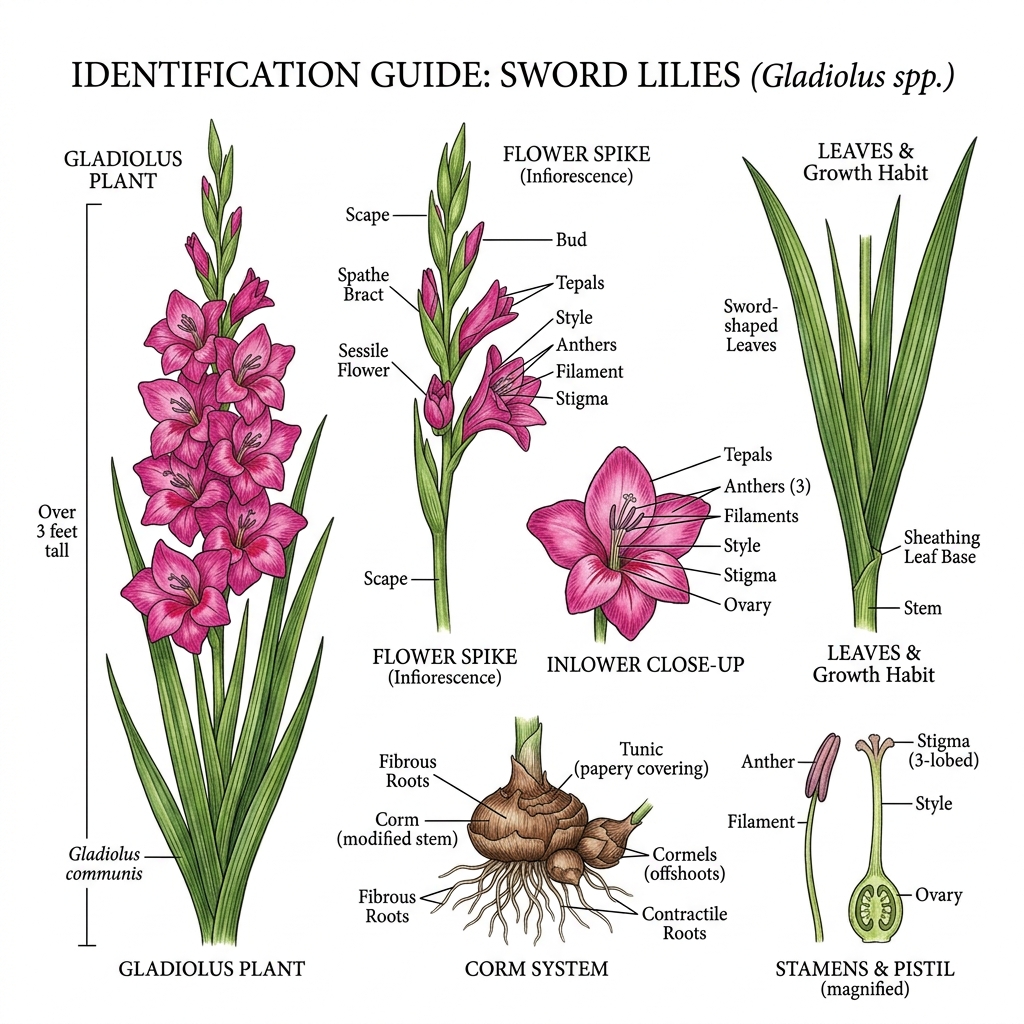
How to identify Sword Lilies (Gladiolus genus):
- Sword-Shaped Leaves: Rigid, flat, upright leaves shaped like sword blades (ensiform), rising from the base.
- One-Sided Flower Spikes: Tall, vertical spikes bearing funnel-shaped, ruffled flowers arranged primarily on one side of the stem.
- Underground Corms: The plant grows from a solid, bulb-like corm wrapped in fibrous tunics.
- Three Stamens: Flowers feature 3 stamens and a single style ending in a 3-lobed stigma.
Types of Gladiolus
Horticulturally, they are classified into three main categories:
- Grandiflora Hybrids: Feature massive, densely packed flowers (up to 30 per spike). Require staking.
- Nanulus (Dwarf) Hybrids: Shorter stems (1-2 feet) that do not require staking. Extremely cold-hardy.
- Primulinus Hybrids: Feature hooded, delicate flowers loosely spaced along the spikes.
Care & Growing Guide
Sword Lily Care & Growing Guide:
- Light: Full sun (at least 6-8 hours of direct sunlight) for strong stalks and dense flower spikes.
- Soil: Sandy, loam-rich, fertile soil with outstanding drainage. Corms will rot in damp, clay soils.
- Watering: Water thoroughly weekly, keeping soil moist but not soggy. Avoid watering the foliage to prevent rust.
- Staking: Stake tall Grandiflora varieties early in the season to prevent them from bending under the weight of the blooms.
Seasonal Blooming & Hardiness
Seasonal Blooming Calendar (US Hardiness Zones 7-10 as perennials; Zones 2-6 as annual corms):
- Native Region: Native to South Africa, the Mediterranean, and Europe, where they bloom in summer dry seasons.
- US Cultivation: Plant corms in spring after frost. In Zones 7-10, they can overwinter in the ground. In Zones 2-6, dig up the corms in autumn, dry them, and store them indoors at 40°F (4°C) for spring replanting. Blooms mid-summer to early autumn.
Bloom Timeline
About Sword Lily
The Sword Lily, botanically classified under the genus Gladiolus and belonging to the family Iridaceae (the iris family), is an exceptionally dramatic, tall, and colorful perennial. Native primarily to the rich grasslands, dry scrub habitats, and mountain valleys of South and East Africa, with a smaller group of species native to the Mediterranean basin and the Arabian Peninsula, this striking genus comprises hundreds of species and tens of thousands of cultivated hybrids.
This erect perennial grows from a specialized, starch-storing underground corm (a bulb-like structure). It gets its dramatic, militaristic common name from its narrow, upright, and highly rigid sword-shaped basal leaves measuring 1 to 3 feet in length. From mid-to-late summer (July through September), it blooms spectacularly, sending up towering, unbranched, and heavy-textured flower spikes standing 2 to 6 feet in height.
Each majestic spike carries a dense, neat, one-sided row of 12 to 30 large, funnel-shaped blossoms measuring 2 to 4 inches across. The flowers open progressively from the bottom of the spike upward over several weeks. They showcase an extraordinary rainbow of colors, ranging from fiery scarlet-reds and hot electric pinks to sunny yellows, deep royal purples, and snow-whites, often with contrasting markings or bicolored throats.
The reproductive morphology of individual flowers is represented by the iris-family floral formula Br ⊕ ⚥ P(3+3) A3+3 G(3). This formula indicates that each flower is supported by a bract (Br), is bisexual, and exhibits radial symmetry (actinomorphic) in its perianth. The perianth consists of 6 petaloid tepals in two whorls of three fused at their bases into a curved tube. The androecium contains 6 stamens fused to the tepal tube, and the gynoecium contains 3 fused carpels forming a 3-locular inferior ovary.
The common name 'Sword Lily' and genus name 'Gladiolus' are derived from the ancient Latin word 'gladius,' which translates to sword, direct references to its sharp-edged, blade-like foliage. Famed in Sanskrit as Gladiolas (ग्लाडियोलस) and in Hindi as Glediyolas (ग्लेडियोलस), it holds deep cultural value in the language of flowers, symbolizing moral integrity, strength of character, infatuation, and never giving up.
For pet owners and veterinarians, the Sword Lily represents an extreme clinical hazard. The plant is classified as HIGHLY TOXIC & LETHAL TO PETS, including dogs, cats, and horses. All parts of the plant are hazardous, but the underground corms contain the highest concentrations of toxic, tissue-irritating glycosides and alkaloids. If chewed or swallowed, ingestion triggers severe oral drooling, vomiting, diarrhea (often bloody), abdominal pain, extreme lethargy, low blood pressure, and cardiac arrhythmia. For general guidance on managing toxic garden bulbs, visit our general Pet Guard page.
Sword Lily is occasionally confused with canna lilies or bearded irises. It is easily distinguished because true Gladiolus produces a highly rigid, unbranched spike of one-sided funnel flowers and narrow sword-shaped leaves, whereas canna lilies have massive, broad banana-like leaves. It is a premier cutting garden centerpiece; we recommend pairing it beside other summer-flowering favorites like Tuberose-rajinigandha or Canna Lily. To explore more spectacular summer spikes, browse our Flower Identifier.
For more botanical profiles and flower identification features, see our guides on Stemless Gentian and Tanner's Cassia.
Floral Formula & Features
This formula indicates the flower is bisexual (⚥), actinomorphic (⊕), has a perianth with 6 tepals in two whorls (P(3+3)), 6 stamens with the androecium attached to the tepals (A3+3), and a superior, tricarpellary, syncarpous (united) ovary (G(3))
- Scientific Name & Classification: Gladiolus (Iridaceae). Globally famed as Sword Lily, Gladiolus Hybrids, and Gladiola.
- Identification Markers: Upright growth from underground corms, stiff sword-shaped leaves, and towering unbranched flower spikes carrying one-sided rows of large funnel-shaped blossoms.
- Floral Formula (Br ⊕ ⚥ P(3+3) A3+3 G(3)): Radially symmetrical, bisexual flowers with 6 fused tepals in a tube, 6 epipetalous stamens, and an inferior ovary.
- Growing Requirements: Full intense direct sun (6-8 hours daily); average, organically rich, sandy-loam, highly well-draining soils. Tall spikes require staking (Zones 7-10).
- Cultural Significance: Name comes from Latin 'gladius' (sword) due to blade-like leaf shape. Symbolizes strength of character, moral integrity, and infatuation in flower lore.
- Safety & Toxicity: HIGHLY TOXIC & LETHAL TO PETS. Fleshy corms contain highly concentrated toxic glycosides, causing severe drooling, bloody vomiting, diarrhea, lethargy, and arrhythmia.
- Common Look-alikes: Confused with Canna Lilies, but easily distinguished by its narrow blade-like leaves and highly structured, one-sided row of trumpet blossoms.
- Internal Links: Creates a towering, majestic vertical focus when planted in sunny beds beside other summer favorites like Tuberose-rajinigandha or Canna Lily; find more in our Flower Identifier.
Names in Different Languages
Botanical Classification: Sword Lily belongs to the Iridaceae family. Learn how to identify its floral symmetry, stamen arrangement, and structural formulas in our Botanical Family Classification Guide.
Toxicity & Safety
Always keep toxic plants out of reach of children and pets. Consult a veterinarian or medical professional immediately if ingestion is suspected.
Frequently Asked Questions
What is Floral Formula?
A floral formula is a symbolic representation of a flower's structure using letters, numbers, and special symbols. It provides a concise way to describe the arrangement and number of floral parts.
This formula describes the flower's symmetry, sepals, petals, stamens, and carpels in a standardized format.
Formula Sequence
- Bract: Br or Ebr
- Bracteole: Brl or Ebrl
- Symmetry: % (Radial) or ⊕ (Bilateral)
- Sex: ♀ (Female), ♂ (Male), or ⚥ (Bisexual)
- Calyx/Sepal: K<number> (Free or Fused)
- Corolla/Petal: C<number> (Free or Fused)
- Androecium: A<number> (Free or Fused)
- Gynaecium: G<number> (Superior or Inferior Ovary)
Symbol Meanings
- Numbers: Indicate quantity of parts
- Parentheses (): Parts are fused together
- Plus (+): Parts in different whorls
- Underline: Superior ovary position
- Overline: Inferior ovary position
- ∞: Numerous parts (too many to count)
Understanding floral formulas helps botanists quickly identify and classify flowers based on their structural characteristics.
Similar Flowers
Discover flowers that share botanical characteristics
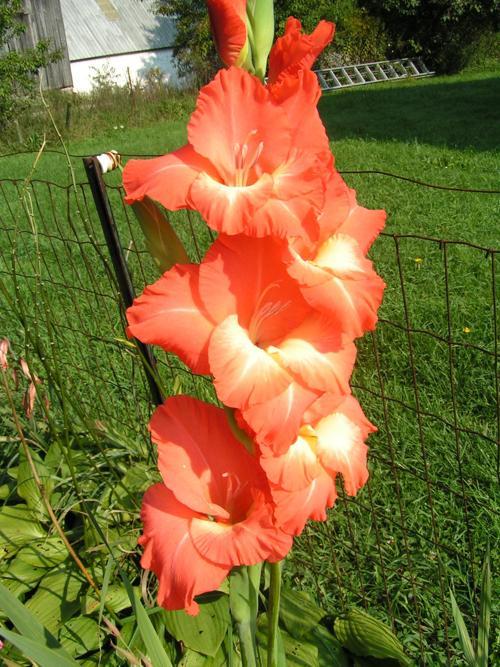
Same Family
4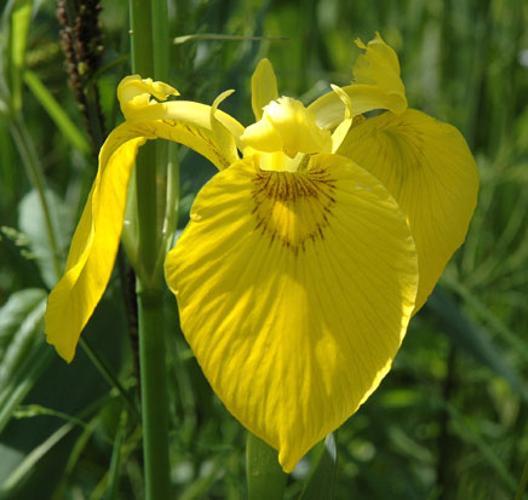
Yellow Iris
Iris pseudacorus
The Yellow Iris, scientifically classified as Iris pseudacorus and commonly known as the Yellow Flag or Water Flag, is a striking, highly vigorous wetland perennial plant belonging to the Iridaceae (iris) family. Native to Europe, Western Asia, and North Africa, this species thrives naturally in...
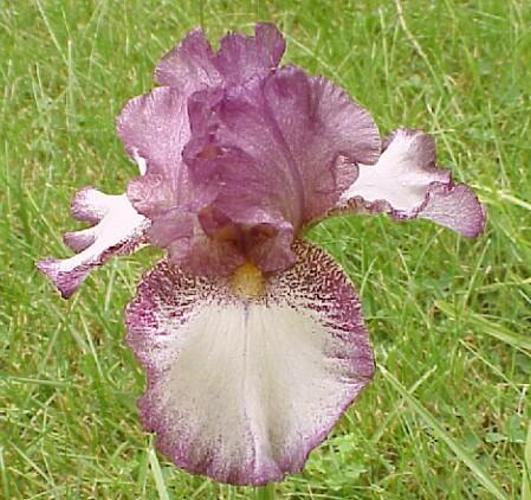
Bearded Iris
Iris germanica
The Bearded Iris, botanically designated under the genus *Iris* (particularly *Iris germanica*), is an exceptionally elegant, highly popular hardy perennial. Belonging to the family Iridaceae (the iris family, tribe Irideae), this spectacular garden favorite is native to the dry, sunny slopes and...
Spring Crocus
Crocus vernus
The Spring Crocus (Crocus vernus), also known as the Giant Crocus or Dutch Crocus, is a delicate, diminutive perennial belonging to the Iridaceae (Iris) family. Native to the alpine meadows and woodlands of central and southern Europe, it has become a globally beloved symbol of the end of winter....
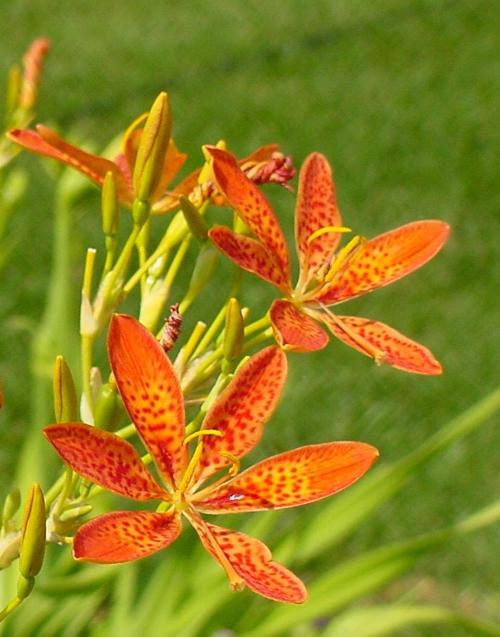
Leopard Lily
Iris domestica (syn. Belamcanda chinensis)
The Leopard Lily, botanically designated as *Iris domestica* (previously classified as *Belamcanda chinensis*, and commonly known as the Blackberry Lily or Leopard Flower), is an exceptionally distinct, highly ornamental perennial. Belonging to the family Iridaceae (the iris family, tribe Irideae...
Similar Characteristics
4
Arum Lily
Zantedeschia aethiopica
The Arum Lily, botanically designated as Zantedeschia aethiopica and universally celebrated as the Calla Lily, is an exceptionally elegant, clump-forming rhizomatous perennial. Belonging to the family Araceae (the arum or aroid family), this majestic plant is native to the streams, damp marshland...
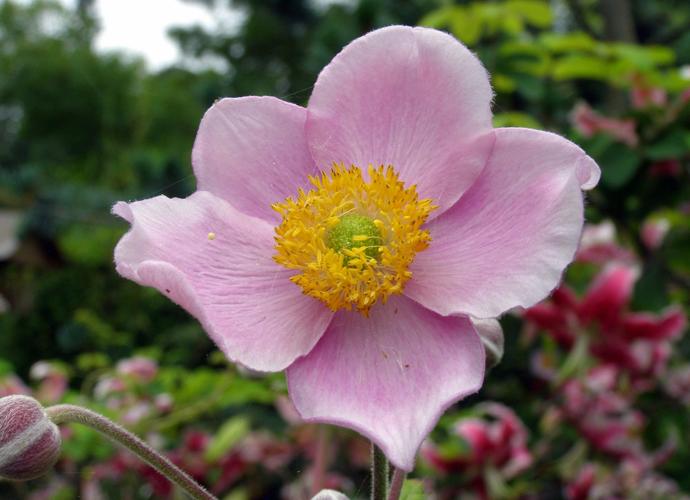
Japanese anemone
Anemone hupehensis, Anemone hybrida
The Japanese Anemone, botanically classified as Anemone hupehensis (and recently reclassified under the genus Eriocapitella), is an exceptionally graceful, late-blooming herbaceous perennial belonging to the Ranunculaceae (buttercup) family. Despite its common name, this elegant species is native...
Bearded Iris
Iris germanica
The Bearded Iris, botanically designated under the genus *Iris* (particularly *Iris germanica*), is an exceptionally elegant, highly popular hardy perennial. Belonging to the family Iridaceae (the iris family, tribe Irideae), this spectacular garden favorite is native to the dry, sunny slopes and...
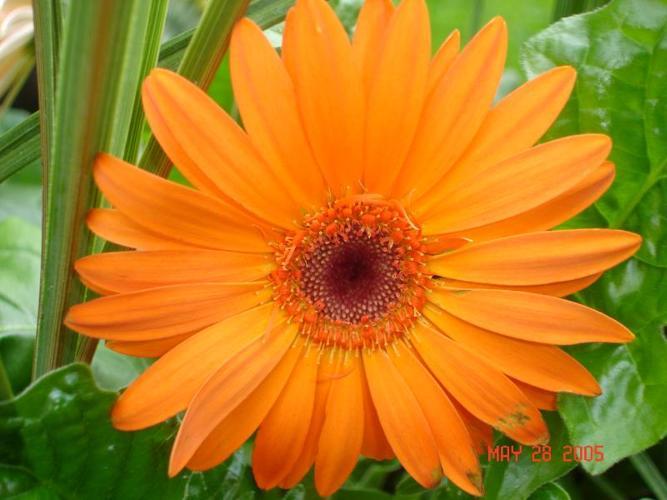
Barberton Daisy
Gerbera jamesonii
The Barberton Daisy, botanically known as Gerbera jamesonii and widely cherished as the Gerbera Daisy or Transvaal Daisy, is an exceptionally cheerful and colorful herbaceous perennial in the Asteraceae (sunflower) family. Native to the rich, subtropical valleys and grassy slopes of South Africa'...