
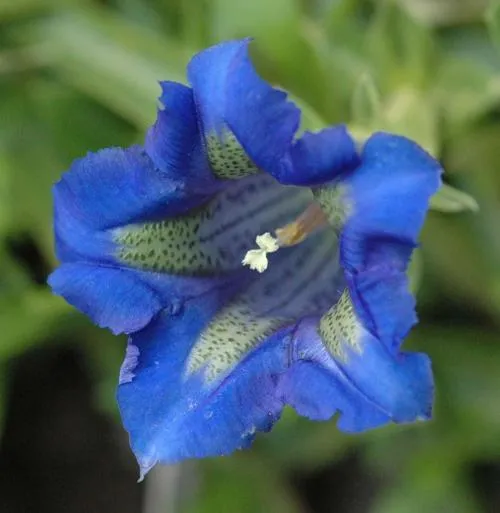
Stemless Gentian
Gentiana acaulis
How to Identify Stemless Gentian
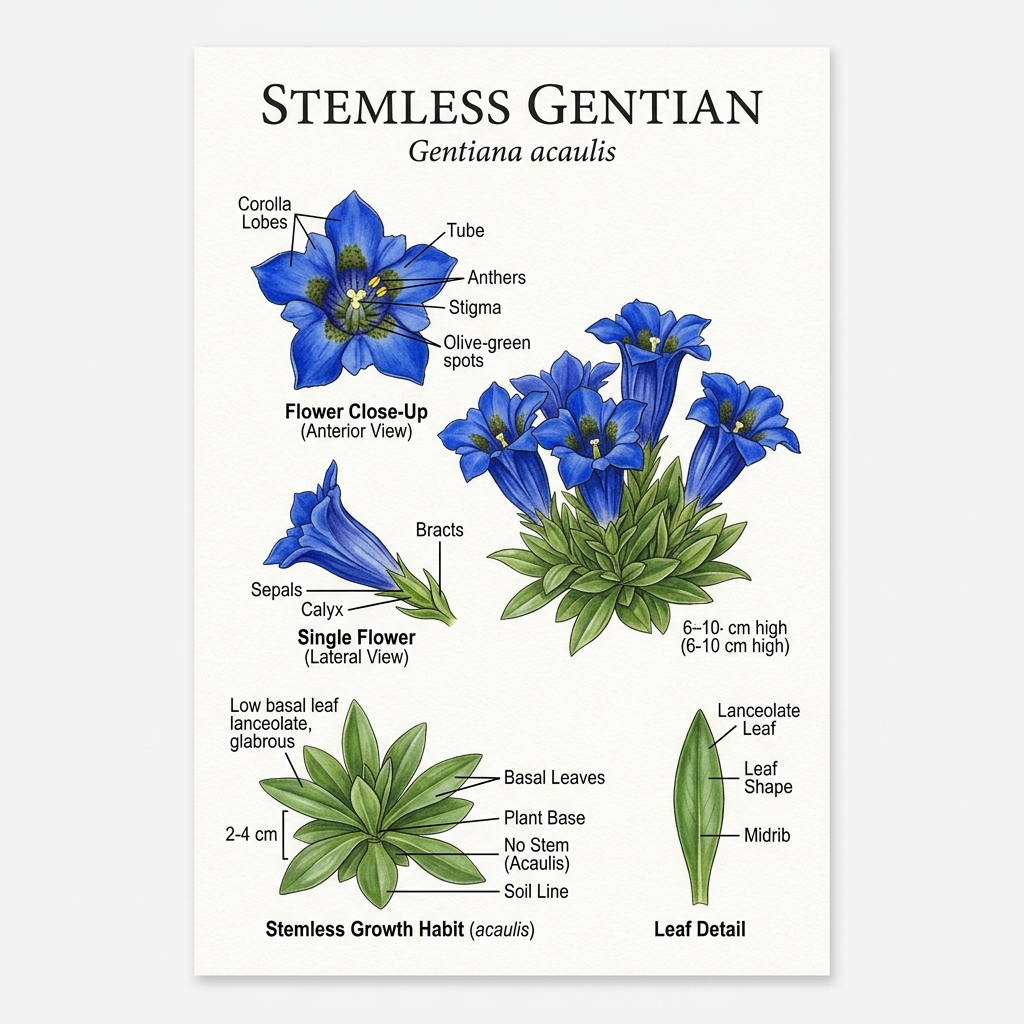
How to identify Stemless Gentian (Gentiana acaulis / Trumpet Gentian):
- Intense Royal Blue Trumpets: Large, upright, trumpet-shaped flowers (up to 2 inches long) of a vivid, deep cobalt-blue color.
- Acaulis (Stemless) Habit: Flowers appear stemless, sitting directly on top of a low, flat rosette of green leaves.
- Spotted Corolla Throat: The interior throat of the blue flower tube features distinct olive-green or yellowish-green spots and stripes.
- Lance-Shaped Rosette Leaves: Clumps of small, opposite, smooth, lance-shaped leaves forming a dense ground-hugging mat.
Alpine Gentian Characteristics
Care & Growing Guide
Stemless Gentian Care & Growing Guide (Ideal for Rock Gardens):
- Light: Full sun to partial afternoon shade. In hot regions, morning sun and afternoon shade are critical.
- Soil: Moist, gritty, humic, and highly permeable gravelly rock-garden soil. Roots must remain cool and well-aerated.
- Watering: Keep soil damp. Water regularly during dry summer weeks, but avoid stagnant, soggy conditions.
- Propagation: Best propagated by dividing clumps in early spring or sowing fresh seeds in autumn.
Seasonal Blooming & Hardiness
Seasonal Blooming Calendar (US Hardiness Zones 3-8):
- Native Region: Native to the high alpine meadows and rocky pastures of central and southern Europe (Alps, Pyrenees, Carpathians) at altitudes up to 9,000 feet, blooming from May to August immediately after snowmelt.
- US Cultivation: Best grown in cool-summer regions (Zones 3-8). Blooms from mid-spring to early summer (May to June).
Bloom Timeline
About Stemless Gentian
The Stemless Gentian, botanically classified as Gentiana acaulis and commonly known as the Trumpet Gentian, Large-flowered Gentian, or Gentianella, is an exceptionally exquisite, low-growing alpine perennial. Belonging to the family Gentianaceae (the gentian family, tribe Gentianeae), this high-altitude wildflower is native to the windy, sun-drenched alpine pastures, grassy meadows, and lime-rich rocky screes of the southern and central European mountains—including the Alps, Pyrenees, Carpathians, and northern Balkans—thriving at elevations ranging from 4,000 to 9,000 feet (1,200 to 2,700 meters).
This charming perennial is a compact, mat-forming herb standing a mere 2 to 4 inches (5 to 10 cm) tall in full bloom, with a slow-spreading evergreen rosette measuring 6 to 12 inches across. It features dense, spreading mats of thick, dark green, glossy, and leathery leaves that are oval to lance-shaped and measure 1 to 2 inches in length. In late spring and early summer (May through July), it produces spectacularly large, upright, and bell-shaped solitary flowers measuring 2 to 3 inches long.
The flowers sit directly atop the evergreen leaf rosettes on almost virtually nonexistent flower stems, giving rise to its botanical name 'acaulis' (meaning stemless). The blossoms are celebrated for their extraordinarily intense, radiant shade of deep royal blue (known universally as 'gentian blue') accented with striking olive-green spots and dark longitudinal stripes running down the interior throat of the trumpet. Individual flowers open widely during sunny days and close up tightly in cloudy weather or shade.
The radially symmetrical reproductive morphology of Gentiana acaulis is represented by the family-specific floral formula EBr ⊕ ⚥ K(5) C(5) A5 G(2). This formula states that the flowers are ebracteate (lacking bracts), actinomorphic, and bisexual. The calyx is composed of 5 fused, angular sepals forming a protective green tube, and the corolla has 5 fused petals forming the large bell-shaped tube with 5 small, pleated lobes. The androecium contains 5 stamens attached directly to the inside corolla tube, and the gynoecium contains 2 fused carpels with a superior ovary.
The genus name Gentiana honors King Gentius of ancient Illyria, who is credited in classical texts with discovering the powerful tonic and fever-reducing qualities of these mountain plants. Famed in Sanskrit as Shankhapushpi (शंखपुष्पी) and in Hindi as Chireta (चिरेता) or Kutki (कुटकी), it is known as 'Enzian' in Germany, acting as a legendary national symbol of Bavaria and the Alps. Its bitter-tasting roots are used to manufacture traditional digestive bitters and liqueurs.
For pet owners and veterinarians, the Stemless Gentian represents an exceptionally safe, low-risk, and pet-safe rock garden choice. Gentiana acaulis is classified as completely NON-TOXIC to cats, dogs, and horses by major global animal safety databases. If an active dog or curious cat brushes past its low rosettes or accidentally nibbles on its leathery green foliage or deep blue trumpets, there is absolutely no danger of chemical poisoning. To explore more safe alpine and rock garden selections, visit our general Pet Guard page.
Stemless Gentian is occasionally confused with alpine bellflowers or bluebells. It is easily distinguished because true Gentiana acaulis produces stemless, upright, intensely deep 'gentian blue' flowers with olive-green spotted throats nesting directly on a flat, ground-hugging leaf rosette, whereas bellflowers have drooping blooms on tall stems. It is a premier selection for rockeries beside other cold-hardy favorites like Primrose-primula or Columbine-aquilegia. For more rock garden species, browse our Flower Identifier.
For more botanical profiles and flower identification features, see our guides on AngelWing Jasmine (Star Jasmine) and Sword Lily.
Floral Formula & Features
Ebracteate, radially symmetrical (actinomorphic), bisexual, 5 fused sepals forming tube, 5 fused petals forming bell-shaped corolla with pleated lobes, 5 stamens attached to corolla tube, 2 fused carpels with superior ovary. Typical of Gentianaceae family
- Scientific Name & Classification: Gentiana acaulis (Gentianaceae). Globally famed as Stemless Gentian, Trumpet Gentian, and Large-flowered Gentian.
- Identification Markers: Low-growing ground-hugging rosette, evergreen leathery glossy leaves, and solitary 2-3 inch trumpet-shaped flowers in radiant deep blue with green-spotted throats.
- Floral Formula (EBr ⊕ ⚥ K(5) C(5) A5 G(2)): Radially symmetrical, bisexual flowers with 5 fused sepals forming a tube, 5 fused petals forming pleated trumpet lobes, 5 stamens, and superior ovary.
- Growing Requirements: Full direct morning sun with cool afternoon shade; gritty, gravelly, lime-rich, exceptionally well-draining soils. Highly cold-hardy (Zones 3-7).
- Cultural Significance: Famed Bavarian national symbol of the Alps known as 'Enzian.' Famed in Sanskrit as 'Shankhapushpi.' Roots used to brew traditional bitter digestive liqueurs.
- Safety & Toxicity: NON-TOXIC. 100% safe for cats, dogs, and horses. Provides an extremely unique, cold-hardy, and completely pet-safe choice for alpine container troughs and rockeries.
- Common Look-alikes: Confused with Alpine Bellflowers, but easily distinguished by its ground-hugging, stemless blooming habit and the green-spotted throat patterns.
- Internal Links: Embellishes alpine troughs and gravelly borders beautifully when paired with other low-growing spring favorites like Primrose-primula or Columbine-aquilegia; find more in our Flower Identifier.
Names in Different Languages
Toxicity & Safety
Frequently Asked Questions
What is Floral Formula?
A floral formula is a symbolic representation of a flower's structure using letters, numbers, and special symbols. It provides a concise way to describe the arrangement and number of floral parts.
This formula describes the flower's symmetry, sepals, petals, stamens, and carpels in a standardized format.
Formula Sequence
- Bract: Br or Ebr
- Bracteole: Brl or Ebrl
- Symmetry: % (Radial) or ⊕ (Bilateral)
- Sex: ♀ (Female), ♂ (Male), or ⚥ (Bisexual)
- Calyx/Sepal: K<number> (Free or Fused)
- Corolla/Petal: C<number> (Free or Fused)
- Androecium: A<number> (Free or Fused)
- Gynaecium: G<number> (Superior or Inferior Ovary)
Symbol Meanings
- Numbers: Indicate quantity of parts
- Parentheses (): Parts are fused together
- Plus (+): Parts in different whorls
- Underline: Superior ovary position
- Overline: Inferior ovary position
- ∞: Numerous parts (too many to count)
Understanding floral formulas helps botanists quickly identify and classify flowers based on their structural characteristics.
Similar Flowers
Discover flowers that share botanical characteristics
Similar Characteristics
4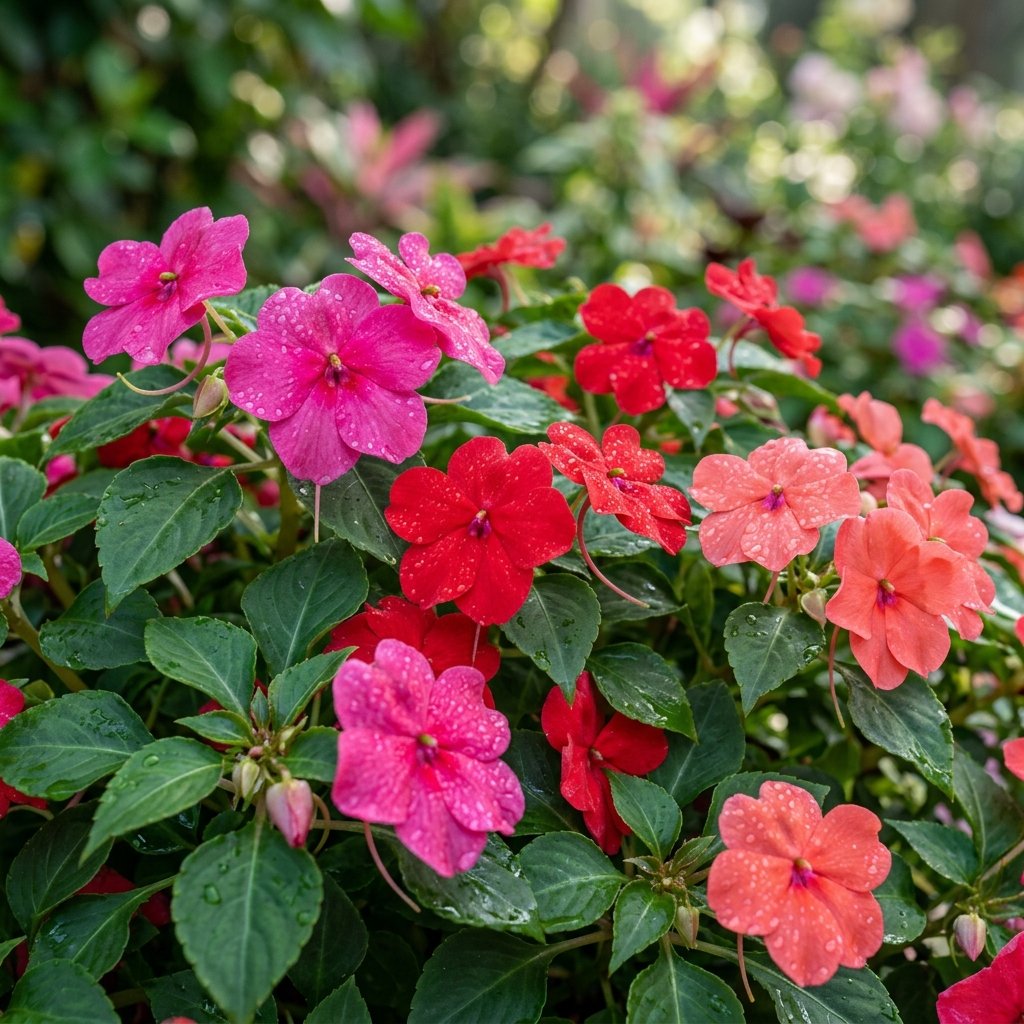
Impatiens Walleriana
Impatiens walleriana
Impatiens Walleriana, botanically classified as *Impatiens walleriana* and universally celebrated across the gardening world as Busy Lizzie, Sultana, or Patient Lucy, is an exceptionally popular, prolific, and shade-tolerant herbaceous perennial commonly cultivated as an annual. Belonging to the...
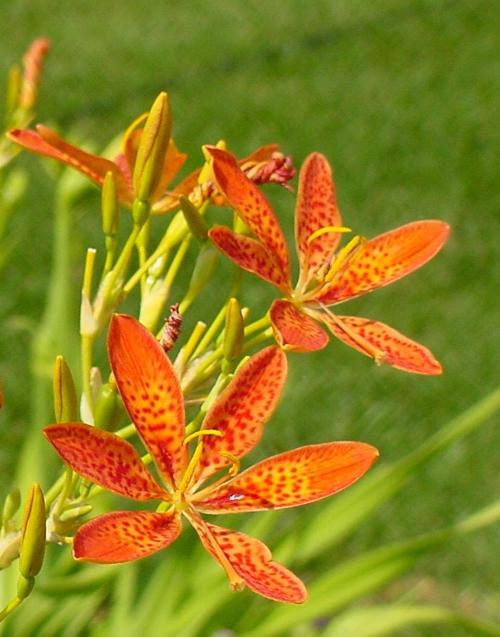
Leopard Lily
Iris domestica (syn. Belamcanda chinensis)
The Leopard Lily, botanically designated as *Iris domestica* (previously classified as *Belamcanda chinensis*, and commonly known as the Blackberry Lily or Leopard Flower), is an exceptionally distinct, highly ornamental perennial. Belonging to the family Iridaceae (the iris family, tribe Irideae...
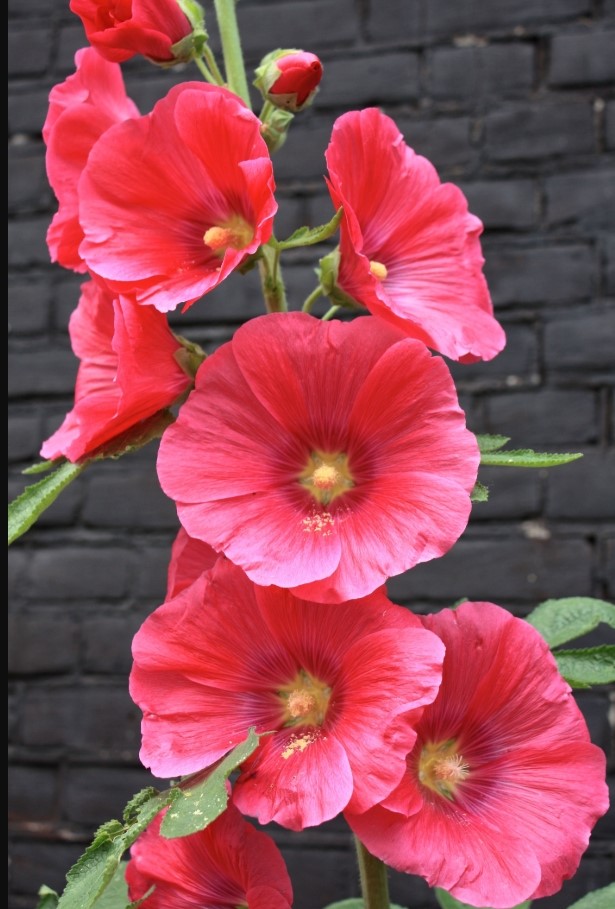
Hollyhock
Alcea rosea
The Hollyhock, botanically designated as Alcea rosea and belonging to the family Malvaceae (the mallow or hibiscus family), is a majestic, towering, and deeply romantic cottage garden classic. Native to the warm, temperate meadows, rocky slopes, and open woodlands of Turkey and southwestern Asia,...
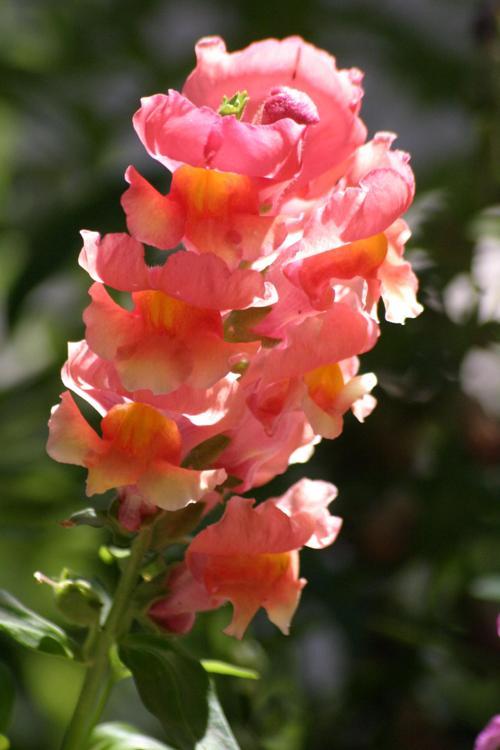
Antirrhinum
Antirrhinum
The Snapdragon, botanically designated as Antirrhinum majus and belonging to the family Plantaginaceae (the plantain family, formerly grouped under Scrophulariaceae), is an exceptionally charming and iconic herbaceous perennial. Native to the rocky screes, ancient ruins, and coastal cliffs of the...