
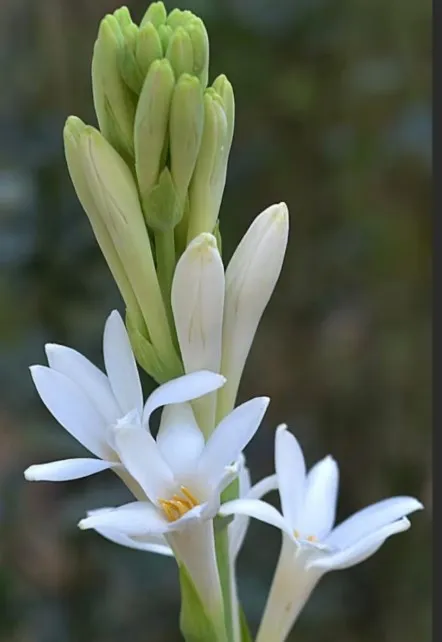
Tuberose Rajinigandha
Polianthes tuberosa
How to Identify Tuberose Rajinigandha
NON-TOXIC. 100% safe for cats, dogs, and horses. Provides an outstanding, pet-safe, and highly fragrant cut flower that perfumes entire rooms.
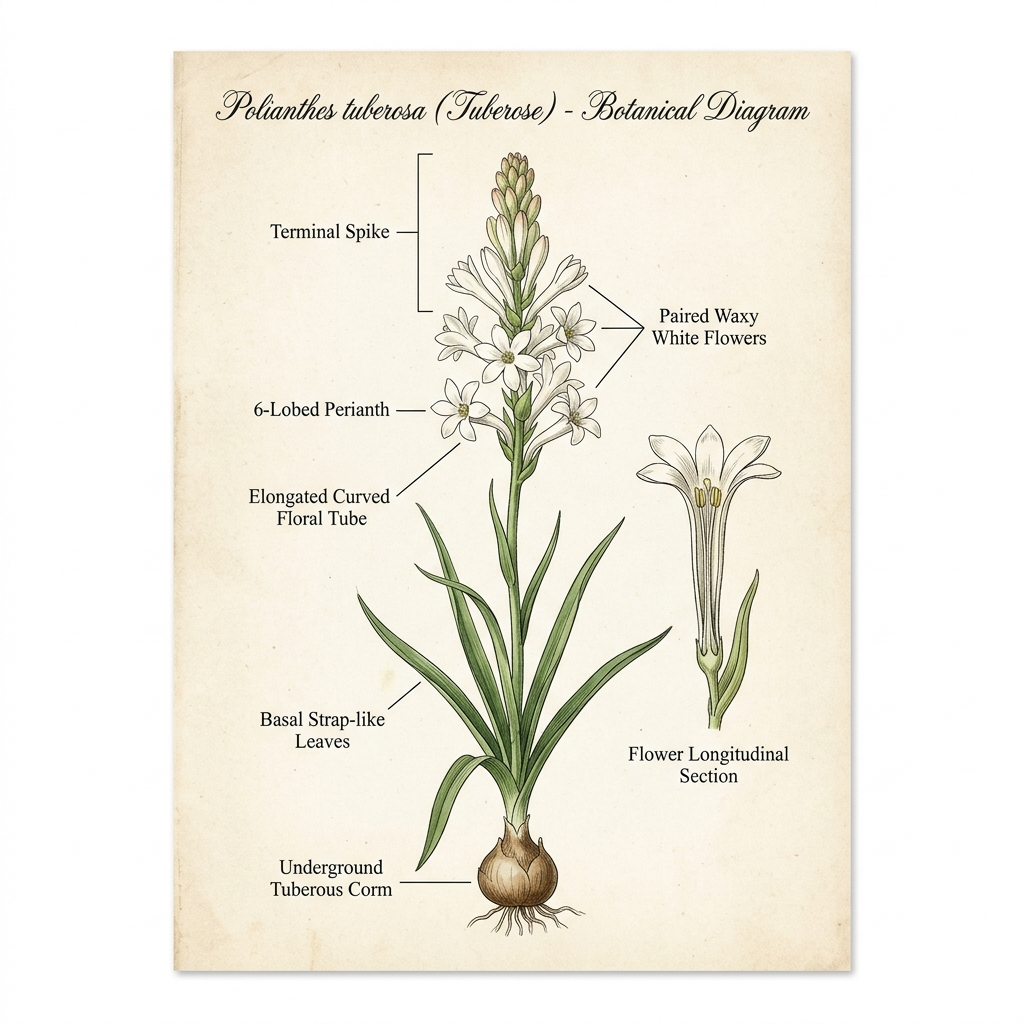
A detailed guide to identifying Tuberose Rajnigandha (Polianthes tuberosa) by its key botanical features:
- Paired Waxy White Flowers: Pure white to creamy porcelain blossoms arranged along an erect central spike in distinct opposite pairs.
- Tubular Funnel-shaped Perianth: Flowers feature an elongated, gracefully curved floral tube that flares open into six spreading, thick waxy petal lobes (tepals).
- Tall Stately Spikes: Unbranched, rigid flowering spikes standing 2 to 3.5 feet tall, blooming sequentially from the bottom upwards.
- Basal Strap-like Foliage: Clustered, grass-like, linear-lanceolate green leaves measuring 1 to 1.5 feet in length, channeled down the middle with reddish-spotted bases.
- Underground Tuberous Rootstock: Solid, bulb-like tuberous rhizome surrounded by fibrous rootlets and producing numerous clustered daughter bulblets.
- Intoxicating Nocturnal Fragrance: Flowers release an exceptionally powerful, sweet, exotic floral perfume that peaks in the evening hours.
Varieties & Cultivar Types of Tuberose
- By Flower Form:
- Single Flowered (e.g., 'Mexican Single', 'Prajwal', 'Shringar'): Features a single whorl of 6 spreading tepals with an open throat; prized for maximum essential oil extraction and cut-flower longevity.
- Double Flowered (e.g., 'The Pearl', 'Suvasini', 'Vaibhav'): Features multiple densely overlapping layers of ruffled white tepals, often tinged with pinkish-purple blush on the tips in cool weather.
- Semi-Double Varieties: Intermediate forms with 2 to 3 rows of corolla lobes.
- By Foliage Cultivation:
- Variegated Tuberose ('Silver Line', 'Gold Bound'): Showcases golden-yellow or creamy-white margins on linear basal leaves.
Care & Growing Guide
Tuberose Rajnigandha Care & Growing Guide:
- Light: Full direct sun (at least 6 to 8 hours daily). Hot, sunny locations are essential for flower bud initiation.
- Soil: Rich, organically fertile, sandy-loam soil with superior drainage (pH 6.5 to 7.5). Avoid heavy waterlogged clays which cause tuber rot.
- Watering: Water consistently once growth sprouts, keeping soil evenly moist during the active growing and flowering season. Reduce watering as foliage naturally declines in autumn.
- Feeding & Maintenance: Feed with a balanced slow-release bulb fertilizer or high-phosphorus organic compost every 4 to 6 weeks during summer. Stake tall spikes in windy locations.
Seasonal Blooming & Hardiness
Seasonal Blooming Calendar (US Hardiness Zones 8-11 as perennial; Zones 3-7 as lifted summer bulb):
- Peak Bloom: Mid-summer to mid-autumn (typically July through October); flowers 90-120 days after spring planting.
- Planting Time: Plant dormant tubers 2-3 inches deep in late spring once soil temperatures reach 70°F (21°C).
- Overwintering: In Zones 7 and below, dig up tubers after the first autumn frost, air-dry for 10-14 days, and store in dry peat moss or sawdust at 50-55°F (10-13°C) until spring.
Bloom Timeline
About Tuberose Rajinigandha
The Tuberose, botanically designated as Polianthes tuberosa (and recently reclassified as Agave amica) and universally celebrated in southern Asia as Rajnigandha, is an exceptionally exquisite, tuberous perennial. Belonging to the family Asparagaceae (the asparagus family, subfamily Agavoideae), this historic plant is native to the central highlands, volcanic fields, and warm sunny valleys of Mexico, where it was cultivated extensively by the Aztecs as an offering and a source of essential oils long before European colonization.
This elegant perennial grows from thick, fleshy, mud-anchored underground tubers (rhizomes). It produces a dense clump of long, narrow, grass-like basal leaves measuring 1 to 2 feet long, and sends up towering, unbranched, and highly rigid flower spikes standing 2 to 4 feet in height. From mid-to-late summer (July through September), it blooms, carrying 12 to 45 waxy, cream-white tubular flowers measuring 1.5 to 2.5 inches long, arranged in highly distinctive, neat, opposite pairs along the spike.
Individual flowers are trumpet-shaped, featuring a thick waxy texture that makes them incredibly durable. Single cultivars have a single row of 6 petals, while double cultivars (commonly called Pearl Tuberose) showcase multiple overlapping rows, creating a dense rose-like shape. Tuberose is legendary for its powerful, sweet, and complex floral perfume, which is released most intensely after sunset to attract its natural nocturnal pollinators, filling entire gardens and rooms with an intoxicating scent.
The reproductive morphology of Polianthes tuberosa is represented by the Agavaceae floral formula ⊕ ⚥ P(3+3) A6 G(3). This formula states that the flowers are radially symmetrical (actinomorphic) and bisexual. The perianth consists of 6 petaloid tepals fused at their bases to form a long, narrow, curved tubular structure that opens into 6 spreading lobes, arranged in two whorls of three. The androecium contains 6 free stamens attached directly to the inside of the tube, and the gynoecium contains 3 fused carpels with a superior ovary.
The genus name Polianthes is derived from the Greek words 'polios,' meaning white or gray, and 'anthos,' meaning flower. Famed in Sanskrit as Rajnigandha (रजनीगन्धा, literally translating to 'the fragrance of the night') and in Hindi as Rajnigandha, it carries immense cultural and spiritual value. In Hindu weddings, ceremonies, and temples, it is highly sacred, widely woven into dense garlands, and used in traditional perfumery to extract luxury 'attar' oils.
For pet owners and veterinarians, the Tuberose represents an exceptionally safe, low-risk, and pet-friendly choice. Polianthes tuberosa is classified as completely NON-TOXIC to cats, dogs, and horses by major global veterinary databases. Unlike true lilies (Lilium species), it contains no toxic alkaloids or resins, making it a wonderful, worry-free option for garden beds and fragrant indoor arrangements. To discover more safe, aromatic summer-blooming bulbs, visit our general Pet Guard page.
Tuberose is occasionally confused with white gladiolas or standard lilies. It is easily distinguished because true Tuberose produces waxy, twin-paired white flowers along rigid stems and possesses an incredibly powerful, sweet, and unique evening perfume, whereas gladiolas have one-sided flower rows and lack fragrance. It is a centerpiece for evening gardens; we recommend pairing it beside other summer stalwarts like Gladiolus, December-barleria, or evening-blooming Four o'Clock. To explore more fragrant summer bulbs, browse our Flower Identifier.
Floral Formula & Features
Radially symmetrical, bisexual, 6 fused tepals in 2 whorls of 3 forming tubular perianth, 6 free stamens, 3 fused carpels with superior ovary typical of Asparagaceae subfamily Agavoideae
- Scientific Name & Classification: Polianthes tuberosa (Asparagaceae). Globally famed as Rajnigandha, Mexican Tuberose, and Mistress of the Night.
- Identification Markers: Fleshy underground tubers, long grass-like basal leaves, and tall rigid spikes carrying intensely fragrant waxy white tubular flowers in pairs.
- Floral Formula (⊕ ⚥ P(3+3) A6 G(3)): Radially symmetrical, bisexual flowers with 6 fused tepals in a curved tube, 6 epipetalous stamens, and superior ovary.
- Growing Requirements: Full direct sun (6-8 hours daily); rich, organic, sandy-loam, highly well-draining soils. Highly frost-sensitive; lift tubers in winter (Zones 8-11).
- Cultural Significance: Sanskrit name 'Rajnigandha' means 'night-fragrance' due to evening scent release. Sacred temple flower in India; major source for high-end perfumery.
- Safety & Toxicity: NON-TOXIC. 100% safe for cats, dogs, and horses. Provides an outstanding, pet-safe, and highly fragrant cut flower that perfumes entire rooms.
- Common Look-alikes: Confused with white Gladiolas or lilies, but easily distinguished by its thick waxy twin-paired white blossoms and intense, sweet night perfume.
- Internal Links: Creates a beautiful, sweet-scented sensory display when planted in sunny beds alongside summer-flowering favorites like Gladiolus, December-barleria, or Four o'Clock; find more in our Flower Identifier.
Names in Different Languages
Toxicity & Safety
Frequently Asked Questions
What is Floral Formula?
A floral formula is a symbolic representation of a flower's structure using letters, numbers, and special symbols. It provides a concise way to describe the arrangement and number of floral parts.
This formula describes the flower's symmetry, sepals, petals, stamens, and carpels in a standardized format.
Formula Sequence
- Bract: Br or Ebr
- Bracteole: Brl or Ebrl
- Symmetry: % (Radial) or ⊕ (Bilateral)
- Sex: ♀ (Female), ♂ (Male), or ⚥ (Bisexual)
- Calyx/Sepal: K<number> (Free or Fused)
- Corolla/Petal: C<number> (Free or Fused)
- Androecium: A<number> (Free or Fused)
- Gynaecium: G<number> (Superior or Inferior Ovary)
Symbol Meanings
- Numbers: Indicate quantity of parts
- Parentheses (): Parts are fused together
- Plus (+): Parts in different whorls
- Underline: Superior ovary position
- Overline: Inferior ovary position
- ∞: Numerous parts (too many to count)
Understanding floral formulas helps botanists quickly identify and classify flowers based on their structural characteristics.
Similar Flowers
Discover flowers that share botanical characteristics
Similar Characteristics
4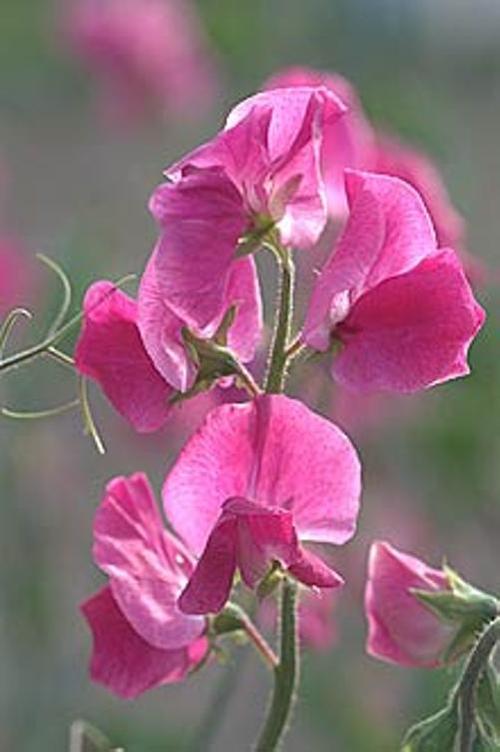
Sweet Pea
Lathyrus odoratus
The Sweet Pea (Lathyrus odoratus) is a highly romanticized, climbing annual vine belonging to the Fabaceae (legume) family. Native to the Mediterranean regions of Sicily, southern Italy, and the Aegean Islands, it became an absolute sensation in Victorian England, where intensive botanical breedi...
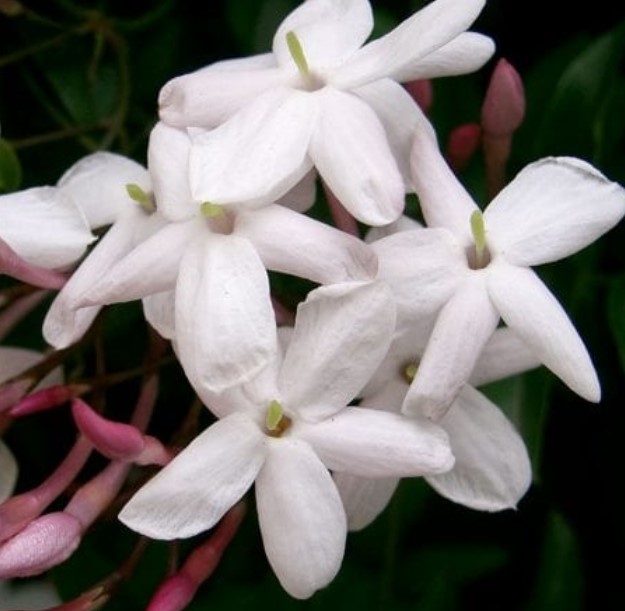
Spanish Jasmine (Royal Jasmine)
Jasminum grandiflorum
Spanish Jasmine, botanically classified as Jasminum grandiflorum and widely known as Royal Jasmine, Catalan Jasmine, or Scented Jasmine, is an exceptionally fragrant semi-evergreen woody vine belonging to the Oleaceae (olive) family. Believed to have originated in the high valleys of the Himalaya...
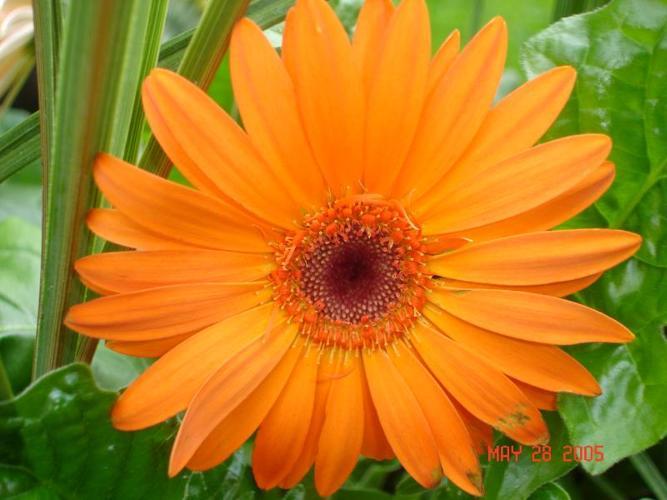
Barberton Daisy
Gerbera jamesonii
The Barberton Daisy, botanically known as Gerbera jamesonii and widely cherished as the Gerbera Daisy or Transvaal Daisy, is an exceptionally cheerful and colorful herbaceous perennial in the Asteraceae (sunflower) family. Native to the rich, subtropical valleys and grassy slopes of South Africa'...
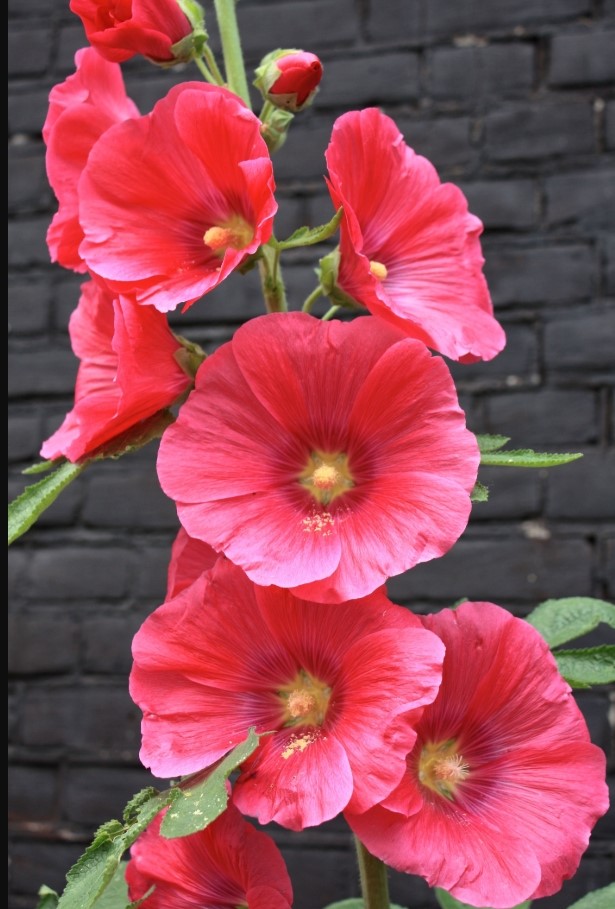
Hollyhock
Alcea rosea
The Hollyhock, botanically designated as Alcea rosea and belonging to the family Malvaceae (the mallow or hibiscus family), is a majestic, towering, and deeply romantic cottage garden classic. Native to the warm, temperate meadows, rocky slopes, and open woodlands of Turkey and southwestern Asia,...