
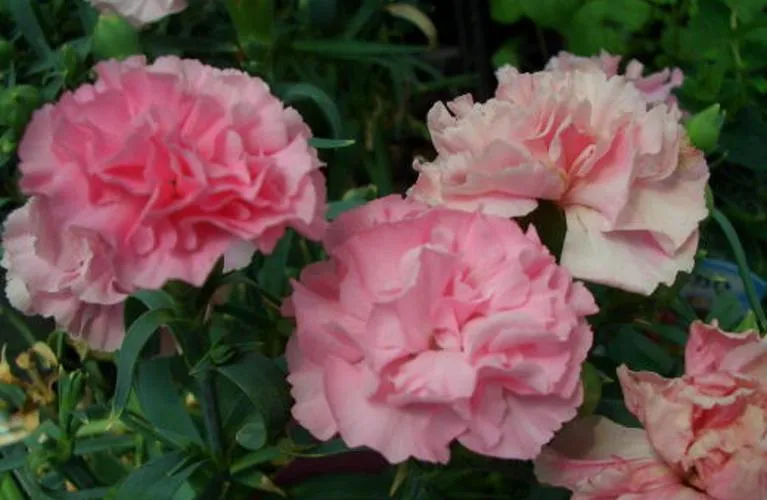
Carnation flower
Dianthus caryophyllus
How to Identify Carnation flower
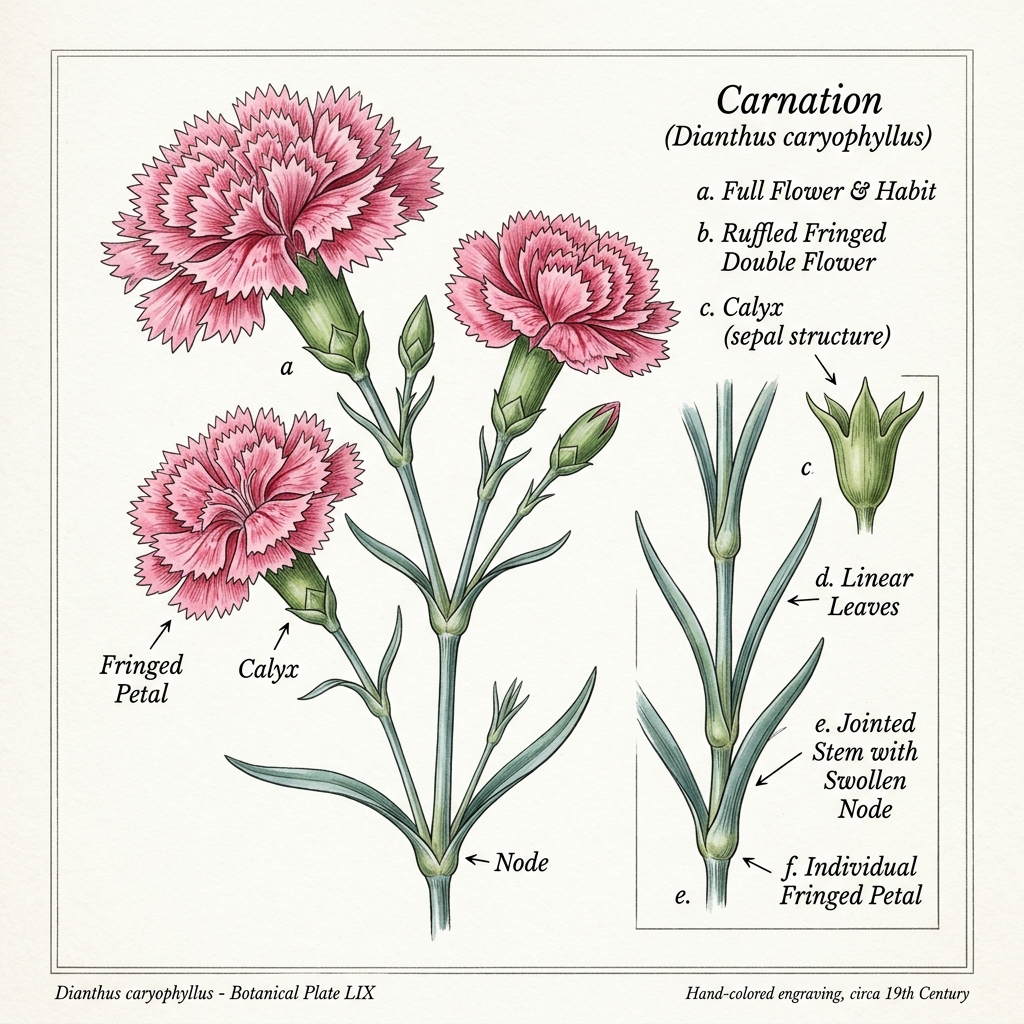
TOXIC TO PETS. Contains triterpenoid saponins that cause mild stomach upset, vomiting, and skin redness if chewed.
A detailed guide to identifying Carnations (Dianthus caryophyllus) by its key features:
- Ruffled, Fringed Petals: Large, dome-shaped double flowers with distinctive fringed, jagged, or serrated petal edges.
- Jointed, Swollen Stems: Rigid, slender green stems characterized by prominent swollen joints or nodes.
- Grass-like Blue-Green Foliage: Slender, narrow, grass-like leaves growing in opposite pairs with a waxy, blue-grey coating (glaucous).
- Spicy Clove Scent: A distinctive, spicy, warm fragrance resembling cloves or cinnamon.
Types & Sub-types of Carnations
Carnations are classified and distinguished into three primary groups based on bloom size and stem arrangement:
- By Flower Form & Stem Type:
- Standard (Large-Flowered) Carnations: Produce a single massive flower head per stem, ideal for florist cuts and boutonnieres. Distinguish by the removal of side buds.
- Spray (Miniature) Carnations: Produce a cluster of multiple smaller blooms on a branched stem. Distinguish by the presence of several active blossoms per stalk.
- Dwarf/Border Carnations: Compact garden plants (6-12 inches tall) producing clusters of small blooms, used mainly for landscaping borders.
- By Petal Patterning & Coloration:
- Selfs: Solid, uniform color throughout all petals (e.g., pure red, white, or pink).
- Fancies: Variegated petals featuring stripes, flecks, or streaks of contrasting colors.
- Picotees: Petals with a distinct margin or edge of a contrasting color (e.g., yellow petals with a red border).
Care & Growing Guide
Seasonal Blooming & Hardiness
Seasonal Blooming Calendar:
- Peak Bloom: Summer (typically June through September).
- Planting Time: Sow seeds directly outdoors in early spring after the last frost, or transplant nursery starts in late spring.
Bloom Timeline
About Carnation flower
The Carnation, botanically known as Dianthus caryophyllus and classically called the Clove Pink or Gillyflower, is an extraordinarily famous herbaceous perennial belonging to the Caryophyllaceae (pink or carnation) family. Native to the rocky slopes and coastal scrub of the Mediterranean region—particularly Greece, Italy, and Spain—this historic species has been cultivated for over 2,000 years. It stands as one of the world's most significant and commercially grown cut flowers, celebrated globally for its deeply ruffled blooms, long-lasting vase life, and rich cultural associations.
Carnations are characterized by their narrow, linear, glaucous blue-green leaves that grow in opposite pairs along rigid, prominently jointed stems. The flowers measure 1.5 to 2.5 inches across, featuring dense, layered whorls of heavily ruffled, fringed petals that form a dome-shaped blossom. While wild varieties are single-flowered with 5 petals, commercial selections are almost exclusively double-flowered with 20 to 40 petals. They come in an incredible spectrum of colors, including deep red, rose-pink, white, yellow, orange, and purple, emitting a rich, spicy fragrance of cloves.
The reproductive blueprint of this classic flower is represented by the formula EBr ⊕ ⚥ K(5) C5 A(5+5) G(2-5). This denotes that the flower is ebracteate, radially symmetrical (actinomorphic), and bisexual. It features a calyx of 5 fused sepals forming a rigid, cylindrical calyx tube, and a corolla of 5 free, clawed petals with fringed edges. The androecium contains 10 stamens in two whorls of five, surrounding a syncarpous gynoecium of 2 to 5 fused carpels forming a single superior ovary with free central placentation.
Thriving in cool-to-moderate climates, Carnations grow beautifully in USDA hardiness zones 3 through 9. They require full sun, needing 6 to 8 hours of direct daily sunlight to produce strong stems and a heavy flush of blooms. They prefer fertile, loamy, moist but exceptionally well-draining soils with a slightly alkaline pH (6.5 to 7.5). They are highly sensitive to soggy soils and overhead watering, which can invite fungal leaf spots, and they benefit from staking to support their tall, heavy flowering stems.
Steeped in ancient Greek history, the genus name Dianthus is derived from 'dios' (divine) and 'anthos' (flower), meaning the 'Divine Flower' or 'Flower of the Gods.' In 1907, Anna Jarvis chose the white carnation as the official symbol of Mother's Day, representing pure love, respect, and maternal devotion. In regional languages, it is known as कार्नेशन in Hindi and Garofano in Italian. Culturally, pink carnations symbolize maternal love, deep red represents passion and romantic affection, while white stands for pure, untamed fidelity.
For families with pets, Carnations present a mild health hazard. Dianthus caryophyllus is classified as TOXIC to dogs and cats by major veterinary groups. The plant contains triterpenoid saponins throughout its leaves and stems. If chewed or ingested, these compounds cause mild gastrointestinal irritation, vomiting, and diarrhea. Additionally, contact with the sap can trigger mild contact dermatitis (skin irritation and redness) on sensitive animal skin. To maintain a safe environment, please cross-reference our Pet Guard safety listings.
Carnations are occasionally confused with their close relative, Sweet William (Dianthus barbatus). They are easily distinguished by their single, massive double flower heads on each main stem (standard types), whereas Sweet William produces flat-topped clusters of many tiny, bearded blossoms. They serve as exceptional additions to perennial borders; we suggest planting them alongside Sweet William, Canterbury Bells, or the classic Rose. Discover more Caryophyllaceae choices in our Flower Identifier.
In global cultural botany, the Carnation is celebrated during American Mother's Day and Spanish Flamenco festivals. However, in Russia and Eastern Europe, red carnations are strictly reserved for military memorials and funerals, and gifting an even number is an absolute social taboo. Learn the international gifting rules and traditions in our Global Flower Etiquette Guide.
Floral Formula & Features
Ebracteate (no bracts), radially symmetrical (actinomorphic), bisexual, 5 fused sepals forming tube, 5 free petals with long claws and fringed limbs, 10 stamens in 2 whorls of 5, 2-5 fused carpels with superior ovary and free central placentation
- Scientific Name & Classification: Dianthus caryophyllus (Caryophyllaceae). Known widely as Clove Pink, Gillyflower, and Divine Flower.
- Identification Markers: Rigid, jointed stems with linear glaucous blue-green leaves. Large, dome-shaped double flowers with ruffled fringed petals and spicy clove fragrance.
- Floral Formula (EBr ⊕ ⚥ K(5) C5 A(5+5) G(2-5)): Radially symmetrical, bisexual flowers featuring 10 stamens, 5 clawed fringed petals, and superior ovary.
- Growing Requirements: Full sun (6-8 hours); prefers cool-to-moderate temperatures (50-70°F) and well-drained slightly alkaline soil. Moderate water (Zones 3-9).
- Cultural Significance: Official flower of Mother's Day; named 'Flower of the Gods' in Greece. Symbol of maternal love, passion, and fidelity.
- Safety & Toxicity: TOXIC TO PETS. Contains triterpenoid saponins that cause mild stomach upset, vomiting, and skin redness if chewed.
- Common Look-alikes: Confused with Sweet William, but easily distinguished by its single, large double flower heads per stem rather than flat-topped clusters.
- Internal Links: Integrates beautifully in flower beds alongside Sweet William, Canterbury Bells, or Rose; find more cut flowers in our Flower Identifier.
- Internal Links: Compare key differences in our Carnation vs Rose comparison, or try our instant Flower Identifier.
Names in Different Languages
Cultural Etiquette & Gifting: Planning to gift or decorate with Carnation flower? Discover its symbolic meanings, festival traditions, and crucial cultural faux pas across 20+ countries in our comprehensive Global Flower Etiquette Guide.
Botanical Classification: Carnation flower belongs to the Caryophyllaceae family. Learn how to identify its floral symmetry, stamen arrangement, and structural formulas in our Botanical Family Classification Guide.
Toxicity & Safety
Always keep toxic plants out of reach of children and pets. Consult a veterinarian or medical professional immediately if ingestion is suspected.
Pet Safety Guide: For detailed toxicity symptoms, first-aid measures, and safe garden alternatives, see our full Pet Guard Profile for Carnation flower.
Frequently Asked Questions
What is Floral Formula?
A floral formula is a symbolic representation of a flower's structure using letters, numbers, and special symbols. It provides a concise way to describe the arrangement and number of floral parts.
This formula describes the flower's symmetry, sepals, petals, stamens, and carpels in a standardized format.
Formula Sequence
- Bract: Br or Ebr
- Bracteole: Brl or Ebrl
- Symmetry: % (Radial) or ⊕ (Bilateral)
- Sex: ♀ (Female), ♂ (Male), or ⚥ (Bisexual)
- Calyx/Sepal: K<number> (Free or Fused)
- Corolla/Petal: C<number> (Free or Fused)
- Androecium: A<number> (Free or Fused)
- Gynaecium: G<number> (Superior or Inferior Ovary)
Symbol Meanings
- Numbers: Indicate quantity of parts
- Parentheses (): Parts are fused together
- Plus (+): Parts in different whorls
- Underline: Superior ovary position
- Overline: Inferior ovary position
- ∞: Numerous parts (too many to count)
Understanding floral formulas helps botanists quickly identify and classify flowers based on their structural characteristics.
Similar Flowers
Discover flowers that share botanical characteristics
Similar Characteristics
4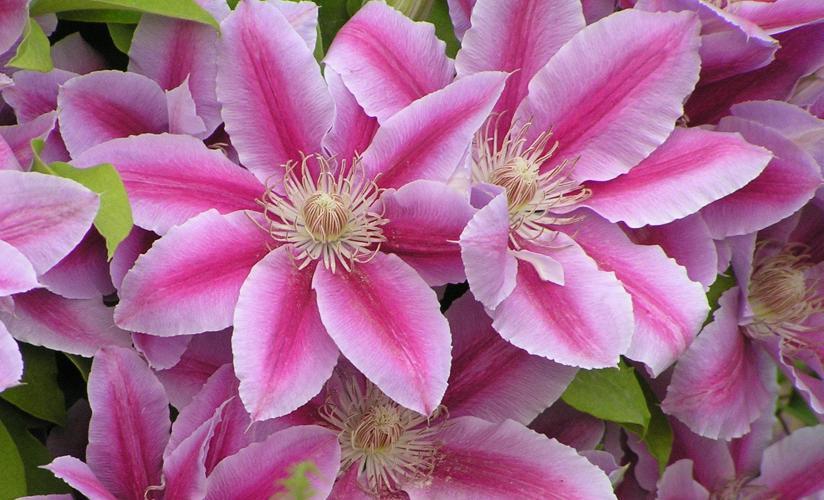
Clematis
Clematis
The Clematis, belonging to the genus Clematis within the family Ranunculaceae (the buttercup family), is a spectacular genus of perennial climbing vines widely hailed as the 'Queen of the Climbers.' Native to the temperate woodlands, rocky hillsides, and river hedgerows across the Northern Hemisp...
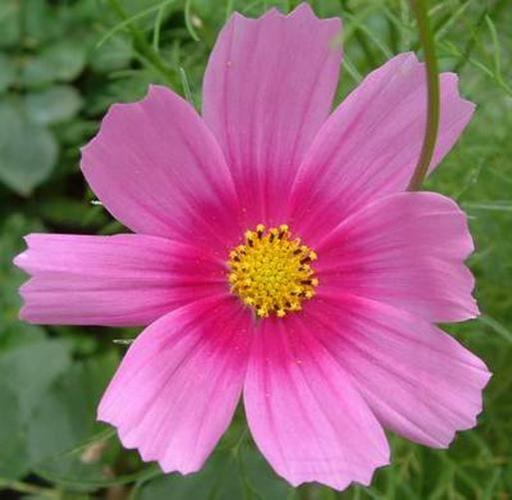
Mexican Aster
Cosmos bipinnatus
The Mexican Aster, botanically designated as Cosmos bipinnatus and commonly referred to as Garden Cosmos or simply Cosmos, is an exceptionally graceful, fast-growing, and heavy-blooming annual. Belonging to the family Asteraceae (the daisy or composite family), this beautiful plant is native to t...
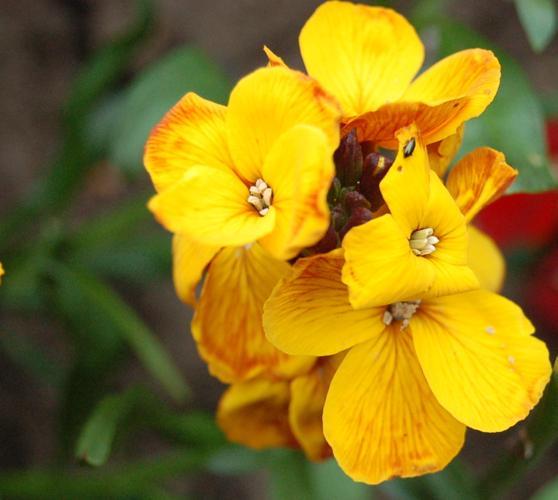
Wallflower
Erysimum cheiri
The Wallflower, botanically known as Erysimum cheiri (formerly classified as Cheiranthus cheiri), is a charming and historic woody-based biennial or short-lived perennial flower belonging to the Brassicaceae (mustard or cabbage) family. Native to the rocky cliffs, coastal regions, and warm sunny...
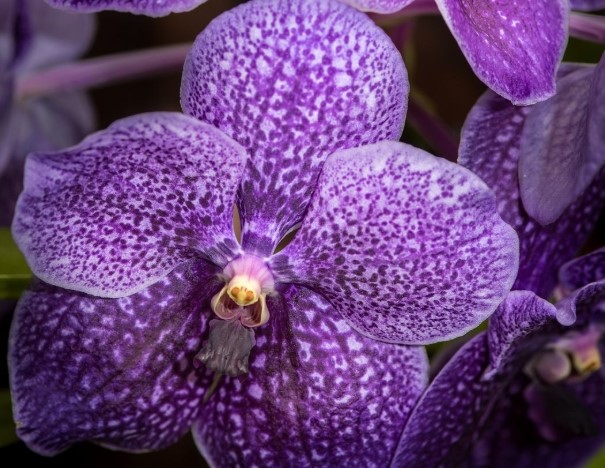
Vanda Orchid
Vanda
The Vanda Orchid, botanically designated under the genus *Vanda*, is an exceptionally spectacular, highly premium epiphytic perennial. Belonging to the family Orchidaceae (the orchid family, tribe Vandeae), this magnificent tropical orchid is native to the warm, highly humid rainforests, mist-shr...