
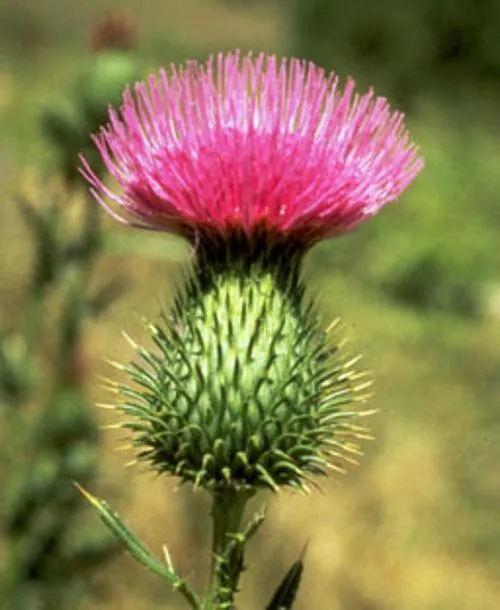
Spear Thistle (Bull Thistle)
Cirsium vulgare
How to Identify Spear Thistle (Bull Thistle)
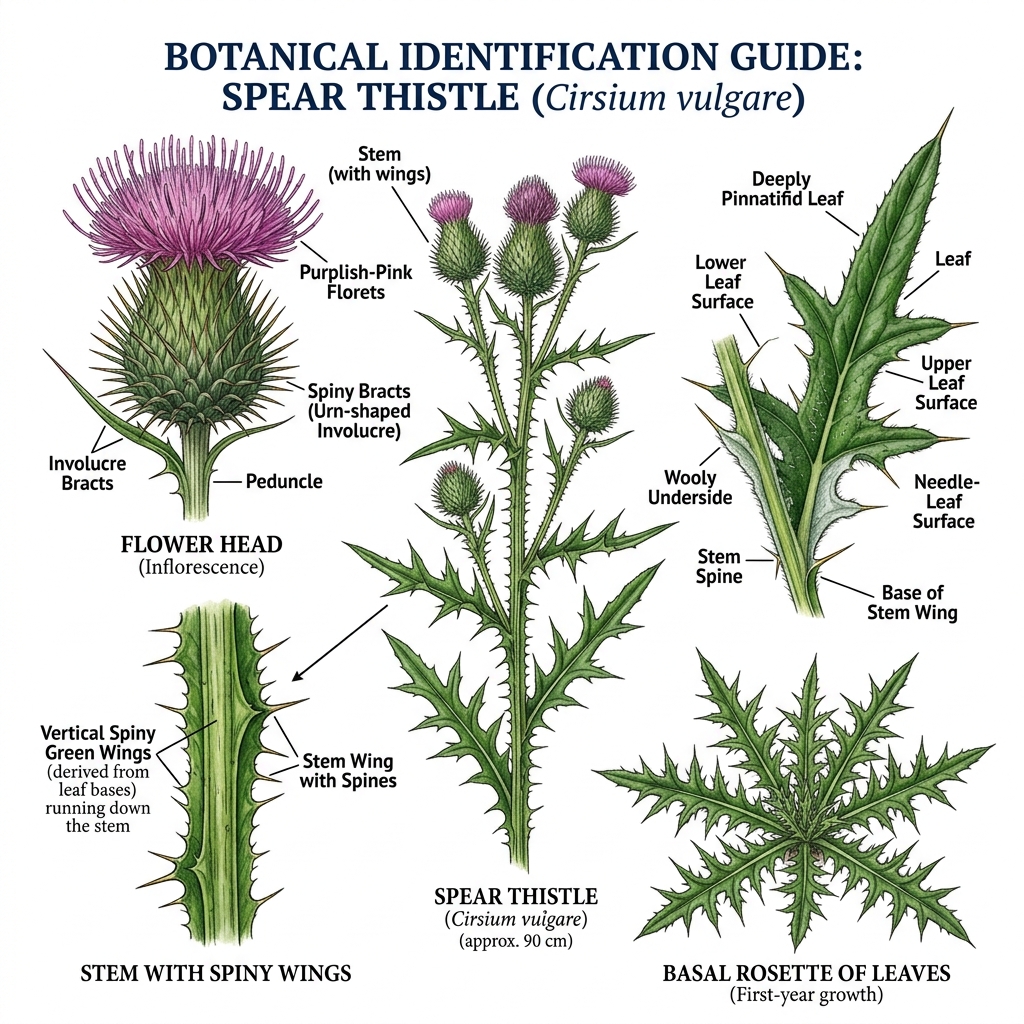
How to identify Spear Thistle (Cirsium vulgare / Bull Thistle):
- Spiny Purple Flower Heads: Globe-shaped to urn-shaped composite flower heads (1-2 inches across) packed with rose-purple tubular florets.
- Needle-Sharp Leaves: Deeply lobed, green leaves with long, rigid, yellow spines on the margins and hairy, rough surfaces.
- Spiny Wings on Stem: Stems are covered with vertical, spiny green leaf tissue ('wings') running along the stalks.
- Spiny Bracts: The base of each flower head is surrounded by an urn-shaped cluster of spiny, recurved green bracts (phyllaries).
Lifecycle Stages of Spear Thistle
As a biennial weed, it goes through two distinct growth phases:
- First Year (Rosette Stage): Grows flat against the ground as a circular cluster of spiny, lance-shaped leaves, establishing a thick taproot.
- Second Year (Bolting Stage): Produces a tall, branched stem (up to 5 feet) that flowers, sets wind-dispersed seeds, and dies.
Care & Growing Guide
Spear Thistle Care & Control Guide (Grown as a wild weed):
- Light: Full, unshaded sun. It does not tolerate shade.
- Soil: Adapts to dry, clay-heavy, disturbed, or poor sandy soils. Thrives in nitrogen-rich environments.
- Watering: Extremely drought-tolerant. Survives on natural rainfall alone.
- Control/Management: To prevent spread, chop down the taproot below the soil surface using a shovel before the purple flowers open and release wind-blown seeds.
Seasonal Blooming & Hardiness
Seasonal Blooming Calendar (US Hardiness Zones 3-10):
- Native Region: Native to Europe, western Asia, and North Africa, where it flowers from June to September.
- US Cultivation: Naturalized as an invasive weed across the US. Spreads aggressively, blooming from mid-summer (July) through early autumn (September).
Bloom Timeline
About Spear Thistle (Bull Thistle)
The Spear Thistle, botanically designated as Cirsium vulgare (and commonly referred to as the Bull Thistle), is a robust and highly spiny biennial herb belonging to the family Asteraceae (the daisy or composite family). Native to the meadows, forest edges, and rocky valleys of Europe, western Asia, and North Africa, this resilient wildflower has naturalized extensively across temperate regions worldwide. Today, it is widely encountered in North America, South America, Australia, and South Africa, often classified as an aggressive and persistent weed of pastures and disturbed land.
This fast-growing biennial follows a strict two-year life cycle. In its first year, it develops a low-growing, rosette of deeply lobed, extremely spiny leaves. In its second year, it sends up a tall, heavily branching, upright flowering stem that stands 2 to 6 feet in height (occasionally reaching 10 feet in nitrogen-rich soils). The stems are covered in winged, spiny ridges, and the lance-shaped leaves are lined with needle-sharp, yellow spines. From June through October, the branch tips carry fluffy, pom-pom-like flower heads of a brilliant pink-purple, surrounded by a dense bulbous base of prickly bracts.
The reproductive biology of the Cirsium genus is summarized by the composite floral formula EBr ⊕ ⚥ K(pappus) C(5) A(5) G(2). This formula states that the individual florets within the flower head are ebracteate, radially symmetrical (actinomorphic), and bisexual. The calyx has been modified into a pappus composed of numerous feathery white bristles that act as a parachute for wind dispersal. The corolla consists of 5 fused petals forming a slender, five-lobed tube. The androecium features 5 stamens fused by their anthers into a cylinder surrounding the style, sitting atop an inferior ovary of 2 fused carpels.
Horticulturally, Spear Thistle is an incredibly tough, highly adaptable, and drought-tolerant plant. It thrives in full, direct sunlight (at least 6 hours daily) and prefers disturbed, poorly aerated, or nitrogen-rich clay soils, though it can grow easily in almost any soil. It spreads aggressively exclusively via seeds; a single healthy plant can produce 100 to 400 flower heads, yielding up to 40,000 wind-dispersed seeds that remain viable in the soil for over 20 years. Because of its invasive nature, it is declared a noxious weed in many regions, and gardeners are advised to mow or cut the plants before they flower.
The genus name Cirsium is derived from the ancient Greek word 'kirsos,' meaning 'swollen vein,' referencing the plant's historic medicinal application in treating varicose veins. Famed in Sanskrit as Mundi (मुण्डि) and in Hindi as Kantila (कँटीला), the thistle carries rich historical lore. It is most famous as the legendary national emblem of Scotland. According to historical lore, a sleeping Scottish army was saved from a Norse invasion when an invading warrior stepped barefoot on a spiny thistle, crying out in pain and alerting the Scottish defenders.
For pet owners and veterinarians, the Spear Thistle represents a physical hazard rather than a chemical one. Cirsium vulgare is classified as completely NON-TOXIC to cats, dogs, and horses by major global animal databases. However, because the entire plant is covered in needle-sharp spines, it presents a significant physical danger that can cause painful skin scratches, mouth punctures, and eye irritation if chewed or run through. For general advice on managing prickly weeds and keeping outdoor spaces safe for pets, visit our general Pet Guard catalog. (Note: Goldfinches and butterflies adore the seed down and nectar, making it highly valuable for wildlife gardens.)
Spear Thistle is occasionally confused with Scotch Thistle or Globe Thistle. It is easily distinguished because Cirsium species have green, deeply lobed leaves with hairy upper surfaces, whereas Scotch Thistle possesses massive, silver-grey, woolly leaves, and Globe Thistle has spherical blue flower heads. To learn more about identifying or safely managing wild thistles, explore our Flower Identifier or compare them with other structural wildflowers like the Globe Thistle or the hardy Dandelion.
For more botanical profiles and flower identification features, see our guides on Silver Slipper Orchid and Spiked Shaded Ginger.
Floral Formula & Features
Ebracteate (but spiny bracts present), radially symmetrical (actinomorphic), bisexual, calyx modified to pappus (feathery bristles for seed dispersal), 5 fused petals forming tubular florets, 5 stamens fused into tube, 2 fused carpels with inferior ovary. Composite flower head typical of Asteraceae
- Scientific Name & Classification: Cirsium vulgare (Asteraceae). Commonly known as Spear Thistle, Bull Thistle, and Scotch Thistle.
- Identification Markers: Tall branching spiny stems, pinnatifid green leaves with yellow spines, and fluffy purple pom-pom flower heads with prickly bract bases.
- Floral Formula (EBr ⊕ ⚥ K(pappus) C(5) A(5) G(2)): Radially symmetrical, bisexual tubular florets with calyx modified to feathery pappus bristles, and fused anthers.
- Growing Requirements: Full sun; highly tolerant of drought, clay, and disturbed soils. Spreads extremely aggressively via wind-blown seeds (Zones 3-10).
- Cultural Significance: Celebrated national emblem of Scotland. Ancient Greek name 'Cirsium' references its historic medicinal use for varicose veins.
- Safety & Toxicity: NON-TOXIC BUT SPINY PHYSICAL HAZARD. Chemically safe for cats and dogs, but the needle-sharp spines can cause severe skin and mouth punctures.
- Common Look-alikes: Confused with Scotch Thistle (silver woolly leaves) or Globe Thistle (perfectly round blue heads), but distinguished by green deeply winged spiny stems.
- Internal Links: Serves as a wildlife magnet; compare its biology with the architectural Globe Thistle or the common Dandelion, and search our Flower Identifier.
Names in Different Languages
Botanical Classification: Spear Thistle (Bull Thistle) belongs to the Asteraceae family. Learn how to identify its floral symmetry, stamen arrangement, and structural formulas in our Botanical Family Classification Guide.
Toxicity & Safety
Frequently Asked Questions
What is Floral Formula?
A floral formula is a symbolic representation of a flower's structure using letters, numbers, and special symbols. It provides a concise way to describe the arrangement and number of floral parts.
This formula describes the flower's symmetry, sepals, petals, stamens, and carpels in a standardized format.
Formula Sequence
- Bract: Br or Ebr
- Bracteole: Brl or Ebrl
- Symmetry: % (Radial) or ⊕ (Bilateral)
- Sex: ♀ (Female), ♂ (Male), or ⚥ (Bisexual)
- Calyx/Sepal: K<number> (Free or Fused)
- Corolla/Petal: C<number> (Free or Fused)
- Androecium: A<number> (Free or Fused)
- Gynaecium: G<number> (Superior or Inferior Ovary)
Symbol Meanings
- Numbers: Indicate quantity of parts
- Parentheses (): Parts are fused together
- Plus (+): Parts in different whorls
- Underline: Superior ovary position
- Overline: Inferior ovary position
- ∞: Numerous parts (too many to count)
Understanding floral formulas helps botanists quickly identify and classify flowers based on their structural characteristics.
Similar Flowers
Discover flowers that share botanical characteristics
Same Family
4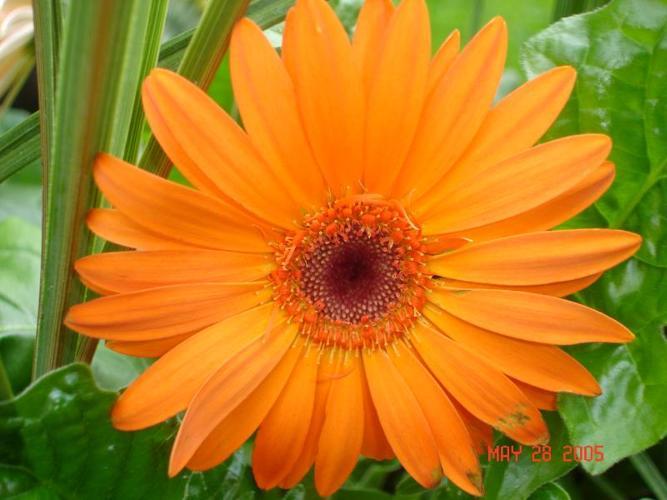
Barberton Daisy
Gerbera jamesonii
The Barberton Daisy, botanically known as Gerbera jamesonii and widely cherished as the Gerbera Daisy or Transvaal Daisy, is an exceptionally cheerful and colorful herbaceous perennial in the Asteraceae (sunflower) family. Native to the rich, subtropical valleys and grassy slopes of South Africa'...
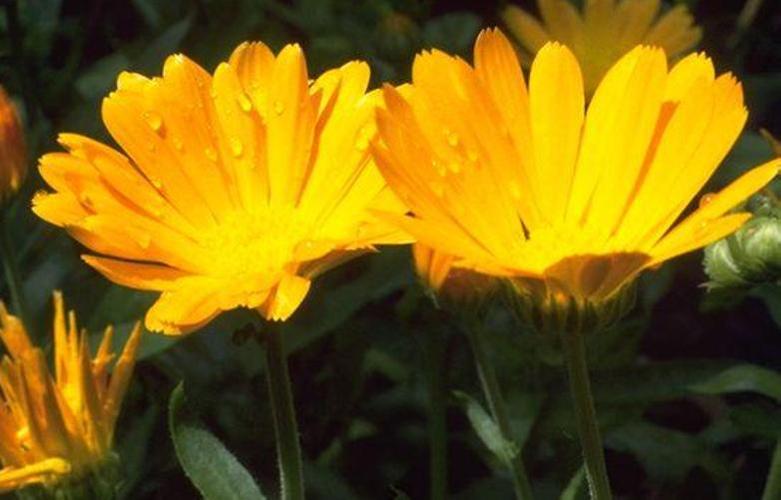
English Marigold (Calendula)
Calendula officinalis
The English Marigold (Calendula officinalis), widely known as the Pot Marigold, is a cheerful and incredibly versatile annual (or short-lived perennial in mild climates) belonging to the Asteraceae family. Native to southern Europe and the Mediterranean region, it has been a staple of traditional...
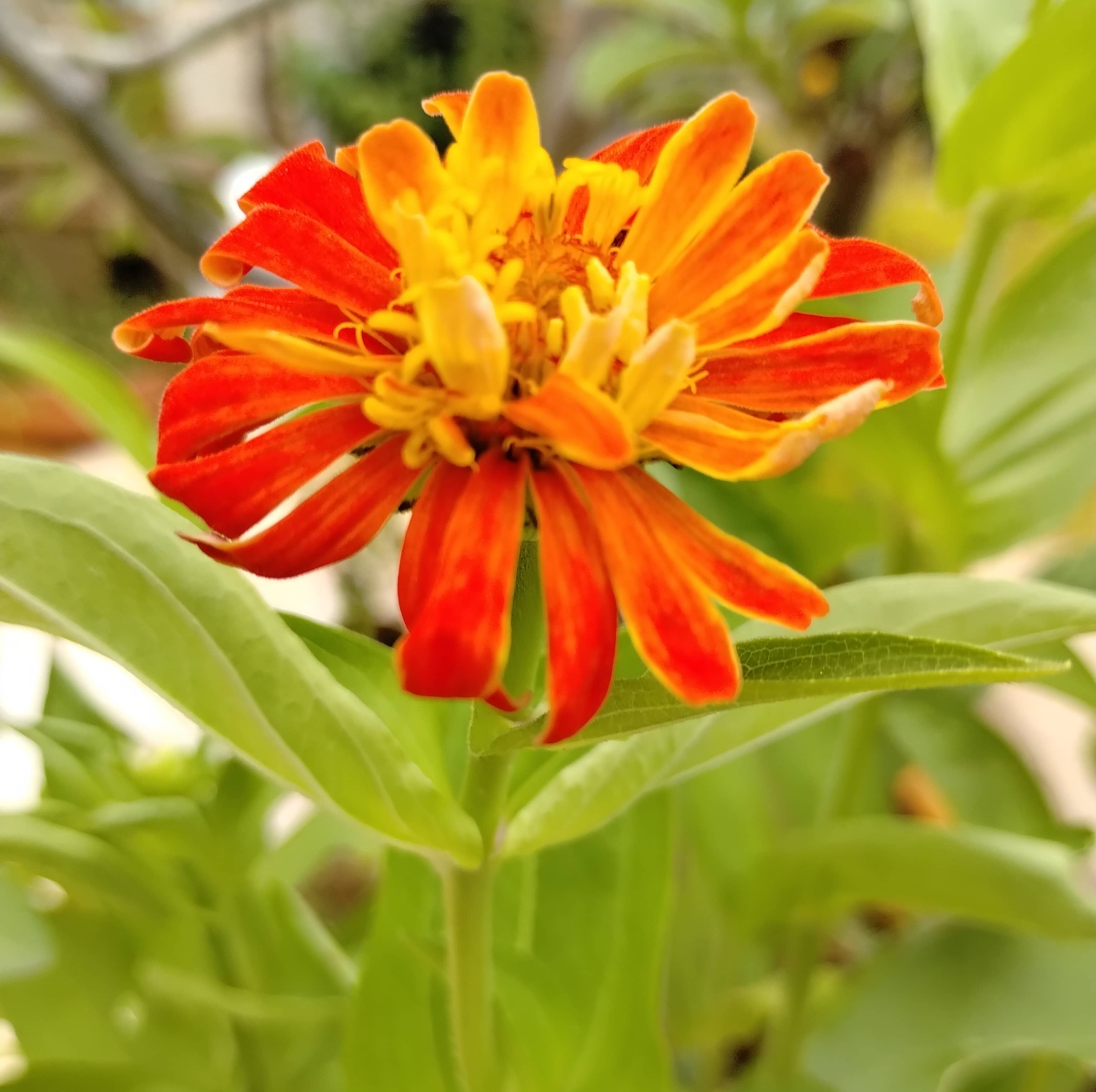
Zinnia
Zinnia elegans
Zinnias (Zinnia elegans), belonging to the Heliantheae tribe within the massive Asteraceae family, are among the most colorful, resilient, and popular warm-season annual flowers in modern horticulture. Native to the scrublands and dry grasslands of Mexico and Central America, these sun-loving pla...
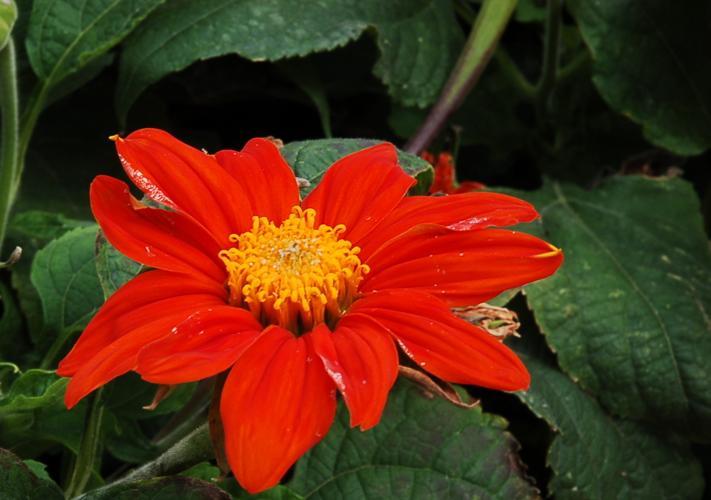
Orange Dahlia
Dahlia × hortensis
The Orange Dahlia, botanically designated under the genus *Dahlia* (particularly hybrids of *Dahlia pinnata*), is an exceptionally spectacular, highly vibrant tuberous perennial. Belonging to the family Asteraceae (the daisy or sunflower family, tribe Coreopsideae), this high-color classic is nat...
Similar Characteristics
4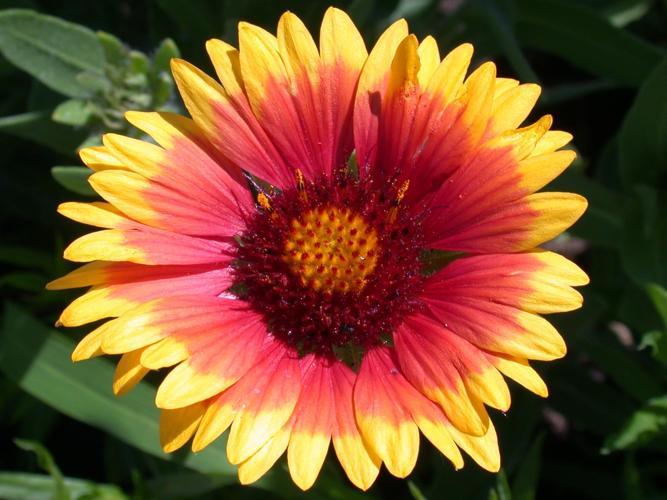
Gaillardia
Gaillardia
Gaillardia, botanically classified within the genus Gaillardia in the Asteraceae (sunflower) family and popularly known as the Blanket Flower or Indian Blanket, is a group of exceptionally cheerful, sun-loving annuals and short-lived perennials. Native to the dry prairies, sandy plains, and pine...
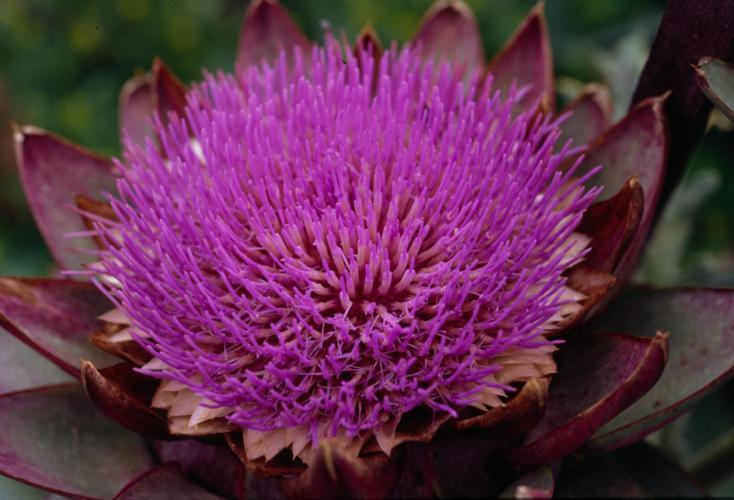
Artichoke
Cynara scolymus
The Artichoke, botanically designated as *Cynara cardunculus* (Scolymus Group) and commonly known as the Globe Artichoke, French Artichoke, or Green Artichoke, is a highly dramatic perennial thistle. Belonging to the family Asteraceae (the daisy or sunflower family, tribe Cynareae), this architec...
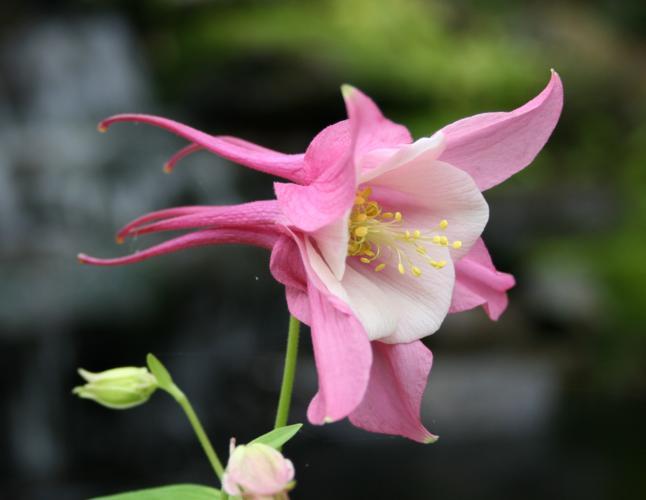
Columbine
Aquilegia
Columbine (Aquilegia), a member of the Ranunculaceae (Buttercup) family, is a gracefully elegant perennial known for its multi-colored, spurred blossoms and delicate, fern-like foliage. Native to the woodlands, meadows, and high-altitude slopes of the Northern Hemisphere—spanning across North Ame...
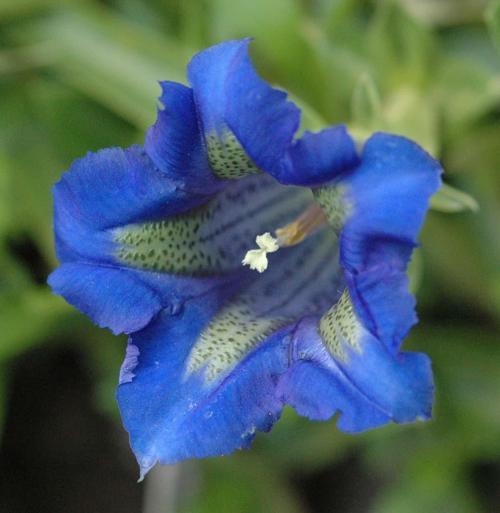
Stemless Gentian
Gentiana acaulis
The Stemless Gentian, botanically classified as Gentiana acaulis and commonly known as the Trumpet Gentian, Large-flowered Gentian, or Gentianella, is an exceptionally exquisite, low-growing alpine perennial. Belonging to the family Gentianaceae (the gentian family, tribe Gentianeae), this high-a...