
📚 Regional Mango Names Guide
Did you know that Alphonso is called Badami in Karnataka and Hapus in Maharashtra? Explore our complete state-by-state guide mapping 30+ regional names across India.
Also known as: Neelum x Dasheheri Hybrid, IARI Hybrid
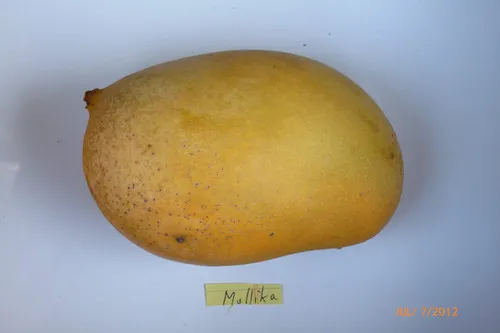
Typical diseases and disorders affecting this variety:
Detect these early using our Plant Guard AI.
Read our detailed Mango Diseases & Safety Guide.
Mallika is a legendary, high-yielding premium hybrid mango variety developed in 1971 by the Indian Agricultural Research Institute (IARI) in New Delhi. It is an intentional cross of Neelum (mother) with Dasheheri (father). Mallika was bred to combine the excellent fruit size, storage resilience, and regular annual bearing habit of Neelum with the outstanding sweetness and fiberless texture of Dasheheri. Today, it is widely regarded as one of the finest mango hybrids in India, prized for its high culinary quality.
Physically, Mallika is a large fruit weighing between 300 and 450 grams. It has an attractive elongated-oval shape with smooth, slightly thick yellow-orange skin that often carries a delicate pinkish-amber blush. The pulp is a striking deep saffron-orange, possessing an incredibly high concentration of beta-carotene (Vitamin A). The texture is firm, dense, and completely fiberless, making it perfect for slicing, fruit salads, and premium processing.
The flavor of Mallika is highly distinct, characterized by an intensely sweet, honey-like profile balanced with bright citrus acidity and notes of melon. It consistently registers a high sugar content, measuring 22° to 24° on the Brix scale. Cultivated extensively across Uttar Pradesh, Andhra Pradesh, Karnataka, and Tamil Nadu, Mallika is commercially successful due to its excellent transport resilience, showing high resistance to skin bruising.
Mallika is a late-season mango, beginning its harvest in early June and running through late July, with peak sweet profiles occurring in late June. It has a prolonged post-harvest shelf life of 8 to 10 days, allowing it to travel long distances easily. For additional insights on premium mangoes, check out the Mango Identifier Hub, or explore our profiles on Chausa, Badami, Amrapali, and Kishen Bhog.
Intensely sweet with citrus and honey notes and perfect acid balance
Very strong, sweet, floral and citrusy bouquet
Firm, dense, completely fiberless, melting pulp
None
How to tell if it's a genuine Mallika:
Did you know that Alphonso is called Badami in Karnataka and Hapus in Maharashtra? Explore our complete state-by-state guide mapping 30+ regional names across India.
Breeding Mallika was a crowning achievement for IARI's hybridization program. By choosing Neelum and Dasheheri, breeders successfully eliminated the alternate-bearing (biennial) tendency of Dasheheri, offering Indian farmers a highly reliable, high-density orchard crop.
In Southern and Northern India alike, Mallika has become a favorite of organic home gardeners and commercial orchardists. Its thick peel provides natural protection against insect pests and environmental decay.
The variety has also gained a dedicated following among international growers in Florida and Central America due to its high disease resistance and spectacular dessert quality.
Quick reference for identifying common healthy vs. problematic conditions:
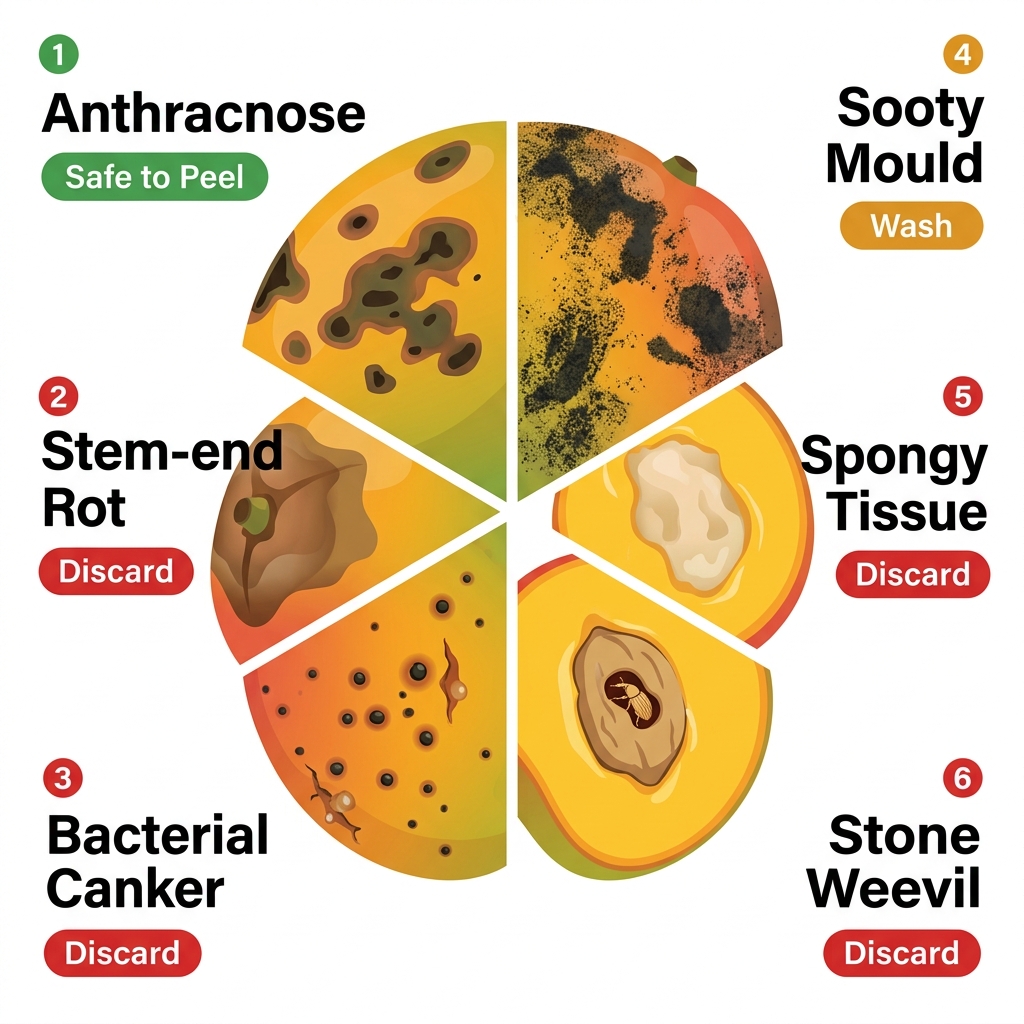
Pro Tip: Surface spots like Anthracnose are often harmless to the fruit inside, while Bacterial Canker or Stem-end Rot usually require discarding the fruit.
Ensure your Mallika mango is naturally ripened. Use Food Guard to detect Calcium Carbide and other chemical ripeners.