Abacaxis são Seguros? Pesticidas, Maturidade e Testes de Inspeção — Guia Completo
O abacaxi é classificado como a principal cultura 'Clean 15' devido à sua casca externa espessa, pontiaguda e protetora que protege a polpa comestível de resíduos químicos. No entanto, ainda requer inspeção para fungicidas pós-colheita, agentes de amadurecimento artificial (gaseificação de ethephon) e podridão interna da copa.
Para saber mais sobre testes de segurança alimentar, leia nossos guias sobre Melancia e Honeydew Melon.
Drop Abacaxi photo here to test purity
or click to browse • Supports JPG, PNG, WEBP • Paste with Ctrl+V
Inspection Guide
Click to enlarge
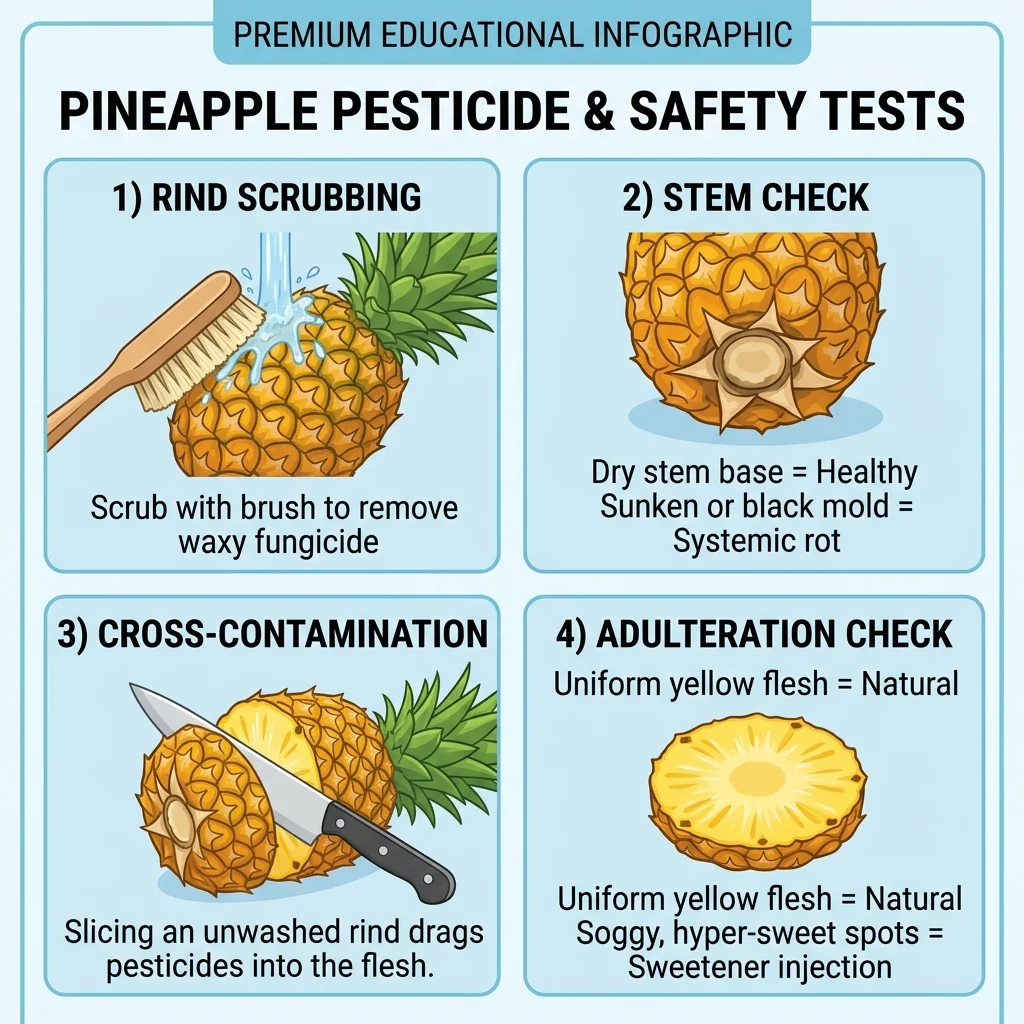
Inspeção de pesticidas e segurança de abacaxi – 4 testes caseiros
Os abacaxis são convencionalmente tratados com fungicidas pós-colheita para evitar o mofo no trânsito. Como cortamos a casca para chegar à polpa, a limpeza e o teste são fundamentais.
1. O Teste de Aroma (Frutado vs. Fermentado):
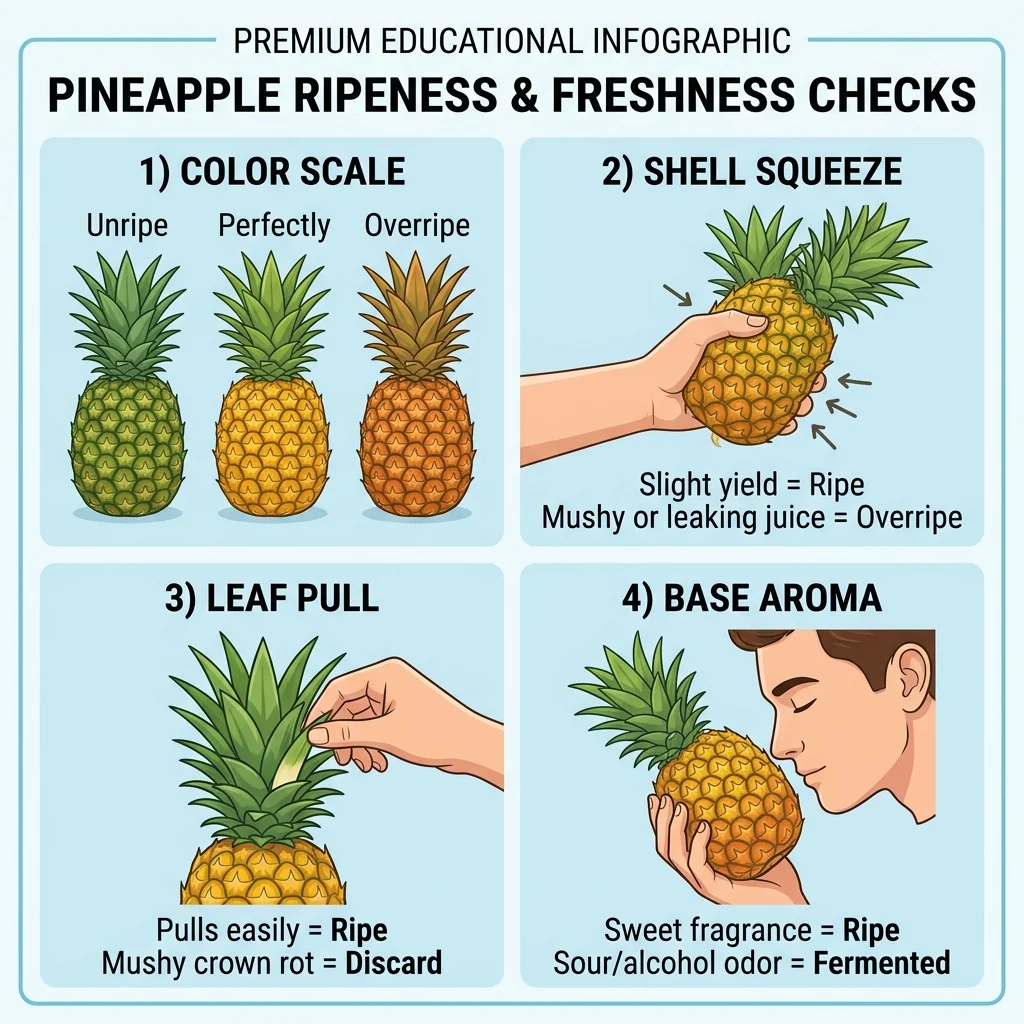
Cheire o abacaxi bem na base. ✅ Um aroma doce e perfumado de abacaxi tropical = amadurecido naturalmente em árvores. ❌ Cheiro azedo, semelhante a vinagre ou álcool = fermentado, maduro demais e em decomposição. ❌Sem cheiro = colhido muito verde, não tem sabor.
2. The Shell Squeeze (verificação de firmeza):
Aperte delicadamente as laterais do abacaxi. ✅ Rende ligeiramente, mas parece sólido e pesado = perfeitamente maduro. ❌ Manchas moles e pastosas ou sucos vazando = machucados, apodrecidos ou muito maduros. ❌ Duro como pedra sem ceder = imaturo.
3. A tração da folha (verificação da maturação da coroa):
Puxe suavemente uma das folhas verdes internas da coroa. ✅Retira facilmente com leve resistência = maduro. ❌ Folha segura = verde. ❌ Folhas moles e marrons que caem facilmente com pó branco = podridão ativa da coroa.
4. Verificação de cores (amarelo dourado vs. verde):
Examine as escamas da concha. ✅ Base amarelo-dourada quente subindo = amadurecido naturalmente em árvore. ❌ Completamente verde escuro com polpa macia = gaseificado artificialmente para amolecer sem adoçar.
Click to enlarge
Como saber se um abacaxi está maduro – e quando descartá-lo
Os abacaxis não amadurecem nem ficam mais doces depois de colhidos, porque não contêm reservas de amido para serem convertidos em açúcar. Eles apenas amolecem e degradam. Isso torna crucial a seleção de um abacaxi amadurecido em árvore.
Estágios de maturação:
✅ Verde-Amarelo (Virando): Começando a amadurecer. É seguro comprar, amolece em temperatura ambiente por 1–2 dias, mas a doçura não aumenta.
✅ Amarelo Dourado (Maduro): Pico de doçura e sabor. Melhor consumido em 1–2 dias ou refrigerado.
⚠️ Laranja-Bronze (muito maduro): Casca muito macia. Alto risco de fermentação interna e sabor amargo.
❌ Vazamento/Base Suave: Fermentando. O bolor de levedura está ativo. Descarte imediatamente.
❌ Coroa acinzentada / Folhas mofadas: Infecção por podridão da coroa. Esporos de fungos estão presentes por toda parte. Descartar.
Quick Safety Tips
- Sempre lave e esfregue a casca externa pontiaguda antes de fatiar para evitar arrastar contaminantes para a polpa
- Evite abacaxis com vazamento de suco ou pontos fracos na base
- Os abacaxis amadurecidos naturalmente em árvores devem ter um aroma tropical doce e perfumado na base
- Rejeite abacaxis com cheiro de álcool, vinagre ou fermento, que indicam fermentação interna
- É necessário descascar; nunca consuma nenhuma parte externa da casca
- Abacaxi é uma das principais culturas do Clean 15: confira o <a href='/blog/clean-15-pesticide-guide/'>Guia de pesticidas do Clean 15</a>
Primary Chemical Concerns
Health Risks & Impacts
Multilingual Local Names
Common Storage Pests
Crown Rot (Phytophthora spp.)
high riskA fungal decay that starts at the top crown or base stem and rots the core.
Detection
- Greyish mold at the crown base
- Crown leaves pull out in a mushy mass
- Sunken water-soaked spots at the base
Prevention
- Store pineapples upright in a cool well-ventilated dry space
- Do not buy fruit with soft bases
Corrective Action: What to do?
Discard if mold is active at the core.
Regulatory Corner: FSSAI (Food Safety and Standards Authority of India) / Codex Alimentarius (Codex Stan 182-1993) / US FDA 21 CFR
Regulation: Food Safety and Standards (Food Products Standards) Regulations 2011, Clause 2.3.1 & Codex Stan 182
Legal Limit:Ethephon plant growth regulator MRL: Max 2.0 ppm; Artificial non-nutritive sweeteners (saccharin): Zero tolerance (0.0 ppm); Carnauba wax coating: Only approved food-grade with mandatory declaration; Lead: Max 0.1 ppm
Report Adulteration to FSSAI (Food Safety and Standards Authority of India) / Codex Alimentarius (Codex Stan 182-1993) / US FDA 21 CFR