¿Las piñas son seguras? Pesticidas, Madurez y Pruebas de Inspección — Guía Completa
La piña está clasificada como uno de los principales cultivos 'Clean 15' debido a su corteza exterior gruesa, puntiaguda y protectora que protege la pulpa comestible de los residuos químicos. Sin embargo, todavía requiere inspección para detectar fungicidas poscosecha, agentes de maduración artificial (gasificación con etefón) y pudrición interna de la corona.
Para obtener más información sobre las pruebas de seguridad alimentaria, lea nuestras guías sobre Sandía y Melón dulce.
Drop Piña photo here to test purity
or click to browse • Supports JPG, PNG, WEBP • Paste with Ctrl+V
Inspection Guide
Click to enlarge
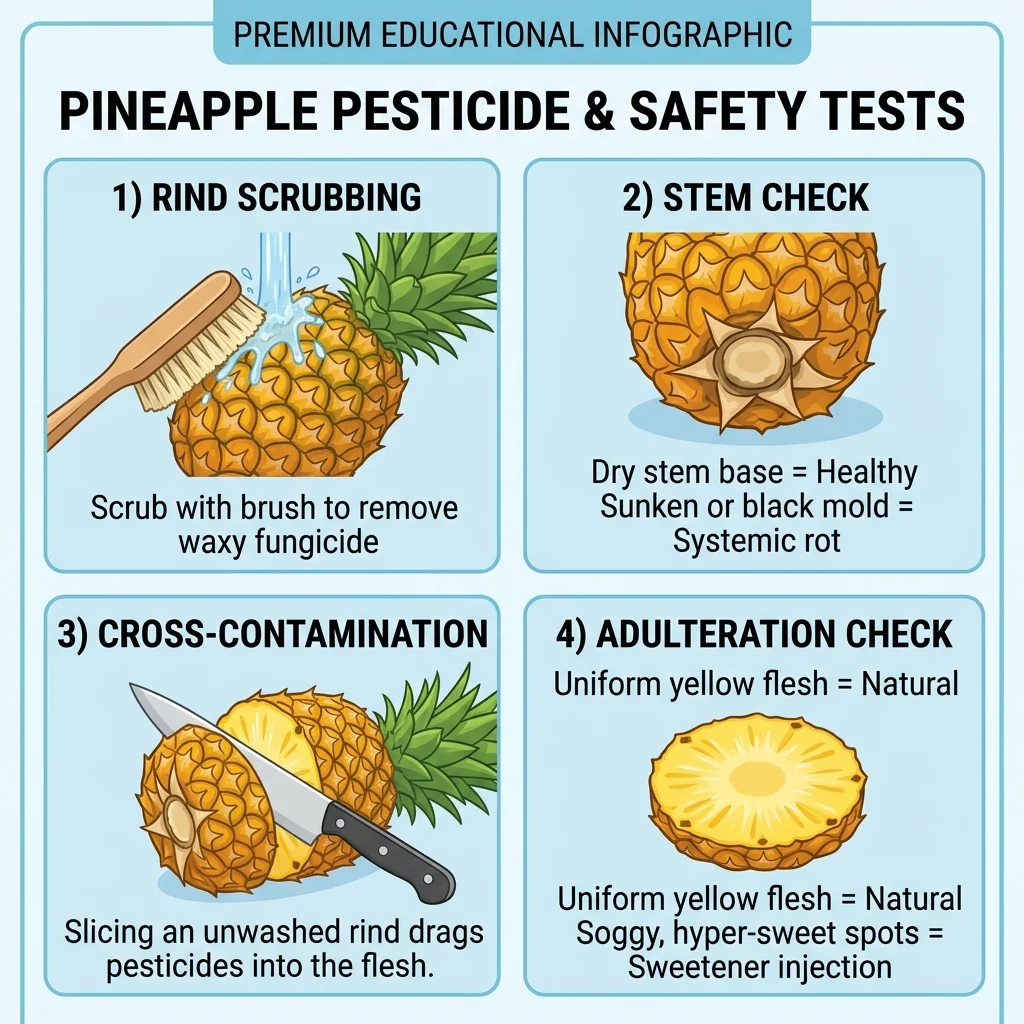
Inspección de seguridad y pesticidas en piña: 4 pruebas caseras
Las piñas se tratan convencionalmente con fungicidas poscosecha para evitar el moho de tránsito. Debido a que cortamos la cáscara para llegar a la pulpa, la limpieza y las pruebas son clave.
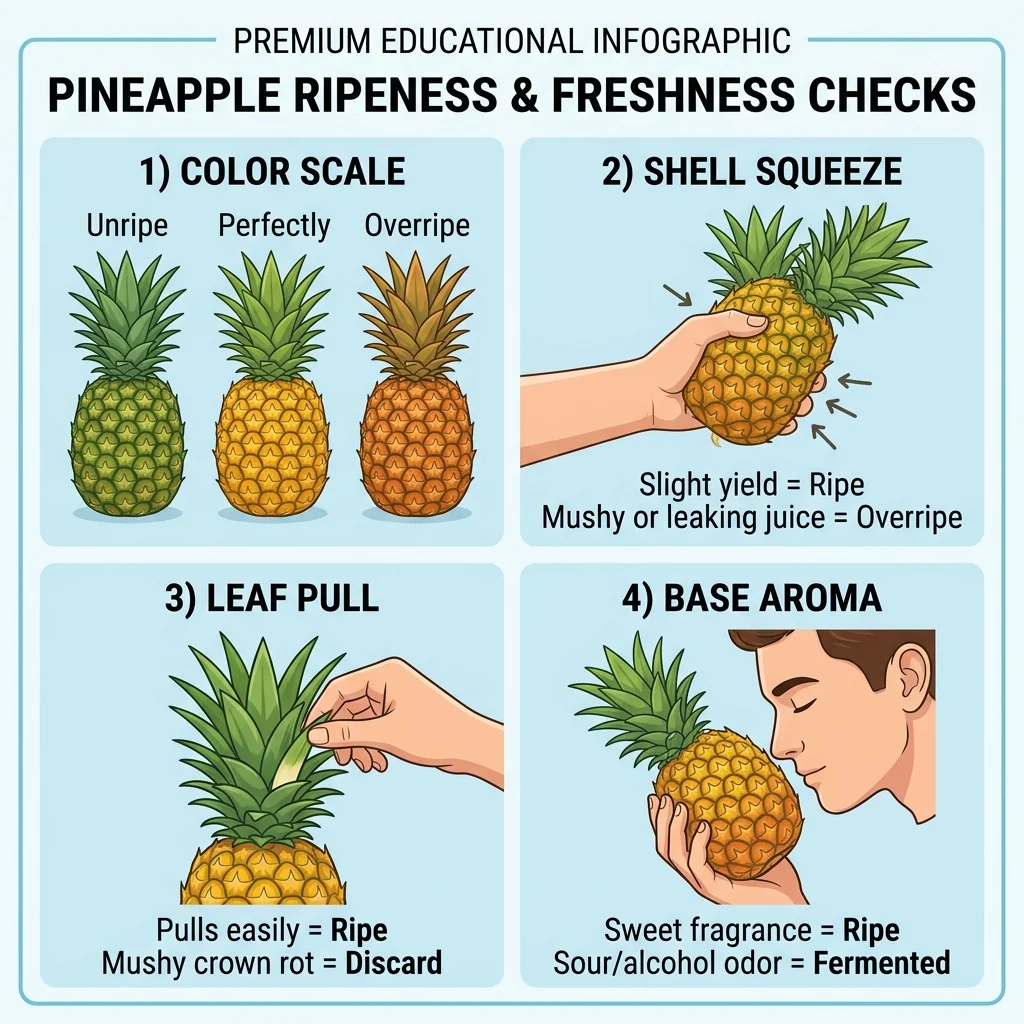
1. La prueba del aroma (afrutado versus fermentado):
Huele la piña justo en su base. ✅ Un aroma dulce y fragante de piña tropical = madurado naturalmente en el árbol. ❌ Un olor agrio, parecido al del vinagre o al alcohol = fermentado, demasiado maduro y en descomposición. ❌ Sin ningún olor = recogido demasiado verde, le falta sabor.
2. The Shell Squeeze (verificación de firmeza):
Exprime suavemente los lados de la piña. ✅ Rinde ligeramente pero se siente sólido y pesado = perfectamente maduro. ❌ Puntos blandos y blandos o jugos que gotean = magullados, podridos o muy demasiado maduros. ❌ Duro como una roca sin ceder = inmaduro.
3. El Arranque de la Hoja (Comprobación de la Madurez de la Corona):
Tira suavemente de una de las hojas verdes interiores de la corona. ✅ Se saca fácilmente con ligera resistencia = maduro. ❌ La hoja se mantiene apretada = inmadura. ❌ Hojas blandas y marrones que se caen fácilmente con un polvo blanco = pudrición activa de la corona.
4. Verificación de color (amarillo dorado versus verde):
Examina las escamas del caparazón. ✅ Base cálida de color amarillo dorado que se eleva hacia arriba = maduración natural en el árbol. ❌ Completamente de color verde oscuro con pulpa blanda = gaseado artificialmente para ablandar sin endulzar.
Click to enlarge
Cómo saber si una piña está madura y cuándo desecharla
Las piñas no maduran ni se vuelven más dulces una vez cosechadas, porque no contienen reservas de almidón para convertirlas en azúcar. Sólo se ablandan y degradan. Esto hace que sea crucial seleccionar una piña madurada en árbol.
Etapas de madurez:
✅Verde-Amarillo (Girando): Empezando a madurar. Es seguro comprarlo, se ablandará a temperatura ambiente durante 1 o 2 días, pero el dulzor no aumentará.
✅ Amarillo dorado (maduro): Máximo dulzor y sabor. Es mejor consumirlo en 1 o 2 días o refrigerado.
⚠️ Naranja-Bronce (demasiado maduro): Cáscara muy suave. Alto riesgo de fermentación interna y sabor amargo.
❌ Fugas/Base blanda: Fermentación. El moho de levadura está activo. Deseche inmediatamente.
❌Corona grisácea/Hojas mohosas: Infección por pudrición de la corona. Las esporas de hongos están presentes en todas partes. Desechar.
Quick Safety Tips
- Siempre lave y frote la corteza exterior puntiaguda antes de cortarla para evitar que se arrastren contaminantes a la pulpa.
- Evite las piñas con jugo goteando o puntos blandos en la base.
- Las piñas maduradas naturalmente en los árboles deben tener un aroma tropical dulce y fragante en la base.
- Rechaza las piñas que huelen a alcohol, vinagre o levadura, que indican fermentación interna.
- Es necesario pelar; Nunca consumas ninguna parte exterior de la corteza.
- Las piñas son un cultivo de primer nivel de Clean 15: consulte la <a href='/blog/clean-15-pesticide-guide/'>Guía de pesticidas Clean 15</a>
Primary Chemical Concerns
Health Risks & Impacts
Multilingual Local Names
Common Storage Pests
Crown Rot (Phytophthora spp.)
high riskA fungal decay that starts at the top crown or base stem and rots the core.
Detection
- Greyish mold at the crown base
- Crown leaves pull out in a mushy mass
- Sunken water-soaked spots at the base
Prevention
- Store pineapples upright in a cool well-ventilated dry space
- Do not buy fruit with soft bases
Corrective Action: What to do?
Discard if mold is active at the core.
Regulatory Corner: FSSAI (Food Safety and Standards Authority of India) / Codex Alimentarius (Codex Stan 182-1993) / US FDA 21 CFR
Regulation: Food Safety and Standards (Food Products Standards) Regulations 2011, Clause 2.3.1 & Codex Stan 182
Legal Limit:Ethephon plant growth regulator MRL: Max 2.0 ppm; Artificial non-nutritive sweeteners (saccharin): Zero tolerance (0.0 ppm); Carnauba wax coating: Only approved food-grade with mandatory declaration; Lead: Max 0.1 ppm
Report Adulteration to FSSAI (Food Safety and Standards Authority of India) / Codex Alimentarius (Codex Stan 182-1993) / US FDA 21 CFR