How to Test Gooseberry for Adulteration (Sulfur Dioxide, Lead, Pesticide)
⚡ Quick 60-Second Amla Purity & Copper Greening Verdict
Toxic Copper Sulfate Greening & Sulfite Preservatives: Fresh and preserved amla fruits are soaked in toxic copper sulfate solution or treated with sulfur dioxide to maintain bright emerald-green color and prevent natural brown oxidation.
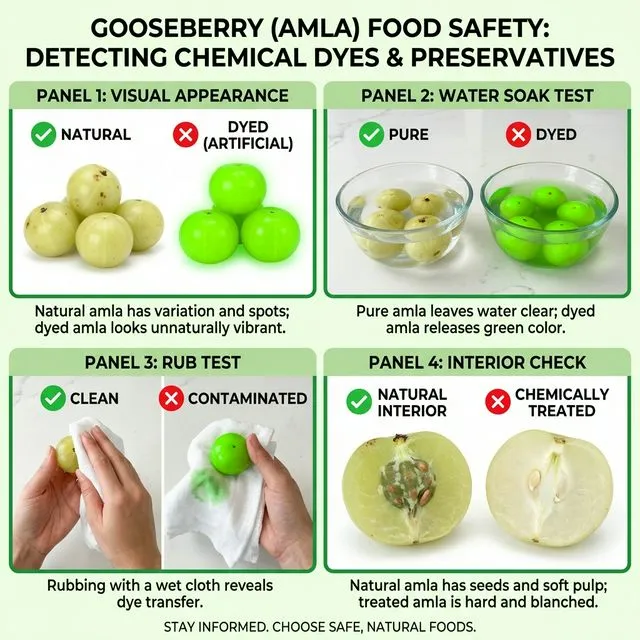
Dip a clean, polished iron nail or stainless steel blade into pureed amla juice or soaking liquid for 10 minutes. If the metal develops a reddish-copper coating, dangerous copper sulfate (CuSO4) dye is confirmed.
Cut an amla in half and leave exposed to air for 15 minutes. Pure amla rich in natural polyphenols and Vitamin C will naturally oxidize and darken to golden-brown. If it remains bright neon green, chemical dye is present.
Bite into fresh fruit. Genuine amla has an intense sour and astringent initial punch followed by a lingering natural sweet aftertaste. A metallic, bitter, or chemical taste reveals chemical treatment.
To learn more about food safety tests and home adulteration detection, read our guides on Cherries and Lychee.
Drop Gooseberry (Amla) photo here to test purity
or click to browse • Supports JPG, PNG, WEBP • Paste with Ctrl+V
Inspection Guide
Click to enlarge
Gooseberry (Amla) Purity & Quality Audit
Amla is often treated with sulfur dioxide to prevent browning or soaked in Alum to maintain a crisp texture in processed forms (like amla candy or murabba).
1. The Color Transition:
Fresh amla has a light green to yellowish-green color. If the amla looks "bright white" or "bleached" in a package, it has likely been treated with sulfur dioxide or other bleaching agents.
2. The Smell Test:
Pure amla has a sharp, slightly acidic, and "green" aroma. If you smell a "burning match" or "sulfurous" scent, the amla has been fumigated with sulfur to increase shelf life.
3. The Taste Profile:
Natural amla is intensely sour followed by a sweet after-taste. If the amla feels "chalky" on the tongue or has a metallic after-taste, it may have high mineral contamination (Lead) or Alum treatment.
4. The Water Clarity:
Wash amla in warm water. If the water turns cloudy or a white precipitate forms, suspect Alum or chemical residues used to maintain firmness.
Quick Safety Tips
- Avoid amla that smells like burning sulfur
- Select medium-sized fruits with some natural brown freckles
- Soak in warm salt water for 20 minutes to reduce surface residues
- Avoid "bleached white" amla products
Primary Chemical Concerns
Health Risks & Impacts
Multilingual Local Names
Common Storage Pests
Fruit Borer (Virachola isocrates)
medium riskInsects that bore into the fruit and eat the stone and pulp.
Detection
- Small entry holes on the skin
- Internal browning and rot
Prevention
- Inspect for skin punctures before buying
- Store in a cool, dry place
Corrective Action: What to do?
Discard infested fruit; use only the fresh, unaffected parts if necessary.
Regulatory Corner: FSSAI (Food Safety and Standards Authority of India) / AYUSH Ministry / Codex
Regulation: Food Safety and Standards (Food Products Standards) Regulations 2011, Clause 2.3.6: Fresh Fruits & Ayurvedic Pharmacopoeia of India (API)
Legal Limit:Copper salts / artificial green dyes: 0.0% (Zero tolerance); Sulfur dioxide (SO2): Max 10.0 ppm (Fresh fruit); Lead: Max 2.5 ppm; Arsenic: Max 1.0 ppm; Foreign matter: Max 1.0%
Report Adulteration to FSSAI (Food Safety and Standards Authority of India) / AYUSH Ministry / Codex