How to Test Turkey Berry for Adulteration (Organophosphate Pesticides, Chemical Green Dyes, Sulfur Preservatives)
⚡ Quick 60-Second Turkey Berry (Sundakkai) Purity & Adulteration Verdict
Gypsum / Talc Adulteration & Excessive Salt Curing: Dried sundakkai berries (vatral) are often weighted with toxic industrial mineral salts or gypsum dust, while fresh berries can be over-bitter with solasonine.
Crush 5 dried salt-cured turkey berries in a glass of warm water. Pure salt dissolves completely, leaving dark berry pulp. Gritty, chalky white residue settling at the bottom reveals industrial gypsum (calcium sulfate) or talc.
Inspect fresh and dried berries. Fresh berries must be uniformly pale-green, firm, and free of dark puncture spots. Dried sundakkai vatral should be dark green to brown with a fragrant sour aroma, never powdery white with mold.
Chew a tiny fragment of cooked berry. Authentic sundakkai provides a clean, medicinal bitter-tonic taste that stimulates digestion. A caustic, caustic-metallic or soapy burn indicates chemical desiccant treatment.
To learn more about food safety tests and home adulteration detection, read our guides on Black Nightshade (Manathakkali) and Yam (Elephant Foot Yam).
Drop Turkey Berry (Sundakkai) photo here to test purity
or click to browse • Supports JPG, PNG, WEBP • Paste with Ctrl+V
Inspection Guide
Click to enlarge
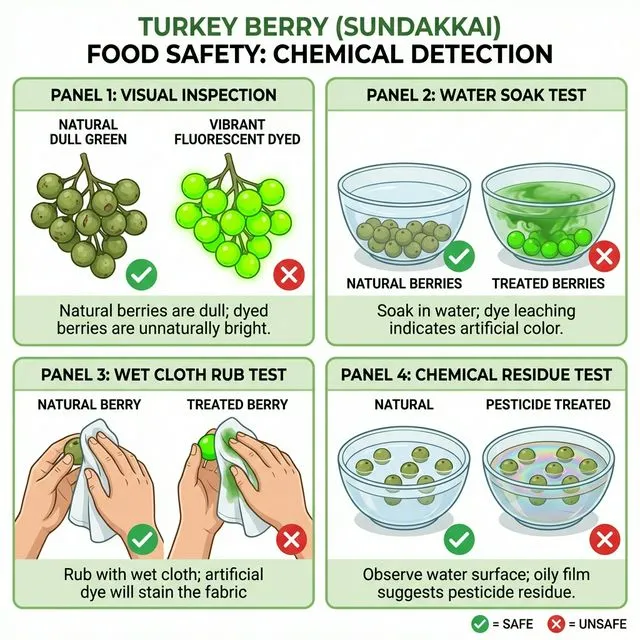
Turkey Berry (Sundakkai) Chemical Check
Turkey Berry is often intensively sprayed with pesticides due to pest susceptibility and treated with dyes to keep them look fresh.
1. The Chemical Film Wash:
Soak turkey berries in water with a pinch of baking soda. If an oily, iridescent film forms on the water surface, it indicates heavy pesticide residue (often organophosphates).
2. The Scent Analysis:
Fresh turkey berry has a mild, earthy, slightly bitter vegetable smell. If you detect a sharp, chemical, or "medicine-like" odor, it is likely contaminated with high pesticide residues.
3. The Cut & Oxidation Test:
Slice a berry. A natural berry will gradually oxidize and turn slightly brown. If the interior stays perfectly bright white or green for a long time, it may have been treated with sulfur-based preservatives.
4. The Color Rub Test:
Rub a few berries with a wet white cloth. If any green color transfers, they have been dyed with Malachite Green or other textile dyes to appear fresher than they are.
Quick Safety Tips
- Always crush slightly and soak in salt water to remove toxins
- Wash 3-4 times in running water
- Use baking soda wash for better pesticide removal
- Avoid berries with an unnatural chemical smell
Primary Chemical Concerns
Health Risks & Impacts
Multilingual Local Names
Common Storage Pests
Fruit Fly Larvae
low riskSmall larvae that can tunnel into the berries if they are over-ripe.
Detection
- Small entry holes
- Internal rot and mushiness
Prevention
- Store in a cool, dry place
- Use within 3-5 days
Corrective Action: What to do?
Discard berries with visible entry holes or internal rot.
Regulatory Corner: FSSAI (Food Safety and Standards Authority of India) / Ayurvedic Pharmacopoeia of India (API Part I, Vol II)
Regulation: Food Safety and Standards (Food Products Standards) Regulations 2011, Clause 2.3.40 & API Monograph
Legal Limit:Moisture in dried berries: Max 12.0%; Total ash: Max 8.0%; Acid-insoluble ash: Max 1.5%; Mineral gypsum/talc: 0.0% (Zero tolerance); Lead: Max 2.5 ppm
Report Adulteration to FSSAI (Food Safety and Standards Authority of India) / Ayurvedic Pharmacopoeia of India (API Part I, Vol II)