
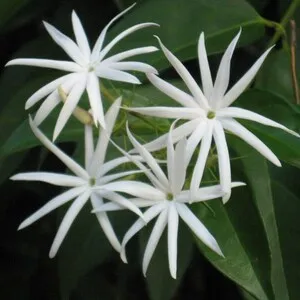
AngelWing Jasmine (Star Jasmine)
Jasminum laurifolium, Jasminum nitidum
How to Identify AngelWing Jasmine (Star Jasmine)
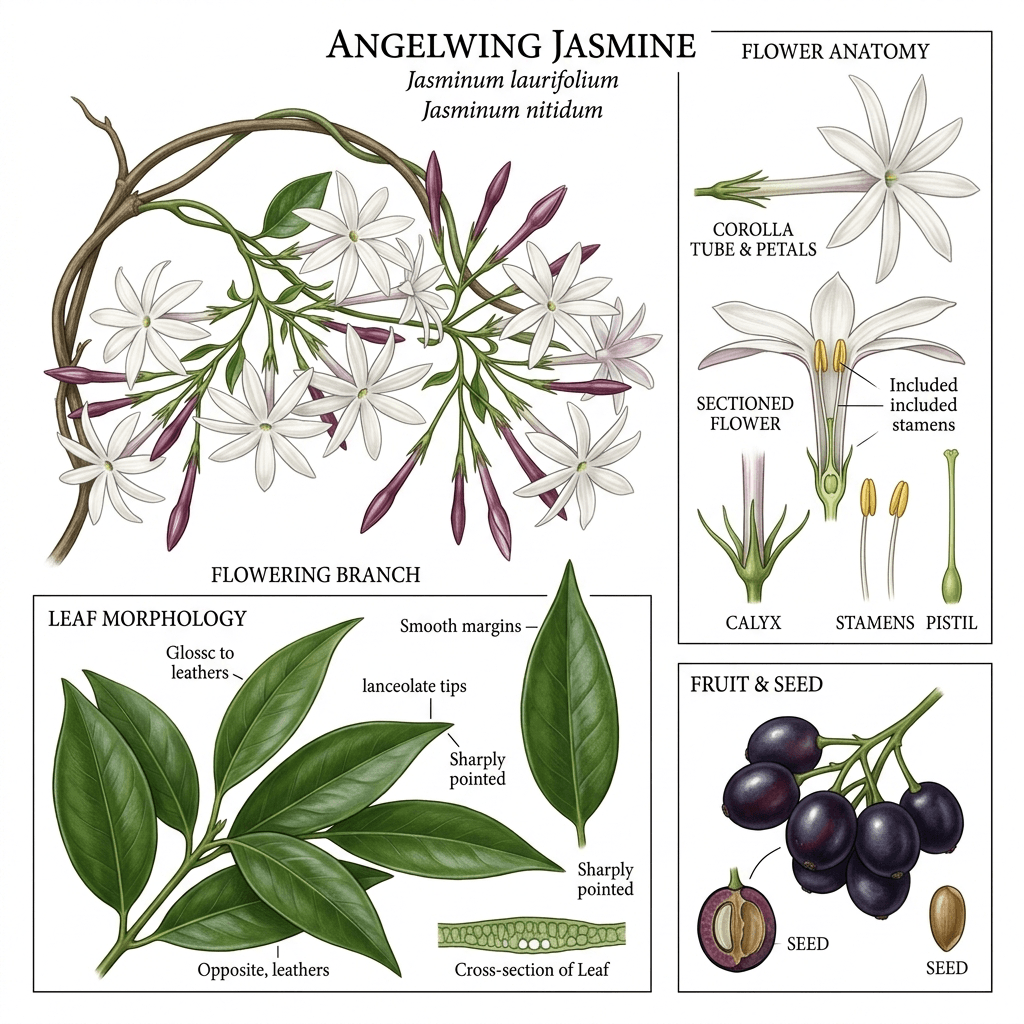
NON-TOXIC. 100% safe for cats, dogs, and horses. Provides a stunning, pet-safe alternative to toxic false jasmines.
A detailed guide to identifying Star / Angelwing Jasmine (Jasminum laurifolium / Jasminum nitidum / Ramar Banam) by key botanical features:
- Starry Pinwheel Flowers with Elongated Petals: Intensely sweet-scented flowers featuring 9 to 12 narrow, elongated, white petals radiating outwards like a slender pinwheel or star from a slender green corolla tube.
- Distinctive Purple-Maroon Flower Buds: Slender, pointed flower buds display striking deep purple, violet, or maroon undersides before unfurling into pure crystalline white blossoms.
- Glossy, Leathery Opposite Leaves: Elliptic to lanceolate dark emerald-green leaves with smooth, wavy margins and sharply pointed tips, arranged in neat opposite pairs along slender stems.
- Vigorous Arching Climber or Sprawling Shrub: Semi-vining woody habit growing 6 to 15 feet tall with flexible, twining stems capable of climbing trellises or mounding into dense fragrant groundcovers.
Types & Sub-types of Star / Angelwing Jasmine
Belonging to the Oleaceae (Olive) family, true jasmines of the genus Jasminum should not be confused with Confederate Jasmine (Trachelospermum jasminoides, in the Apocynaceae family):
- By Botanical Form & Nomenclature:
- Angelwing Jasmine (Jasminum laurifolium var. nitidum): The premier garden variety featuring oversized, starry flowers (up to 2 inches wide), purple flower buds, and high-gloss foliage. Known as 'Ramar Banam' in South India.
- Shining Jasmine (Jasminum nitidum): Known for exceptionally glossy, laurel-like leaves that remain pristine throughout the year in warm, subtropical to tropical climates.
- By Garden Application:
- Climbing Vine / Trellis Accent: Trained vertically up fences, arbors, and entrance arches to release sweet fragrance near doors and walkways.
- Sprawling Groundcover / Shrub: Pruned as an arching evergreen shrub (3–4 feet high) or allowed to cascade over retaining walls and embankments.
Care & Growing Guide
Seasonal Blooming & Hardiness
Seasonal Blooming Calendar:
- Peak Bloom: Spring to early summer (typically April through June).
- Planting Time: Sow seeds directly outdoors in early spring after the last frost, or transplant nursery starts in late spring.
Bloom Timeline
About AngelWing Jasmine (Star Jasmine)
The Angelwing Jasmine, botanically classified as Jasminum nitidum (and often associated with Jasminum laurifolium), is an exceptionally beautiful and intensely fragrant evergreen sprawling shrub. Native to the warm, tropical lowlands, coastal woodlands, and river valleys of the Indian Subcontinent—particularly India and Sri Lanka—and parts of Southeast Asia, this elegant species has been cultivated for centuries. It is globally celebrated as Star Jasmine, Windmill Jasmine, or Ramar Banam, prized for its unique pinwheel-shaped flowers and glossy, shining leaves.
This fast-growing woody plant exhibits a highly versatile growth habit, naturally developing as a sprawling, multi-stemmed shrub that reaches a height of 6 to 12 feet and a spread of 4 to 8 feet. If given a trellis or support structure, it can be easily trained to climb as a lush flowering vine. It features opposite, simple, oval-to-lanceolate leaves that are highly glossy and deep green, measuring 2 to 4 inches in length. From spring through summer (March through August), it produces abundant flower clusters, with a sweet, nocturnal perfume that carries far on warm evening breezes.
The reproductive morphology of Jasminum nitidum is summarized by the botanical floral formula EBr ⊕ ⚥ K(5) C(10-12) A2 G(2). This formula states that the flowers are ebracteate (lacking typical green bracts directly beneath the calyx), radially symmetrical (actinomorphic), and bisexual. The calyx is composed of 5 fused sepals forming a short, ridged tube. The corolla is salverform, featuring a long, slender purple-tinted tube that opens into 10 to 12 narrow, elongated, pure-white spreading petals (lobes). The androecium consists of exactly 2 stamens, and the gynoecium contains 2 fused carpels with a superior ovary.
Horticulturally, Angelwing Jasmine is a heat-loving tropical plant well-suited for USDA hardiness zones 9 through 11. It performs best in full, direct sun to light, partial shade, requiring at least 6 to 8 hours of daily sunlight to produce a high density of flowers. It thrives in fertile, organic, moist, and well-draining soils, requiring regular watering to keep the soil consistently moist but never soggy. In cooler climates (USDA zones 8 and below), it should be grown in containers and overwintered indoors in a bright, sunny room.
The specific Tamil name 'Ramar Banam' translates poetically to 'Rama's Arrow,' directly referencing the plant's long, sharp, purple-tinted flower buds, which closely resemble tiny arrows before opening. Famed in Sanskrit as Kunda (कुंद) or Mallika (मल्लika) and in Hindi as Raj Chameli (राज चमेली), the flowers hold highly sacred value in Hindu worship. They are extensively woven into traditional fragrant garlands, used for wedding decorations, and featured in classical literature to symbolize divine love, spiritual purity, and serene grace.
For pet owners and veterinarians, Angelwing Jasmine is an exceptionally safe and highly premium selection. Jasminum nitidum is classified as completely NON-TOXIC to cats, dogs, and horses by major global animal safety databases, including the ASPCA. If a pet plays with or chews on the glossy leaves or fragrant blooms, there is absolutely no danger of toxic chemical poisoning. To explore more safe green additions and family-friendly tropical plants, visit our general Pet Guard page. (Note: Do not confuse this true jasmine with Confederate Star Jasmine Trachelospermum jasminoides, which belongs to the toxic dogbane family and releases irritating milky sap.)
Angelwing Jasmine is occasionally confused with Confederate Star Jasmine or Pinwheel Flower. It is easily distinguished because true Jasminum species possess opposite, simple leaves, have exactly 2 stamens, produce 10-12 narrow petals, and lack any toxic milky sap. It makes a stunning specimen plant or container climber; we recommend pairing it with other non-toxic tropical favorites like Arabian Jasmine or Spanish Jasmine. To discover more fragrant climbers and tropical care guides, browse our Flower Identifier.
For more botanical profiles and flower identification features, see our guides on Tiger Lily and Stemless Gentian.
Floral Formula & Features
Ebracteate, radially symmetrical (actinomorphic), bisexual, 5 fused sepals forming short tube, 10-12 fused petals forming long tube with narrow spreading lobes (salverform), 2 stamens attached to corolla tube, 2 fused carpels with superior ovary. Unusual petal number for Oleaceae
- Scientific Name & Classification: Jasminum nitidum / Jasminum laurifolium (Oleaceae). Famed as Angelwing Jasmine, Star Jasmine, and Ramar Banam.
- Identification Markers: Sprawling evergreen woody growth, glossy deep green leaves, and purple flower buds opening into 10-12 narrow white pinwheel petals.
- Floral Formula (EBr ⊕ ⚥ K(5) C(10-12) A2 G(2)): Radially symmetrical, bisexual flowers with 5 fused sepals, 10-12 fused petals, exactly 2 stamens, and a superior ovary.
- Growing Requirements: Full sun to light shade; rich, moist, organic, well-draining soil. Bring container plants indoors in cold zones (Zones 9-11).
- Cultural Significance: Famed Tamil name 'Ramar Banam' means 'Rama's Arrow,' describing the arrow-like purple flower buds. Highly valued in wedding garlands and temples.
- Safety & Toxicity: NON-TOXIC. 100% safe for cats, dogs, and horses. Provides a stunning, pet-safe alternative to toxic false jasmines.
- Common Look-alikes: Confused with Confederate Star Jasmine (toxic dogbane family), but distinguished by its lack of milky sap, opposite leaves, and 10-12 petals.
- Internal Links: Mixes beautifully in warm courtyards with other fragrant, non-toxic jasmines like Arabian Jasmine or Spanish Jasmine; find more in our Flower Identifier.
- Internal Links: Compare key differences in our Arabian Jasmine vs Star Jasmine comparison, or try our instant Flower Identifier.
Names in Different Languages
Botanical Classification: AngelWing Jasmine (Star Jasmine) belongs to the Oleaceae family. Learn how to identify its floral symmetry, stamen arrangement, and structural formulas in our Botanical Family Classification Guide.
Toxicity & Safety
Frequently Asked Questions
What is Floral Formula?
A floral formula is a symbolic representation of a flower's structure using letters, numbers, and special symbols. It provides a concise way to describe the arrangement and number of floral parts.
This formula describes the flower's symmetry, sepals, petals, stamens, and carpels in a standardized format.
Formula Sequence
- Bract: Br or Ebr
- Bracteole: Brl or Ebrl
- Symmetry: % (Radial) or ⊕ (Bilateral)
- Sex: ♀ (Female), ♂ (Male), or ⚥ (Bisexual)
- Calyx/Sepal: K<number> (Free or Fused)
- Corolla/Petal: C<number> (Free or Fused)
- Androecium: A<number> (Free or Fused)
- Gynaecium: G<number> (Superior or Inferior Ovary)
Symbol Meanings
- Numbers: Indicate quantity of parts
- Parentheses (): Parts are fused together
- Plus (+): Parts in different whorls
- Underline: Superior ovary position
- Overline: Inferior ovary position
- ∞: Numerous parts (too many to count)
Understanding floral formulas helps botanists quickly identify and classify flowers based on their structural characteristics.
Similar Flowers
Discover flowers that share botanical characteristics
Same Genus
4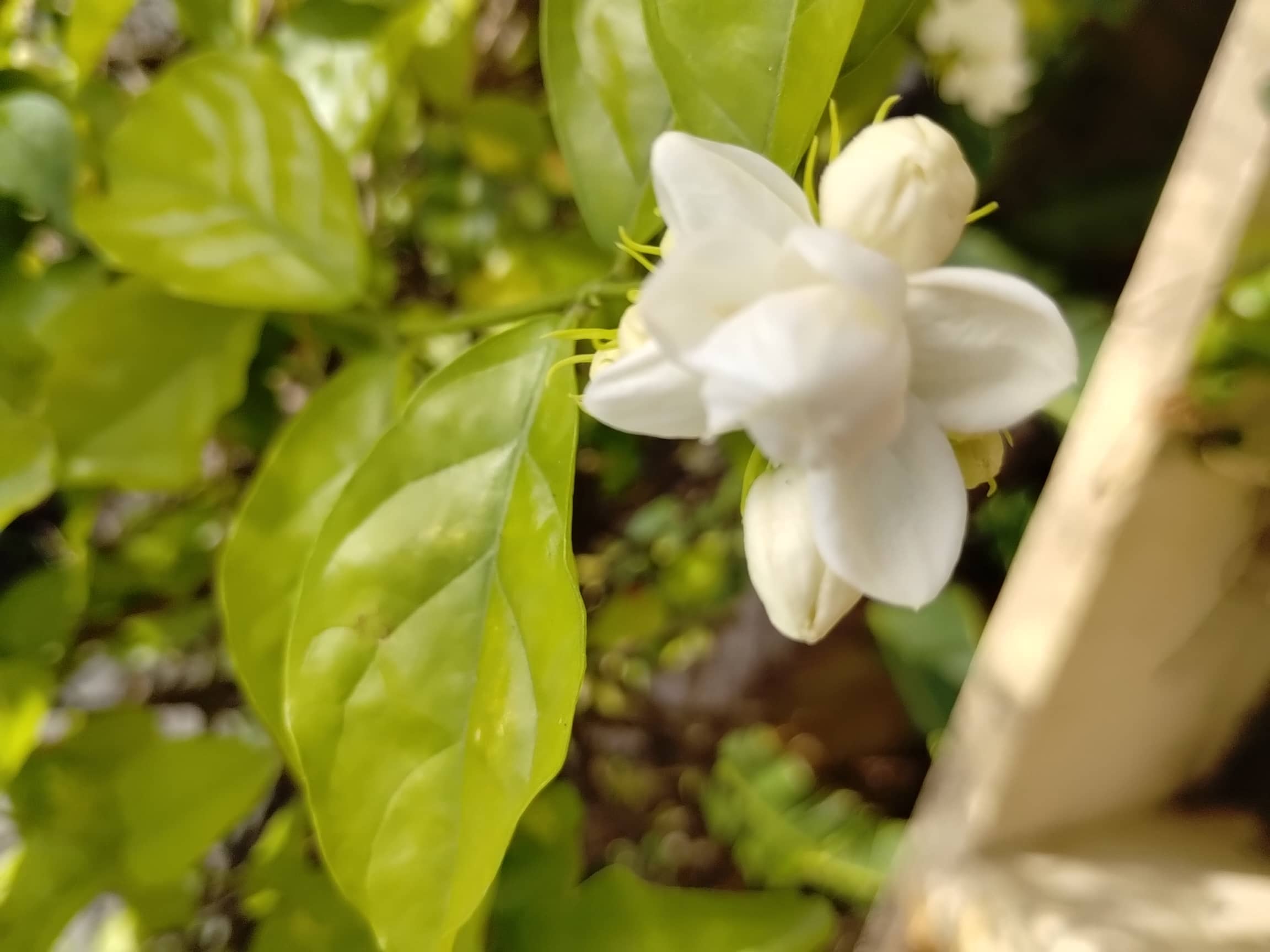
Arabian jasmine
Jasminum sambac
The Arabian Jasmine, botanically named Jasminum sambac and belonging to the Oleaceae (olive) family, is an exceptionally celebrated evergreen climbing shrub. Native to the warm, tropical valleys and humid plains of the Indian subcontinent and Southeast Asia, this legendary plant has been cultivat...
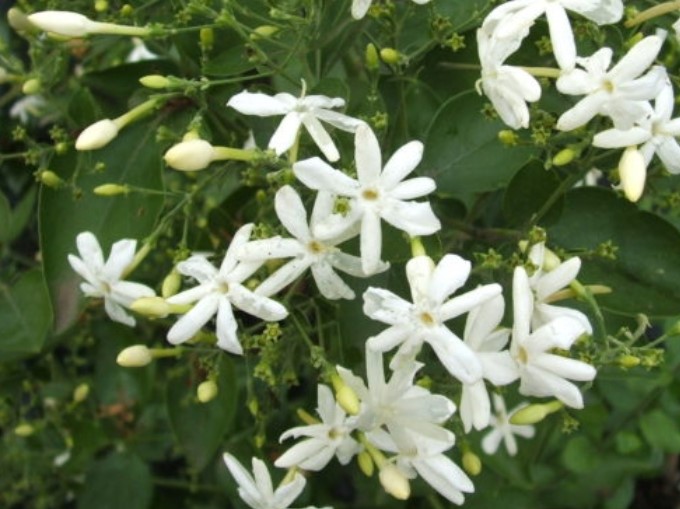
Juhi Jasmine
Jasminum auriculatum
Jasminum auriculatum, affectionately known as Juhi Jasmine or Mulla, is a highly aromatic, scrambling evergreen shrub or woody vine belonging to the Oleaceae (Olive) family. Native primarily to the Indian subcontinent and parts of Southeast Asia, it is globally celebrated not for the sheer size o...
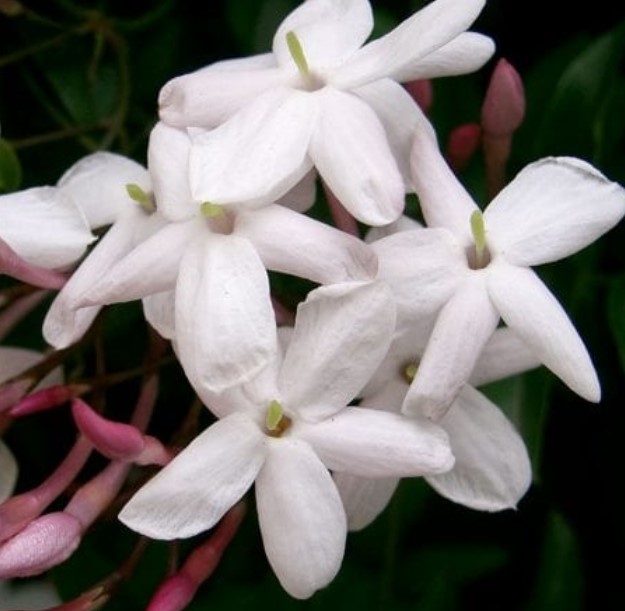
Spanish Jasmine (Royal Jasmine)
Jasminum grandiflorum
Spanish Jasmine, botanically classified as Jasminum grandiflorum and widely known as Royal Jasmine, Catalan Jasmine, or Scented Jasmine, is an exceptionally fragrant semi-evergreen woody vine belonging to the Oleaceae (olive) family. Believed to have originated in the high valleys of the Himalaya...
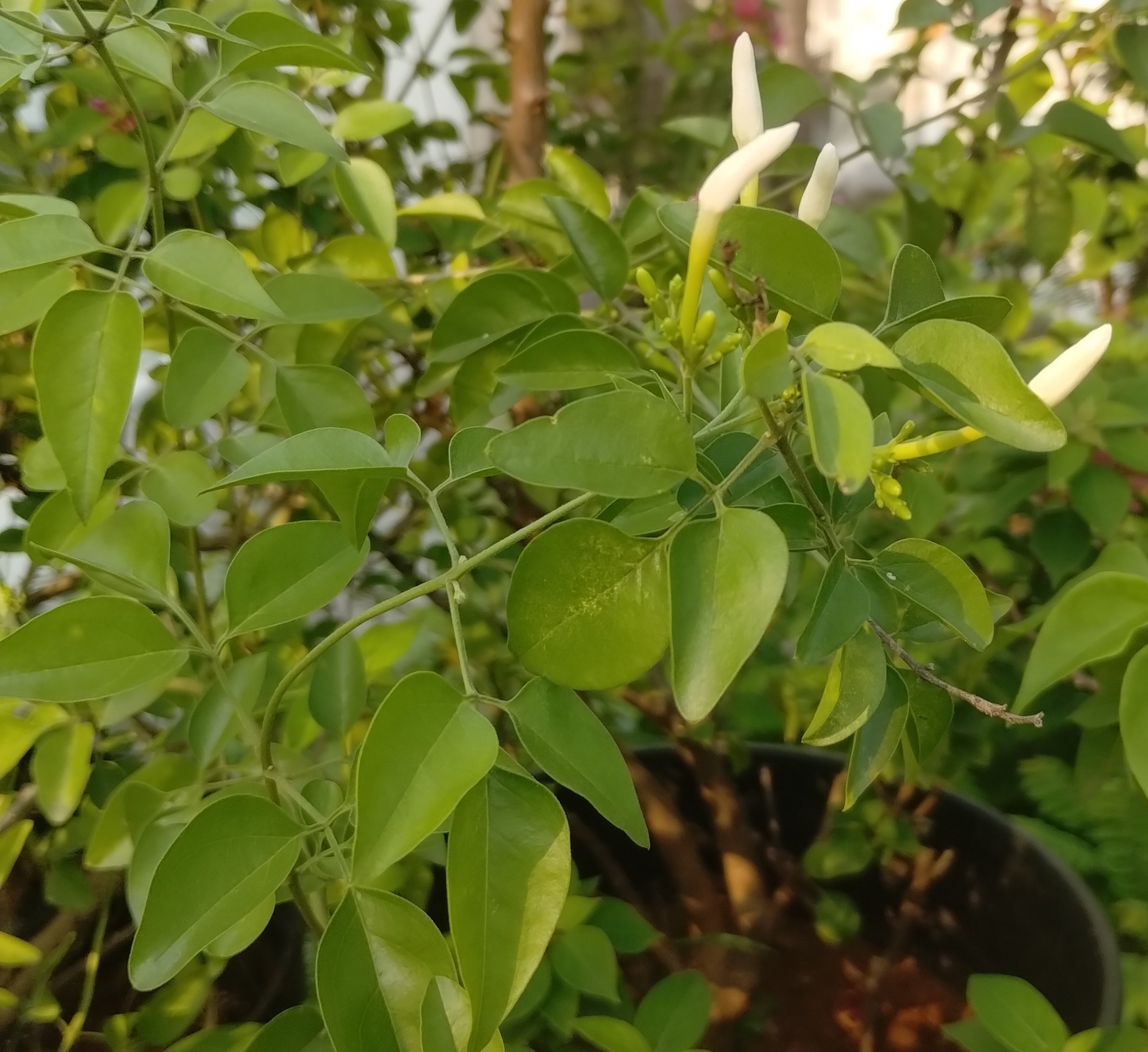
River Jasmine (Fluminense)
Jasminum fluminense
Jasminum fluminense, commonly known as the River Jasmine or Brazilian Jasmine—and widely known across South Asia as Nitya Malli or Nithya Malligai (meaning 'ever-blooming jasmine')—is a vigorous and aromatic evergreen climber that embodies the lush, tropical essence of South America. Native to th...
Similar Characteristics
4
Pincushion
Scabiosa
The Pincushion Flower, botanically designated under the genus *Scabiosa* (particularly *Scabiosa atropurpurea*, known as the Sweet Scabious or Pincushion Flower), is an exceptionally charming, airy herbaceous perennial or annual. Belonging to the family Caprifoliaceae (the honeysuckle family, tri...
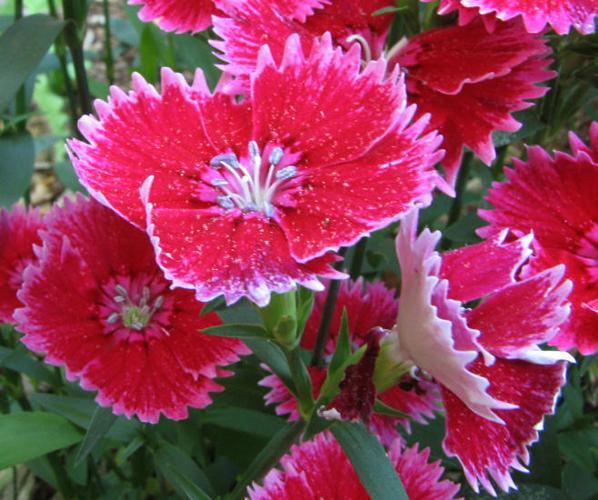
Sweet William (Dianthus barbatus)
Dianthus
Dianthus barbatus, universally cherished as Sweet William, is a charming, fragrant cottage garden biennial or short-lived perennial belonging to the Caryophyllaceae (pink or carnation) family. Native to the mountainous meadows, rocky slopes, and light woodlands of southern and southeastern Europe...
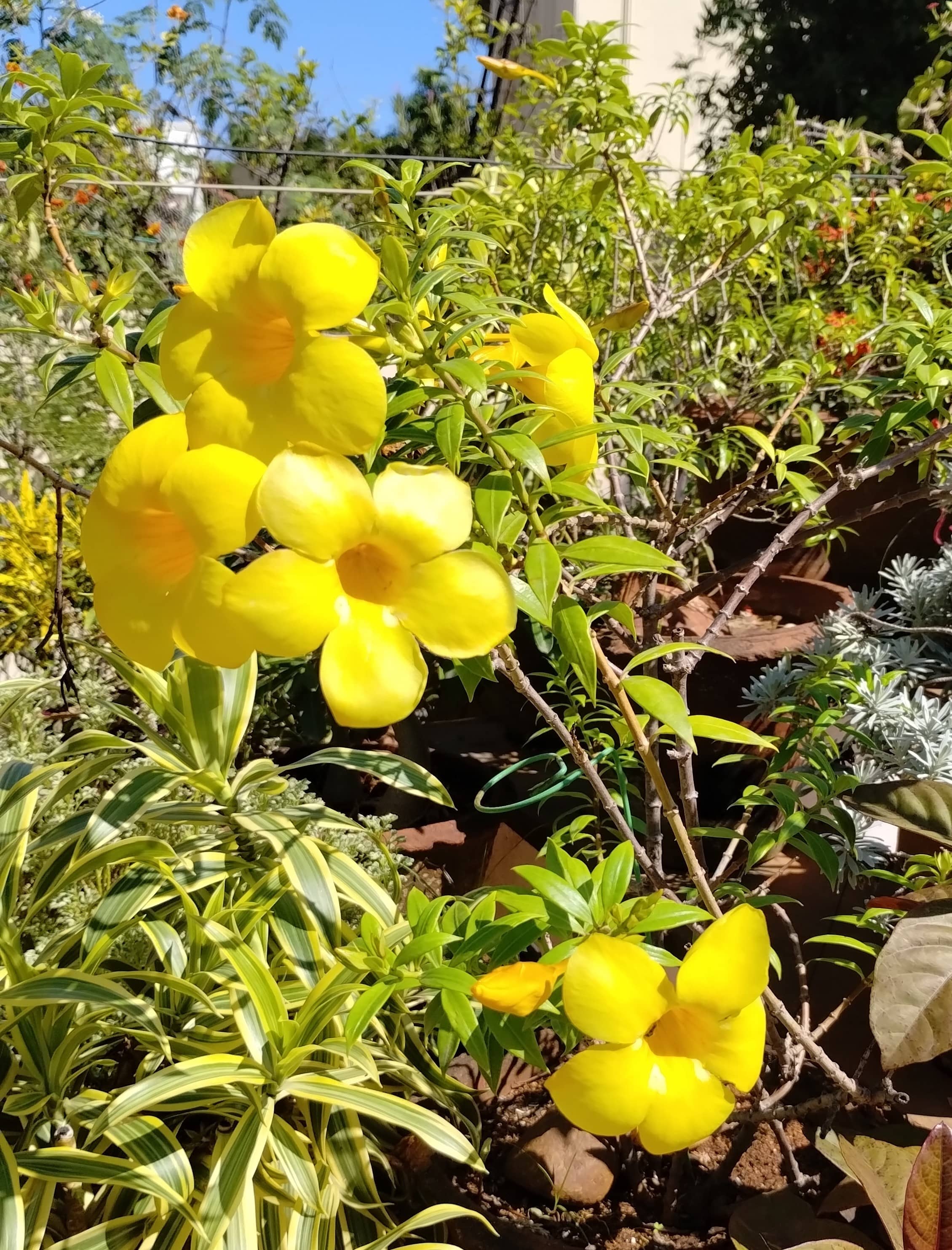
Allamanda
Allamanda cathartica
The Allamanda, botanically designated as Allamanda cathartica and commonly known as the Golden Trumpet, Common Trumpet Vine, or Yellow Bell, is a spectacular tropical evergreen perennial. Belonging to the family Apocynaceae (the dogbane family), this vigorous climbing vine or sprawling shrub is n...
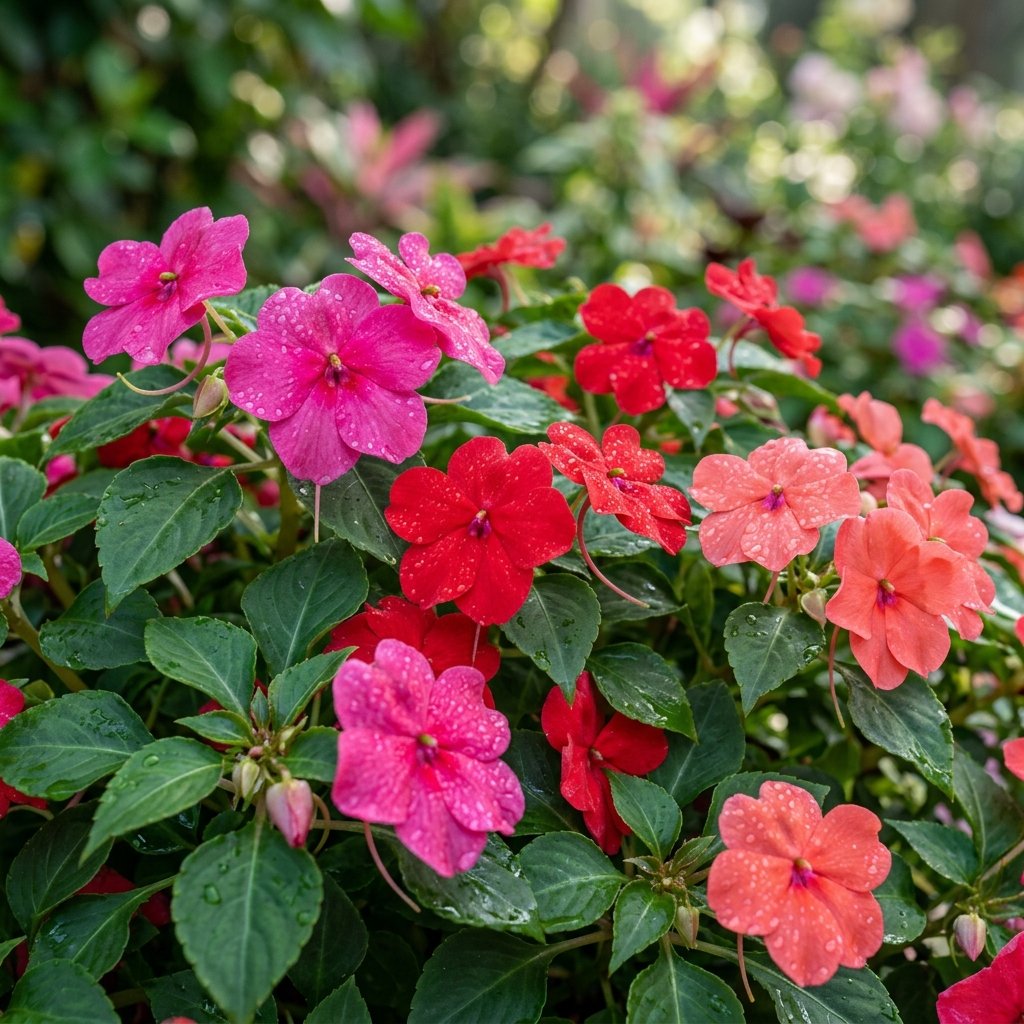
Impatiens Walleriana
Impatiens walleriana
Impatiens Walleriana, botanically classified as *Impatiens walleriana* and universally celebrated across the gardening world as Busy Lizzie, Sultana, or Patient Lucy, is an exceptionally popular, prolific, and shade-tolerant herbaceous perennial commonly cultivated as an annual. Belonging to the...