
Spanish Jasmine (Royal Jasmine)
Jasminum grandiflorum
How to Identify Spanish Jasmine (Royal Jasmine)
NON-TOXIC. 100% safe for cats, dogs, and horses, making them a safe and heavenly scented trellis vine for family yards.
A detailed guide to identifying Spanish Jasmine / Royal Jasmine (Jasminum grandiflorum / Chameli) by its key botanical features:
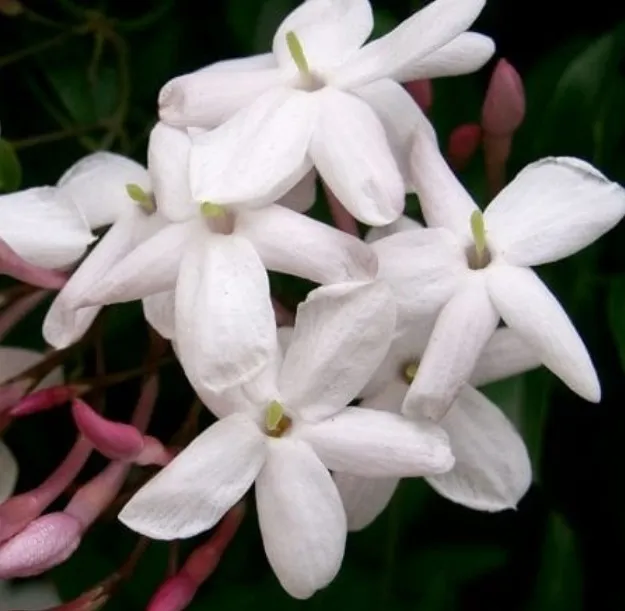
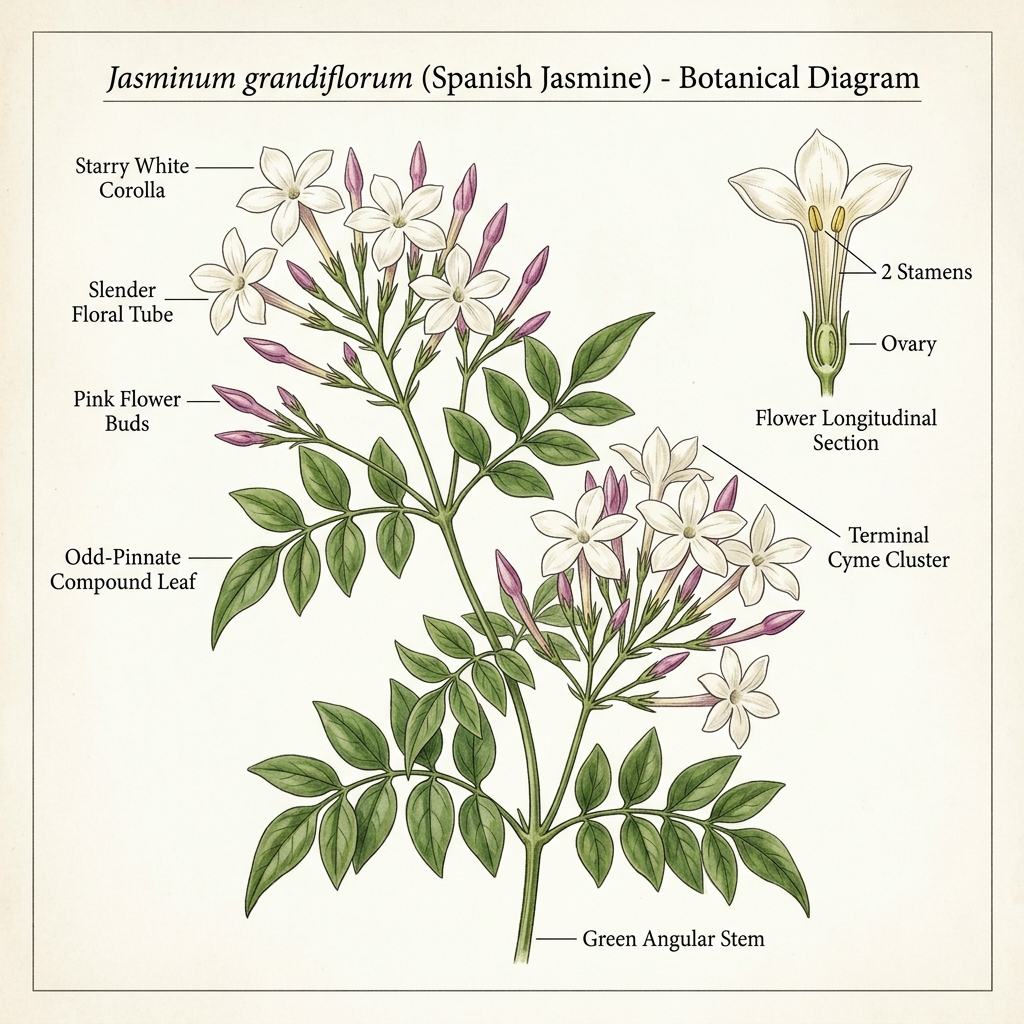
- Star-Shaped Pure White Corolla: Highly fragrant, starry blossoms featuring 5 broad, flat, spreading oval petals radiating from an elongated, slender cylindrical floral tube.
- Pinkish-Purple Pointed Buds: Flower buds are prominently tinged with deep reddish-pink or purplish blush on the outside prior to opening into glistening white flowers.
- Odd-Pinnate Compound Leaves: Opposite green leaves composed of 5 to 7 (sometimes 9) ovate leaflets, with the terminal leaflet distinctly larger than the lower paired lateral leaflets.
- Slender Angular Green Stems: Flexible, scrambling, 4-angled green branchlets that climb gracefully across trellises, arbors, and hedges up to 10 to 15 feet.
- Heady Nocturnal Fragrance: Blossoms open in late afternoon and dusk, emitting an intensely sweet, warm, fruity floral aroma that has made this species the premier jasmine for French and international perfumery.
Varieties & Cultivar Distinctions
- By Regional & Perfumery Cultivation:
- French Perfumery Jasmine (Grasse Jasmine): Historically cultivated in Grasse, France, for pure jasmine absolute extraction in high-end luxury fragrances.
- Indian Jathi Malli / Pitchi Form: A vigorous, floriferous tropical selection widely grown in Tamil Nadu and across South India for temple garlands, weddings, and hair adornments.
- Botanical Distinction from Arabian Jasmine (Jasminum sambac):
- Foliage Structure: Jasminum grandiflorum bears pinnately compound leaves (5-7 leaflets), whereas Jasminum sambac (Mogra) has simple, unlobed opposite leaves.
- Corolla & Buds: J. grandiflorum has starry, slender petals and pink-flushed buds, while J. sambac has rounded petals and creamy-green buds.
Care & Growing Guide
Spanish Jasmine (Royal Jasmine / Chameli) Care & Growing Guide:
- Light: Full sun to bright partial shade (at least 5 to 6 hours of direct sunlight daily). Adequate sunshine is essential for abundant bud set.
- Soil: Rich, fertile, loamy, well-draining soil enriched with organic compost (pH 6.0 to 7.0). Tolerates sandy or light clay soils if drainage is reliable.
- Watering: Water regularly during the active summer growing and blooming season to maintain even soil moisture. Reduce watering during cooler winter rest periods.
- Pruning & Support: Provide a sturdy trellis, pergola, or arbor. Prune immediately after the main flowering season in late winter or early spring to remove tangled growth and stimulate vigorous new flowering shoots.
Seasonal Blooming & Hardiness
Seasonal Blooming Calendar (US Hardiness Zones 7b-11 / Subtropical & Warm Temperate):
- Peak Bloom: Summer through mid-to-late autumn (typically June through November); blooms over an exceptionally extended season in warm frost-free regions.
- Planting Time: Plant container nursery vines outdoors in early-to-mid spring after all danger of frost has passed.
- Cold Hardiness: Moderately cold-hardy for a jasmine (Zones 7b-11). Mature vines tolerate brief dips down to 15-20°F (-7 to -6°C), re-sprouting vigorously in spring if top foliage freezes back.
Bloom Timeline
About Spanish Jasmine (Royal Jasmine)
Spanish Jasmine, botanically classified as Jasminum grandiflorum and widely known as Royal Jasmine, Catalan Jasmine, or Scented Jasmine, is an exceptionally fragrant semi-evergreen woody vine belonging to the Oleaceae (olive) family. Believed to have originated in the high valleys of the Himalayas (stretching across India, Nepal, and Pakistan), it was introduced to Spain and the Mediterranean by Moorish traders, where it became a classic cultural landscape staple. It is universally celebrated for producing pure white, star-shaped blossoms containing the world's most luxurious, intoxicating perfume.
Growing as a vigorous sprawling shrub or training as a climbing vine, Jasminum grandiflorum produces arching branches that easily reach lengths of 6 to 15 feet. It features dark-green, opposite compound leaves composed of 5 to 9 leaflets. Throughout summer and fall (June to October), and continuously year-round in frost-free tropical climates, the plant is covered in dense clusters (cymes) of highly star-shaped white flowers measuring 1 to 1.5 inches across. The blooms emerge from charming pink-tinged buds and emit a powerful, sweet fragrance that peaks at night.
The reproductive architecture of the Spanish Jasmine is represented by the botanical floral formula EBr ⊕ ⚥ K(4-5) C(4-5) A2 G(2). This formula indicates that the flowers are ebracteate, radially symmetrical (actinomorphic), and bisexual. The calyx is composed of 4 to 5 short sepals fused into a small cup, while the salverform corolla features 4 to 5 petals fused into a long, narrow tube that flares into spreading white lobes. The androecium consists of 2 stamens attached inside the corolla tube, surrounding a superior ovary of 2 fused carpels.
Jasminum grandiflorum is a sun-loving species that thrives in warm-temperate, Mediterranean, and subtropical climates. It requires full morning sun to partial afternoon shade, needing at least 6 hours of direct daily exposure to maximize its spectacular bloom output. It demands well-drained, moderately fertile, loamy soil and regular watering during the active growing season. Notably, it is more cold-hardy than other tropical jasmines, withstanding brief drops to 10°F with root protection in USDA zones 7 through 11.
The genus name Jasminum is derived from 'yasmin,' a Persian word meaning 'a gift from God,' in reference to the plant's heavenly, soothing aroma, while the specific epithet grandiflorum literally means 'large-flowered.' Culturally, it is a cornerstone of the world's luxury perfume industry, with the fields of Grasse, France harvesting millions of flowers to extract jasmine absolute (the heart of Chanel No. 5). Famed on the Indian subcontinent as Chameli (चमेली) in Hindi and Jathi malli (ஜாதிமல்லி) in Tamil, it represents pure sensuality and grace.
For families with household pets, Spanish Jasmine is a highly premium and completely safe landscape choice. Jasminum grandiflorum is classified as completely NON-TOXIC to cats, dogs, and horses by major global veterinary toxicology associations, including the ASPCA. Pet owners must distinguish true jasmines from toxic plants like Carolina Jasmine or Star Jasmine, but true Spanish Jasmine contains no harmful alkaloids or chemical irritants, making it completely safe. To find more safe, aromatic vines, explore our Pet Guard catalog.
Spanish Jasmine is occasionally confused with Carolina Jessamine (Gelsemium sempervirens) or Star Jasmine (Trachelospermum jasminoides). It is easily distinguished because Jasminum grandiflorum features star-shaped white flowers and pinnately compound leaves (5-9 leaflets), whereas Carolina Jessamine has lethal yellow flowers and simple narrow leaves. It pairs beautifully on trellises beside other climbers; we suggest planting it near colorful Trumpet Vine or yellow Tecoma. Explore more Oleaceae in our Flower Identifier.
Floral Formula & Features
Actinomorphic, bisexual, 4-5 fused sepals forming tube, 4-5 fused petals forming a salverform corolla, 2 stamens attached inside corolla tube, 2 fused carpels with superior ovary
- Scientific Name & Classification: Jasminum grandiflorum (Oleaceae). Commonly known as Spanish Jasmine, Royal Jasmine, and Chameli.
- Identification Markers: Sprawling semi-evergreen vine with opposite compound leaves (5-9 leaflets). Star-shaped white flowers emerging from pink buds with an intense night perfume.
- Floral Formula (EBr ⊕ ⚥ K(4-5) C(4-5) A2 G(2)): Actinomorphic, bisexual flowers with a salverform corolla of fused petals, 2 stamens, and a superior ovary.
- Growing Requirements: Full sun to partial shade; prefers well-drained, fertile, compost-rich soil. More cold-hardy than typical tropical jasmines (Zones 7-11).
- Cultural Significance: Major absolute oil source for luxury perfumes (Chanel No. 5). Name translates to 'gift from God' in Persian; symbol of pure grace.
- Safety & Toxicity: NON-TOXIC. 100% safe for cats, dogs, and horses, making them a safe and heavenly scented trellis vine for family yards.
- Common Look-alikes: Confused with highly lethal Carolina Jessamine, but distinguished by compound leaves and pure white (rather than bright yellow) flowers.
- Internal Links: Creates a gorgeous scented trellis backdrop paired with climbing Trumpet Vine or upright yellow Tecoma; find more in our Flower Identifier.
Names in Different Languages
Botanical Classification: Spanish Jasmine (Royal Jasmine) belongs to the Oleaceae family. Learn how to identify its floral symmetry, stamen arrangement, and structural formulas in our Botanical Family Classification Guide.
Toxicity & Safety
Frequently Asked Questions
What is Floral Formula?
A floral formula is a symbolic representation of a flower's structure using letters, numbers, and special symbols. It provides a concise way to describe the arrangement and number of floral parts.
This formula describes the flower's symmetry, sepals, petals, stamens, and carpels in a standardized format.
Formula Sequence
- Bract: Br or Ebr
- Bracteole: Brl or Ebrl
- Symmetry: % (Radial) or ⊕ (Bilateral)
- Sex: ♀ (Female), ♂ (Male), or ⚥ (Bisexual)
- Calyx/Sepal: K<number> (Free or Fused)
- Corolla/Petal: C<number> (Free or Fused)
- Androecium: A<number> (Free or Fused)
- Gynaecium: G<number> (Superior or Inferior Ovary)
Symbol Meanings
- Numbers: Indicate quantity of parts
- Parentheses (): Parts are fused together
- Plus (+): Parts in different whorls
- Underline: Superior ovary position
- Overline: Inferior ovary position
- ∞: Numerous parts (too many to count)
Understanding floral formulas helps botanists quickly identify and classify flowers based on their structural characteristics.
Similar Flowers
Discover flowers that share botanical characteristics
Same Genus
4
AngelWing Jasmine (Star Jasmine)
Jasminum laurifolium, Jasminum nitidum
The Angelwing Jasmine, botanically classified as Jasminum nitidum (and often associated with Jasminum laurifolium), is an exceptionally beautiful and intensely fragrant evergreen sprawling shrub. Native to the warm, tropical lowlands, coastal woodlands, and river valleys of the Indian Subcontinen...
River Jasmine (Fluminense)
Jasminum fluminense
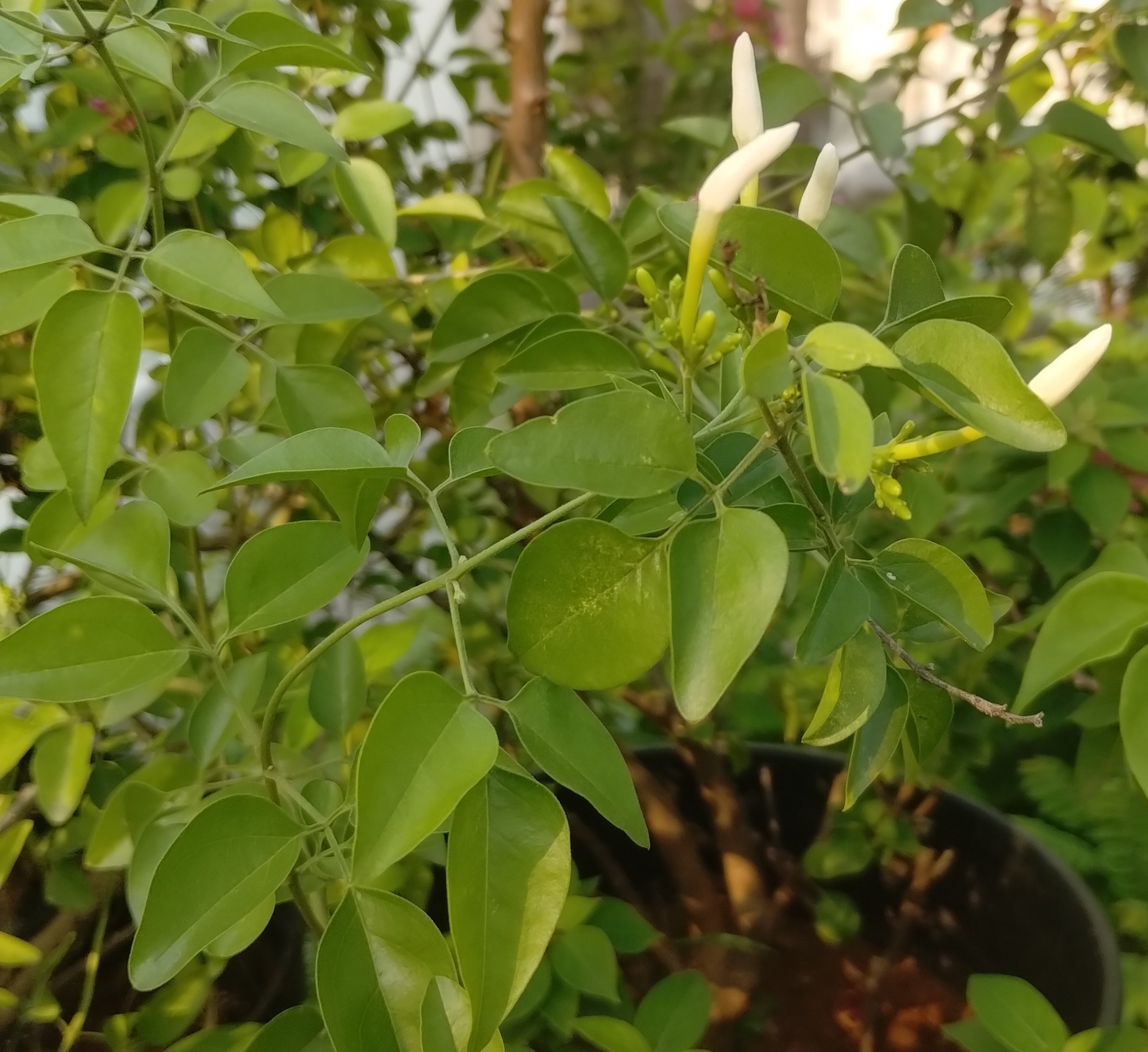
Jasminum fluminense, commonly known as the River Jasmine or Brazilian Jasmine—and widely known across South Asia as Nitya Malli or Nithya Malligai (meaning 'ever-blooming jasmine')—is a vigorous and aromatic evergreen climber that embodies the lush, tropical essence of South America. Native to th...
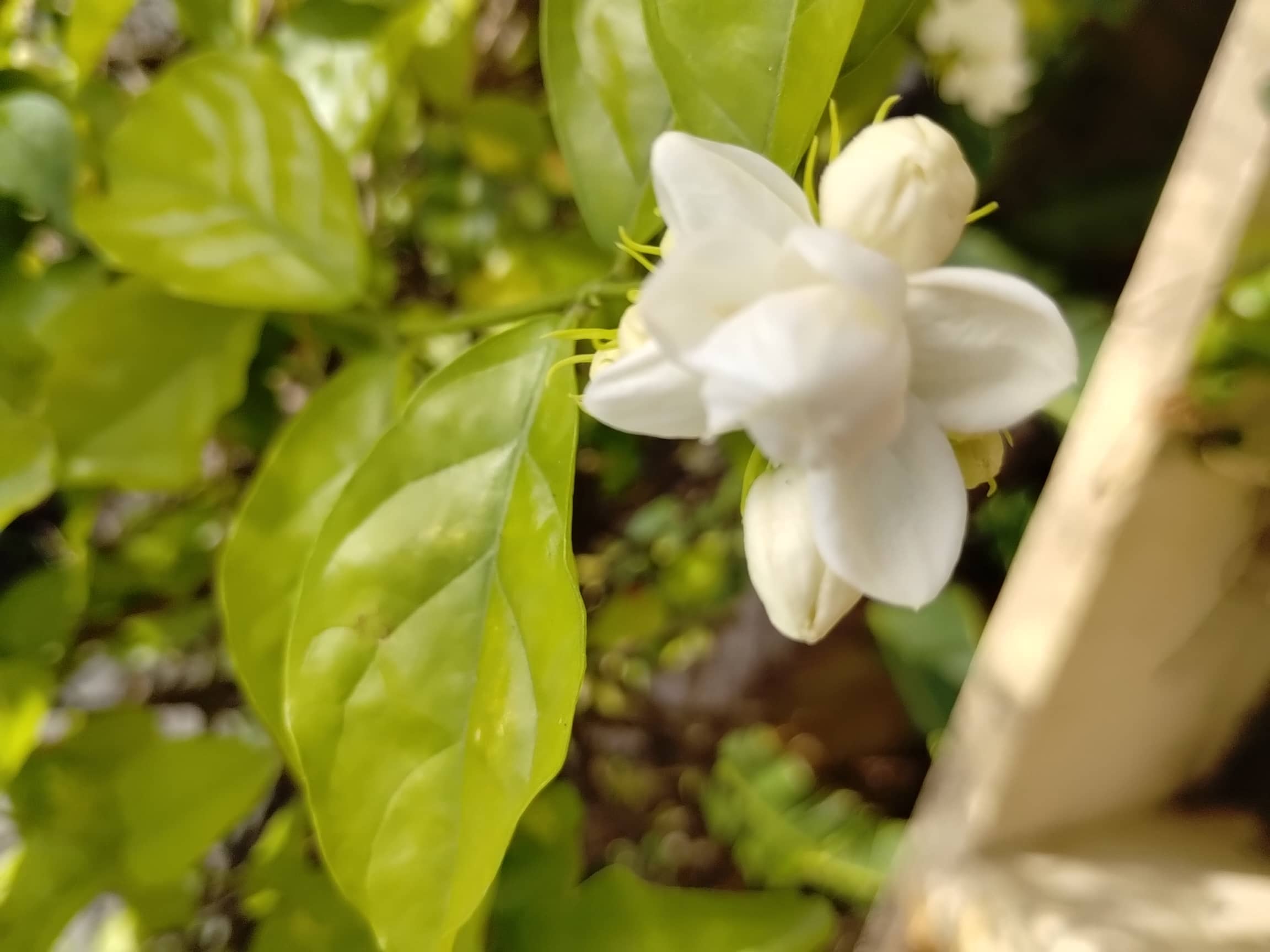
Arabian jasmine
Jasminum sambac
The Arabian Jasmine, botanically named Jasminum sambac and belonging to the Oleaceae (olive) family, is an exceptionally celebrated evergreen climbing shrub. Native to the warm, tropical valleys and humid plains of the Indian subcontinent and Southeast Asia, this legendary plant has been cultivat...
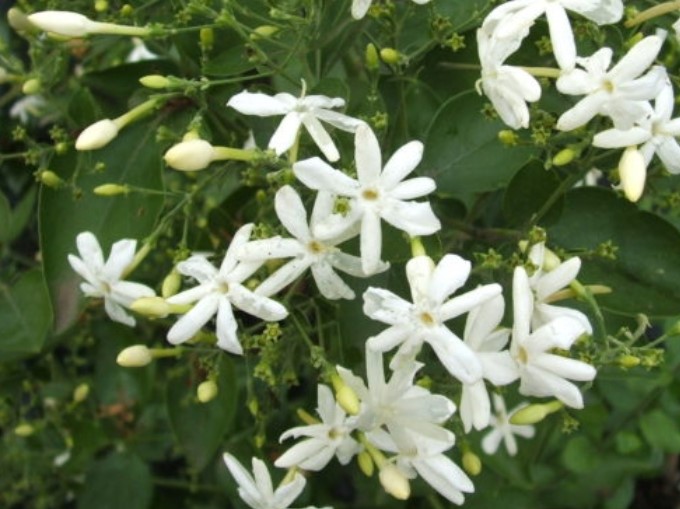
Juhi Jasmine
Jasminum auriculatum
Jasminum auriculatum, affectionately known as Juhi Jasmine or Mulla, is a highly aromatic, scrambling evergreen shrub or woody vine belonging to the Oleaceae (Olive) family. Native primarily to the Indian subcontinent and parts of Southeast Asia, it is globally celebrated not for the sheer size o...
Similar Characteristics
4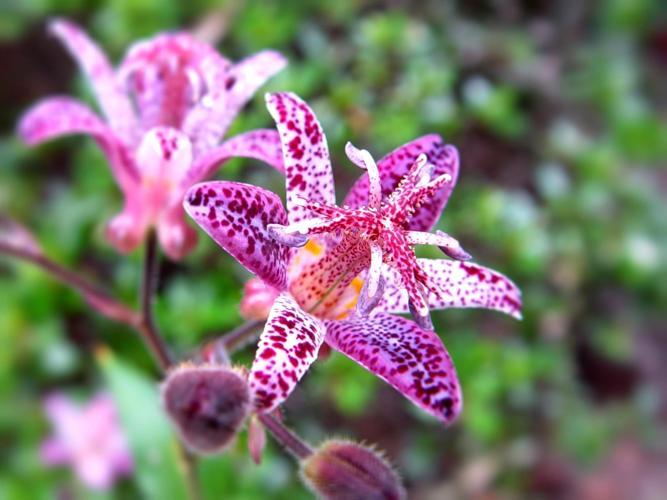
Toad Lily
Tricyrtis
The Toad Lily, botanically classified under the genus Tricyrtis and belonging to the family Liliaceae (the lily family, tribe Lilieae), is an exceptionally exotic, shade-loving perennial. Native to the damp forest understories, shaded mountain valleys, and rocky stream banks of eastern Asia—with...
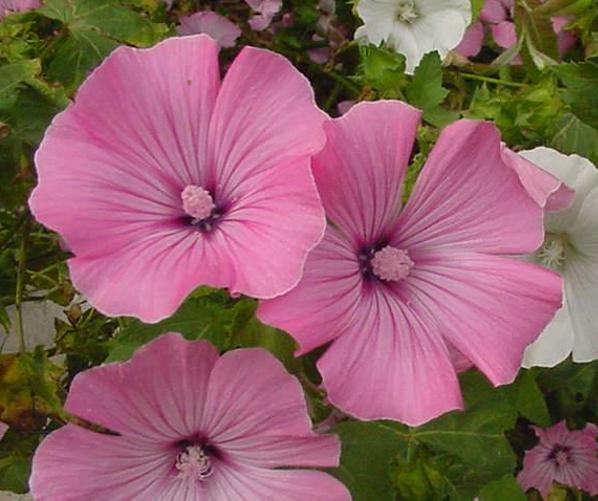
Tree Mallow
Malva arborea
The Tree Mallow, botanically classified as Malva arborea (and previously known as Lavatera arborea), is a robust, fast-growing biennial or short-lived perennial shrub belonging to the Malvaceae (mallow) family. Native to the Mediterranean basin and the rugged, salt-swept coastal cliffs of Western...
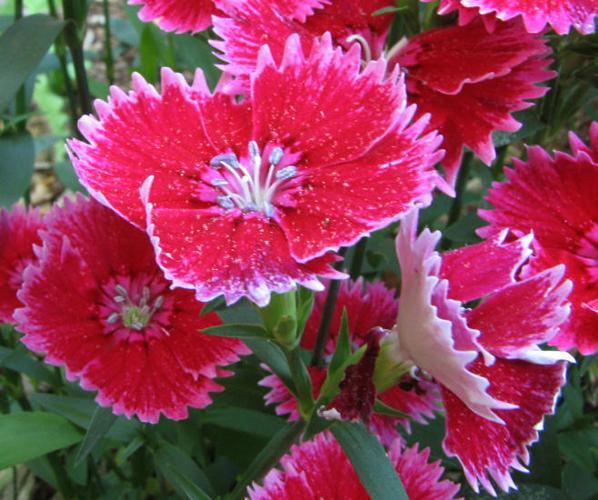
Sweet William (Dianthus barbatus)
Dianthus
Dianthus barbatus, universally cherished as Sweet William, is a charming, fragrant cottage garden biennial or short-lived perennial belonging to the Caryophyllaceae (pink or carnation) family. Native to the mountainous meadows, rocky slopes, and light woodlands of southern and southeastern Europe...
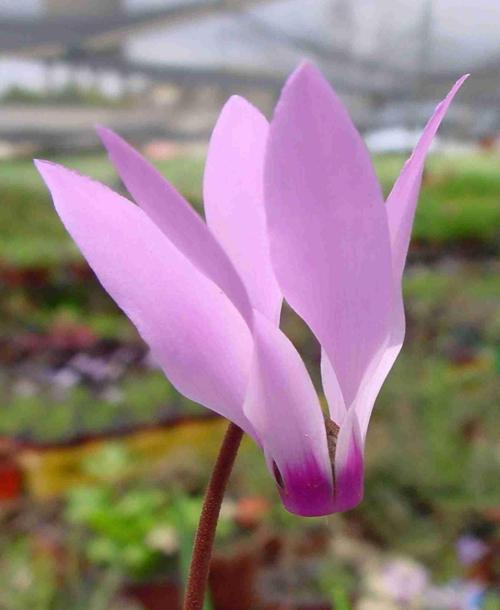
Cyclamen
Cyclamen persicum
Cyclamen (Cyclamen persicum), often referred to as the Persian Cyclamen or Sowbread, is a captivating tuberous perennial that has enchanted gardeners for centuries with its unique, upswept blossoms and elegantly patterned foliage. Native to the rocky hillsides and woodlands of the Mediterranean r...