
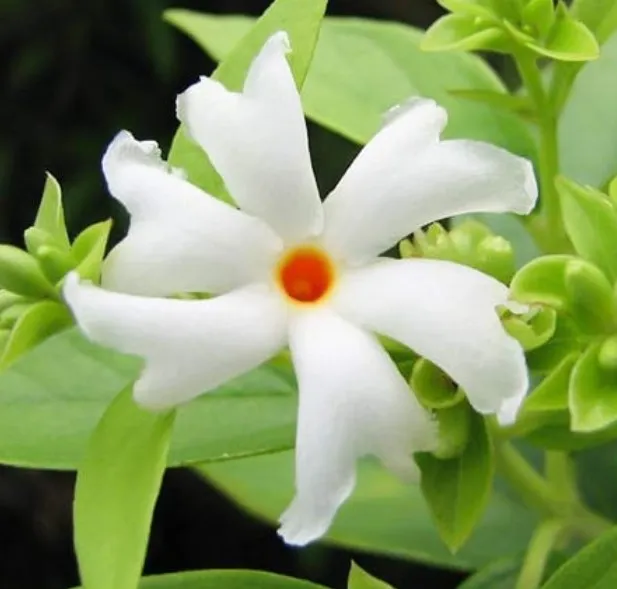
Night Jasmine (Coral Jasmine)
Nyctanthes arbor-tristis
How to Identify Night Jasmine (Coral Jasmine)
NON-TOXIC. Safe for cats and dogs. Human Safety: Generally safe; used in Ayurvedic teas and infusions. Handling the rough leaves may cause mild skin irritation for sensitive individuals.
A detailed guide to identifying Night Jasmine / Coral Jasmine (Nyctanthes arbor-tristis) by its key botanical features:
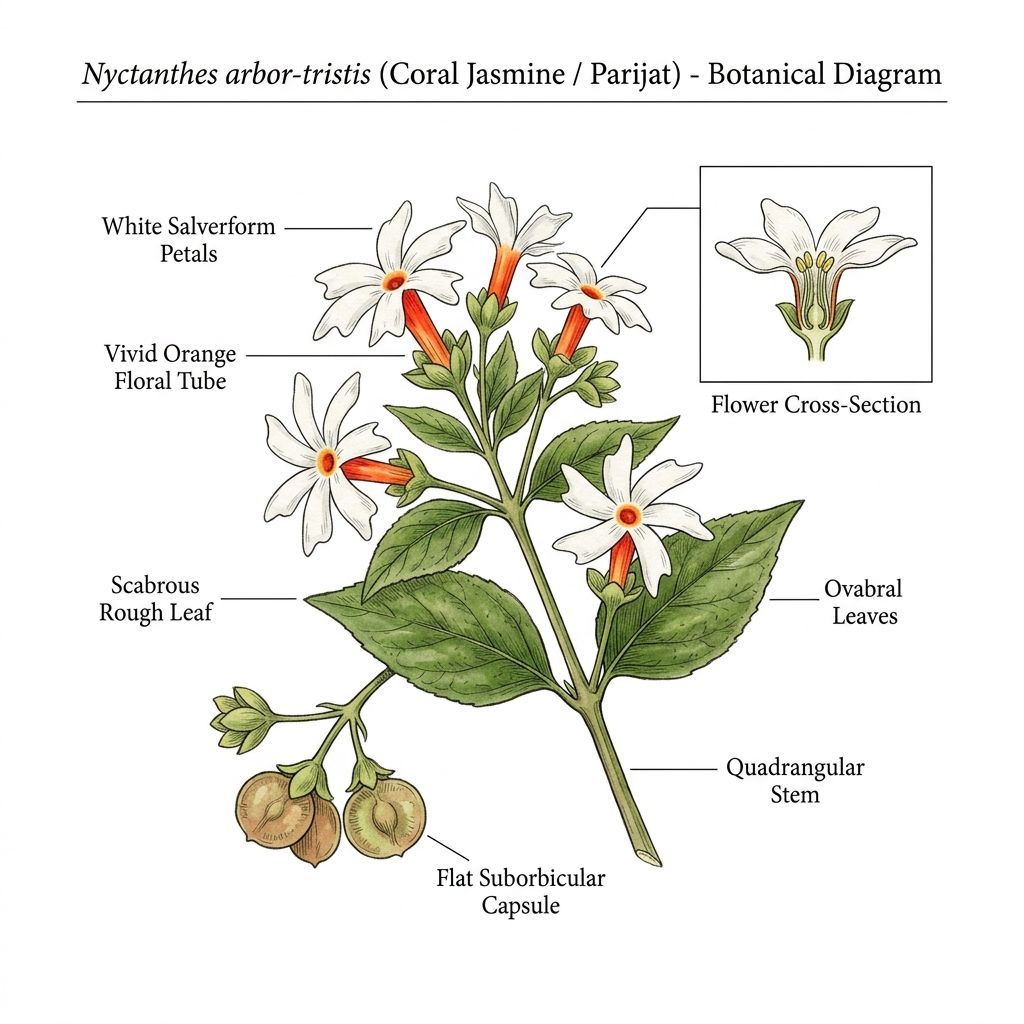
- Star-shaped White Corolla with Orange Tube: Pure white pinwheel or star-shaped flowers with 5 to 8 spreading lobes, radiating from a vividly contrasting bright orange-to-coral cylindrical floral tube.
- Nocturnal Blooming & Dawn Drop: Buds open at dusk, filling the night air with an intense honey-like floral fragrance, and fall to the ground untouched at dawn.
- Rough Sandpaper (Scabrous) Leaves: Large opposite ovate leaves with acute tips, covered in stiff microscopic silica hairs that feel distinctly rough like sandpaper when stroked.
- Quadrangular Square Twigs: Young stems and branchlets are distinctly 4-sided (quadrangular) with grey-green bark.
- Flat Disc Capsules: Compressed, suborbicular to heart-shaped flat brown seed capsules that split into two one-seeded sections.
Botanical Cultivars & Forms of Nyctanthes arbor-tristis
- By Flower Corolla Size & Petal Count:
- Standard 5-to-8 Lobe Form: Classic wild and garden form featuring starry white corollas with 5 to 8 rounded or emarginate petal lobes around the slender orange tube.
- Large-Flowered Selections: Cultivated garden varieties producing slightly larger blossoms (over 1 inch wide) with intensified orange corolla tubes used for natural textile dyes.
- By Growth Habit:
- Multi-Stemmed Large Shrub: Bushy shrub reaching 8 to 12 feet tall with extensive branching, commonly planted along borders or courtyards.
- Small Specimen Tree: Trained single-trunk standard tree reaching 15 to 25 feet in maturity with an open spreading canopy.
Care & Growing Guide
Night Jasmine / Coral Jasmine (Parijat) Care & Growing Guide:
- Light: Full sun to partial shade (at least 5 to 6 hours of direct sunlight daily). Adequate sunlight is crucial for abundant autumn bud initiation.
- Soil: Well-drained, sandy-loam or loamy soil rich in organic compost (pH 6.0 to 7.5). Avoid heavy waterlogged soils that cause root rot.
- Watering: Water thoroughly when the top 2 inches of soil feel dry. Mature plants possess substantial drought tolerance, but consistent summer moisture yields peak autumn flowering.
- Pruning & Maintenance: Prune immediately after the winter flowering cycle finishes in early spring. Hard pruning stimulates fresh new quadrangular shoots that carry the subsequent season's blooms.
Seasonal Blooming & Hardiness
Seasonal Blooming Calendar (US Hardiness Zones 9b-11 / Tropical & Subtropical Climates):
- Peak Bloom: Autumn through early winter (typically September through December); blooming peaks during cool crisp autumn evenings.
- Planting Time: Plant container saplings or rooted cuttings during early spring or the rainy monsoon season.
- Cold Hardiness: Moderately frost-sensitive (Zones 9b-11). Hardy down to 30°F (-1°C) for short periods once mature, but young plants require protection from freezing temperatures.
Bloom Timeline
About Night Jasmine (Coral Jasmine)
Nyctanthes arbor-tristis, profoundly known as Parijat, Night-Blooming Jasmine, or Coral Jasmine, is a botanical treasure that holds a sacred place in the heart of South Asian culture. Belonging to the Oleaceae (Olive) family, this small tree or large shrub is celebrated not just for its physical beauty, but for its intoxicating fragrance and its unique nocturnal blooming habit. Native to the Indian subcontinent and Southeast Asia, it is often found gracing the courtyards of temples and traditional homes, where it is affectionately known as the "Tree of Sorrow" because its delicate flowers lose their brilliance and drop to the ground at the first light of dawn.
The blossoms of the Parijat are a study in exquisite contrast. Each small, star-shaped flower features five to eight creamy-white petals that radiate from a vibrant, orange-red cylindrical tube at the center. This striking "coral" center is not only visually arresting but is also the source of the plant's legendary perfume—a sweet, honeyed scent that can fill an entire garden during the quiet hours of the night. Unlike most flowers used in Hindu worship, which must be plucked from the plant, Parijat is the only flower whose fallen blossoms are considered pure and fit for offering to the deities, symbolizing the beauty of detachment and the cycle of life.
The structure of the Parijat plant is rugged and functional. It typically grows as a multi-stemmed shrub or a small tree, reaching heights of 10 to 30 feet. Its most distinctive vegetative feature is its rough, sandpapery leaves, which are opposite and ovate with a sharp apex. These leaves have been used for centuries in traditional Ayurvedic medicine for their potent anti-inflammatory and anti-pyretic properties. The bark is grey and flaky, adding a sense of ancient wisdom to the plant's overall silhouette. As the seasons turn, the plant produces flat, heart-shaped brown capsules, each containing two seeds that are easily dispersed by the wind.
Cultivating Parijat is a rewarding experience for gardeners in tropical and subtropical climates (USDA Zones 9-11). It is a sun-loving species that thrives in well-drained soil and requires a moderate amount of water. While it is remarkably drought-tolerant once established, it truly flourishes when provided with occasional organic fertilizer and a sheltered spot away from strong winds, which can prematurely scatter its delicate nocturnal blooms. Because it blooms on new growth, a light pruning after the flowering season is recommended to maintain a bushy shape and ensure a prolific display of fragrant stars the following year.
Beyond its aesthetic and religious significance, Parijat is a powerhouse of biodiversity and traditional utility. The orange tubes of the flowers are a natural source of yellow dye, traditionally used to color silk and cotton robes. Ecologically, the night-blooming flowers attract various moths and nocturnal pollinators, while the dense foliage provides nesting sites for small birds. In the modern landscape, Parijat stands as a bridge between the spiritual and the botanical, a resilient tree that teaches the value of fragrance in the darkness and the grace of letting go in the light. Its presence in a garden is more than just a choice of flora; it is an invitation to experience the ancient rhythms of nature. For another sensory garden evening highlight, learn about Four o'Clock.
Floral Formula & Features
Ebracteate, radially symmetrical, bisexual, 5-8 fused sepals forming tube, 5-8 fused petals forming corolla tube with spreading lobes, 2 stamens attached to corolla tube, 2 fused carpels with superior ovary. Typical of Oleaceae family
- Scientific Name & Classification: Nyctanthes arbor-tristis (Oleaceae). The genus name "Nyctanthes" comes from the Greek words for "night" and "flower," perfectly describing its nocturnal blooming cycle.
- Identification Markers: Look for white, star-shaped flowers with a bright orange-red central tube. Leaves are opposite, large, and remarkably rough to the touch (scabrous). Flowers bloom at dusk and fall by dawn.
- Floral Formula (⊕ ⚥ K(5) [C(5) A2] G(2)): Radially symmetrical, bisexual, with 5 fused sepals, 5 fused petals (forming the orange tube), 2 stamens fused to the corolla, and a 2-carpellate superior ovary.
- Growing Requirements: Thrives in full sun to partial shade (USDA Zones 9b-11). Requires well-drained, sandy-loam soil. Drought-tolerant once established but benefits from regular deep watering during summer.
- Cultural Significance: Known as the "Kalpavriksha" or wish-fulfilling tree in Hindu mythology. The only flower allowed to be offered to gods even after falling. Symbolizes devotion, purity, and the bittersweet nature of time.
- Safety & Toxicity: NON-TOXIC. Safe for cats and dogs. Human Safety: Generally safe; used in Ayurvedic teas and infusions. Handling the rough leaves may cause mild skin irritation for sensitive individuals.
- Similar Characteristics and Family: A member of the Oleaceae family, it shares the opposite leaf arrangement and fragrant flower traits with Jasminum (Jasmine) and Olea (Olive). It is uniquely distinguished by its orange floral tube and its unusual status as a "Night Jasmine" that is not a true jasmine.
- Common Look-alikes: Often confused with Cestrum nocturnum (Night-Blooming Jessamine). Cestrum has long, tubular greenish-white flowers and is highly toxic, whereas Parijat has flat-petaled stars with orange centers and is non-toxic.
- Internal Links: For more fragrant night wonders, explore our Flower Identifier. You may also enjoy the Arabian Jasmine, the Rose Jasmine, and the Star Jasmine, or Four o'Clock for an aromatic sanctuary.
Names in Different Languages
Botanical Classification: Night Jasmine (Coral Jasmine) belongs to the Oleaceae family. Learn how to identify its floral symmetry, stamen arrangement, and structural formulas in our Botanical Family Classification Guide.
Toxicity & Safety
Frequently Asked Questions
What is Floral Formula?
A floral formula is a symbolic representation of a flower's structure using letters, numbers, and special symbols. It provides a concise way to describe the arrangement and number of floral parts.
This formula describes the flower's symmetry, sepals, petals, stamens, and carpels in a standardized format.
Formula Sequence
- Bract: Br or Ebr
- Bracteole: Brl or Ebrl
- Symmetry: % (Radial) or ⊕ (Bilateral)
- Sex: ♀ (Female), ♂ (Male), or ⚥ (Bisexual)
- Calyx/Sepal: K<number> (Free or Fused)
- Corolla/Petal: C<number> (Free or Fused)
- Androecium: A<number> (Free or Fused)
- Gynaecium: G<number> (Superior or Inferior Ovary)
Symbol Meanings
- Numbers: Indicate quantity of parts
- Parentheses (): Parts are fused together
- Plus (+): Parts in different whorls
- Underline: Superior ovary position
- Overline: Inferior ovary position
- ∞: Numerous parts (too many to count)
Understanding floral formulas helps botanists quickly identify and classify flowers based on their structural characteristics.
Similar Flowers
Discover flowers that share botanical characteristics
Same Family
4
Juhi Jasmine
Jasminum auriculatum
Jasminum auriculatum, affectionately known as Juhi Jasmine or Mulla, is a highly aromatic, scrambling evergreen shrub or woody vine belonging to the Oleaceae (Olive) family. Native primarily to the Indian subcontinent and parts of Southeast Asia, it is globally celebrated not for the sheer size o...
AngelWing Jasmine (Star Jasmine)
Jasminum laurifolium, Jasminum nitidum
The Angelwing Jasmine, botanically classified as Jasminum nitidum (and often associated with Jasminum laurifolium), is an exceptionally beautiful and intensely fragrant evergreen sprawling shrub. Native to the warm, tropical lowlands, coastal woodlands, and river valleys of the Indian Subcontinen...
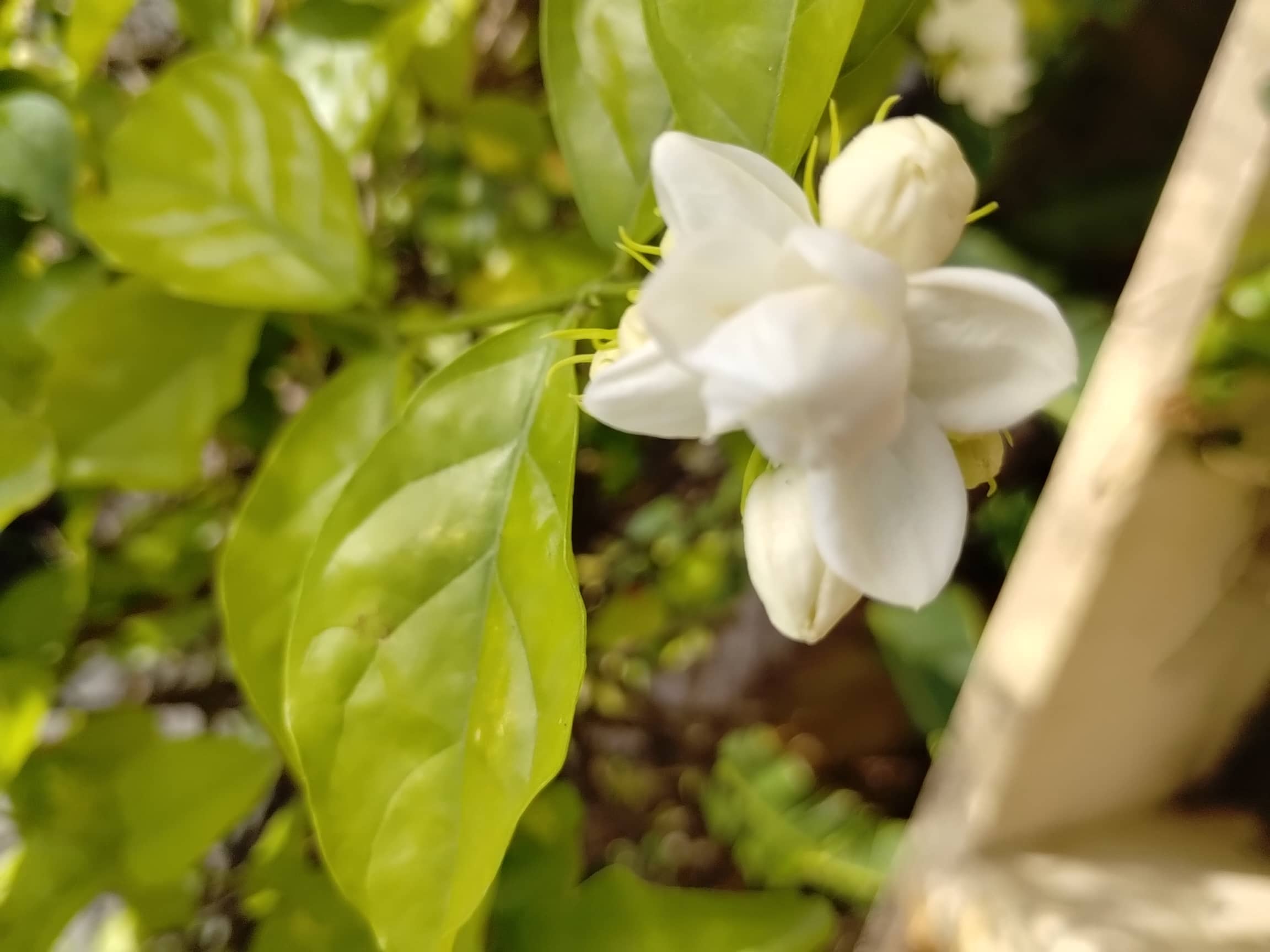
Arabian jasmine
Jasminum sambac
The Arabian Jasmine, botanically named Jasminum sambac and belonging to the Oleaceae (olive) family, is an exceptionally celebrated evergreen climbing shrub. Native to the warm, tropical valleys and humid plains of the Indian subcontinent and Southeast Asia, this legendary plant has been cultivat...
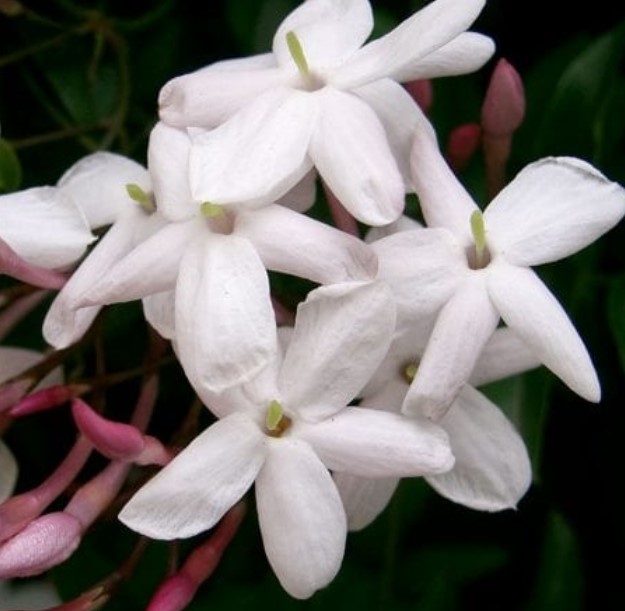
Spanish Jasmine (Royal Jasmine)
Jasminum grandiflorum
Spanish Jasmine, botanically classified as Jasminum grandiflorum and widely known as Royal Jasmine, Catalan Jasmine, or Scented Jasmine, is an exceptionally fragrant semi-evergreen woody vine belonging to the Oleaceae (olive) family. Believed to have originated in the high valleys of the Himalaya...
Similar Characteristics
4Juhi Jasmine
Jasminum auriculatum
Jasminum auriculatum, affectionately known as Juhi Jasmine or Mulla, is a highly aromatic, scrambling evergreen shrub or woody vine belonging to the Oleaceae (Olive) family. Native primarily to the Indian subcontinent and parts of Southeast Asia, it is globally celebrated not for the sheer size o...
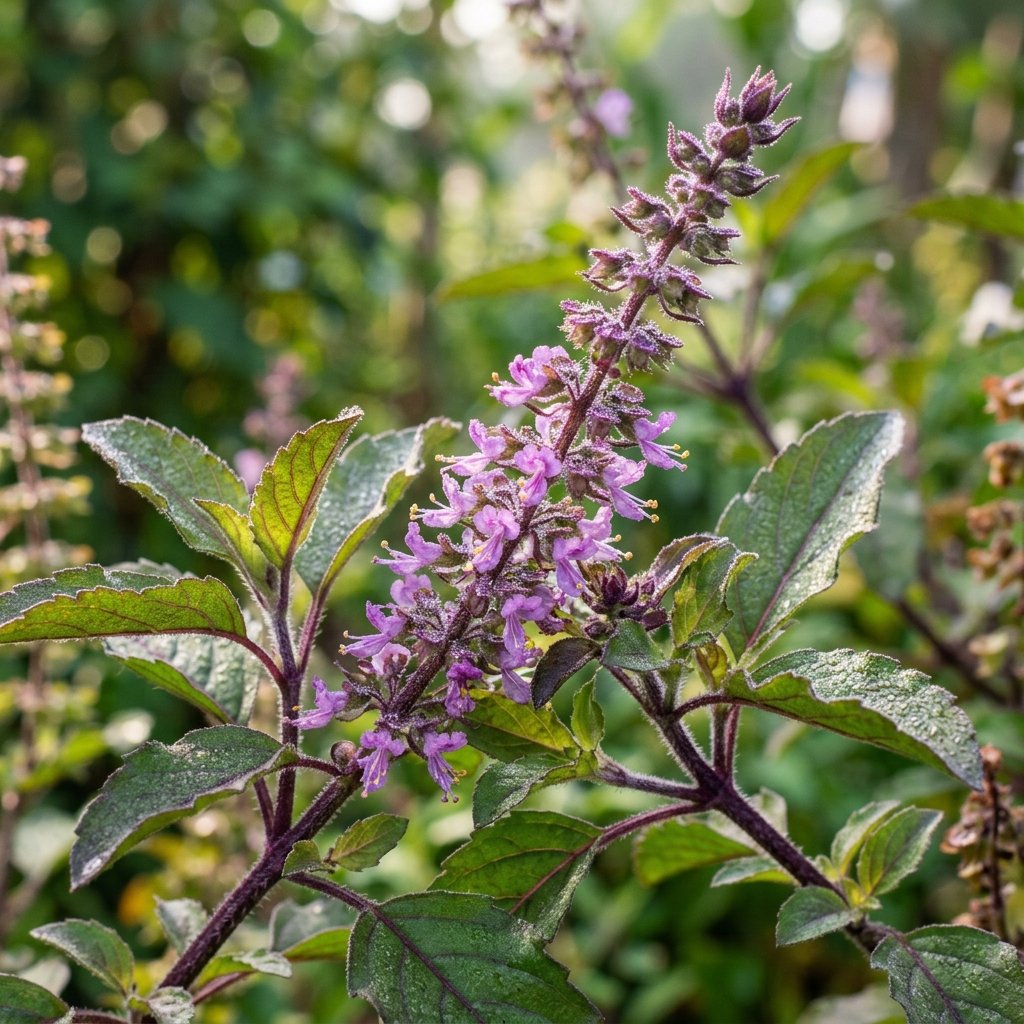
Holy Basil (Tulsi)
Ocimum tenuiflorum
Holy Basil, botanically classified as *Ocimum tenuiflorum* (synonymous with *Ocimum sanctum*) and universally revered throughout India and the Eastern world as Tulsi (the 'Incomparable One'), is a profoundly sacred, highly aromatic, and therapeutically celebrated perennial subshrub. Belonging to...
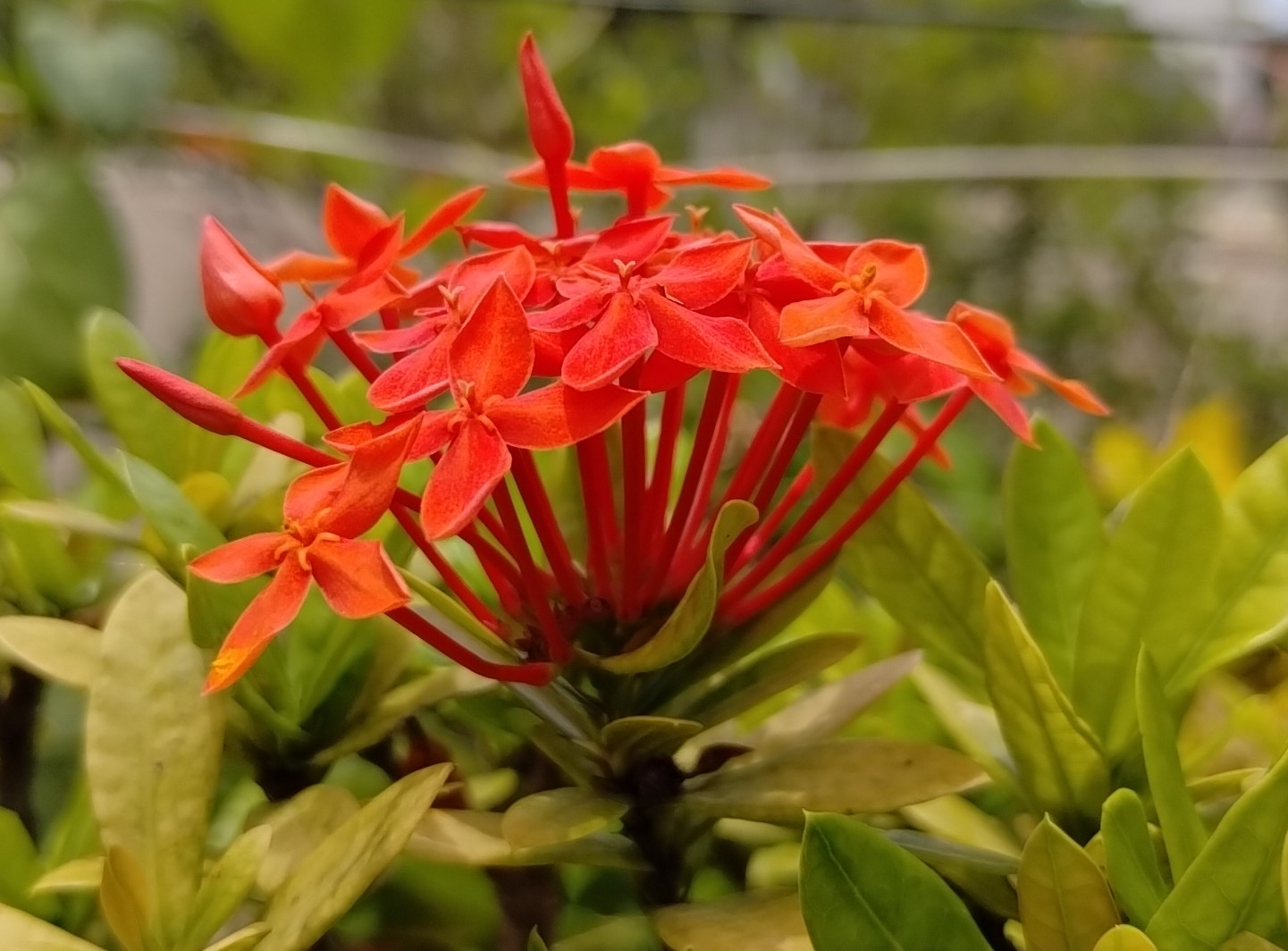
Ixora
Ixora coccinea
Ixora, botanically classified as Ixora coccinea and colloquially celebrated as the Jungle Flame or Flame of the Woods, is an exceptionally vibrant, evergreen flowering shrub belonging to the Rubiaceae (madder or coffee) family. Native to the damp tropical forests, rocky hillsides, and coastal scr...
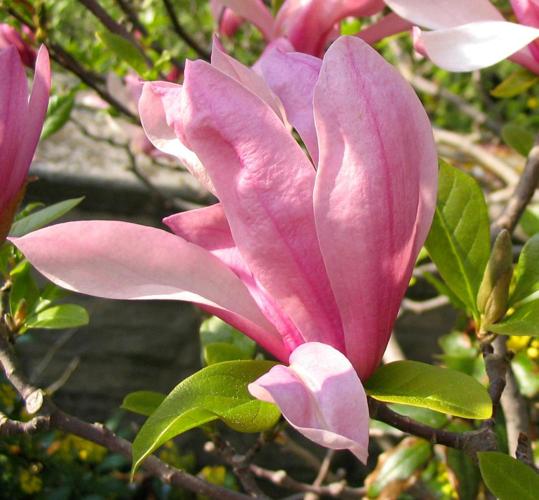
Magnolia
Magnolia
The Magnolia genus, the namesake of the **Magnoliaceae** family, represents one of the most ancient and majestic lineages of flowering plants on Earth. Fossil records indicate that Magnolias have existed for over 95 million years, flourishing long before the evolution of bees. This prehistoric or...