
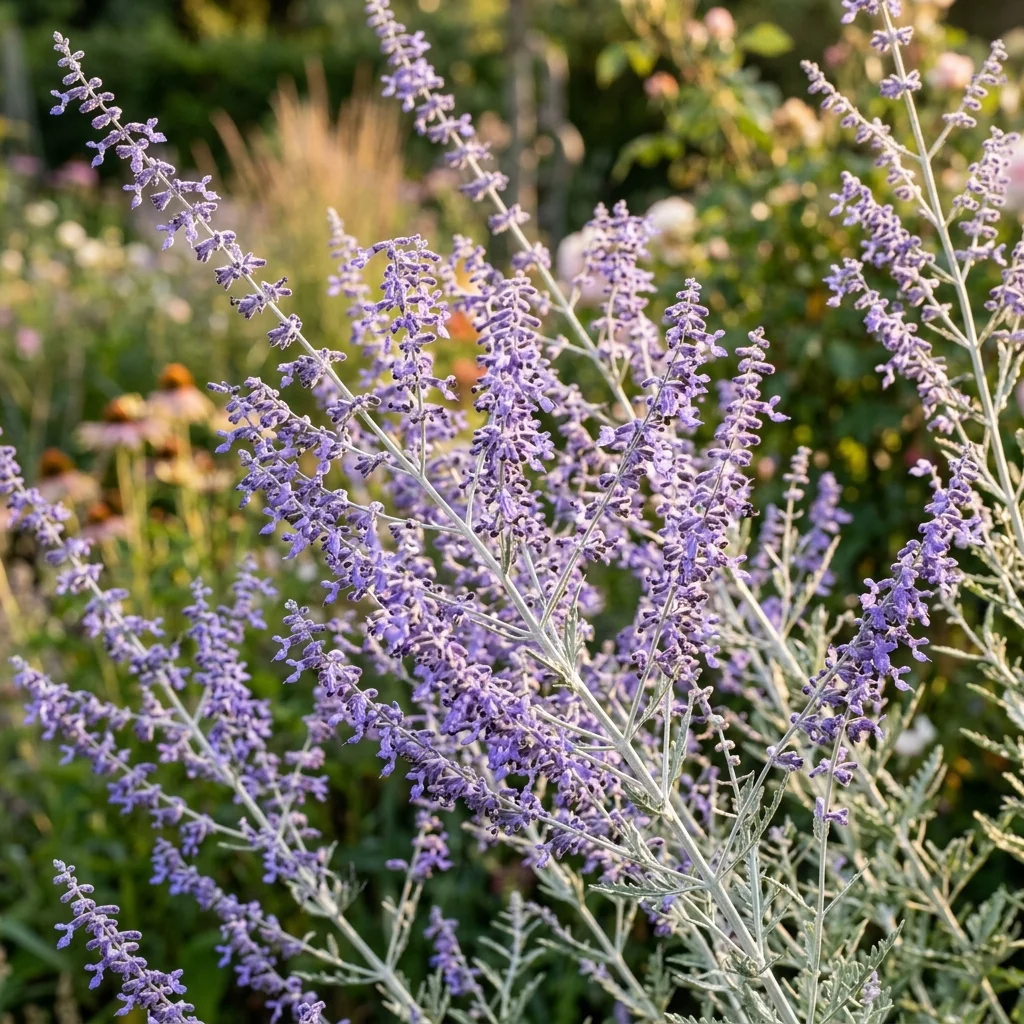
Russian Sage
Salvia yangii
How to Identify Russian Sage
NON-TOXIC. 100% pet-safe for cats, dogs, and horses. Safe for family yards, pollinator gardens, and sunny borders.
A botanical field guide to identifying Russian Sage (Salvia yangii / Perovskia atriplicifolia) by its distinctive morphological traits:
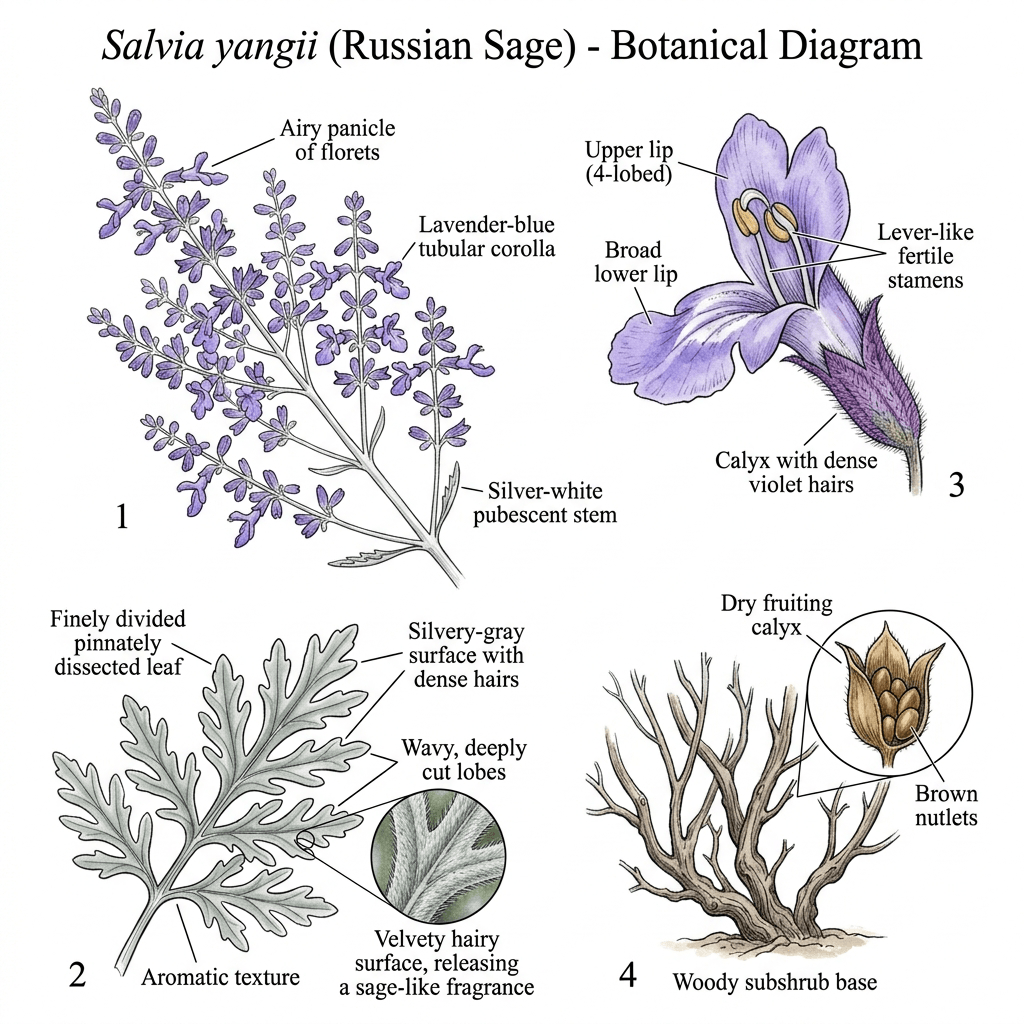
- Ghostly Silver Stems: Upright, rigid, multi-branched square stems coated with a dense, white-silver felt of tiny branched hairs.
- Finely Dissected Silvery Foliage: Opposite, aromatic leaves (1.5 to 2.5 inches long) with deeply cut, irregular wavy lobes and a grayish-silver, velvety surface.
- Airy Lavender-Blue Panicles: Large, cloud-like branching flower sprays (12 to 18 inches long) covered with hundreds of tiny, delicate tubular blossoms.
- Persistent Purple Calyx: Tubular, two-lipped calyx clothed in dense violet-purple hairs that retains its rich color long after the petals drop.
- Pungent Herbal Aroma: Crushing leaves or brushing stems releases a sharp, refreshing, medicinal fragrance blending herbal sage with resinous lavender notes.
Botanical Forms & Regional Variations
- By Cultivar Stature:
- Standard Species Form: Tall, arching subshrub growing 4 to 5 feet high, ideal for mid-to-back borders and airy screening drifts.
- Dwarf Compact Cultivars (e.g., 'Little Spire', 'Blue Jean Baby'): Compact selections reaching 2 to 3 feet tall with sturdier, non-flopping stems for smaller containers and walkway borders.
- By Inflorescence Density:
- Open Cloud Type: Feathery, dispersed flower spikes providing a misty, see-through prairie effect.
- Dense-Spike Form: Tightly clustered floral tiers offering a more saturated, deep violet-blue color block.
Care & Growing Guide
Russian Sage (Salvia yangii) Care & Growing Guide:
- Light: Full direct sun (at least 6 to 8 hours daily). Full sunlight is essential; even partial shade causes weak, floppy, sprawling stems.
- Soil: Lean, poor, sandy, rocky, or gravelly soil with sharp, rapid drainage (pH 6.5 to 8.0). Avoid overly fertile or heavy soils, which promote weak foliage at the expense of flowers.
- Watering: Minimal water required once established. Exceptionally drought-tolerant; overwatering and damp soil will rot root crowns.
- Pruning & Maintenance: In late winter or early spring, prune stems back to 4 to 6 inches above the ground to stimulate strong, upright new flowering branches.
Seasonal Blooming & Hardiness
Seasonal Blooming Calendar (Temperate & Arid Zones):
- Peak Bloom: Mid-summer through mid-autumn (July through October in Northern Hemisphere zones 4 to 9).
- Foliage Phase: Silver-gray stems and aromatic leaves emerge in late spring, remaining decorative throughout winter after flowers fade.
- Life Cycle: Long-lived, extremely cold-hardy and drought-resilient perennial subshrub.
Bloom Timeline
About Russian Sage
Russian Sage, botanically reclassified as Salvia yangii (long celebrated under its classic horticultural synonym Perovskia atriplicifolia), is an exceptionally drought-tolerant, graceful, and cloud-like deciduous perennial subshrub. Belonging to the mint family Lamiaceae (tribe Mentheae), this resilient, aromatic landscape favorite is native to the harsh, high-altitude rocky gravels, dry steppes, and foothills of Central Asia and southwestern Asia, ranging from Afghanistan, Pakistan, and Iran through Tibet and western China.
The plant typically grows 3 to 5 feet (90 to 150 cm) tall with an open, airy, and arching vase-shaped habit spreading 2 to 4 feet wide. It is distinguished by its upright, multi-branched, semi-woody square stems that are cloaked in a dense, silvery-white felt of microscopic stellate hairs. Its opposite, finely divided or pinnately dissected leaves measure 1.5 to 2.5 inches long, boasting a distinctive grayish-silver coloration and wavy, coarsely lobed margins. When touched, brushed, or crushed, the foliage releases an invigorating, pungent aroma combining notes of fresh sage and lavender.
From mid-summer straight through mid-autumn (July to October), Russian Sage puts on a spectacular display, transforming garden borders into a shimmering, hazy cloud of cool blue. The plant produces immense, branched terminal panicles measuring 12 to 18 inches long that bear hundreds of tiny, tubular, two-lipped blossoms in shades of lavender-blue, smoky violet, and azure. The flowers are accented by tiny, hairy purple calyces that retain their rich color even after the delicate petals have fallen, extending the ornamental season well into late autumn.
The zygomorphic floral morphology of Salvia yangii is represented by the family-specific floral formula ↑ ⚥ K(2+3) C(2+3) A2 G(2). This formula illustrates a bilaterally symmetrical (zygomorphic) and bisexual flower. The tubular calyx is two-lipped, composed of 5 fused sepals (2 upper, 3 lower) densely covered with violet glandular hairs. The corolla is composed of 5 fused petals forming a slender two-lipped tube: a broad 4-lobed upper lip and an extended, flat lower lip that serves as a landing pad for pollinators. Crucially, the flower bears only 2 fertile stamens equipped with the characteristic lever mechanism of the genus Salvia, and the superior ovary is deeply 4-lobed with a gynobasic style.
Despite its popular English common name, Russian Sage is neither native to Russia nor a true culinary sage; it was historically named in the 19th century in honor of the Russian general and statesman Vasily Perovsky by the Russian botanist Grigory Karelin. Renowned in contemporary landscape architecture for its architectural silhouette, it has received the prestigious Award of Garden Merit from the Royal Horticultural Society (RHS) and was voted Perennial Plant of the Year for its unmatched durability, drought tolerance, and pollinator magnet qualities.
For pet owners and veterinarians, Russian Sage represents a safe, low-risk, and garden-friendly choice. Salvia yangii is considered NON-TOXIC to cats, dogs, and horses by major veterinary toxicological consensus. It contains no hazardous cardiac glycosides, saponins, or neurotoxins. Its strong, pungent sage-scented essential oils naturally deter dogs and cats from chewing on the foliage, making it a worry-free selection for sunny family gardens. To learn more about garden safety, visit our general Pet Guard catalog.
Russian Sage is frequently confused with true Lavender (Lavandula angustifolia) or garden Salvia. It is readily distinguished by its much taller, airy, fountain-like architecture, intensely dissected silvery-gray foliage, and ghostly white branching stems, whereas lavender has narrow, unlobed linear leaves and denser, compact flower spikes. In sunny, water-wise borders, it creates an unforgettable tapestry when paired alongside Salvia, Lavender, Verbena, Purple Coneflower, and Black-eyed Susan. Explore our Flower Identifier to discover more drought-tolerant perennials.
For more detailed botanical identification guides and prairie gardening studies, explore our comprehensive articles on Salvia, Lavender, and Purple Coneflower.
Floral Formula & Features
Zygomorphic (bilaterally symmetrical), bisexual, tubular 2-lipped calyx with 5 fused sepals clothed in dense violet hairs, 2-lipped corolla with 4-lobed upper lip and broad lower lip, 2 fertile stamens with lever-action connective tissue, 4-lobed superior ovary with gynobasic style, 4 dry nutlets
- Scientific Name & Classification: Salvia yangii / Perovskia atriplicifolia (Lamiaceae). Celebrated as Russian Sage, Afghan Sage, and Perovskia.
- Identification Markers: Ghostly silver-white square stems, finely dissected silvery-gray aromatic leaves, and massive airy panicles of tiny lavender-blue two-lipped flowers.
- Floral Formula (↑ ⚥ K(2+3) C(2+3) A2 G(2)): Zygomorphic, bisexual flowers with 2-lipped hairy violet calyx, 2-lipped lavender corolla, 2 fertile lever-action stamens, and 4-lobed superior ovary.
- Growing Requirements: Full direct sun (at least 6 to 8 hours daily); poor, lean, sandy, or gravelly well-draining soils; exceptionally drought, heat, and cold-tolerant (Zones 4-9).
- Cultural Significance: Named in honor of Russian General Vasily Perovsky; winner of the RHS Award of Garden Merit and Perennial Plant of the Year for outstanding garden performance and pollinator support.
- Safety & Toxicity: NON-TOXIC. 100% pet-safe for cats, dogs, and horses. Safe for family yards, pollinator gardens, and sunny borders.
- Common Look-alikes: Distinguished from English Lavender by its taller, fountain-like stature and deeply lobed leaves, and from Meadow Sage by its ghostly silver stems and cloud-like panicles.
- Internal Links: Pairs breathtakingly in water-wise, sunny borders beside companion plants like Salvia, Lavender, Verbena, and Purple Coneflower; browse our Flower Identifier.
Names in Different Languages
Botanical Classification: Russian Sage belongs to the Lamiaceae family. Learn how to identify its floral symmetry, stamen arrangement, and structural formulas in our Botanical Family Classification Guide.
Toxicity & Safety
Frequently Asked Questions
What is Floral Formula?
A floral formula is a symbolic representation of a flower's structure using letters, numbers, and special symbols. It provides a concise way to describe the arrangement and number of floral parts.
This formula describes the flower's symmetry, sepals, petals, stamens, and carpels in a standardized format.
Formula Sequence
- Bract: Br or Ebr
- Bracteole: Brl or Ebrl
- Symmetry: % (Radial) or ⊕ (Bilateral)
- Sex: ♀ (Female), ♂ (Male), or ⚥ (Bisexual)
- Calyx/Sepal: K<number> (Free or Fused)
- Corolla/Petal: C<number> (Free or Fused)
- Androecium: A<number> (Free or Fused)
- Gynaecium: G<number> (Superior or Inferior Ovary)
Symbol Meanings
- Numbers: Indicate quantity of parts
- Parentheses (): Parts are fused together
- Plus (+): Parts in different whorls
- Underline: Superior ovary position
- Overline: Inferior ovary position
- ∞: Numerous parts (too many to count)
Understanding floral formulas helps botanists quickly identify and classify flowers based on their structural characteristics.
Similar Flowers
Discover flowers that share botanical characteristics
Same Family
4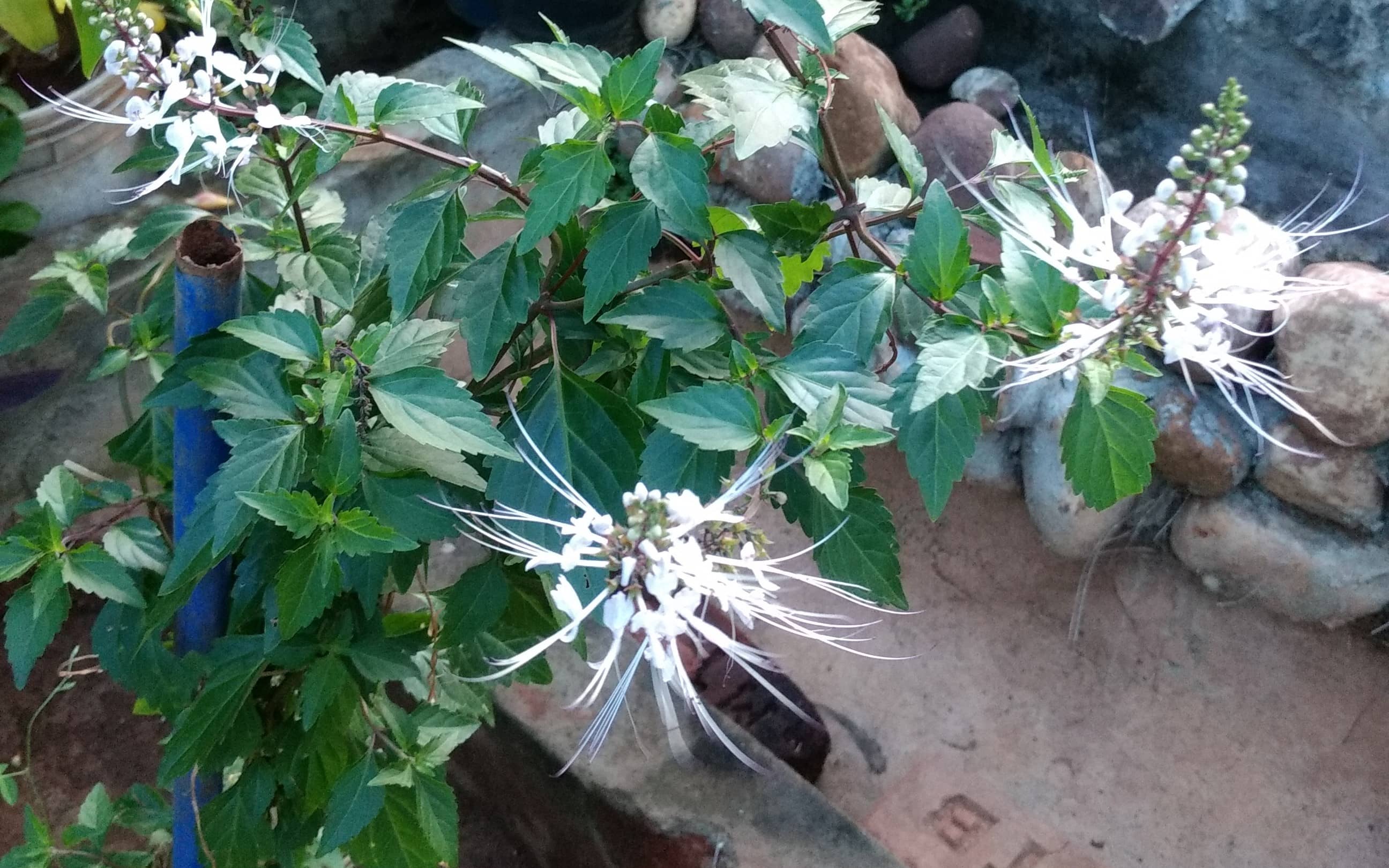
Cat's whiskers
Orthosiphon aristatus
The Cat's Whisker, botanically classified as Orthosiphon aristatus (and often called Orthosiphon stamineus), is an extraordinarily distinctive, fast-growing herbaceous perennial shrub in the Lamiaceae (mint) family. Native to the damp, shaded margins, grassy valleys, and riverbanks of tropical So...
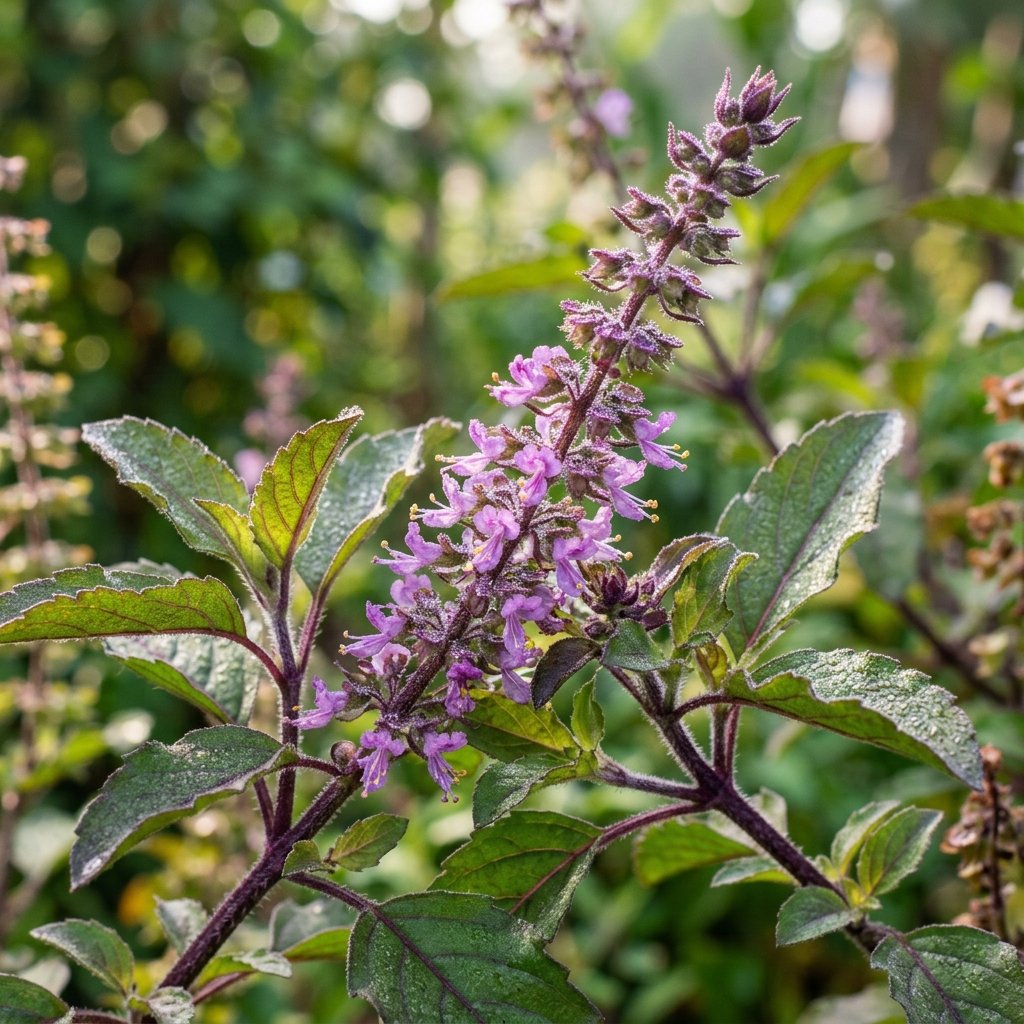
Holy Basil (Tulsi)
Ocimum tenuiflorum
Holy Basil, botanically classified as *Ocimum tenuiflorum* (synonymous with *Ocimum sanctum*) and universally revered throughout India and the Eastern world as Tulsi (the 'Incomparable One'), is a profoundly sacred, highly aromatic, and therapeutically celebrated perennial subshrub. Belonging to...
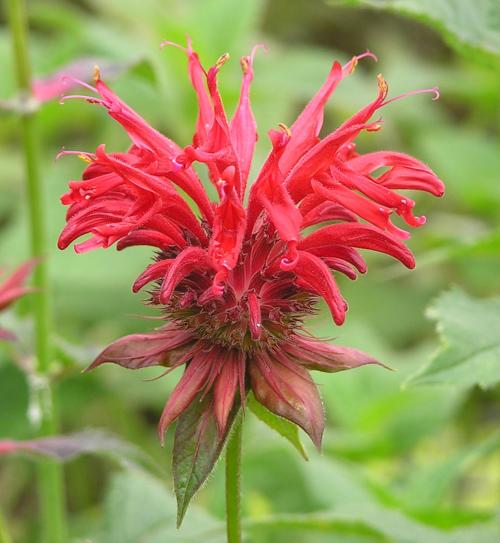
Beebalm
Monarda didyma, Monarda fistulosa
Bee Balm, botanically classified under the genus Monarda within the family Lamiaceae (the mint family), is a spectacular and highly aromatic clump-forming herbaceous perennial. Native to the rich floodplains, moist meadows, woodland margins, and stream banks of eastern North America—ranging from...
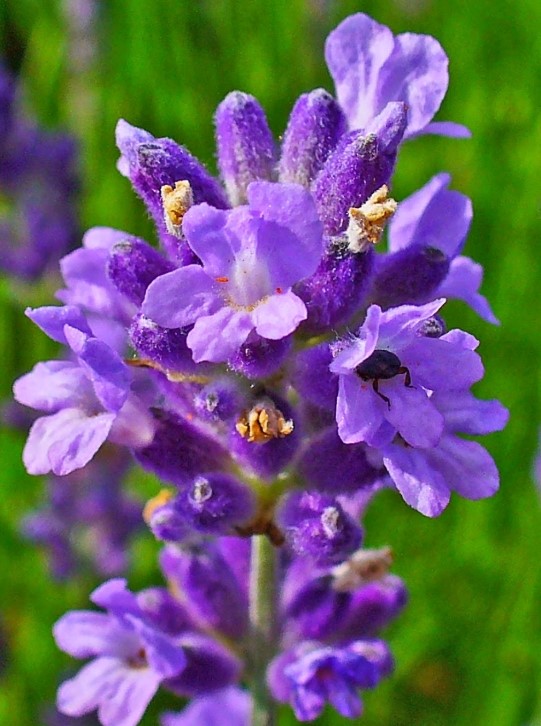
Lavender
Lavandula angustifolia
Lavender, botanically designated under the genus Lavandula and most widely represented by Lavandula angustifolia (English Lavender), is an exceptionally famous, highly aromatic evergreen perennial shrub belonging to the Lamiaceae (mint) family. Native to the sun-baked, rocky limestone hillsides a...
Similar Characteristics
4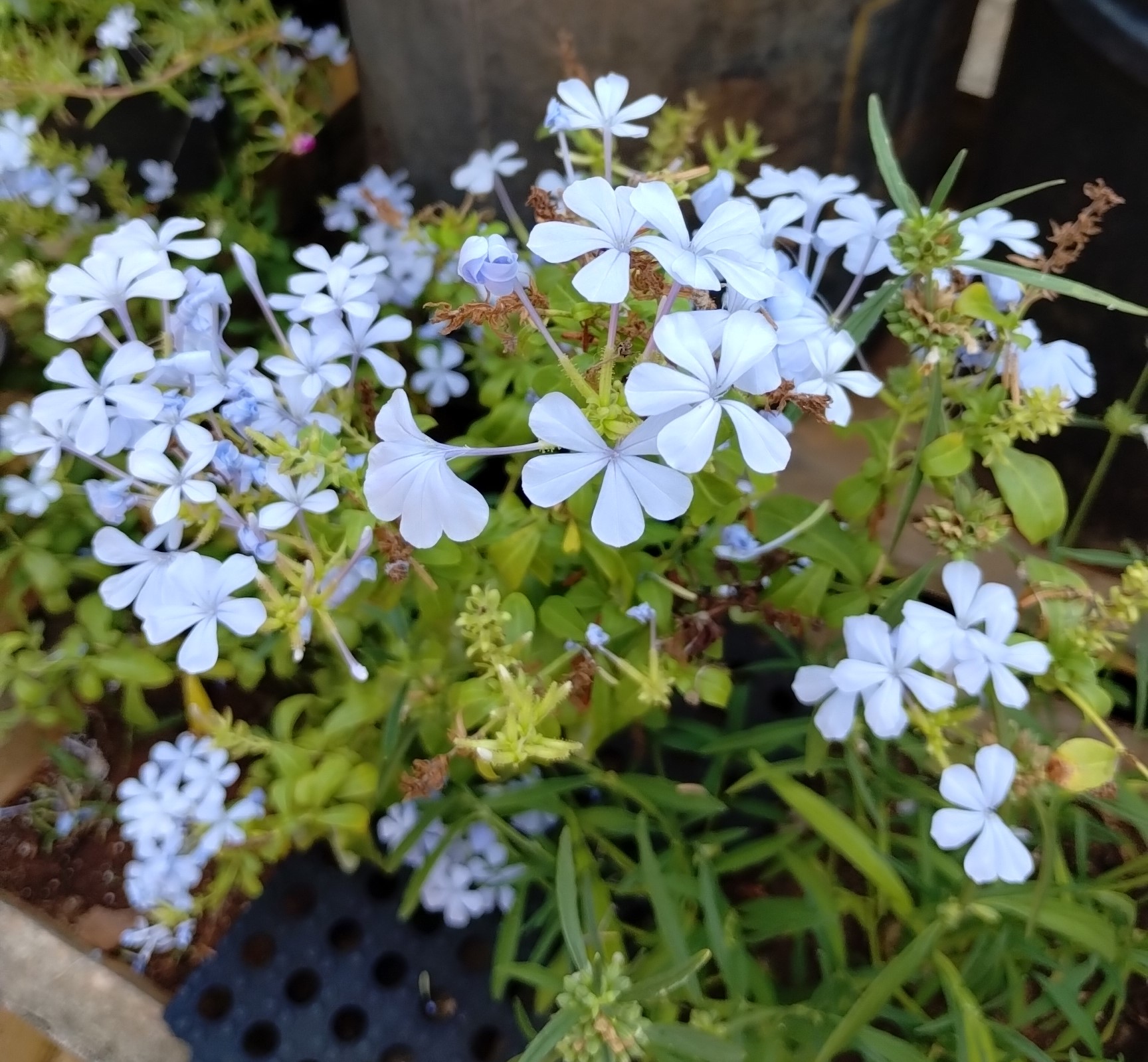
Leadwort
Plumbago auriculata
The Leadwort, botanically designated as Plumbago auriculata and commonly known as the Cape Leadwort, Blue Plumbago, or Sky Flower, is an exceptionally vigorous, sprawling evergreen shrub. Belonging to the family Plumbaginaceae (the leadwort family), this resilient and floriferous plant is native...
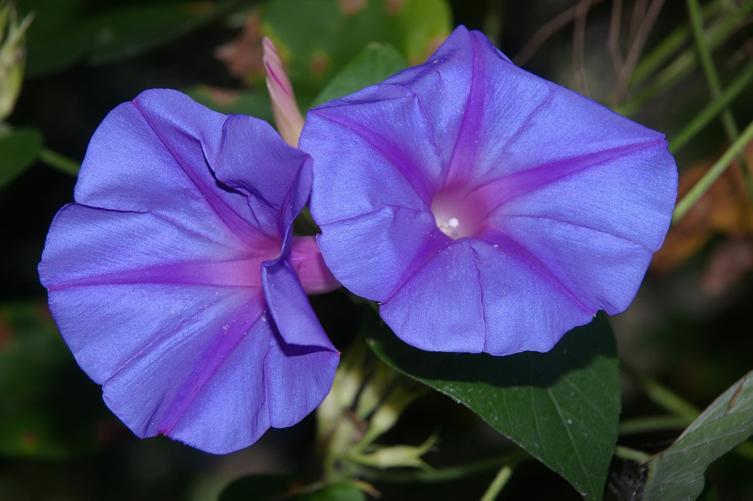
Morning Glory
Ipomoea tricolor
The Morning Glory, botanically designated as Ipomoea tricolor (and including the closely related *Ipomoea purpurea*), is an exceptionally vigorous, fast-growing climbing annual vine. Belonging to the family Convolvulaceae (the bindweed or morning glory family, tribe Ipomoeeae), this classic garde...
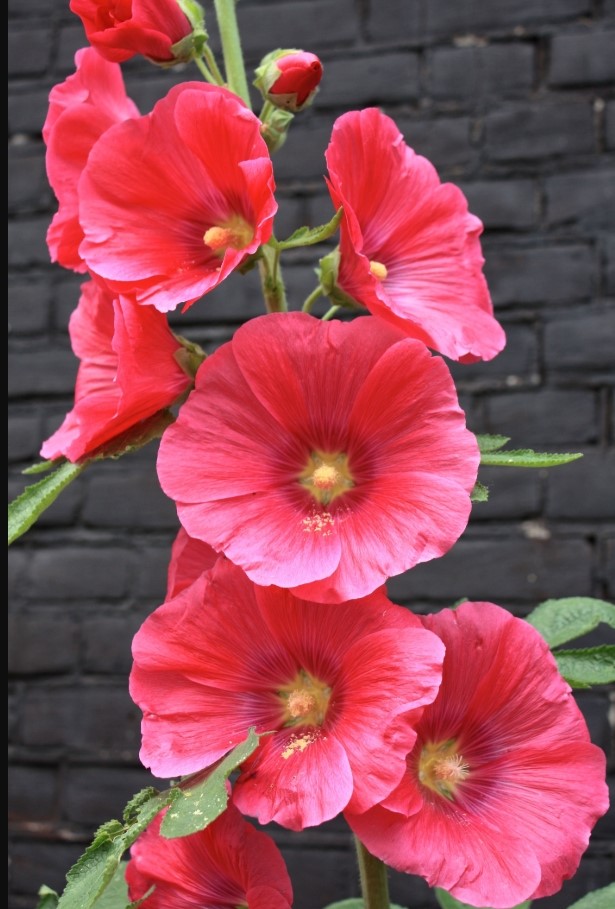
Hollyhock
Alcea rosea
The Hollyhock, botanically designated as Alcea rosea and belonging to the family Malvaceae (the mallow or hibiscus family), is a majestic, towering, and deeply romantic cottage garden classic. Native to the warm, temperate meadows, rocky slopes, and open woodlands of Turkey and southwestern Asia,...
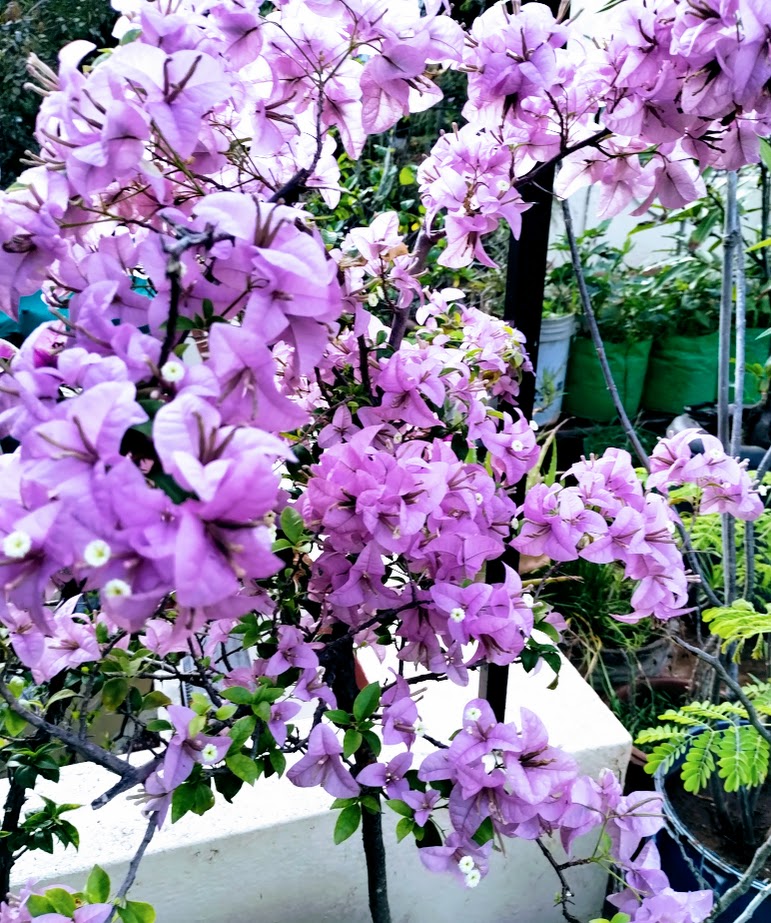
Bougainvillea
Bougainvillea spectabilis
The Bougainvillea, botanically designated as Bougainvillea spectabilis (and including the closely related *Bougainvillea glabra*), is an exceptionally spectacular, highly vigorous woody and thorny evergreen climbing vine. Belonging to the family Nyctaginaceae (the four o'clock family, tribe Bouga...