
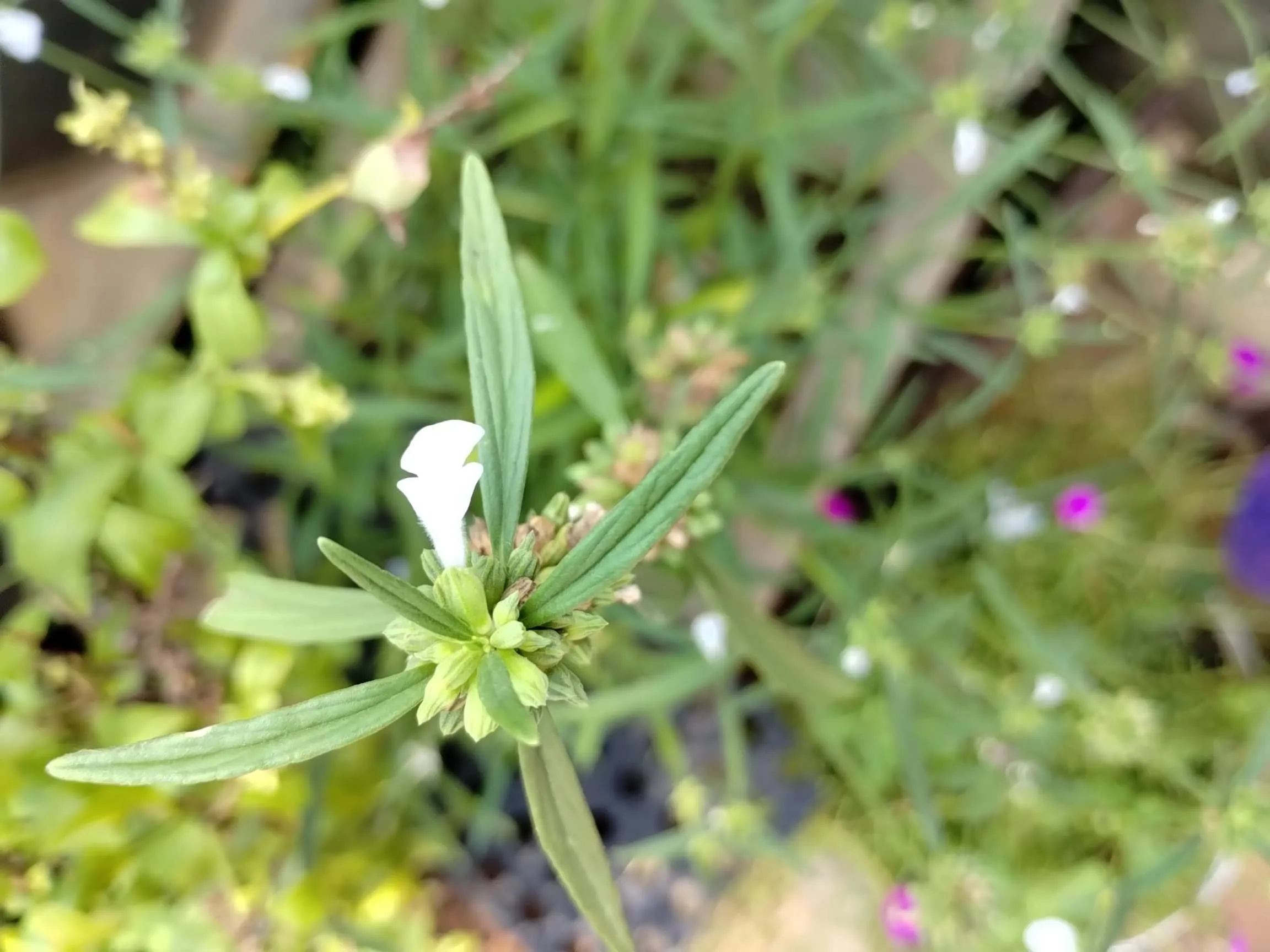
Leucas Aspera
Leucas aspera
How to Identify Leucas Aspera
NON-TOXIC. 100% safe for cats, dogs, and horses. Provides a resilient, self-seeding, and completely pet-safe wild medicinal herb for eco-gardens.
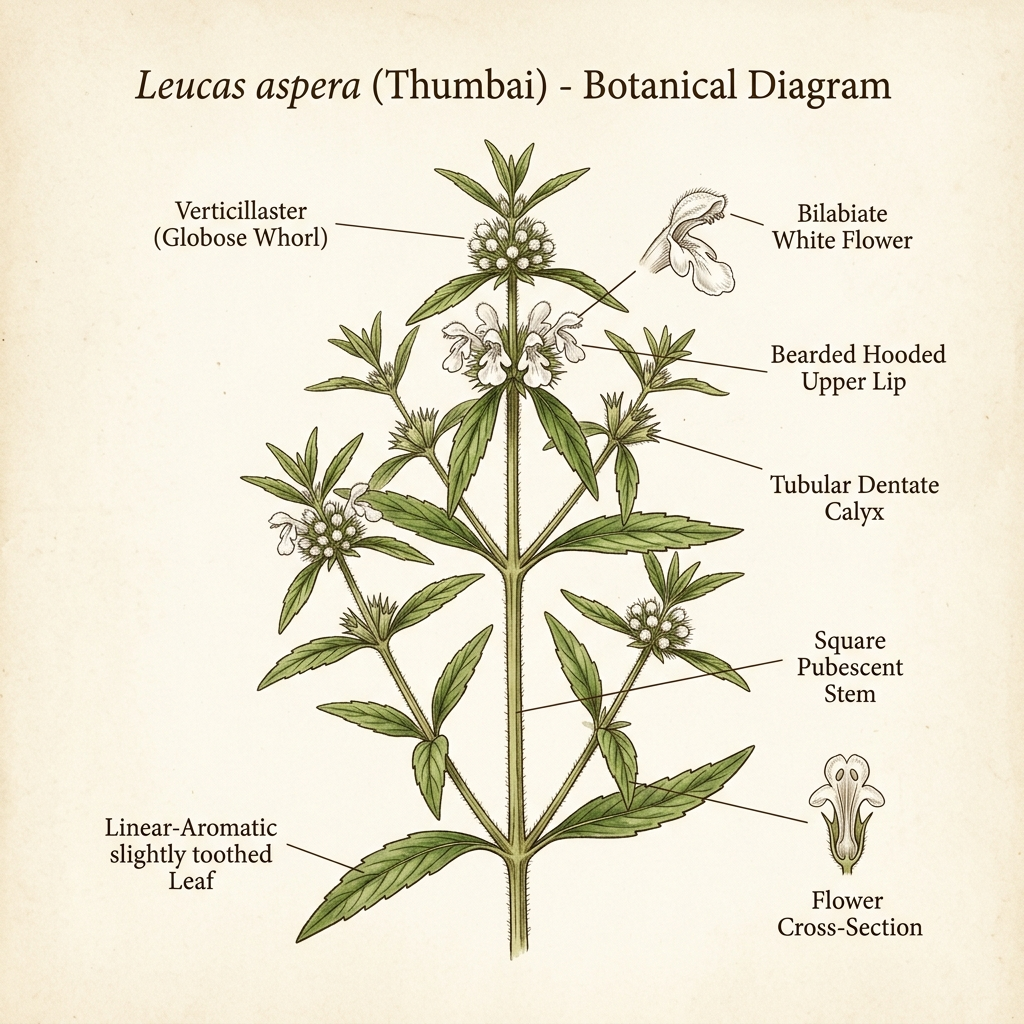
A detailed guide to identifying Leucas Aspera (Thumbai / Dronapushpi) by its key botanical features:
- Globose Whorls (Verticillasters): Dense, ball-like spherical clusters of tiny white flowers clustered tightly at leaf axils and stem tips.
- Two-Lipped Bilabiate Flowers: Pure white hooded flowers featuring a woolly, bearded upper lip arching over four stamens, and a prominent 3-lobed lower lip acting as a pollinator landing platform.
- Square Hairy Stems: Quadrangular, distinctly 4-sided stems densely covered with stiff, bristly white hairs (hispid/pubescent).
- Opposite Linear Leaves: Slender, elongated linear-to-lanceolate green leaves with shallowly serrated margins, emitting a pungent herbal aroma when crushed.
- Cup-like Tubular Calyx: Curved green calyx tube with 10 sharply pointed teeth at the rim, resembling a miniature ceremonial cup (Drona in Sanskrit).
Botanical Forms & Regional Variations
- By Growth Habit:
- Erect Wild Form: Upright, strongly branched annual herb standing 1 to 2 feet tall, common in open fields, wastelands, and dry roadsides.
- Prostrate Spreading Form: Low-growing, multi-branched ground-covering form found in arid, wind-swept, or grazed pastures.
- By Calyx & Bract Structure:
- Dentate Calyx Type: Features sharp, bristly spinous calyx teeth that persist and dry into papery seed vessels after flowering.
- Villous Bract Form: Inflorescence base wrapped in dense, long, bristly hairs protecting developing nutlets.
Care & Growing Guide
Leucas Aspera (Thumbai) Care & Growing Guide:
- Light: Full direct sunlight (at least 6 hours daily). Thrives in open, unshaded, sunny spots.
- Soil: Tolerates poor, sandy, gravelly, or rocky soils with neutral to slightly alkaline pH. Requires sharp drainage; cannot tolerate soggy soil.
- Watering: Minimal water requirements once established. Highly drought-tolerant; water sparingly during dry spells and allow the soil to dry out between waterings.
- Propagation & Care: Self-sows readily from fallen nutlets. Needs virtually no fertilizer; excess nutrients lead to rank foliage growth with fewer blooms.
Seasonal Blooming & Hardiness
Seasonal Blooming Calendar (Tropical & Warm Temperate Zones):
- Peak Bloom: Monsoon through post-monsoon and winter (typically August through February in India; late summer to frost in warm temperate climates).
- Harvest & Sowing: Sow seeds outdoors in late spring or at the onset of monsoon rains; flowers appear within 6 to 8 weeks.
- Life Cycle: Resilient annual herb that flowers profusely, sets seeds, and freely naturalizes in warm sunny borders.
Bloom Timeline
About Leucas Aspera
Leucas Aspera, botanically classified as Leucas aspera and celebrated in Tamil heritage as Thumbai or in Sanskrit as Dronapushpi, is an exceptionally valuable, resilient, and highly aromatic annual or short-lived perennial herb. Belonging to the family Lamiaceae (the mint family, tribe Leucadeae), this famous wild medicinal herb is native to the warm tropical and subtropical plains, agricultural fields, waste grounds, and roadsides of southern Asia, with a primary distribution centered across India, Sri Lanka, Southeast Asia, and the Philippines.
This erect, branching herb typically grows 1 to 3 feet (30 to 90 cm) tall and spreads 1 to 2 feet wide. It features the characteristic square-shaped stems of the mint family, which are completely covered in dense, stiff, and rough white hairs, giving the plant its Latin species name aspera (meaning rough). Its opposite, lance-shaped leaves measure 1 to 3 inches long, possessing coarsely serrated margins and a rough, hairy texture that releases a strong, pleasant herbal aroma when crushed.
Leucas Aspera is globally famous for producing dense, globe-shaped axillary whorls (verticillasters) of small, pure white, two-lipped flowers at leaf junctions. Individual flowers measure 0.4 to 0.6 inches in length, blooming continuously throughout the year in warm tropical climates (with peak blooming during the monsoon season from July through October). The brilliant snow-white blossoms stand out beautifully against the coarse, green, hairy foliage.
The zygomorphic reproductive morphology of individual flowers is represented by the family-specific floral formula Br % ⚥ K(5) C(2+3) A4 G(2). This formula states that each flower is supported by a small green bract (Br), is bisexual, and exhibits bilateral symmetry (zygomorphic). The calyx is composed of 5 fused sepals forming a tubular sheath with 10 small teeth, and the corolla has 5 fused petals forming a two-lipped tube. The upper lip is hooded and covered in white hairs, while the lower lip is 3-lobed with a large middle lobe. The 4 stamens are didynamous, and the 2 fused carpels form a superior ovary.
The genus name Leucas is derived from the Greek word 'leukos,' meaning white, in direct reference to its pure white flowers. Famed in Sanskrit as Dronapushpi (द्रोणपुष्पी, translating to 'cup flower' due to the cup-like shape of its calyx) and in Tamil as Thumbai (தும்பை), these sacred blossoms are highly revered in Hindu tradition, offered as a primary devotion to Lord Shiva. In traditional Ayurveda, a leaf tea is used as a home remedy for colds, asthma, headaches, and fevers.
For pet owners and veterinarians, Leucas Aspera represents an exceptionally safe, low-risk, and pet-friendly wild herb. Leucas aspera is classified as completely NON-TOXIC to cats, dogs, and horses by major global animal safety databases. It contains no toxic chemical alkaloids or cardioactive glycosides, and its coarse, hairy leaf texture naturally discourages pets from chewing on it. To discover more safe, medicinal wild herbs, visit our general Pet Guard page.
Leucas Aspera is occasionally confused with white dead-nettles or other wild mints. It is easily distinguished because true Leucas Aspera produces dense, globe-like, spherical clusters of small white flowers at its leaf joints, whereas other dead-nettles produce looser flower spikes. It is an excellent choice for cottage gardens; we recommend pairing it alongside Arabian Jasmine-mogra or December-barleria. To explore more sacred white wildflowers, browse our Flower Identifier.
For more botanical profiles and flower identification features, see our guides on Leopard Lily and Love in a mist.
Floral Formula & Features
Bracteate (small bracts present), bilaterally symmetrical (zygomorphic), bisexual, 5 fused sepals forming tubular calyx with 10 teeth, 5 fused petals forming two-lipped corolla (upper lip 2-lobed, lower lip 3-lobed), 4 stamens (didynamous - 2 long, 2 short), 2 fused carpels with superior ovary, characteristic of Lamiaceae
- Scientific Name & Classification: Leucas aspera (Lamiaceae). Globally famed as Thumbai, Dronapushpi, Ceylon Slitwort, and Common Leucas.
- Identification Markers: Square stems covered in rough white hairs, opposite serrated aromatic leaves, and dense globe-shaped axillary clusters of small white two-lipped flowers.
- Floral Formula (Br % ⚥ K(5) C(2+3) A4 G(2)): Bilaterally symmetrical, bisexual flowers with 5 fused sepals, 5 fused petals forming a hairy hooded upper lip and 3-lobed lower lip, 4 stamens in two pairs, and superior ovary.
- Growing Requirements: Full direct sun to partial shade (6+ hours sun daily); poor, sandy, gravelly, highly well-draining soils. Highly drought, heat, and salt-tolerant (Zones 9-11).
- Cultural Significance: Name comes from Greek 'leukos' (white). Famed in Sanskrit as 'Dronapushpi' (cup flower). Sacred temple flower offered to Lord Shiva; revered in Ayurveda for respiratory health.
- Safety & Toxicity: NON-TOXIC. 100% safe for cats, dogs, and horses. Provides a resilient, self-seeding, and completely pet-safe wild medicinal herb for eco-gardens.
- Common Look-alikes: Confused with White Dead-Nettles, but easily distinguished by its highly unique, dense spherical globes of white blossoms nestled at its leaf junctions.
- Internal Links: Creates a beautiful, native wildlife ground cover when planted beside other heat-tolerant Indian landscape selections like Arabian Jasmine-mogra or December-barleria; find more in our Flower Identifier.
Names in Different Languages
Botanical Classification: Leucas Aspera belongs to the Lamiaceae family. Learn how to identify its floral symmetry, stamen arrangement, and structural formulas in our Botanical Family Classification Guide.
Toxicity & Safety
Frequently Asked Questions
What is Floral Formula?
A floral formula is a symbolic representation of a flower's structure using letters, numbers, and special symbols. It provides a concise way to describe the arrangement and number of floral parts.
This formula describes the flower's symmetry, sepals, petals, stamens, and carpels in a standardized format.
Formula Sequence
- Bract: Br or Ebr
- Bracteole: Brl or Ebrl
- Symmetry: % (Radial) or ⊕ (Bilateral)
- Sex: ♀ (Female), ♂ (Male), or ⚥ (Bisexual)
- Calyx/Sepal: K<number> (Free or Fused)
- Corolla/Petal: C<number> (Free or Fused)
- Androecium: A<number> (Free or Fused)
- Gynaecium: G<number> (Superior or Inferior Ovary)
Symbol Meanings
- Numbers: Indicate quantity of parts
- Parentheses (): Parts are fused together
- Plus (+): Parts in different whorls
- Underline: Superior ovary position
- Overline: Inferior ovary position
- ∞: Numerous parts (too many to count)
Understanding floral formulas helps botanists quickly identify and classify flowers based on their structural characteristics.
Similar Flowers
Discover flowers that share botanical characteristics
Same Family
4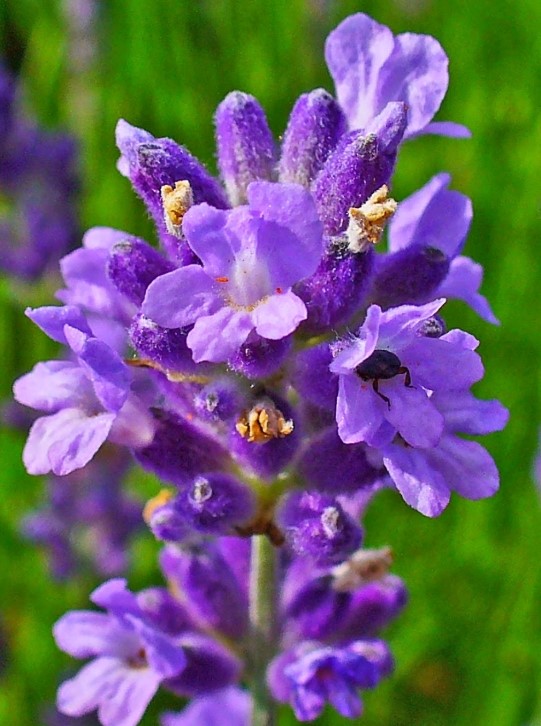
Lavender
Lavandula angustifolia
Lavender, botanically designated under the genus Lavandula and most widely represented by Lavandula angustifolia (English Lavender), is an exceptionally famous, highly aromatic evergreen perennial shrub belonging to the Lamiaceae (mint) family. Native to the sun-baked, rocky limestone hillsides a...
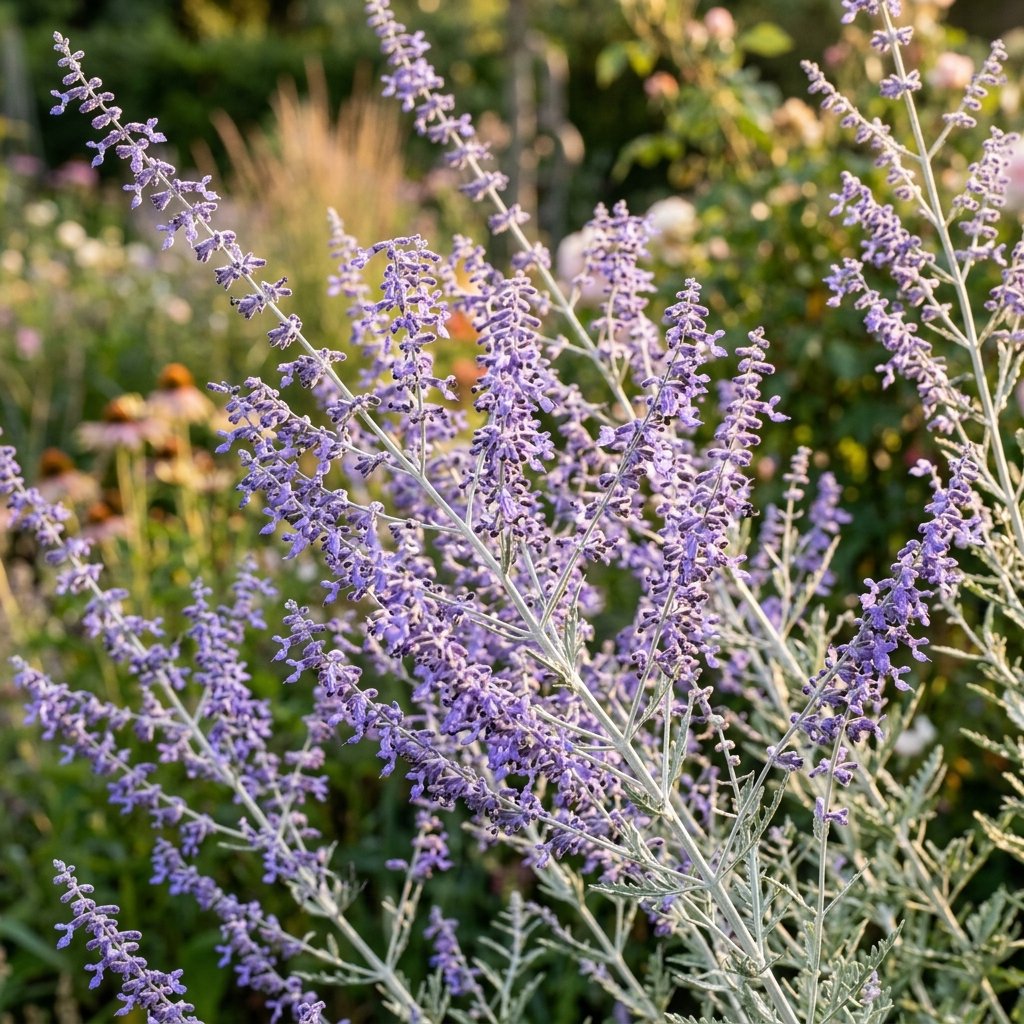
Russian Sage
Salvia yangii
Russian Sage, botanically reclassified as *Salvia yangii* (long celebrated under its classic horticultural synonym *Perovskia atriplicifolia*), is an exceptionally drought-tolerant, graceful, and cloud-like deciduous perennial subshrub. Belonging to the mint family Lamiaceae (tribe Mentheae), thi...
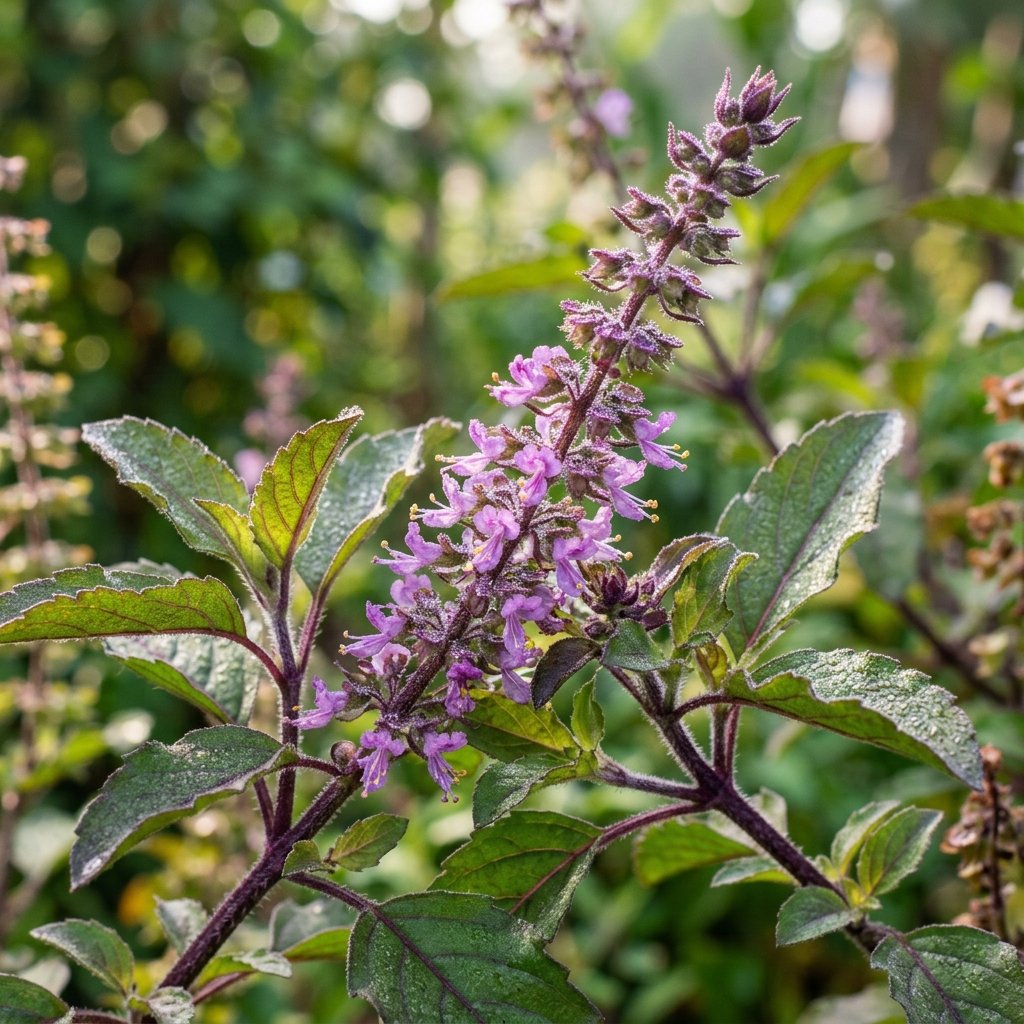
Holy Basil (Tulsi)
Ocimum tenuiflorum
Holy Basil, botanically classified as *Ocimum tenuiflorum* (synonymous with *Ocimum sanctum*) and universally revered throughout India and the Eastern world as Tulsi (the 'Incomparable One'), is a profoundly sacred, highly aromatic, and therapeutically celebrated perennial subshrub. Belonging to...
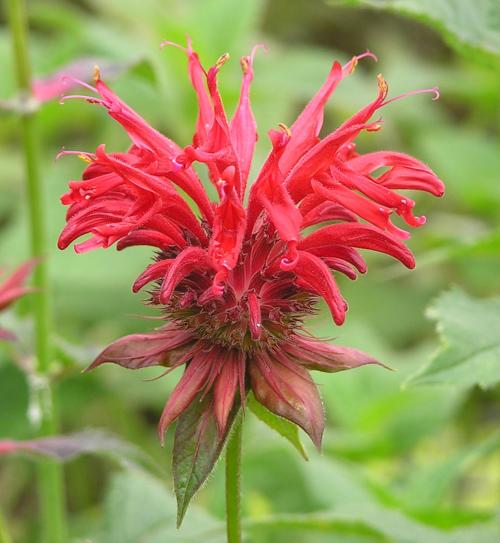
Beebalm
Monarda didyma, Monarda fistulosa
Bee Balm, botanically classified under the genus Monarda within the family Lamiaceae (the mint family), is a spectacular and highly aromatic clump-forming herbaceous perennial. Native to the rich floodplains, moist meadows, woodland margins, and stream banks of eastern North America—ranging from...
Similar Characteristics
4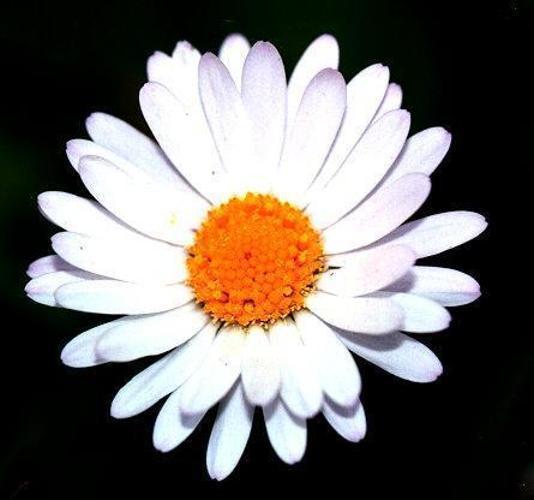
Oxeye Daisy
Leucanthemum vulgare
The Oxeye Daisy, botanically classified as Leucanthemum vulgare and historically celebrated as the Moon Daisy or Dog Daisy, is an exceptionally cheerful, rhizomatous herbaceous perennial belonging to the Asteraceae (daisy or composite) family. Native to the sweeping fields, dry pastures, and sunn...
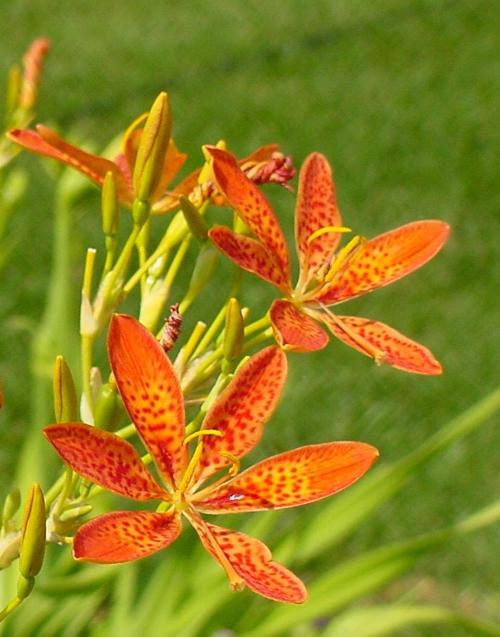
Leopard Lily
Iris domestica (syn. Belamcanda chinensis)
The Leopard Lily, botanically designated as *Iris domestica* (previously classified as *Belamcanda chinensis*, and commonly known as the Blackberry Lily or Leopard Flower), is an exceptionally distinct, highly ornamental perennial. Belonging to the family Iridaceae (the iris family, tribe Irideae...
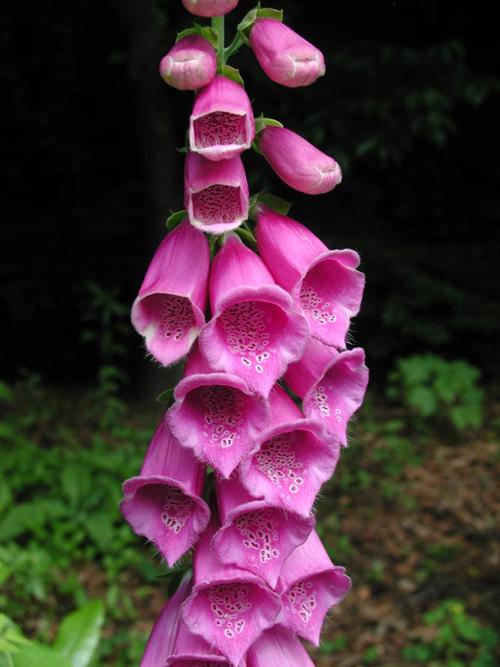
Foxglove
Digitalis purpurea
Digitalis purpurea, commonly known as Foxglove, is a majestic and iconic biennial plant belonging to the Plantaginaceae family. Native to the cool, temperate woodlands, hedgerows, and mountainous clearings of western and southwestern Europe, this striking species has naturalized throughout North...
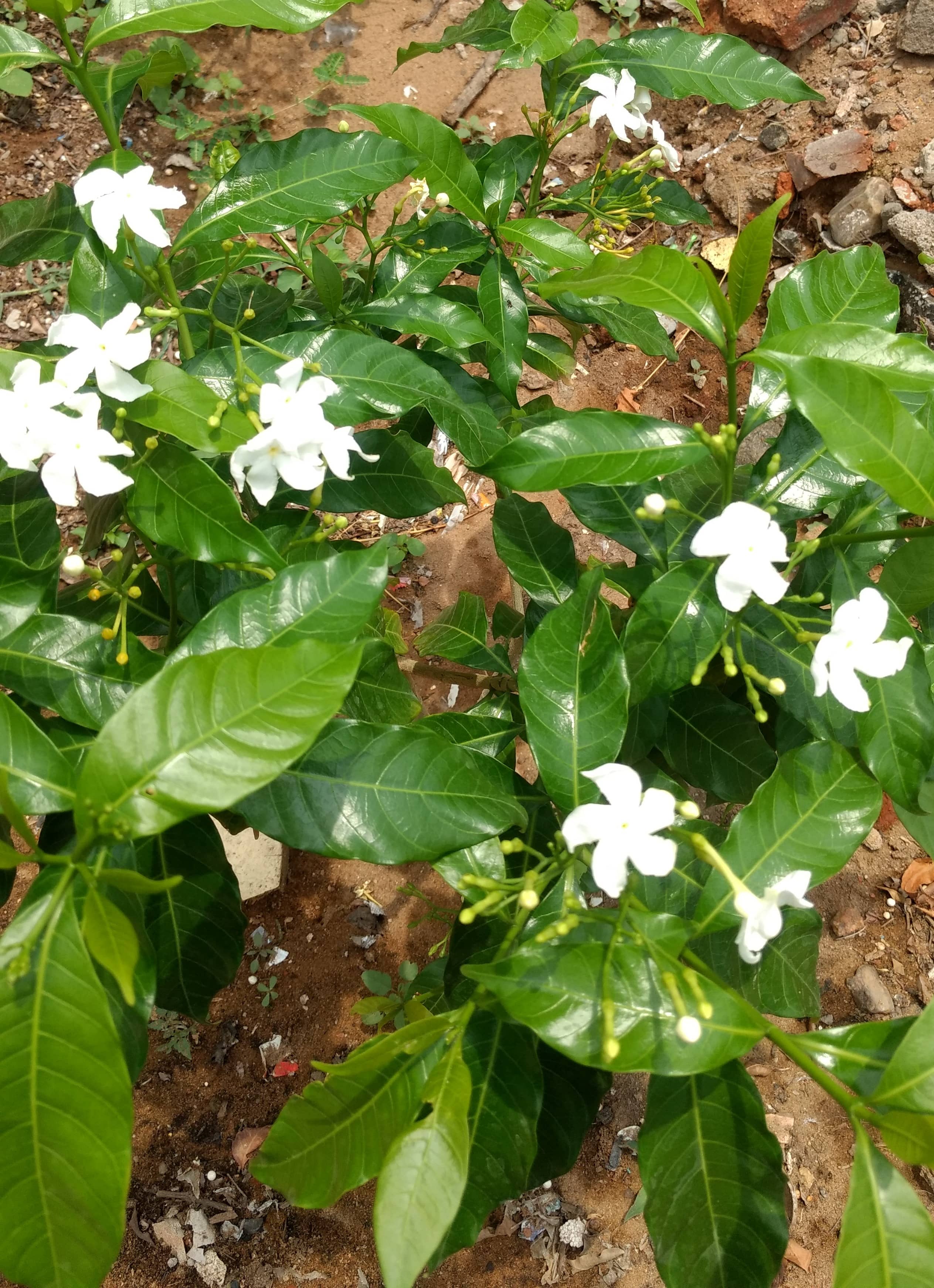
Pinwheel
Tabernaemontana divaricata
Pinwheel, botanically classified as Tabernaemontana divaricata and widely celebrated as Crape Jasmine, Crepe Jasmine, or Chandni, is an exceptionally elegant, evergreen flowering tropical shrub belonging to the Apocynaceae (dogbane) family. Native to the warm, humid, low-elevation woodland plains...