
Bagworm
Thyridopteryx ephemeraeformis
About Bagworm
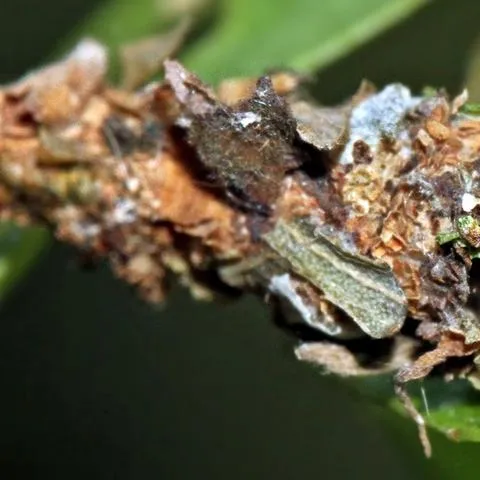
The Bagworm (*Thyridopteryx ephemeraeformis*), a highly unique foliage-chewing caterpillar belonging to the family *Psychidae* under the order *Lepidoptera*, is a major pest of ornamental and forest evergreen trees across North America. This pest is renowned for its remarkable construction behavior: as soon as the larvae hatch, they construct a portable spindle-shaped protective case (bag) made of silk interwoven with twigs, needles, and leaves from the host plant. The caterpillar lives inside this case, dragging it along as it feeds, which provides outstanding camouflage against predators but makes detection highly challenging.
Identifying a bagworm infestation involves spotting their distinctive hanging bags on branches. These conical, spindle-shaped bags (1 to 5 cm long) look like small, dead pine cones hanging vertically from twigs. Feeding damage on evergreens starts as small, light-brown chewed patches on needles, rapidly progressing to complete defoliation where branches are stripped bare. Severely affected evergreens turn a dead brown and can die completely because evergreens do not regenerate new needles from bare wood. On deciduous trees, lacy holes are chewed in leaves, though they typically recover.
Bagworms are highly polyphagous chewing pests, with evergreens like arborvitae, juniper, pine, and cedar being extremely vulnerable, though they can also defoliate various deciduous hardwood trees.
| Affected Crops / Plants | Severity Rating | Damage Symptoms |
|---|---|---|
| Arborvitae, Juniper, Cedar | Extreme (⭐⭐⭐) | Complete defoliation of needles, twig girdling, rapid tree death |
| Spruce, Pine, Fir | High (⭐⭐) | Needle browning, lacy chewed foliage, dead crown sections |
| Maples, Oaks, Willows | Medium (⭐) | Chewed foliar margins, localized leaf skeletonization |
The bagworm's lifecycle is highly unusual: the adult female has no wings or legs and never leaves her protective bag. In autumn, she mates with winged males, lays up to 1,000 eggs inside her bag, and dies. The eggs overwinter inside the mother's bag and hatch in late spring. Tiny larvae emerge and disperse by spinning silk threads to float on wind currents (ballooning) to new branches. Organic management involves hand-picking and destroying the bags in winter, making sure to cut the tough silk wrap around twigs to prevent stem girdling, and spraying young caterpillars in June with biological *Bacillus thuringiensis* (Bt) or neem oil. Chemical control is achieved with foliar sprays of spinosad, permethrin, or bifenthrin. For more complete guides, visit our Plant Disease Identifier Hub, or explore related chewing pest profiles like Japanese Beetles, Flea Beetles, and Cabbage Worms.
Taxonomy & Features
- Camouflage Silk Bag: Larvae spin portable silk cases incorporating host needles, twigs, and leaves, perfectly mimicking pine cones to avoid detection.
- Wingless Sedentary Females: Adult females have no functional wings, legs, or eyes, living their entire life cycle and dying inside the silk bag.
- Lethal Evergreen Defoliation: Slashes needles rapidly, killing evergreens completely since they cannot regenerate new needles from bare woody branches.
- Wind Ballooning Dispersal: Tiny spring larvae spin long silk lines, launching into the air to drift on wind currents (ballooning) to colonize nearby trees.
- Twig-Girdling Band: The caterpillar wraps a tough, thick band of silk around twigs to anchor the bag, which can girdle and kill branches over time.
- Manual Picking Control: Winter hand-picking and burning of bags represents a highly effective, completely non-chemical physical control method.
Seasonal Outbreak Calendar
Outbreak risk and activity timeline for Bagworm based on seasonal climate patterns:
Names in Different Languages
Affected Plant Species
Vegetables & Crops
- None
Flowers & Ornamentals
- Roses
- Clematis
Fruits & Berries
- Apple
- Peach
- Cherry
Prevention & Cure
Natural & Organic Methods
- Winter Hand-Picking: Hand-pick and destroy all bags during late autumn, winter, or early spring. Ensure you cut the anchoring silk loop to prevent girdling.
- Predatory Attractors: Plant pollen-rich wildflowers nearby to attract parasitic wasps (Ichneumonidae) that lay eggs inside bagworm bags.
- Bt Biological Spray: Spray foliage with Bacillus thuringiensis (Bt) in early June when young larvae first emerge from bags.
- Neem Oil Treatment: Spray young caterpillars with 1% neem oil formulations to disrupt their feeding and growth.
Chemical & Professional Control
- Spinosad Sprays: Apply spinosad foliar sprays in June and July for highly effective biological contact and stomach control.
- Pyrethroid Treatments: Spray active contact synthetics like bifenthrin, permethrin, or carbaryl on host crowns to knock down larvae.
- Late-Season Limitation: Avoid chemical sprays in late August and September; mature larvae cease feeding, making chemicals ineffective.
Frequently Asked Questions
Can bagworms kill a mature evergreen tree?
Yes. Bagworms are highly lethal to evergreens like arborvitae, junipers, and spruces. Unlike deciduous trees, evergreens cannot regenerate new needles from bare wood. If a bagworm infestation completely defoliates an evergreen branch or the entire tree, that section or the entire tree will die.
How do bagworms spread from tree to tree if females cannot fly?
Newly hatched spring larvae spin fine threads of silk into the air. The wind catches these silk lines, lifting the tiny caterpillars up and blowing them onto neighboring branches or adjacent yards. This natural method of aerial transport is called 'ballooning.'
What is the best time to control bagworms?
The absolute best time for physical removal is during winter and early spring (October to April) by hand-picking and destroying all visible bags. For biological sprays like Bt or spinosad, the optimal window is in early summer (June), when the larvae are small, active, and most vulnerable to the treatments.
Recommended diagnostics based on crop family and symptoms:
Remedy Disclaimer & Safety Notice
This disease guide is for educational screening purposes only. Pathogen behavior, severity, and host susceptibility can vary dramatically based on seed variety, weather conditions, and regional microclimates. Chemical pesticides and organic treatments are subject to strict regional environmental regulations and registration mandates. Please verify all chemical registrations and review manufacturer safety labels carefully with local certified agronomists or agricultural extension service offices before applying.