
📚 Regional Mango Names Guide
Did you know that Alphonso is called Badami in Karnataka and Hapus in Maharashtra? Explore our complete state-by-state guide mapping 30+ regional names across India.
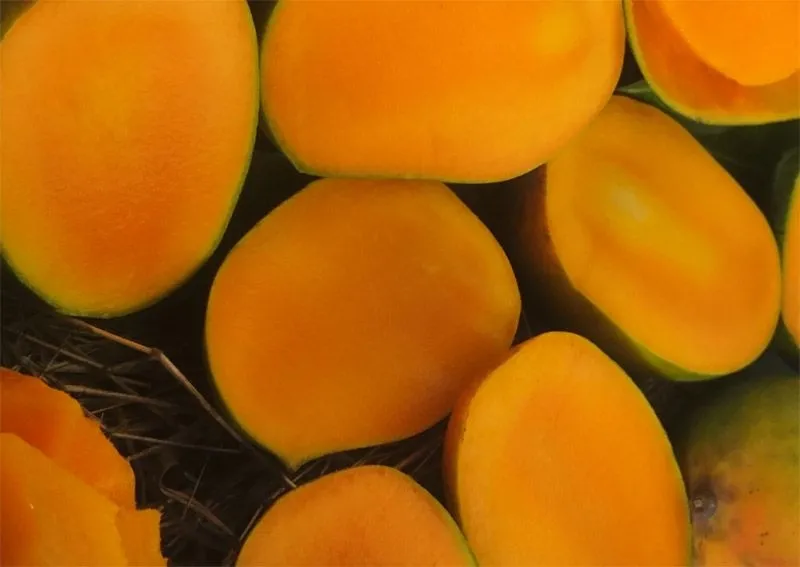
Typical diseases and disorders affecting this variety:
Detect these early using our Plant Guard AI.
Read our detailed Mango Diseases & Safety Guide.
The Kesar mango is legally protected under India's Geographical Indications of Goods Act. Genuine Kesar mangoes must originate from the certified soils of its designated region (e.g., Konkan coast for Alphonso, Saurashtra for Kesar) to carry this designation.
Kesar, famously known as the 'Queen of Mangoes', is a highly premium commercial variety originating from the foothills of Girnar in Gujarat, India. It was first grown by the Nawabs of Junagadh in 1931 and was named 'Kesar' (Saffron) due to the spectacular bright orange color of its pulp.
Physically, the Kesar mango is medium-sized, weighing between 200 and 300 grams. It has a distinctive elongated, somewhat curved shape with a prominent beak. The skin is uniquely unappealing compared to its interior; it remains a dull green with a slight yellow tinge even when fully ripe, occasionally sporting a faint red blush.
However, the flavor and aroma are breathtaking. The pulp is a brilliant saffron-orange, intensely sweet (often sweeter than Alphonso), and exceptionally juicy with a very minimal amount of soft fiber. Its aroma is powerful, sweet, and fills the room, making it instantly recognizable.
The Kesar season begins in mid-May, hits its absolute peak in early June, and extends until July. It is predominantly cultivated in the Junagadh, Amreli, and Kutch districts of Gujarat, as well as in neighboring parts of Maharashtra.
When comparing Kesar to Alphonso, Rajapuri, or Jamadar, its outward appearance is deceiving. Alphonso has a beautiful golden skin, whereas Kesar remains greenish-yellow. Yet, Kesar often surpasses Alphonso in pure sweetness. Discover more varieties at the Mango Identifier hub.
Kesar has excellent post-harvest characteristics. It boasts a very good shelf life of 8-10 days, making it ideal for export. Furthermore, it is highly sought after for making 'Aamras' (mango pulp) because of its intense saffron color and high sugar content.
Sweet with mild tang, rich flavor
Strong, aromatic
Smooth, slightly fibrous
Minimal
How to tell if it's a genuine Kesar:
Did you know that Alphonso is called Badami in Karnataka and Hapus in Maharashtra? Explore our complete state-by-state guide mapping 30+ regional names across India.
First cultivated by the Wazir of Junagadh in 1931, it was named 'Kesar' by the Nawab of Junagadh in 1934 because its pulp resembled the color of saffron.
Gir Kesar was granted a Geographical Indication (GI) tag in 2011, recognizing its unique connection to the Saurashtra region of Gujarat.
It is the second most exported mango from India after Alphonso.
Quick reference for identifying common healthy vs. problematic conditions:
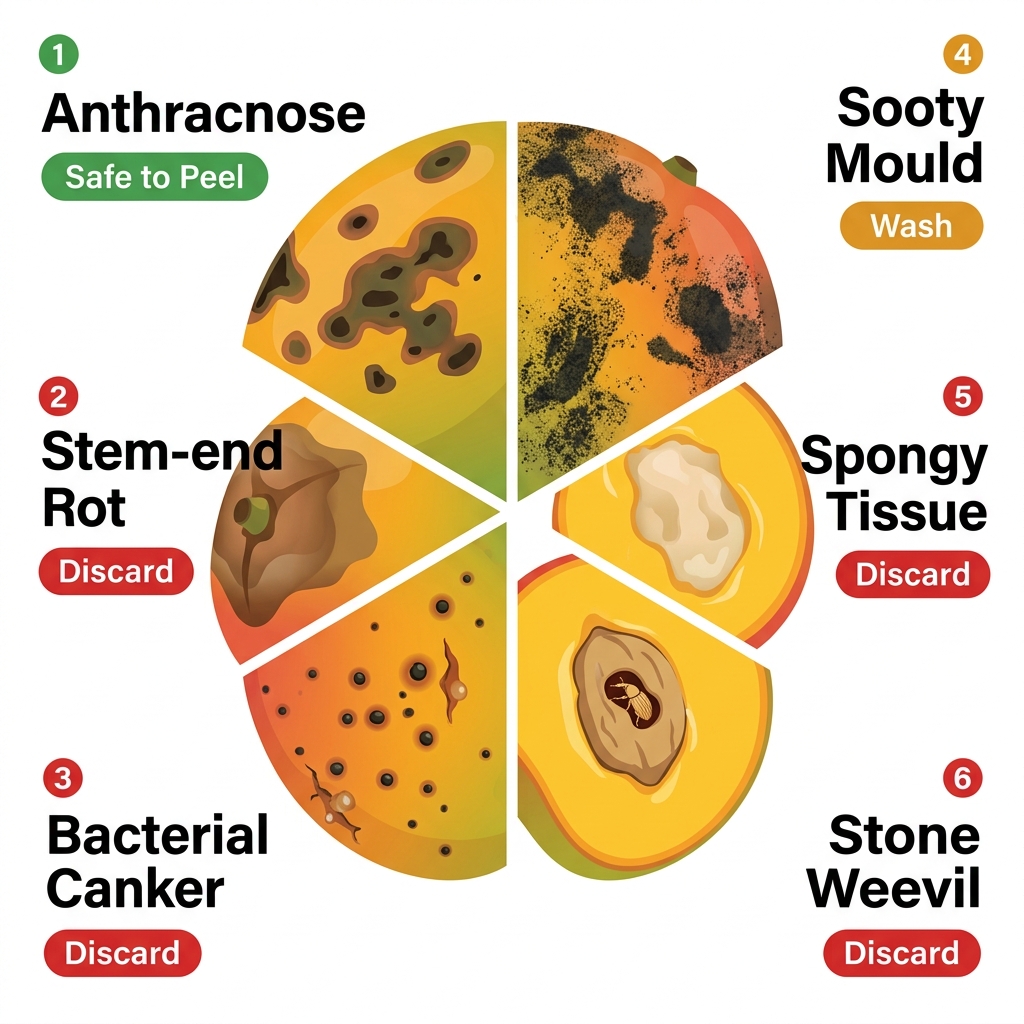
Pro Tip: Surface spots like Anthracnose are often harmless to the fruit inside, while Bacterial Canker or Stem-end Rot usually require discarding the fruit.
Ensure your Kesar mango is naturally ripened. Use Food Guard to detect Calcium Carbide and other chemical ripeners.