
📚 Regional Mango Names Guide
Did you know that Alphonso is called Badami in Karnataka and Hapus in Maharashtra? Explore our complete state-by-state guide mapping 30+ regional names across India.
Also known as: Himayat, Himayuddin, Humayun Pasand
Typical diseases and disorders affecting this variety:
Detect these early using our Plant Guard AI.
Read our detailed Mango Diseases & Safety Guide.
Imam Pasand (also known as Himayat, Himayuddin, or Humayun Pasand) is a legendary, ultra-premium heirloom mango variety originating in Andhra Pradesh and grown extensively in Tamil Nadu. Famously named after the Mughal Emperor Humayun, who considered it a royal delicacy, its name translates to 'Favored by the Imam/Leader'. It is widely celebrated in Southern India as the supreme standard of mango quality, rivaling the Alphonso in prestige and offering a highly complex eating experience.
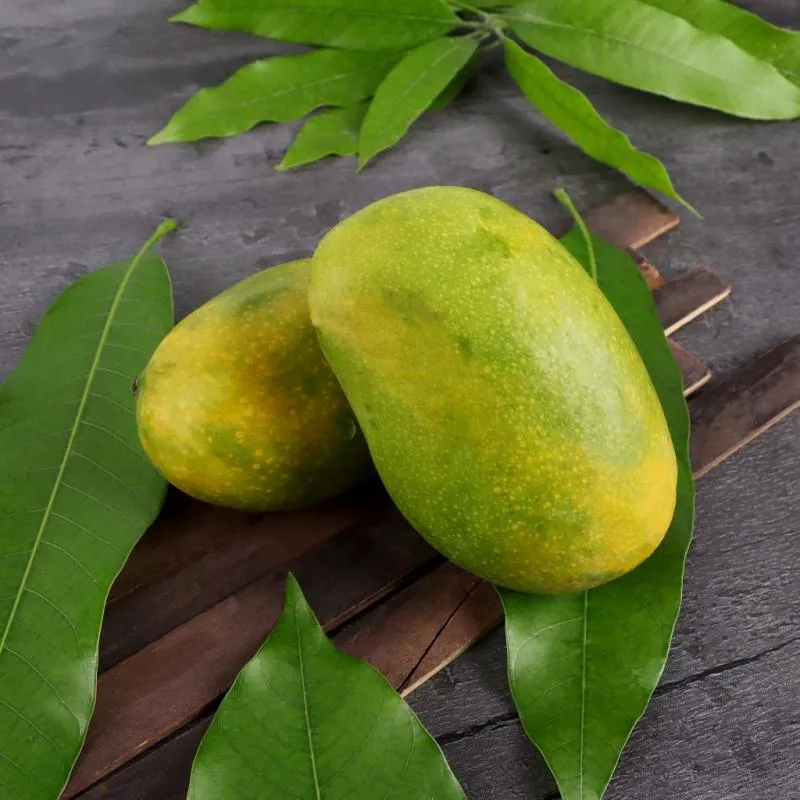
In physical terms, Imam Pasand is a massive fruit, regularly weighing between 450 and 800 grams. It has a round-oval, slightly asymmetric shape, with thick green-to-yellow-green skin punctuated by prominent white lenticels. Uniquely, the skin retains a yellow-green hue even when fully ripe. The pulp is a pale ivory-yellow to warm gold, with a silky, velvety texture that contains absolutely zero fiber. Despite the fruit's large size, the inner stone is remarkably thin and flat, yielding an exceptionally high pulp percentage.
The flavor of Imam Pasand is highly complex and specific — starting with a burst of honeyed sweetness that transitions into a distinct coconutty-pine finish with subtle notes of lime. Total soluble solids (TSS) range from 18° to 20° Brix. Cultivated in Trichy, Madurai, and Salem districts of Tamil Nadu and Chittoor in Andhra Pradesh, this variety is highly delicate, requiring careful post-harvest management because its soft pulp can easily bruise.
The harvesting season for Imam Pasand is early, beginning in late April and extending through early June, peaking in mid-May. Because it is highly sensitive to weather variations and alternate-bearing cycles, it is a rare specialty, fetching premium prices in elite fruit markets. For further information, explore our Mango Identifier Hub, or view profiles on Banganapalli, Alphonso, Jahangir, and Panchadara Kalasa.
Exquisitely sweet, buttery, with a distinct coconut-citrus aftertaste
Subtle, highly complex, floral and spicy aroma with coconut undertones
Silky, velvety, melting, entirely fiberless pulp
None
How to tell if it's a genuine Imam Pasand:
Did you know that Alphonso is called Badami in Karnataka and Hapus in Maharashtra? Explore our complete state-by-state guide mapping 30+ regional names across India.
Imam Pasand has a storied history linked to the royal orchards of Southern India. It was actively propagated by the Nawabs of Trichy and Hyderabad, who restricted its consumption to the royal courts. For generations, grafting techniques were kept as closely guarded secrets.
Today, it is considered the absolute connoisseur's choice in Tamil Nadu and Telangana. Its cultivation remains restricted to small-holder orchards because the trees are delicate and require meticulous pruning and disease protection.
Its royal association and delicate fruit set mean it remains one of the most expensive mango varieties in Indian domestic markets, representing a luxury gift item during the peak summer months.
Quick reference for identifying common healthy vs. problematic conditions:
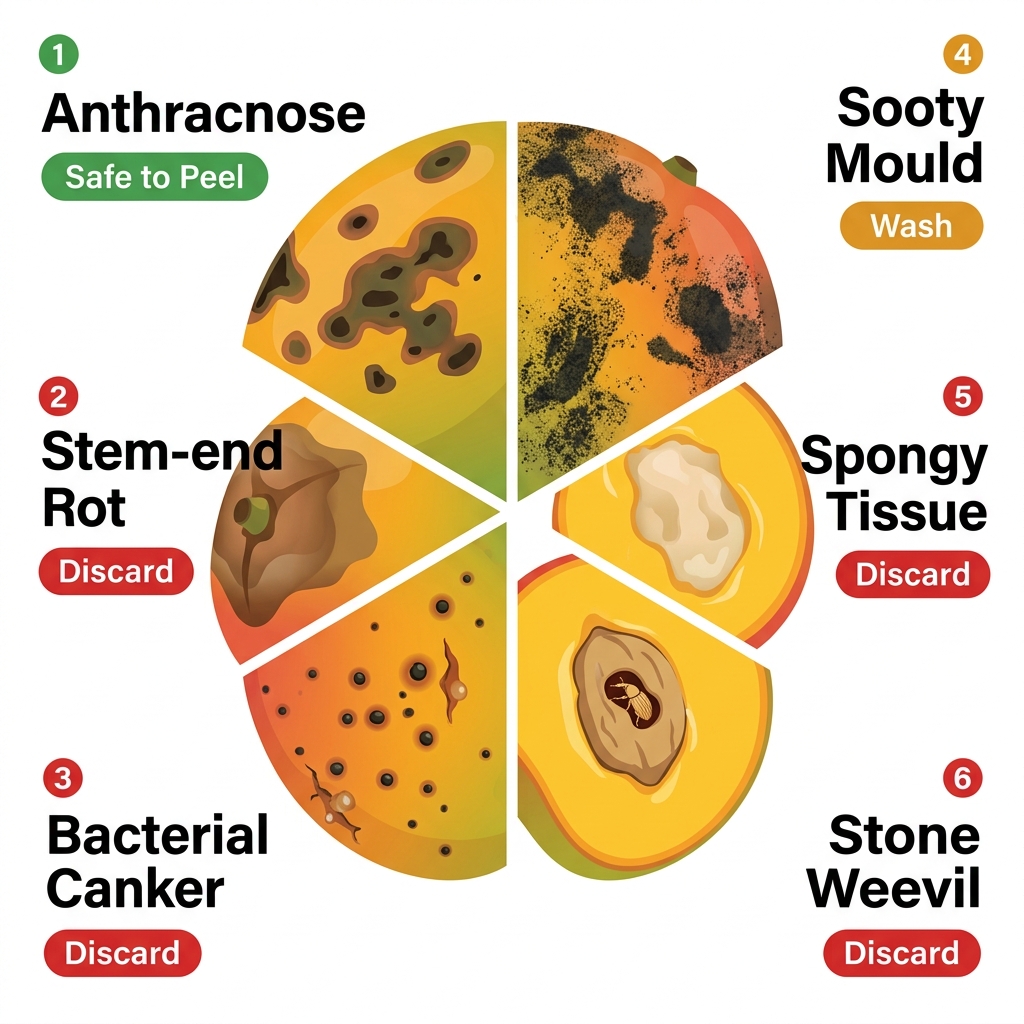
Pro Tip: Surface spots like Anthracnose are often harmless to the fruit inside, while Bacterial Canker or Stem-end Rot usually require discarding the fruit.
Ensure your Imam Pasand mango is naturally ripened. Use Food Guard to detect Calcium Carbide and other chemical ripeners.