How to Test Yam for Adulteration (Bleaching Agents, Heavy Metals, Pesticide)
⚡ Quick 60-Second Yam (Jimikand / Elephant Foot Yam) Purity & Chemical Verdict
Caustic Soda Bleaching & Rot Concealment: Sliced elephant foot yam is frequently washed in caustic soda or chlorine bleach to brighten flesh and remove muddy slime, disguising microbial decomposition.
Place cut yam pieces in a bowl of cold water and agitate vigorously for 30 seconds. Persistent soapy foam and a slippery, slimy feel that is difficult to rinse off indicates detergent or caustic soda chemical washing.
Inspect the cut face of the yam. Healthy fresh jimikand has dense, pale-yellowish to pinkish flesh that is rock-hard. Water-soaked, soft, brownish rings or foul-smelling hollow pockets reveal masked decay.
Raw yam naturally contains sharp calcium oxalate raphide crystals that cause mild itchiness if touched to sensitive skin; a complete absence of natural starch or presence of chemical bleach odor suggests chemical treating.
To learn more about food safety tests and home adulteration detection, read our guides on Turkey Berry (Sundakkai) and Colocasia.
Drop Yam (Elephant Foot Yam) photo here to test purity
or click to browse • Supports JPG, PNG, WEBP • Paste with Ctrl+V
Inspection Guide
Click to enlarge
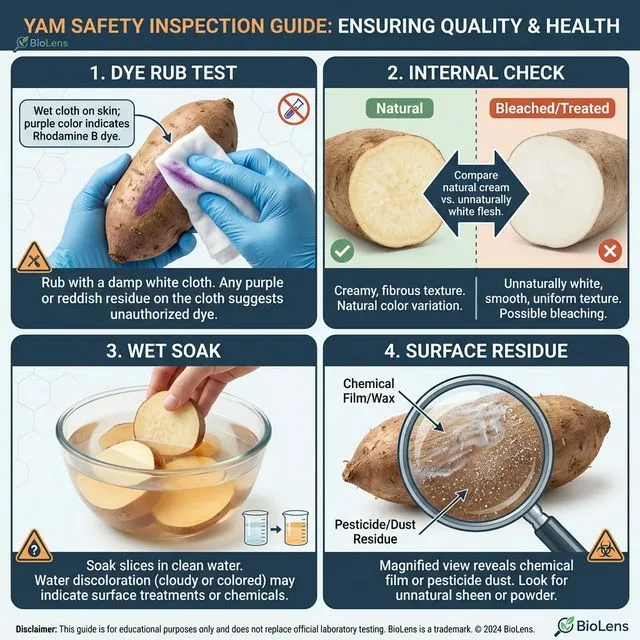
Yam (Jimikand) Purity & Safety Audit
Yam, especially the Elephant Foot variety, contains natural calcium oxalate crystals that cause itching. However, older yams may be bleached to look fresh or grown in contaminated soil.
1. The Cut Color Check:
Cut a small slice of the yam. The internal flesh should be creamy white to light pinkish-orange depending on the variety. If the flesh looks "stark white" or has a chemical, chlorine-like smell, it has likely been bleached for a fresh appearance.
2. The Texture and Firmness:
A fresh yam should be very hard and dry to the touch. If it feels spongy, soft, or has "slimy" patches on the surface, it is old or has started to rot internally.
3. The Itch Test (Natural Indicator):
While all yams cause some itching due to oxalates, an unnaturally intense burning sensation immediately upon contact may indicate high chemical concentration or poor processing.
4. The Soil Residue:
Examine the outer skin. Natural yams are often covered in dry soil. If the yam is perfectly clean, "polished," and looks unnaturally bright, suspect chemical washing.
Quick Safety Tips
- Choose yams that are hard and dry; avoid spongy ones
- Avoid yams with a chlorine or bleach-like smell
- Always wear gloves or apply oil to hands when cutting to prevent oxalate irritation
- Boil yam with a bit of tamarind or lemon juice to neutralize natural irritants
Primary Chemical Concerns
Health Risks & Impacts
Multilingual Local Names
Common Storage Pests
Yam Scale
low riskSmall, circular, brownish-white insects that live on the surface of the tuber.
Detection
- Small white/grey crusty patches on the skin
Prevention
- Store in a cool, dry, dark place
- Ensure good ventilation
Corrective Action: What to do?
Scrub off with a brush; the internal flesh is usually unaffected if the skin is intact.
Regulatory Corner: FSSAI (Food Safety and Standards Authority of India) / Codex Alimentarius (Codex Stan 164-1989)
Regulation: Food Safety and Standards (Contaminants, Toxins and Residues) Regulations 2011, Clause 2.3 & Codex Stan 164
Legal Limit:Lead MRL: Max 0.1 ppm; Cadmium MRL: Max 0.1 ppm; Caustic soda / chemical bleach residues: Zero on edible tubers (0.0 ppm); Chlorpyrifos insecticide MRL: Max 0.05 ppm
Report Adulteration to FSSAI (Food Safety and Standards Authority of India) / Codex Alimentarius (Codex Stan 164-1989)