How to Test Colocasia for Adulteration (Malachite Green, Growth Enhancers, Pesticide)
⚡ Quick 60-Second Colocasia (Arbi / Taro Root) Purity Verdict
Detergent / Chemical Peeling Washes & Spongy Rot: Muddy taro corms (arbi) are washed with industrial detergents or chemical bleaches to simulate pre-cleaned roots, concealing hidden mold and internal decay.
Place 4-5 arbi corms in a closed jar with water and shake vigorously for 10 seconds. Formation of persistent soapy froth that doesn't dissipate confirms industrial detergent washing to scrub off root mud.
Firmly press each corm between your thumb and forefinger, especially at the tip. Fresh arbi is rock-hard throughout. Spongy, yielding, or hollow corms contain internal fungal rot and bacterial decay.
Cut across a corm. The interior should be bright white or pale cream with fine concentric rings and odorless sticky sap. Dark grey spots, brown streaks, or sour fermented smells indicate decaying produce.
To learn more about food safety tests and home adulteration detection, read our guides on Yam (Elephant Foot Yam) and Mushrooms.
Drop Colocasia photo here to test purity
or click to browse • Supports JPG, PNG, WEBP • Paste with Ctrl+V
Inspection Guide
Click to enlarge
Colocasia (Taro) Safety Guide
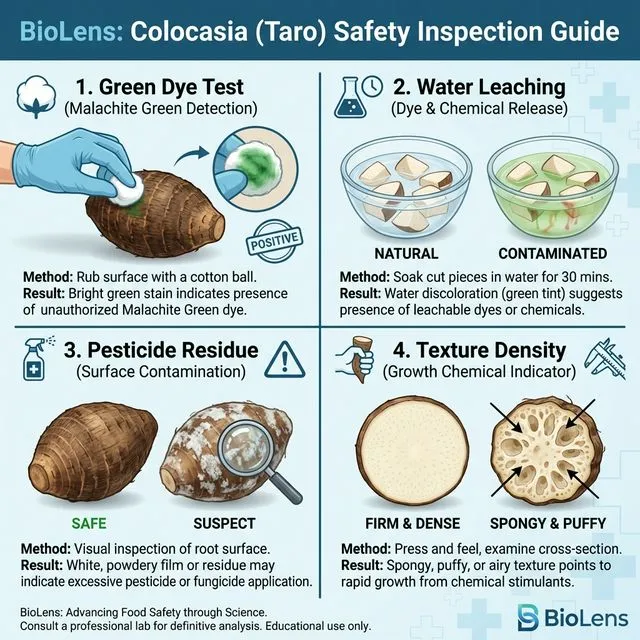
Colocasia can be treated with toxic green dyes to look fresh or chemicals to induce rapid growth.
1. Green Dye Test: Rub the skin and cut ends with a cotton ball soaked in water or oil. If the cotton turns green, it has been treated with Malachite Green, a toxic industrial dye.
2. Water Leaching: Slice a small piece and place it in water. If a green or blue tint starts bleeding into the water, it is chemically dyed.
3. Pesticide Residue: Inspect the hairy skin for white, powdery, or chalky deposits. These are often residues of harmful organophosphate pesticides used in farming.
4. Texture Density:
Naturally grown colocasia is firm and heavy. If the root feels light, "spongy," or unnaturally puffy, it may have been treated with chemical growth enhancers.
5. Shared Root Vegetable Concerns:
Similar dye treatments and chemical washes are common in other root vegetables. Read our guide to test Sweet Potato for toxic dyes.
Quick Safety Tips
- Use wet cotton to test for Malachite Green dye
- Avoid roots with a visible green/blue tint on the skin
- Thoroughly wash and peel to remove surface pesticide residues
- Select firm, heavy roots over spongy or light ones
Primary Chemical Concerns
Health Risks & Impacts
Multilingual Local Names
Common Storage Pests
Root Aphids
low riskSmall insects that can live on the "hairs" of the outer skin.
Detection
- Tiny insects on the skin
- Sticky residue
Prevention
- Store in a dry, dark place
- Use within 3-5 days
Corrective Action: What to do?
Wash thoroughly; the tuber is safe after peeling and cooking.
Regulatory Corner: FSSAI (Food Safety and Standards Authority of India) / Codex Alimentarius (Codex Stan 164-1989)
Regulation: Food Safety and Standards (Food Products Standards) Regulations 2011 & FSS (Contaminants) Regulations
Legal Limit:Lead MRL: Max 0.1 ppm; Cadmium MRL: Max 0.1 ppm; Chemical detergents / surfactants: Prohibited (0.0 ppm - Zero tolerance); Cyanide compounds: Nil
Report Adulteration to FSSAI (Food Safety and Standards Authority of India) / Codex Alimentarius (Codex Stan 164-1989)What CANNOT be Verified (Lab-Only)
Invisible Risks (Lab-Only):
* Systemic Pesticides: Chemicals absorbed into the flesh of the root require HPLC or GC-MS testing.
* Malachite Green Traces: Low concentrations that don't bleed visually involve specialized residue extraction.