How to Detect Argemone Oil in Mustard Oil: 3 Rapid Home Tests & Safety Guide
⚡ Quick 60-Second Mustard (Sarson) Oil Purity Verdict
Deadly Argemone Adulteration: Raw cold-pressed mustard oil is adulterated with toxic Argemone Mexicana oil (containing sanguinarine alkaloid, the cause of Epidemic Dropsy, cardiac arrest, and blindness) and cheap solvent-extracted rice bran oil.
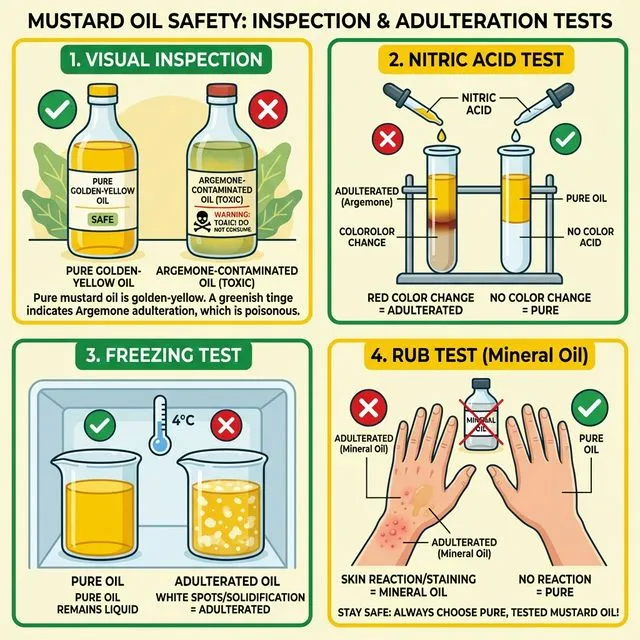
Add 5ml mustard oil + 5ml concentrated Nitric Acid (HNO3) in a glass tube and shake for 10s. A red, crimson, or brownish-red ring confirms deadly Argemone oil adulteration.
Place oil in the freezer (-10°C) for 4 hours. Pure mustard oil remains liquid or forms slight uniform crystals. White waxy solid sediment at the bottom indicates cheap palm oil blending.
Pure Kachi Ghani mustard oil releases a strong, sharp natural pungency (Allyl isothiocyanate) that causes immediate mild tearing. Blended or refined oils lack this authentic bite.
Drop Mustard Oil photo here to test purity
or click to browse • Supports JPG, PNG, WEBP • Paste with Ctrl+V
Inspection Guide
Click to enlarge
Mustard Oil Purity & Argemone Detection Protocol
🚨 Why Argemone Contamination Occurs
Argemone mexicana (Mexican Prickly Poppy or Satyanashi) grows abundantly as a weed in mustard fields. Its seeds closely resemble dark mustard seeds and are often harvested together, either inadvertently or through deliberate adulteration by unscrupulous millers to maximize oil yields. Even 0.1% to 1% argemone contamination can trigger acute epidemic dropsy.
🧪 Test 1: The Concentrated Nitric Acid Test (Official FSSAI DART Method)
This is the gold-standard chemical test for rapid home/bench detection of Sanguinarine.
1. Procedure: In a clean test tube or glass vial, pour 5 ml of mustard oil.
2. Reagent: Carefully add 5 ml of concentrated Nitric Acid (HNO₃) along the side of the tube.
3. Mixing: Shake the tube gently for 10–15 seconds and place it in a hot water bath (or let stand for 2–3 minutes).
4. Result:
- ✅ Pure Mustard Oil: The lower acid layer remains clear or pale yellow with no distinct color shift.
- ❌ Adulterated (Argemone Present): A distinct crimson-red, reddish-brown, or orange-red ring/layer develops at the interface or in the acid layer.
⚠️ Safety Precaution: Concentrated nitric acid is highly corrosive. Wear gloves and eye protection; never inhale fumes.
❄️ Test 2: The Refrigerator / Solidification Test (Zero-Chemical Home Check)
Detects blending with cheap Palm Oil, Cottonseed Oil, or Vegetable Ghee (Vanaspati).
1. Procedure: Pour 50 ml of mustard oil into a dry transparent glass jar.
2. Chilling: Place the jar in the main refrigerator compartment (at 4°C to 8°C) for 2 to 3 hours.
3. Result:
- ✅ Pure Cold-Pressed Mustard Oil: Remains completely liquid, clear, and uniform throughout.
- ❌ Adulterated Oil: A cloudy white solidified fatty layer forms at the bottom or top, indicating foreign saturated oils.
🖐️ Test 3: The Palm Friction & Nasal Pungency Test
Verifies natural Allyl Isothiocyanate pungency vs synthetic coloring/dilution.
1. Procedure: Rub 3–4 drops of mustard oil vigorously between your clean palms for 20–30 seconds until warm.
2. Aroma Inspection: Immediately cup your hands over your nose and inhale gently.
3. Result:
- ✅ Pure Kachi Ghani Oil: Delivers an instant, sharp, pungent 'kick' or sting in the eyes and nostrils without greasy chemical residue.
- ❌ Adulterated / Refined Oil: Lacks sharp pungency, smells dull/fatty like neutral cooking oil, or emits an unpleasant bitter, solvent-like chemical odor.
💡 Seed Distinction Check (Mustard vs Argemone Seeds)
If buying whole seeds to press at a local mill, inspect the raw seeds:
- Mustard Seeds: Smooth surface, uniformly round, rolls smoothly across a flat tray.
- Argemone Seeds: Rough, pitted surface, angular shape with a distinct pointed apex/notch at one end, dull black finish. Do not press batches containing angular seeds.
Visual Inspection Reference
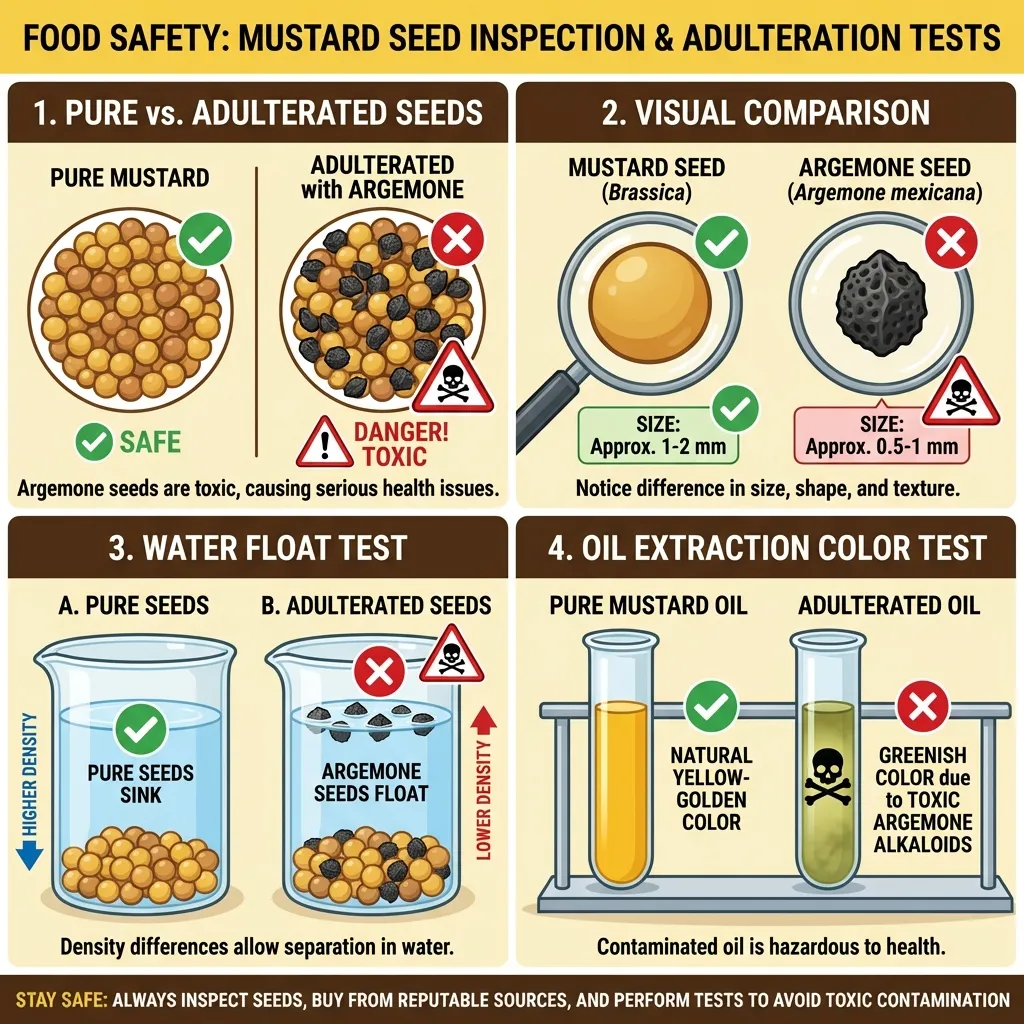 Mustard Seeds vs Toxic Argemone Seeds Visual Comparison
Quick Safety Tips
- Step 1: Perform the Nitric Acid Test — a crimson/reddish ring indicates toxic Argemone oil
- Step 2: Chill in refrigerator for 2 hours — pure mustard oil stays 100% liquid without white sediment
- Step 3: Rub between palms — authentic Kachi Ghani produces an instant sharp nasal pungency
- Never consume suspicious mustard oil: Sanguinarine toxin is heat-stable and CANNOT be neutralized by cooking
- Inspect whole mustard seeds: discard batches containing angular, rough, pitted black seeds
- Look for AGMARK Grade-1 certification on commercial bottles for verified laboratory testing
Primary Chemical Concerns
Health Risks & Impacts
Multilingual Local Names
Common Storage Pests
Fungal & Oxidative Spoilage (Moisture Contamination)
low riskPure mustard oil does not host insect pests, but moisture ingress causes hydrolysis and fungal development (Aspergillus species), producing free fatty acids and rancidity.
Detection
- Cloudy haze or whitish suspended filaments in the oil
- Sharp rancid, acrid, or sour smell replacing fresh pungency
- High free fatty acid (FFA) value
Prevention
- Store in dark glass bottles or food-grade tin containers
- Keep tightly sealed away from direct sunlight and heat
- Never introduce wet spoons or open water drops into the container
Corrective Action: What to do?
Discard rancid or fungus-contaminated oil. Do not use for cooking.
Regulatory Corner: FSSAI (Food Safety and Standards Authority of India)
Regulation: Food Safety and Standards (Prohibition and Restrictions on Sales) Regulations, Clause 2.1.1: Ban on Blending of Mustard Oil
Legal Limit:Argemone Oil: 0.0% (Zero tolerance — prohibited under law); Acid value: Max 6.0; Allyl isothiocyanate (natural pungency): 0.25% to 0.60% w/w
Report Adulteration to FSSAI (Food Safety and Standards Authority of India)What CANNOT be Verified (Lab-Only)
Advanced Laboratory Verification (For Confirmatory Forensic & FSSAI Audits)
- Thin Layer Chromatography (TLC): Silica gel TLC plates using solvent system (Hexane:Ether:Acetic Acid) sprayed with Dragendorff's reagent or viewed under UV (366 nm) reveals bright golden-yellow fluorescence of Sanguinarine and Chelerythrine alkaloids (detection limit: 0.005%).
- High-Performance Liquid Chromatography (HPLC) / GC-MS: Quantifies sanguinarine and dihydrosanguinarine down to parts-per-billion (ppb) concentrations.
- Fatty Acid Profile Analysis (GC-FID): Confirms Erucic acid (typically 35–48%), Oleic acid, and Linolenic acid ratios to detect foreign refined vegetable oil blends.
- Halphen Test & Baudouin Test: Detects Cottonseed oil and Sesame oil adulterants respectively.