Black Beans Quality & Safety Tests: Detect Dyed Beans & Destroy Lectins
⚡ Quick 60-Second Black Beans Purity & Dye Verdict
Coal-Tar Dyeing (Black PN / Carbon Black) & Mineral Oil Polish: Faded, weathered, or lower-grade navy/pinto beans are artificially dyed with synthetic black dyes to imitate expensive black turtle beans.
Place 20 black beans in a glass of cold water for 15 minutes. Authentic black beans release water-soluble anthocyanins slowly, tinting water deep purplish-burgundy. Chemically dyed beans instantly shed inky blue-black pigment.
Rub dry black beans vigorously against a sheet of rough white paper. Real black beans leave no color mark. Dyed beans coated with carbon black or dye solutions leave distinct charcoal/black streaks.
Cut or crack a black bean in half. The internal cotyledon flesh of genuine black turtle beans is creamy-white or pale ivory. If the black dye has seeped into the interior meat, chemical dyeing is confirmed.
To learn more about legume and grain safety, read our guides on Chickpeas and Rice.
Drop Black Beans photo here to test purity
or click to browse • Supports JPG, PNG, WEBP • Paste with Ctrl+V
Inspection Guide
Click to enlarge
Black Beans Purity & Lectin Destruction Audit
Black beans (Phaseolus vulgaris), a staple of Mexican, Caribbean, and Latin American cuisines, are highly nutritious. However, dried beans in bulk markets are sometimes adulterated with cheaper, common white or red beans artificially dyed black. More importantly, raw or undercooked black beans contain high concentrations of phytohemagglutinin (lectin), a toxic plant protein that causes acute food poisoning. Proper preparation and boiling are absolute safety requirements.
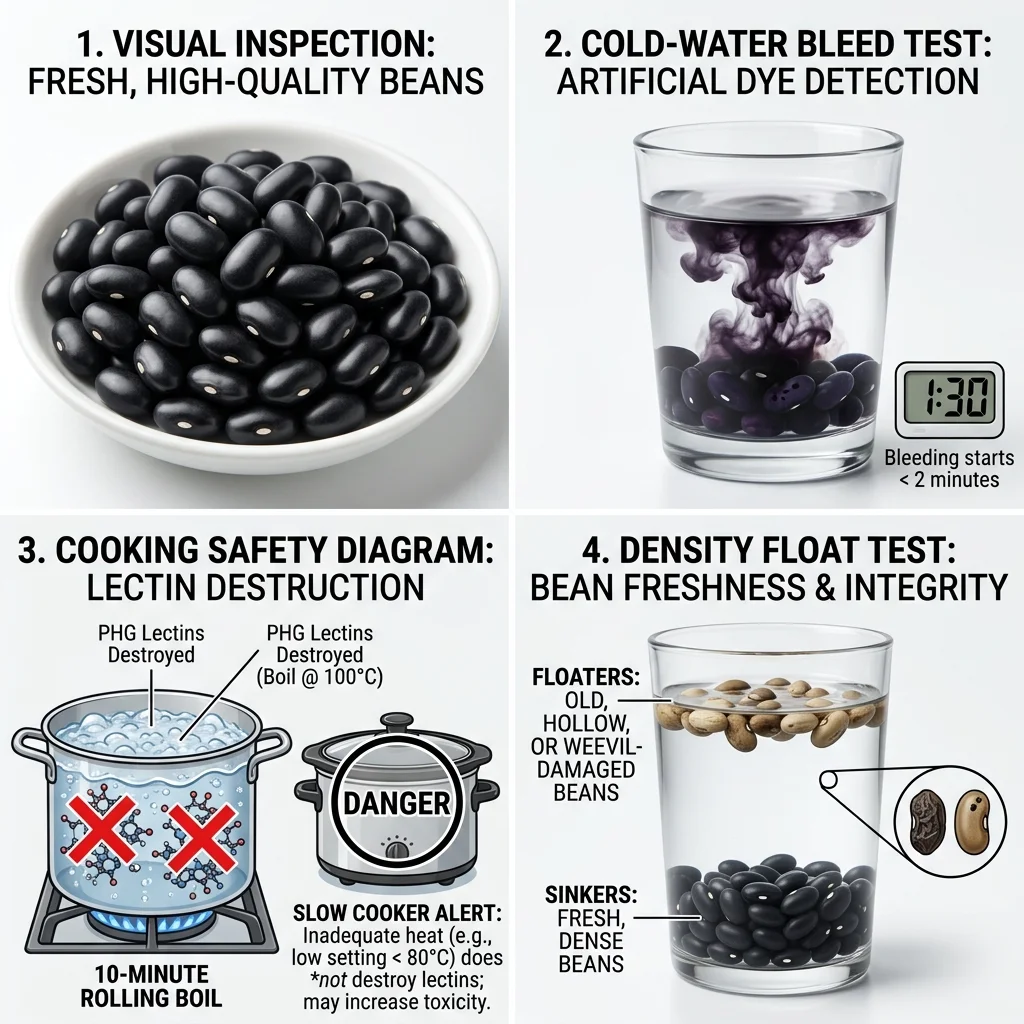
1. The Cold Water Stir Test (Dye Adulteration):
Place a handful of dried black beans in a glass of cold water and stir for 2 minutes. Naturally black beans have a tough, pigmented seed coat that will not bleed color in cold water, leaving the water clear or very faintly grey. If the water immediately turns dark purple, blue, or black, the beans are cheaper varieties artificially dyed with chemical food coloring to mimic black beans.
2. The 10-Minute Rolling Boil (Lectin Safety):
Phytohemagglutinin is a powerful toxin that agglutinates red blood cells. To neutralize it completely, dried beans must be soaked in water for at least 5 hours, drained, rinsed, and then boiled at a rolling boil (100°C / 212°F) for a minimum of 10 minutes. WARNING: Never cook dried beans in a slow cooker or crockpot on low heat without boiling them first. Low-temperature cooking (under 80°C / 176°F) fails to destroy the toxin and can actually increase lectin toxicity by up to five times!
3. The Water Float Test (Age & Damage):
Drop a handful of beans into a bowl of water. Fresh, high-quality dried beans are dense and will sink to the bottom. Old, dehydrated, hollow, or insect-damaged beans will float on the surface. Stale beans are extremely hard and will remain tough and dry even after hours of boiling.
4. The Visual Mold and Insect Audit:
Inspect the beans carefully. Healthy black beans are plump, smooth, shiny, and uniform jet-black. Discard any beans that are heavily shriveled, have powdery white-grey mold on their skin, or show tiny entry holes (indicating bean weevil infestation).
Click to enlarge
Black Beans Freshness & Texture Audit
Freshness ensures optimal digestion, nutrient absorption, and proper softening during cooking.
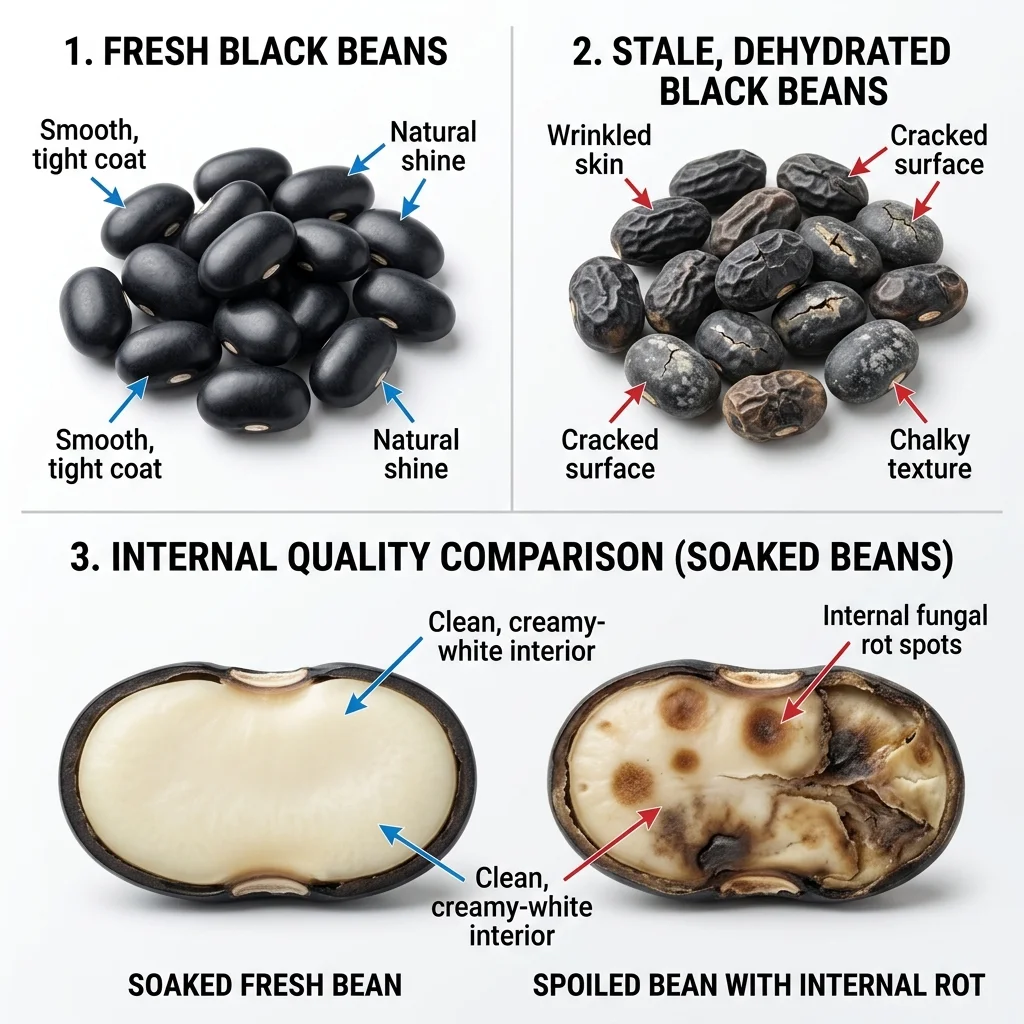
1. Skin Smoothness:
Fresh dried beans have smooth, tight, shiny coats. Wrinkled, cracked, or dusty-looking skins indicate old stock that has lost its moisture and will not soften properly.
2. Flowability:
Pour the beans out. They should flow freely like dry pebbles. Any sticky clumps or musty, earthy odors indicate moisture exposure and active fungal mold growth.
3. Internal Cross-Section:
Split a soaked bean. The interior should be clean, cream-colored, and firm. Internal browning or grey spots indicate fungal rot.
Quick Safety Tips
- Perform the cold water stir test to detect chemical dye adulteration
- Always boil soaked black beans at a rolling boil for 10 minutes before slow-cooking or simmering
- Discard beans that float in water, as they are stale, hollow, or insect-infested
- Look for uniform, smooth, shiny skins and avoid shriveled or moldy batches
Primary Chemical Concerns
Health Risks & Impacts
Multilingual Local Names
Regulatory Corner: FSSAI (Food Safety and Standards Authority of India) / US FDA (21 CFR 164.150) / Codex Stan 171-1989
Regulation: Food Safety and Standards (Food Products Standards) Regulations 2011, Clause 2.4.6.15 & Codex Stan 171
Legal Limit:Non-permitted synthetic black/blue dyes (Black PN, Indigo): Zero tolerance (0.0 ppm); Mineral oil / paraffin: Prohibited (0.0%); Lead MRL: Max 0.2 ppm; Moisture: Max 12.0%
Report Adulteration to FSSAI (Food Safety and Standards Authority of India) / US FDA (21 CFR 164.150) / Codex Stan 171-1989