How to Test Beetroot for Adulteration (Rhodamine B, Excessive Nitrates, Lead)
⚡ Quick 60-Second Beetroot Purity & Toxic Dye Verdict
Rhodamine B Dye Bath & Industrial Soil Heavy Metals: Pale, fibrous, or stale beetroots are soaked in toxic Rhodamine B or Red 40 solutions to impart an intense crimson-red hue, alongside potential heavy metal uptake from industrial soils.
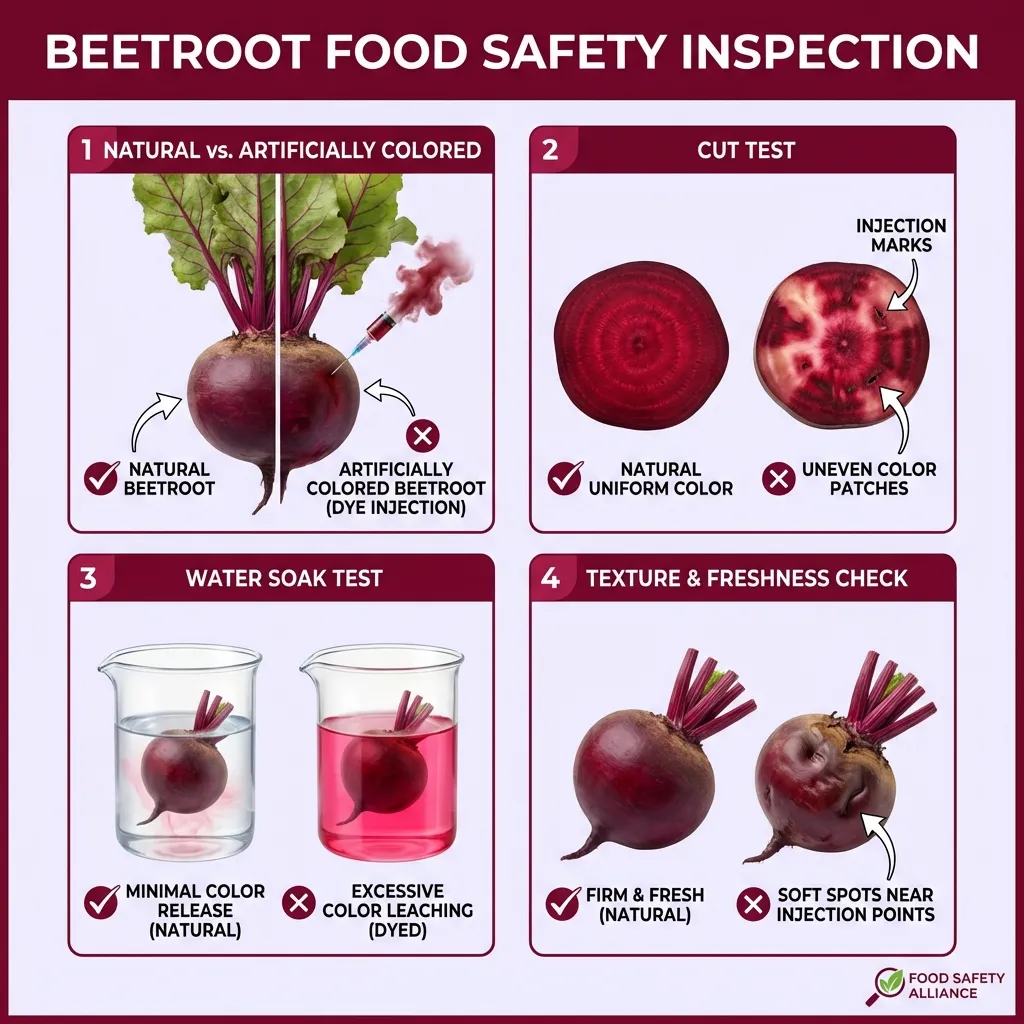
Wipe the unpeeled outer skin with cotton moistened with water. Genuine raw beetroot does not bleed color through intact skin. A vibrant pink or fluorescent red streak on the cotton indicates banned Rhodamine B dye.
Drop a freshly cut beetroot cube into cold water. Natural betanin pigment takes several minutes to diffuse gradually. Rhodamine B or synthetic dye leaches out instantly in swirling magenta clouds.
Slice across the root center. Fresh beetroot shows concentric natural pale and dark red rings. An unnaturally uniform, glowing neon-pink interior without ring definition indicates chemical dye infusion.
To learn more about food safety tests and home adulteration detection, read our guides on Radish (Mooli) and Cucumber (Kheera).
Drop Beetroot photo here to test purity
or click to browse • Supports JPG, PNG, WEBP • Paste with Ctrl+V
Inspection Guide
Click to enlarge
Beetroot Purity & Dye Check
Beetroots are sometimes dyed with Rhodamine B (a fluorescent red dye) to appear fresher and deeper in color, especially when sold sliced or peeled.
1. The Cotton Rub Test:
Take a cotton ball soaked in water or liquid paraffin and rub the outer skin or a freshly cut surface. If the cotton turns bright pink or red, it is an artificial dye. Natural beetroot juice is a deep purple-red and takes a moment to bleed.
2. The Water Dissolution:
Place a slice of beetroot in a glass of cold water. Natural beetroot color leaches slowly. If the water turns bright pink immediately, suspect Rhodamine B.
3. The Leaf Health:
If the beetroot still has leaves, check their condition. Vibrant, deep red roots attached to withered, yellowing leaves often indicate the root has been "refreshed" with dyes.
4. The Internal Texture:
Cut the beetroot crosswise. Natural beetroots often show faint white concentric rings. Unnaturally dyed ones may have uniform, neon-like color saturation throughout.
Quick Safety Tips
- Perform the wet cotton rub test for Rhodamine B
- Check leaching speed in water - dyes bleed instantly
- Avoid beetroots with an unnaturally uniform, neon-red interior
- Peel the skin deeply to reduce surface chemical intake
Primary Chemical Concerns
Health Risks & Impacts
Multilingual Local Names
Common Storage Pests
Root Aphids
low riskSmall insects that can live on the surface of the root or in the soil residue.
Detection
- Small white or greyish clusters on the root surface
- Sticky residue
Prevention
- Thoroughly wash and scrub the root before storage
- Store in a cool, humid environment (crisper drawer)
Corrective Action: What to do?
Scrub off with a brush under running water; use a vinegar rinse.
Regulatory Corner: FSSAI (Food Safety and Standards Authority of India) / Codex Alimentarius (Codex Stan 193-1995)
Regulation: Food Safety and Standards (Contaminants, Toxins and Residues) Regulations 2011, Clause 2.3 & FSS (Prohibition of Sales) Reg 2.1
Legal Limit:Rhodamine B: Prohibited industrial dye (0.0 ppm - Zero tolerance); Lead (root vegetables): Max 0.1 ppm; Cadmium: Max 0.1 ppm; Nitrates: Max 2000 ppm
Report Adulteration to FSSAI (Food Safety and Standards Authority of India) / Codex Alimentarius (Codex Stan 193-1995)