How to Inspect Sliced & Whole Pumpkin for Dyes, Preservatives, and Nitrates
⚡ Quick 60-Second Pumpkin Purity & Dye Verdict
Metanil Yellow Dye Injections & Copper Sulfate Washes: Cut pumpkin segments and winter squashes are frequently wiped with yellow azo dyes to fake rich carotenoid maturity, and washed in copper solutions.
Press a dry white paper towel firmly against the freshly cut orange flesh. Natural carotenoids stay bound inside intact plant cells; an instant bright yellow or orange dye transfer onto paper indicates synthetic coloring.
Place 2 drops of dilute hydrochloric acid (or concentrated vinegar) onto the orange pulp. An immediate change to vibrant magenta-pink confirms presence of toxic non-permitted Metanil Yellow dye.
Scoop out a seed from the central cavity. Mature, naturally ripened pumpkin contains plump, firm seeds with developed white kernels. Chemically forced/dyed squash contains flat, hollow, papery seeds.
To learn more about food safety tests and home adulteration detection, read our guides on Cucumber, Watermelon, and Bottle Gourd (Lauki).
Drop Pumpkin photo here to test purity
or click to browse • Supports JPG, PNG, WEBP • Paste with Ctrl+V
Inspection Guide
Click to enlarge
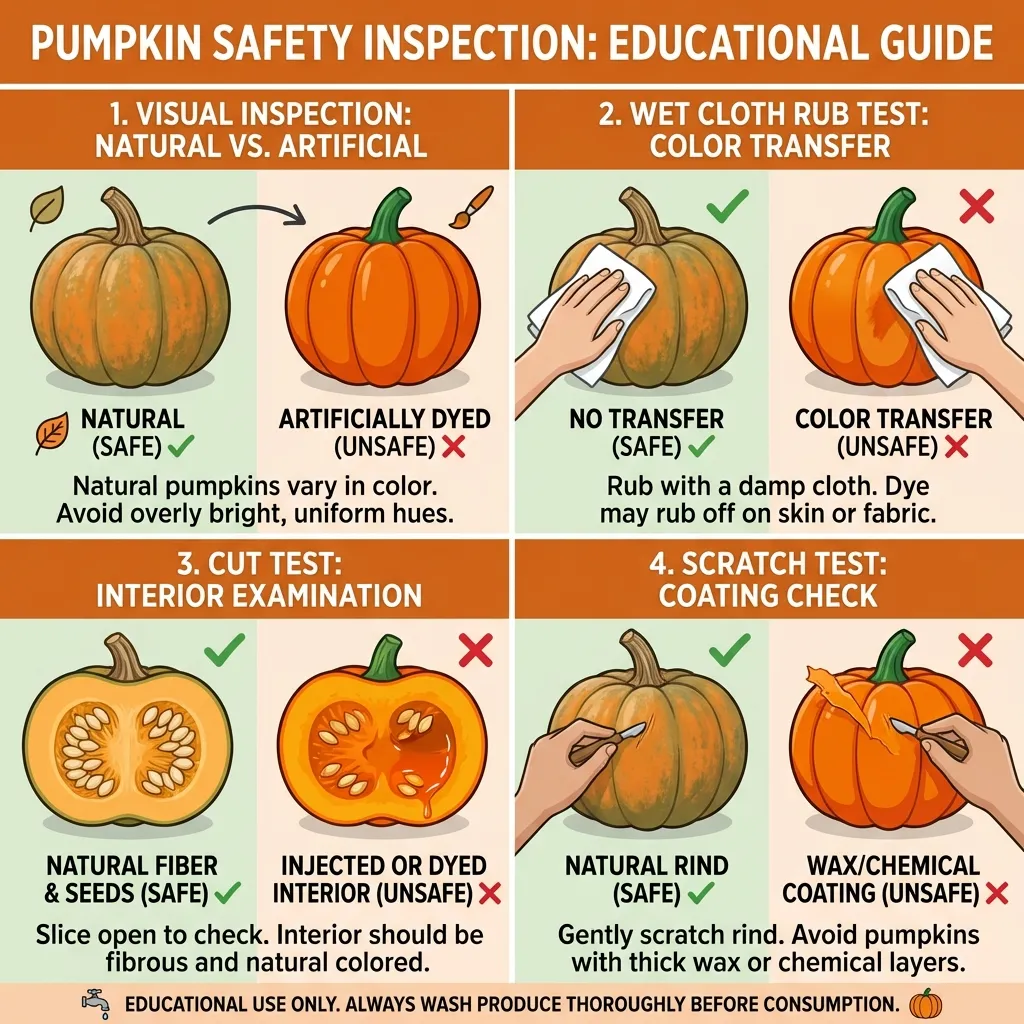
Pumpkin Purity & Sliced Preservation Audit
Due to their size, pumpkins are often sold in pre-cut slices, which are highly susceptible to oxidation, spoilage, and chemical preservation treatments.
1. The Sliced Face Cotton Rub (Sunset Yellow Dye):
Take a cotton ball soaked in water or liquid paraffin and rub the exposed orange flesh of a sliced pumpkin. If the cotton turns bright orange-pink, synthetic coloring (Sunset Yellow) has been applied to simulate mature ripening.
2. Sliced surface Formaldehyde Check:
Vendors frequently spray pre-cut pumpkin faces with Formaldehyde (Formalin) or chemical preservatives to prevent rot, browning, and slime. Smelling the cut surface is the first line of defense: naturally cut pumpkins have a sweet, earthy gourd scent. A sharp, chemical, or medicinal odor indicates chemical preservation.
3. Nitrate accumulation in oversized pumpkins:
Oversized pumpkins are often grown with excessive nitrate fertilizers. Check the interior flesh—if the pumpkin is extremely heavy and watery but has a pale center, thick woody veins, and no characteristic sweet aroma, it contains high nitrate levels.
4. Skin Scraping (Wax on Whole Pumpkin):
For whole pumpkins, scrape the outer green/yellow rind with a dull knife. If white flaky wax residue peels off, the pumpkin has been coated in industrial paraffin wax to artificially extend shelf life.
5. Cross-Contamination in Gourd Cultivars:
Pumpkins share botanical traits and agricultural pests with other gourds. Check our safety guides for Cucumber and Bottle Gourd to understand cross-contamination risks.
Quick Safety Tips
- Perform the cotton rub test on sliced pumpkin flesh to check for dyes
- Smell pre-cut slices for sharp chemical or medicinal preservation odors
- Avoid pumpkins with thick, wood-like internal veins or pale, scentless flesh
- Wash and peel the outer skin of whole pumpkins before slicing
Primary Chemical Concerns
Health Risks & Impacts
Multilingual Local Names
Common Storage Pests
Squash Bug
low riskInsects that feed on the sap of pumpkins and squash.
Detection
- Small sunken spots on the skin
- Brown or yellowing patches
Prevention
- Store in a cool, dry, dark place
- Avoid storing near bruised fruits
Corrective Action: What to do?
Cut away affected skin; the internal flesh is usually safe if the damage is superficial.
Cucumber Beetle
medium riskA destructive agricultural pest during the growth phase that feeds on young pumpkin foliage and scars the mature fruit.
Detection
- Yellow-and-black striped beetles near the patch
- Scarred tracks or shallow holes on pumpkin skin
Prevention
- Use row covers during the early growth stages
- Keep the storage area clean and beetle-free
Corrective Action: What to do?
Thoroughly wash the outer rind. If scarring is only superficial, peel the affected skin away; if deep boring has occurred, discard to prevent secondary rot.
Regulatory Corner: FSSAI (Food Safety and Standards Authority of India) / Codex Alimentarius (Codex Stan 193-1995)
Regulation: Food Safety and Standards (Food Products Standards and Food Additives) Regulations 2011, Clause 2.3.1
Legal Limit:Metanil Yellow & non-permitted synthetic dyes: Strictly prohibited (0.0 ppm - Zero tolerance); Lead MRL: Max 0.1 ppm; Cadmium: Max 0.05 ppm; Copper sulfate: 0.0 ppm
Report Adulteration to FSSAI (Food Safety and Standards Authority of India) / Codex Alimentarius (Codex Stan 193-1995)