How to Test Sapota for Adulteration (Ethephon, Saccharin, Calcium Carbide)
⚡ Quick 60-Second Sapota (Chikoo) Ripening & Sweetener Verdict
Calcium Carbide Ripening & Saccharin Soaking: Chikoos are routinely ripened with hazardous calcium carbide (acetylene gas) to force skin softening, and dipped in saccharin baths to fake high natural sugar content.
Press the fruit and slice open lengthwise. Naturally ripened chikoos are evenly soft and buttery throughout. Carbide-ripened fruit feels soft on the outside but has a hard, pale, crunchy core that resists biting.
Taste a small piece of pulp. Natural sapota has a rich, malty, caramel sweetness. An instant intense sweetness followed by a metallic, persistent bitter chemical aftertaste reveals artificial saccharin soaking.
Rub the rough sandy skin with a dry dark cloth. Whitish-gray powdery residues accompanied by a faint garlic or sulfur odor indicate toxic calcium carbide gas exposure.
To learn more about food safety tests and home adulteration detection, read our guides on Watermelon and Jackfruit.
Drop Sapota (Chikoo) photo here to test purity
or click to browse • Supports JPG, PNG, WEBP • Paste with Ctrl+V
Inspection Guide
Click to enlarge
Sapota (Chikoo) Purity & Ripening Audit
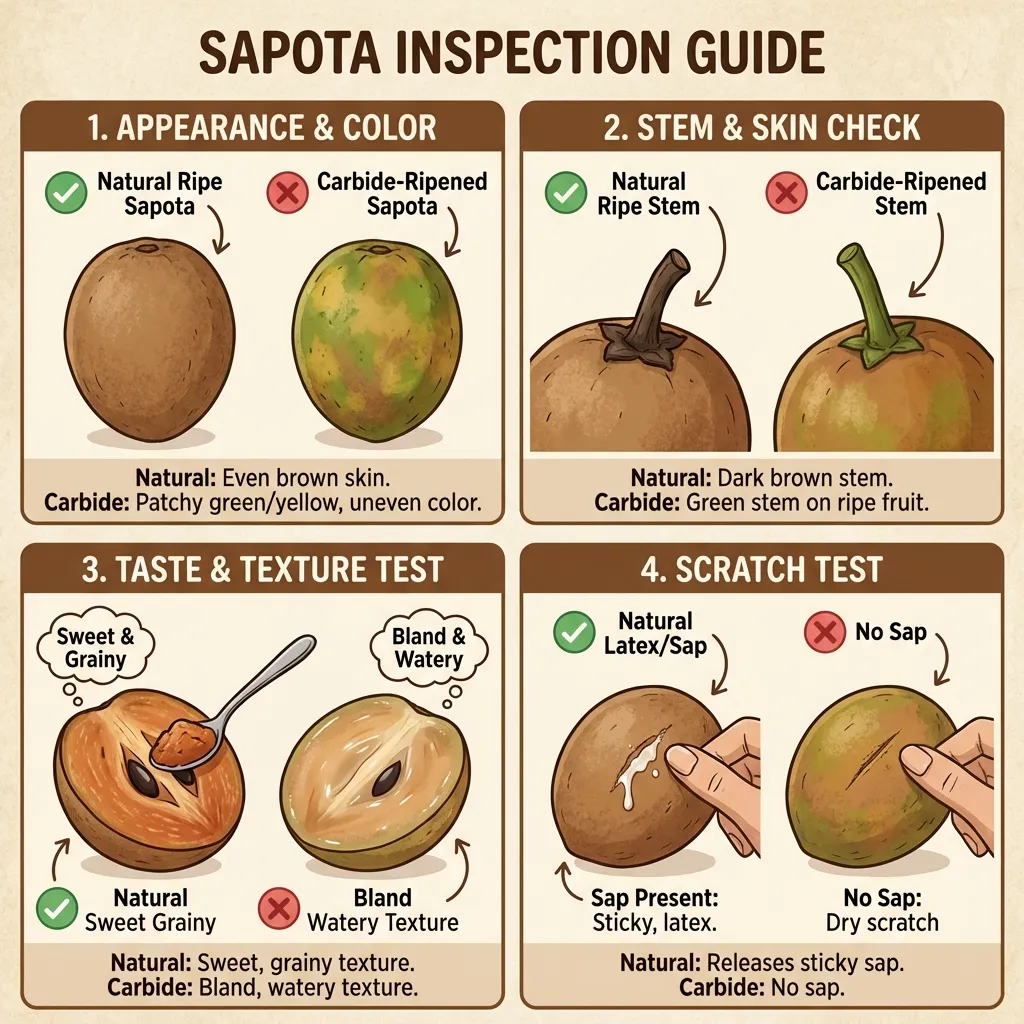
Sapotas are often ripened artificially with Ethephon dips or even injected with sweeteners like Saccharin to make them taste like premium "sweet" varieties.
1. The Skin Texture Check:
Naturally ripened chikoo has a slightly rough, sandy-textured skin and feels uniformly soft when pressed. If the fruit is very soft but the skin is still "stretchy" and looks unnaturally fresh, suspect artificial Ethephon ripening.
2. The Internal Uniformity:
Cut the chikoo in half. A naturally ripened one is brown and grainy throughout. If the outer layers are soft and brown but the core near the seeds is hard or yellowish, it indicates uneven chemical ripening.
3. The Sweetness Profile:
Natural sapota has a complex, malty, and "brown sugar" sweetness. If you experience an intense, "cloying," or metallic sweetness that lingers on your tongue, it likely contains added Saccharin.
4. The Sap Test:
Naturally ripe chikoo has very little "latex" (white sticky sap) when cut. If a very soft chikoo releases a lot of white sticky sap, it indicates it was ripened artificially before its time.
Quick Safety Tips
- Avoid chikoos with an unnaturally cloying or metallic sweetness
- Check for internal uniformity - hard cores in soft fruit are a sign of gas ripening
- Wash the outer skin thoroughly to remove ripening chemical residues
- Select fruits with a natural, sandy skin texture and sweet malty aroma
Primary Chemical Concerns
Health Risks & Impacts
Multilingual Local Names
Common Storage Pests
Sapota Bud Borer
low riskSmall caterpillars that can bore into the fruit during the early stages.
Detection
- Small entry holes near the stem-end
- Internal browning
Prevention
- Inspect each fruit before buying
- Store in a cool, ventilated place
Corrective Action: What to do?
Cut away affected parts; the rest of the fruit is usually safe.
Regulatory Corner: FSSAI (Food Safety and Standards Authority of India) / Codex Alimentarius (Codex Stan 193-1995)
Regulation: Food Safety and Standards (Prohibition and Restrictions on Sales) Regulations 2011, Regulation 2.3.5 & FSS Act Sec 44A
Legal Limit:Calcium carbide (acetylene gas): Completely prohibited (0.0 ppm); Artificial non-nutritive sweeteners (saccharin/cyclamate): Prohibited in fresh fruits (0.0 ppm); Ethephon MRL: Max 2.0 ppm
Report Adulteration to FSSAI (Food Safety and Standards Authority of India) / Codex Alimentarius (Codex Stan 193-1995)