How to Test Jackfruit for Adulteration (Saccharin, Sunset Yellow, Pesticide)
⚡ Quick 60-Second Jackfruit Purity & Colorant Verdict
Sunset Yellow / Metanil Yellow Dyeing & Artificial Sweetening: Pre-cut jackfruit pods (carpels) are frequently dyed with synthetic yellow coal-tar dyes to simulate golden ripeness and drenched in sugar syrup containing saccharin.
Rub a raw jackfruit pod with a damp white cotton ball. Authentic ripe jackfruit has carotenoid pigments bound firmly in the plant cells; a yellow stain on the cotton indicates synthetic surface dye.
Add a few drops of dilute hydrochloric acid (or strong vinegar) to a small piece of pulp. An immediate turn to bright pink or magenta reveals banned industrial Metanil Yellow dye.
Inspect the core and rag fibers. Freshly cut, untreated jackfruit always exhibits sticky white natural latex. Pods that are completely slick, watery, and sticky only with sweet syrup have been chemically washed.
To learn more about food safety tests and home adulteration detection, read our guides on Sapota (Chikoo) and Sweet Lime / Mosambi.
Drop Jackfruit photo here to test purity
or click to browse • Supports JPG, PNG, WEBP • Paste with Ctrl+V
Inspection Guide
Click to enlarge
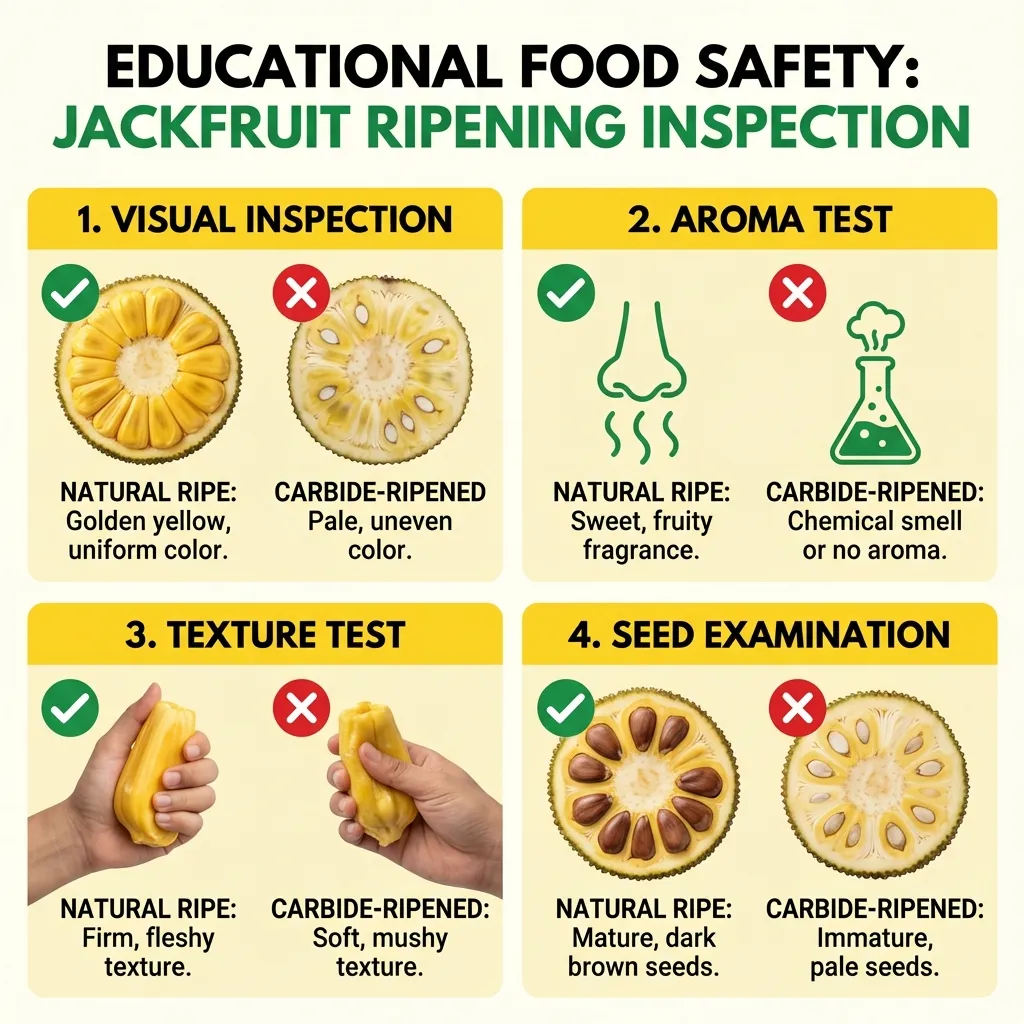
Jackfruit Purity & Sweetener Audit
Jackfruit, especially when sold as pre-cut yellow bulbs, is often treated with yellow dyes (Sunset Yellow) to look more vibrant or injected/soaked in Saccharin solutions to increase sweetness.
1. The Color Rub Test (Sliced Bulbs):
Take a cotton ball soaked in water and rub a yellow jackfruit bulb. If the cotton picks up a bright yellow tint, artificial dyes have been applied to enhance the color of under-ripe fruit.
2. The Sweetness Check (Saccharin):
Taste a piece of the jackfruit bulb. Natural jackfruit has a complex, honey-like sweetness. If you experience an intense, "cloying," or metallic sweetness that lingers on the back of your tongue, it likely contains Saccharin.
3. The Water Solubility:
Drop a small bulb into a glass of warm water. If the water turns bright yellow immediately, suspect artificial dyes. Natural jackfruit color does not leach into water easily.
4. The Aroma Test:
Pure, ripe jackfruit has an extremely powerful, sweet, and characteristic aroma that can fill a room. If the yellow bulbs have no scent or smell slightly like chemicals/laboratory, they have been artificially ripened and colored.
Quick Safety Tips
- Perform the color rub test for Sunset Yellow dye
- Avoid jackfruit with an unnaturally cloying or metallic sweetness
- Select whole jackfruits with a strong, sweet aroma
- Check for natural "latex" (white sticky sap) - its presence often indicates fresh, untreated fruit
Primary Chemical Concerns
Health Risks & Impacts
Multilingual Local Names
Common Storage Pests
Jackfruit Borer
medium riskCaterpillars that tunnel into the fruit and eat the internal pith and bulbs.
Detection
- Small entry holes on the thick skin
- Dark rot patches
Prevention
- Store in a cool, well-ventilated area
- Inspect for skin damage
Corrective Action: What to do?
Cut away the affected parts; the rest of the fruit is usually safe if the damage is localized.
Regulatory Corner: FSSAI (Food Safety and Standards Authority of India) / Codex Alimentarius (Codex Stan 192-1995)
Regulation: Food Safety and Standards (Food Products Standards and Food Additives) Regulations 2011, Clause 2.3.1
Legal Limit:Metanil Yellow & non-permitted coal-tar dyes: Zero tolerance (0.0 ppm); Artificial non-nutritive sweeteners: Prohibited on raw fruit (0.0 ppm); Lead: Max 0.1 ppm; Formaldehyde preservative: 0.0 ppm
Report Adulteration to FSSAI (Food Safety and Standards Authority of India) / Codex Alimentarius (Codex Stan 192-1995)