How to Test Mushrooms for Adulteration (Formaldehyde, Heavy Metals, Pesticide)
⚡ Quick 60-Second Mushroom Bleaching & Freshness Verdict
Sulfur Dioxide (SO2) Bleaching & Heavy Bacterial Slime: Old or discolored white button mushrooms are washed in sodium metabisulfite or sulfuric acid solutions to restore pristine cosmetic whiteness.
Hold a fresh mushroom to your nose and inhale. Pure fresh mushrooms have a distinct, clean, woodland-earthy aroma. A sharp, chemical, acidic sulfur odor indicates preservative acid washing.
Touch the cap with dry fingers. Fresh mushrooms have dry, firm, velvety skin. If the surface feels slippery, sticky, or slimy, bacterial breakdown (Pseudomonas tolaasii) has begun—discard.
Look under the cap. In fresh young button mushrooms, the gills are sealed tightly by a clean white membrane (veil). If the veil is broken exposing black/dark brown gills, the mushroom is stale.
To learn more about food safety tests and home adulteration detection, read our guides on Colocasia and Carrots.
Drop Mushrooms photo here to test purity
or click to browse • Supports JPG, PNG, WEBP • Paste with Ctrl+V
Inspection Guide
Click to enlarge
Mushrooms Purity & Chemical Audit
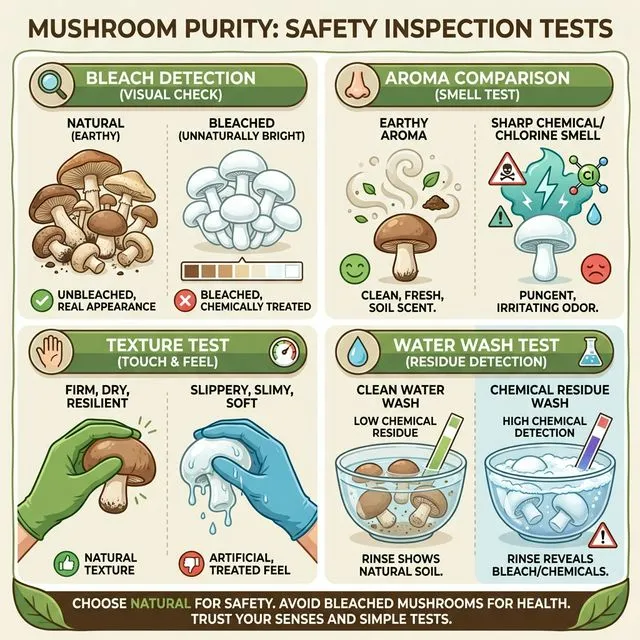
Mushrooms are highly absorbent and perishable, making them targets for Formaldehyde (to keep them firm) or Chlorine bleach (to make them look white).
1. The Smell Test (Formaldehyde):
Natural mushrooms have an earthy, woodsy, or slightly savory smell. If they have a sharp, "stinging," or medicinal odor similar to a laboratory or new paint, suspect Formaldehyde treatment.
2. The Texture/Touch Test:
Fresh mushrooms should be slightly firm but give a little under pressure. If they feel unnaturally "rubbery" or stay perfectly firm even when they look old, they may be chemically preserved.
3. The Color Clarity (Bleach Check):
While button mushrooms are white, they naturally develop brown spots or a slight creamy tint over time. If a pack of mushrooms looks "bleached white" or "neon white" with zero natural imperfections, suspect a chlorine or sulfite wash.
4. The Squeeze Test:
Gently squeeze a mushroom. If it releases a lot of water or feels "slimy" while the surface is white, it may be old stock treated with preservatives to look fresh.
Quick Safety Tips
- Avoid mushrooms with a sharp, medicinal odor
- Select mushrooms with some natural brown spots - "perfect" white is suspicus
- Check for a rubbery texture that feels artificial
- Always wash thoroughly but quickly - mushrooms absorb water like sponges
Primary Chemical Concerns
Health Risks & Impacts
Multilingual Local Names
Common Storage Pests
Mushroom Flies (Sciaridae)
medium riskTiny flies whose larvae feed on the mushroom tissue.
Detection
- Small black flies around the mushrooms
- Tiny tunnels or larvae in the stem
Prevention
- Keep mushrooms in a paper bag (not plastic)
- Store in the refrigerator immediately
Corrective Action: What to do?
Discard if tunnels or larvae are visible; minor infestations can be cut away.
Regulatory Corner: FSSAI (Food Safety and Standards Authority of India) / US FDA
Regulation: Food Safety and Standards (Food Products Standards) Regulations 2011, Clause 2.3.26: Edible Mushrooms & FDA CPG Sec. 585.575
Legal Limit:Sulfur dioxide residue (SO2): Max 50 ppm (in fresh mushrooms); Decomposed / insect-infested mushrooms: Max 5.0%; Toxic amatoxins / phallotoxins: 0.0% (Zero tolerance)
Report Adulteration to FSSAI (Food Safety and Standards Authority of India) / US FDA