How to Test Carrots for Adulteration (Rhodamine B, Pesticide, Chlorine Wash)
⚡ Quick 60-Second Carrot Dye & Freshness Verdict
Rhodamine B Dye & Chemical Freshening: Pale or old carrots are soaked in Rhodamine B dye (a toxic, non-food industrial red/pink dye) to mimic fresh winter red Delhi carrots.
Moisten a cotton swab with clean water and rub across the outer carrot skin. If the cotton turns vivid fluorescent pink or bright red, Rhodamine B dye is present.
Cut a carrot slice and soak in a glass of warm water. Pure carrots release zero surface color. Artificially dyed carrots leach red dye into the water within minutes.
Slice crosswise. In naturally grown carrots, the inner core and outer cortex have a harmonious natural gradient. Artificially dyed carrots have neon outer rings with dull pale inner cores.
To learn more about food safety tests and home adulteration detection, read our guides on Mushrooms and Drumstick (Moringa Pod), and read our field guide on dangerous vegetable look-alikes.
Drop Carrots photo here to test purity
or click to browse • Supports JPG, PNG, WEBP • Paste with Ctrl+V
Inspection Guide
Click to enlarge
Carrot Purity & Dye Audit
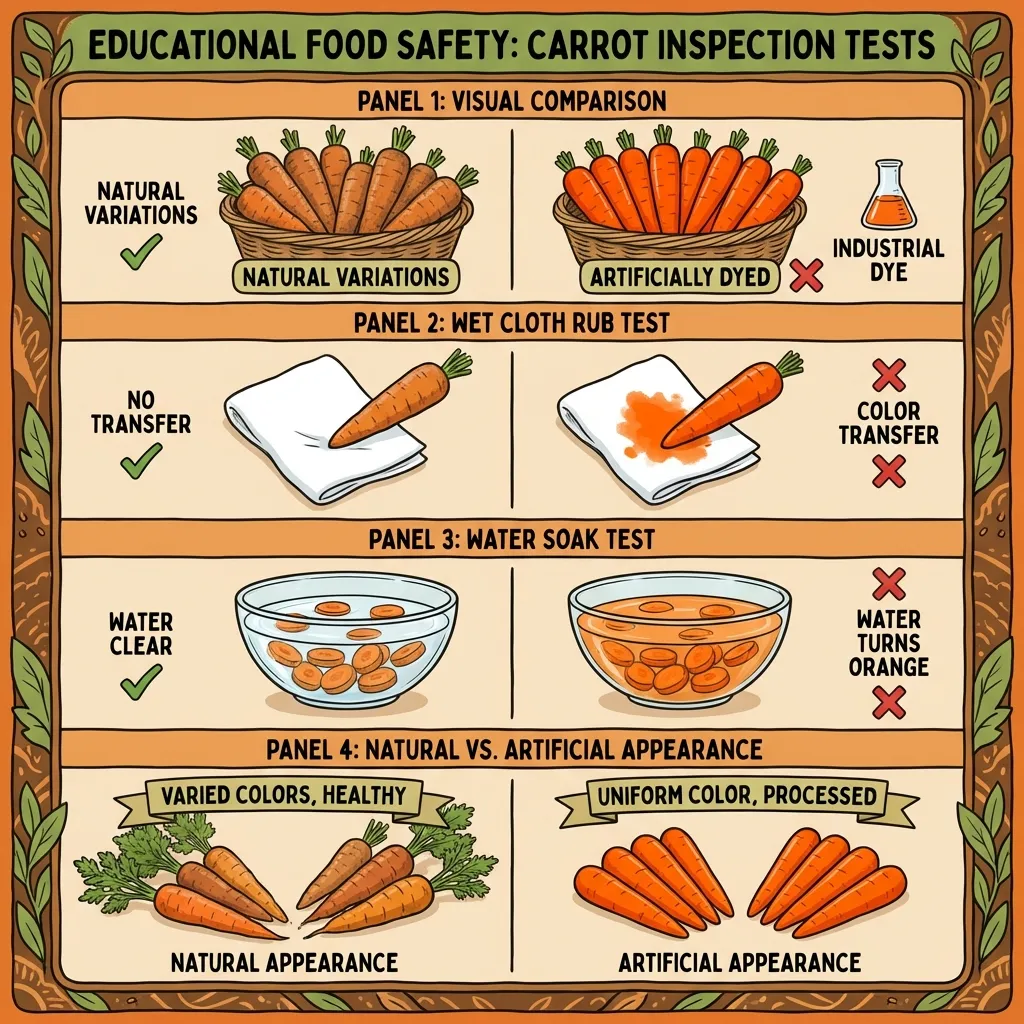
Carrots, especially the deep red varieties (Delhi Carrots), are often treated with Rhodamine B dye to enhance their color. Some "baby carrots" or pre-peeled varieties may be treated with chlorine bleach to maintain their bright orange color.
1. The Cotton Rub Test:
Take a cotton ball soaked in water or liquid paraffin and rub the outer skin of the carrot. If the cotton turns bright pink or orange, artificial dye has been used. Natural carrot color (Beta-carotene) does not rub off easily.
2. The Water Soak:
Soak sliced carrots in a glass of cold water for 15 minutes. If the water turns bright pink or orange immediately, suspect artificial coloring. Natural carrot color leaches very slowly and turns the water a faint, pale yellow-orange.
3. The Surface Shine (Bleach Check):
Examine the carrot for a "whitish" or "chalky" film on the surface. While some natural drying causes this, an unnaturally uniform white layer on pre-cut carrots often indicates a chlorine or sulfite wash used for preservation.
4. The Snapping Test:
Snap a carrot in half. It should be crisp and have a distinct sweet aroma. If it feels "rubbery" or has a chemical, laboratory-like smell, it may be over-preserved with chemicals.
Quick Safety Tips
- Perform the cotton rub test on red carrots for Rhodamine B
- Avoid carrots with a chalky white film (indicates chlorine wash)
- Select carrots with some soil residue - "too clean" can be suspicious
- Always peel carrots deeply to remove surface chemical residues
Primary Chemical Concerns
Health Risks & Impacts
Multilingual Local Names
Common Storage Pests
Carrot Rust Fly
medium riskSmall flies whose larvae tunnel into the lower part of the carrot root.
Detection
- Dark, rusty-looking tunnels on the surface
- Internal brown tracks when cut
Prevention
- Store in a cool, ventilated crisper drawer
- Remove the green tops before storage
Corrective Action: What to do?
Cut away affected parts; discard if tunnels are extensive.
Regulatory Corner: FSSAI (Food Safety and Standards Authority of India) / Codex Alimentarius (CXS 312-2013)
Regulation: Food Safety and Standards (Contaminants, Toxins and Residues) Regulations 2011, Schedule 2: Root & Tuber Vegetables
Legal Limit:Artificial red dyes (Rhodamine B, Sudan I): 0.0% (Strict zero tolerance); Cadmium: Max 0.1 ppm; Lead: Max 0.1 ppm; Chlorpyrifos: Max 0.1 ppm; Nitrates: Max 400 mg/kg
Report Adulteration to FSSAI (Food Safety and Standards Authority of India) / Codex Alimentarius (CXS 312-2013)