How to Test Poha for Adulteration (Metanil Yellow, Lead, Stone Dust)
⚡ Quick 60-Second Poha Purity & Chemical Bleach Verdict
Industrial Bleaching Powder & Urea Whitening: Coarse brown paddy rice is often processed using synthetic bleaching agents, urea, or optical brighteners to produce unnaturally white, crisp flattened rice flakes.
Soak 2 tbsp poha in 50ml clean water for 2 minutes and stir gently. Pure poha softens cleanly without turning water milky. Rapid milky white cloudiness with chemical smell indicates chalk or bleaching powder residues.
Place a small pinch on a white plate and add 1 drop dilute iodine. Uniform deep blue reaction is natural starch; immediate bubbling or effervescence indicates added calcium carbonate (chalk).
Crush a handful of dry poha in your palm. Authentic poha is brittle with a delicate sweet rice aroma. A pungent chlorine, chemical, or fertilizer-like odor reveals chemical treatment.
To learn more about food safety tests and home adulteration detection, read our guides on Ragi (Finger Millet) and Groundnut Oil (Peanut Oil).
Drop Poha (Flattened Rice) photo here to test purity
or click to browse • Supports JPG, PNG, WEBP • Paste with Ctrl+V
Inspection Guide
Click to enlarge
Poha Purity & Dye Audit
Poha (flattened rice) is sometimes treated with Metanil Yellow (toxic dye) to look more "golden" and premium, or may contain lead residues from older industrial rollers.
1. The Hydrochloric Acid Test (Dye Detection):
In a test tube, take a small amount of Poha and add a little water. Add a few drops of concentrated HCl. If the solution turns pink or magenta, Metanil Yellow is present. Pure Poha remains unchanged.
2. The Water Wash (Color Bleed):
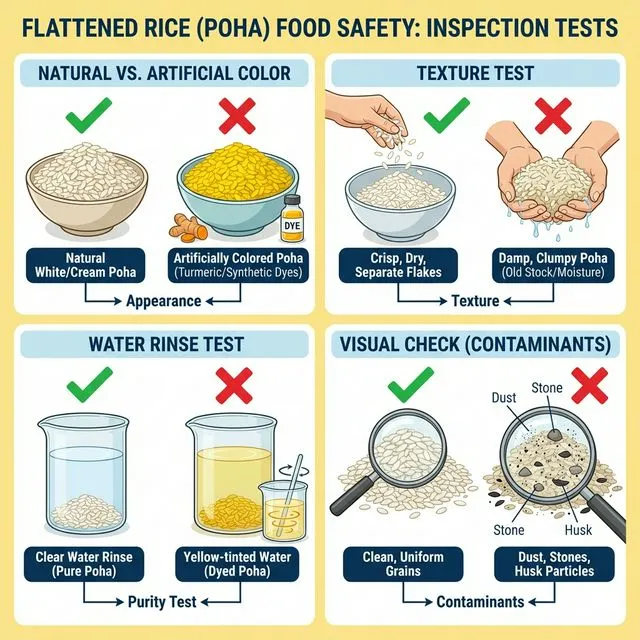
Soak a handful of Poha in warm water for 5 minutes. If the water turns bright yellow immediately, suspect artificial coloring. Natural Poha remains white or pale cream even after soaking.
3. The Texture and Brittleness:
Naturally fresh Poha is slightly flexible and should not crumble into fine powder when pressed. If it feels extremely "stiff" or "brittle" and has a sharp chemical smell, it has likely been over-processed or chemically treated for shelf life.
4. The Grit Check:
Rinse Poha in a large bowl of water and let it settle for 30 seconds. Carefully lift the Poha. If a layer of sand, grit, or stone dust remains at the bottom, it indicates poor cleaning during the flattening process.
Quick Safety Tips
- Perform the HCl test for Metanil Yellow - pink color is a red flag
- Avoid Poha that looks unnaturally "golden" or yellow
- Wash at least 2-3 times to remove surface dust and potential lead residues
- Select "Thick" (Jada) Poha for better nutritional retention during cooking
Primary Chemical Concerns
Health Risks & Impacts
Multilingual Local Names
Common Storage Pests
Grain Mite
low riskTiny pests that can infest stored flattened rice if kept in humid conditions.
Detection
- Fine dust at the bottom of the container
- Musty odor
Prevention
- Store in an airtight container
- Keep in a dry, cool pantry
Corrective Action: What to do?
Discard infested Poha; the musty smell indicates fungal growth as well.
Regulatory Corner: FSSAI (Food Safety and Standards Authority of India) / BIS (IS 4367)
Regulation: Food Safety and Standards (Food Products Standards) Regulations 2011, Clause 2.4.6: Flattened Rice (Chira / Poha)
Legal Limit:Moisture: Max 13.0% by weight; Total ash: Max 2.0%; Acid insoluble ash: Max 0.2%; Chemical bleaching agents (Urea, Calcium hypochlorite): 0.0% (Strictly prohibited); Uric acid: Max 100 mg/kg
Report Adulteration to FSSAI (Food Safety and Standards Authority of India) / BIS (IS 4367)