Coffee Powder Adulteration: Detect Chicory, Date Seeds & Tamarind Fillers
⚡ Quick 60-Second Coffee Powder Purity Verdict
Bulking & Chicory Adulteration: Ground coffee and instant coffee powder are regularly bulked with roasted chicory root, roasted date/tamarind seed powder, and exhausted (used) coffee grounds re-dyed with caramel color.
Gently sprinkle 1/2 tsp coffee powder on a glass of cold water without stirring. Pure ground coffee floats on the surface for minutes. Chicory, clay, or seed powder sinks to the bottom within 15 seconds.
Watch the water surface. Pure coffee releases zero color initially. Chicory contains high water-soluble caramel and immediately bleeds a distinct brownish-red trail down into the water.
Rub a pinch of powder between wet fingertips. Pure coffee feels hard, gritty, and non-slimy. Chicory feels gummy and soft due to absorbed moisture.
Drop Coffee Powder photo here to test purity
or click to browse • Supports JPG, PNG, WEBP • Paste with Ctrl+V
Inspection Guide

Click to enlarge
Coffee Purity & Chicory Audit
Coffee powder is frequently adulterated with chicory to increase volume or with roasted date/tamarind seed powder to mimic its texture and color.
1. The Cold Water Float Test (Chicory Detection):
Sprinkle a spoonful of coffee powder on the surface of a glass of cold water without stirring. Pure coffee particles contain hydrophobic natural oils and will float on the surface for a long time leaving the water crystal clear. Chicory and seed particles absorb water instantly, sink to the bottom within 10–15 seconds, and leave a dense trail of reddish-brown color streaming downward.
2. The Iodine Starch Test (Tamarind Seed & Cereal Fillers):
Boil a spoonful of coffee powder in 50 ml of water for 3 minutes, then cool completely. Add 3 to 4 drops of tincture of iodine. Pure coffee contains zero starch and will remain brownish. If the liquid turns dark blue, purple, or black, adulteration with starch-rich tamarind seeds or cereal grains (roasted corn/barley) is confirmed.
3. The Wet Blotting Paper Test (Caramel Dye Check):
Sprinkle a little coffee powder on a wet piece of white blotting paper or filter paper. Pure coffee does not release color in cold water. If reddish-brown spots appear quickly spreading on the paper, suspect the presence of artificial caramel dye or re-dyed used coffee grounds.
4. The Texture and Aroma Examination:
Rub a pinch of powder between wet fingertips. Pure coffee feels hard, sharp, gritty, and non-slimy. Adulterants like chicory or caramel dissolve into a gummy, sticky paste. In addition, pure coffee has a rich, roasted, lively fragrance; fillers smell like burnt wood, dry earth, or straw.
Click to enlarge
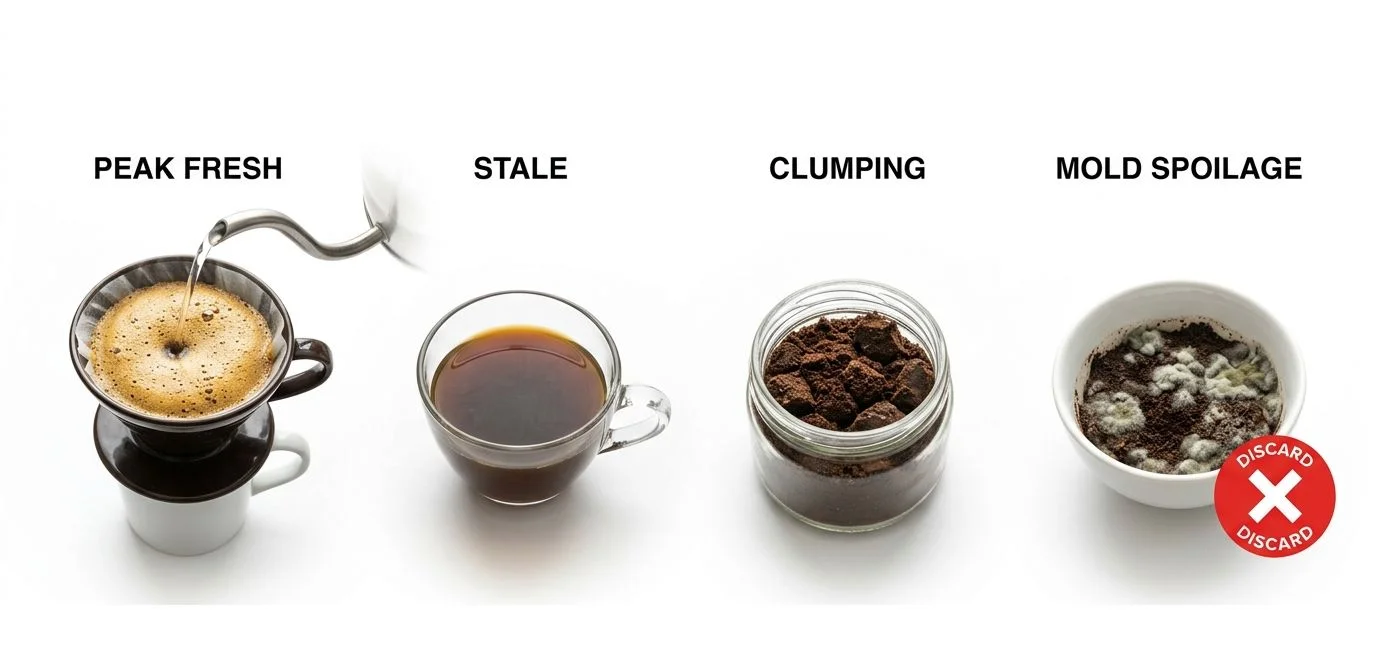
4 Stages of Ground Coffee Freshness & Degassing
Ground coffee is extraordinarily reactive to atmospheric oxygen and humidity. Freshness governs both exquisite sensory aromatics and safety against fungal contamination.
4 Stages of Freshness:
✅ Peak Freshness & Active Bloom: Freshly roasted and ground coffee retains abundant natural CO₂ gas and volatile aromatic oils. Pouring hot water (92–96°C) triggers vigorous foaming expansion (Blooming) with thick golden crema and room-filling aroma.
⚠️ Stale & Degassed Coffee: After 3–4 weeks in an opened package, trapped gases escape and delicate lipids oxidize. When brewed, no foam appears, producing a flat, dull, papery, or bitter cup.
⚠️ Moisture Clumping: Coffee powder is strongly hygroscopic. If stored in an unsealed jar, it absorbs room humidity, fusing into hard, sticky lumps that prevent uniform extraction.
❌ Mold & Ochratoxin Contamination (Spoiled): Storing under humid conditions encourages toxigenic mold growth (Aspergillus ochraceus / A. carbonarius). Spoilage produces a musty basement odor and pale gray-green fungal mycelium. It releases nephrotoxic Ochratoxin A (OTA). Discard immediately.
Storage Tip: Store ground coffee in an airtight, opaque container in a cool, dark pantry. Avoid frequent freezer opening to prevent internal moisture condensation.
Quick Safety Tips
- Perform the water float test - chicory sinks and leaves a color trail
- Avoid coffee with an earthy, woody, or stale cardboard smell
- Prefer buying whole roasted coffee beans and grinding them freshly
- Check for explicit coffee-to-chicory ratio on the label (e.g. 80:20 or 100% Pure)
Primary Chemical Concerns
Health Risks & Impacts
Multilingual Local Names
Common Storage Pests
Coffee Berry Borer (Hypothenemus hampei)
medium riskA tiny beetle that bores into coffee cherries and beans, carving out internal chambers and reducing the bean to frass.
Detection
- Tiny pinhead holes in roasted whole beans
- Dark powder around drill holes
Prevention
- Purchase high-grade sorted coffee beans
- Store in airtight packaging
Corrective Action: What to do?
Discard beans showing insect bores before home grinding.
Toxigenic Mold (Aspergillus ochraceus / carbonarius)
high riskFilamentous fungi that proliferate on coffee stored at moisture levels above 12%, producing hazardous Ochratoxin A.
Detection
- Musty, damp basement odor
- Pale grayish-white or greenish mold patches on the powder
Prevention
- Store in airtight dry containers
- Never use wet spoons in the coffee jar
Corrective Action: What to do?
Discard moldy coffee powder immediately; mycotoxins are not destroyed by boiling water.
Regulatory Corner: FSSAI (Food Safety and Standards Authority of India) / BIS (IS 2791)
Regulation: Food Safety and Standards (Food Products Standards) Regulations 2011, Clause 2.10.2: Pure Coffee & Coffee-Chicory Mixtures
Legal Limit:Pure Ground Coffee: Caffeine min 1.0% on dry basis, chicory 0.0%; Coffee-Chicory Blend: Coffee min 51.0% (mandatory prominent label declaration), chicory max 49.0%; Roasted date/tamarind seeds: 0.0% (Strict zero tolerance); Ochratoxin A: max 5.0 µg/kg
Report Adulteration to FSSAI (Food Safety and Standards Authority of India) / BIS (IS 2791)