How to Test Brussel Sprouts for Adulteration (Malachite Green, Pesticide, Chlorine Wash)
⚡ Quick 60-Second Brussel Sprouts Purity & Chemical Verdict
Copper Sulfate Greening & Systemic Pesticide Residues: Wilted or yellowing brussel sprouts are revived with copper sulfate solutions or chlorine bleach washes, and carry heavy organophosphate pesticide loads.
Soak 3 loose outer leaves in warm water with 3 drops of vinegar for 10 minutes. If the water takes on a distinct bluish-green or turquoise tint, artificial copper sulfate or chemical dyes have been used.
Slice a sprout in half through the stem base. Fresh high-quality sprouts have tightly compacted, pale-green leaves without black fungal spotting, yellow decay rings, or hidden aphid colonies.
Sniff the cut stem base. Fresh sprouts smell clean, nutty, and mildly pungent. A chemical pool-water or chlorine bleach scent indicates commercial wash solutions used to suppress microbial slime.
To learn more about food safety tests and home adulteration detection, read our guides on Turnip (Shalgam) and Bottle Gourd (Lauki).
Drop Brussel Sprouts photo here to test purity
or click to browse • Supports JPG, PNG, WEBP • Paste with Ctrl+V
Inspection Guide
Click to enlarge
Brussel Sprouts Purity & Pesticide Audit
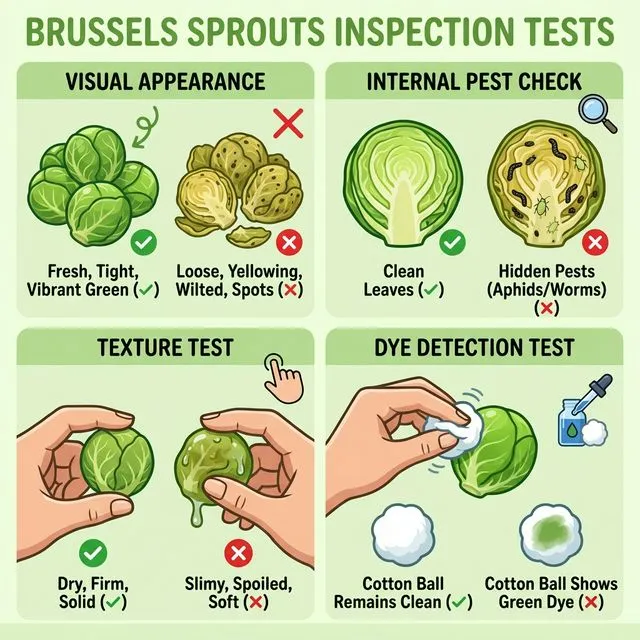
Brussel sprouts are often treated with Malachite Green to look fresh and vibrant, masking the natural yellowing of old outer leaves.
1. The Cotton Rub Test:
Rub a wet cotton ball on the green outer leaves of the brussel sprout. If the cotton picks up a green or bluish-green color, artificial dye like Malachite Green has been applied.
2. The Leaf Pull Check:
Gently peel back one of the outer leaves. A naturally fresh sprout should be green on the outside and slightly lighter green inside. If the outer leaves are bright green but the next layer is significantly yellow or brown, it indicates the exterior was dyed.
3. The Stem End Inspection:
Examine the cut end of the sprout. A fresh sprout has a white or creamy-white, moist cut end. If the cut end is dark brown, dry, or shriveled despite bright green leaves, it is old stock chemically refreshed.
4. The Water Soak (Color Bleed):
Soak brussel sprouts in warm water for 15 minutes. If the water turns green, artificial coloring is confirmed. Natural chlorophyll does not leach easily into warm water.
Quick Safety Tips
- Perform the cotton rub test for Malachite Green detection
- Avoid sprouts that look "too vibrant" or neon green
- Soak in salt water and vinegar for 20 minutes to reduce pesticide residues
- Always trim the stem end and remove the outermost layer of leaves before cooking
Primary Chemical Concerns
Health Risks & Impacts
Multilingual Local Names
Common Storage Pests
Cabbage Aphids
low riskSmall grey-green insects that cluster on the leaves and can be hidden between layers.
Detection
- Small clusters of insects or sticky residue between leaves
Prevention
- Store in a cool, ventilated crisper drawer
- Keep dry
Corrective Action: What to do?
Thoroughly wash each sprout under running water; remove and discard heavily infested outer leaves.
Regulatory Corner: US FDA (21 CFR 173.315 - Washing Chemicals) / Codex Alimentarius (Codex Stan 193-1995)
Regulation: FDA 21 CFR 173.315 (Chemicals used in washing fruits and vegetables) & Codex MRL Standards
Legal Limit:Copper sulfate / synthetic dyes: Prohibited (0.0 ppm); Imidacloprid pesticide MRL: Max 0.5 ppm; Chlorpyrifos MRL: Max 0.01 ppm; Lead MRL: Max 0.1 ppm; Cadmium: Max 0.05 ppm
Report Adulteration to US FDA (21 CFR 173.315 - Washing Chemicals) / Codex Alimentarius (Codex Stan 193-1995)