Pruebas de Pureza de la Berenjena: Detecta colorantes y pesticidas
Detectan colorantes artificiales y residuos de pesticidas en Brinjal
Para obtener más información sobre las pruebas de seguridad alimentaria y la detección de adulteración en el hogar, lea nuestras guías sobre Okra (Ladyfinger) y Onion.
Drop Brinjal (berenjena) photo here to test purity
or click to browse • Supports JPG, PNG, WEBP • Paste with Ctrl+V
Inspection Guide
Click to enlarge
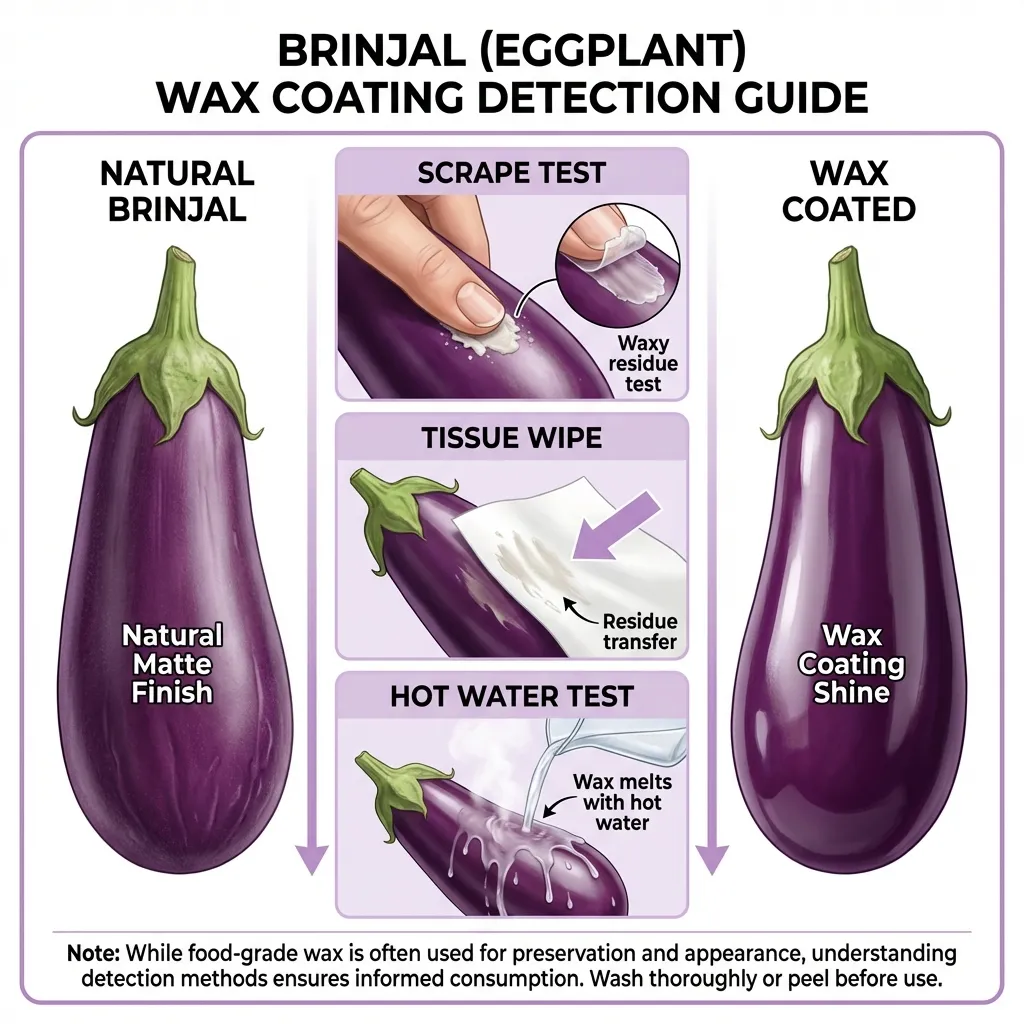
Auditoría de pureza y pesticidas de berenjena (berenjena)
Las berenjenas a menudo se tratan con tintes artificiales para realzar su color púrpura o se rocían intensamente con pesticidas para prevenir la infestación por el barrenador de la fruta.
1. La prueba de frotación con algodón (prueba de tinte):
Remoja un algodón en agua o parafina líquida y frota la piel morada de la berenjena. Si el algodón adquiere un tinte violeta o rosado, se ha aplicado tinte artificial. El color natural de la berenjena no se borra.
2. El color y la textura del tallo:
Examina el tallo (cáliz). Una berenjena naturalmente fresca tiene un tallo verde vibrante y ligeramente espinoso. Si el cuerpo de la berenjena se ve perfectamente morado pero el tallo es de color marrón oscuro, está marchito o se siente "viscoso", es probable que haya sido conservado o teñido químicamente.
3. El control de carne interno:
Corta la berenjena por la mitad. La pulpa debe ser de color blanco cremoso con semillas pequeñas y tiernas. Si ve "huellas" de color marrón oscuro en el interior, indica una infestación del barrenador de la fruta. Si la carne se ve anormalmente blanca o "blanqueada", sospeche de un lavado con sulfito o cloro.
4. El remojo en agua (verificación química):
Remojar la berenjena en rodajas en agua con sal durante 15 minutos. Si el agua se vuelve de color púrpura intenso o marrón inmediatamente, sospeche de colorantes artificiales o de una alta carga química. (Nota: un ligero dorado es oxidación natural).
Quick Safety Tips
- Realice la prueba de frotación con algodón para detectar tinte morado.
- Verifique si hay huellas de barrenadores internos antes de cocinar.
- Seleccione berenjenas con un tallo verde vibrante y piel brillante.
- Remojar en agua salada para reducir tanto el amargor como los pesticidas superficiales.
Primary Chemical Concerns
Health Risks & Impacts
Multilingual Local Names
Common Storage Pests
Brinjal Fruit and Shoot Borer
high riskThe most destructive pest of eggplant.
Detection
- Small entry holes on the skin
- Brown internal tunnels and larvae
Prevention
- Inspect each fruit carefully before buying
- Store in a cool, well-ventilated place
Corrective Action: What to do?
Cut away and discard infested parts; ensure the remaining flesh is clean.
Ash Weevil (Myllocerus subfasciatus)
medium riskSmall grey snout beetles that chew scalloped leaf margins and shelter under the green fruit calyx caps in harvest crates.
Detection
- Adult ash-grey weevils hiding beneath the green calyx cap
- Small feeding wounds and surface rot on the fruit shoulder
Prevention
- Inspect and wipe calyx caps before storing in mesh crates
- Store produce in cool, well-ventilated areas (10°C to 12°C)
Corrective Action: What to do?
Remove and discard calyx; trim any surface feeding marks before cooking.
Regulatory Corner: FSSAI (Food Safety and Standards Authority of India) / Codex Alimentarius
Regulation: Food Safety and Standards (Contaminants, Toxins and Residues) Regulations 2011, Schedule 2: Solanaceous Vegetables
Legal Limit:Cypermethrin pesticide residue: Max 0.2 ppm; Chlorpyrifos: Max 0.05 ppm; Petroleum gloss paraffin wax: 0.0%; Internal insect-damaged fruit: Max 2.0%
Report Adulteration to FSSAI (Food Safety and Standards Authority of India) / Codex Alimentarius