
Guia de Segurança de Frutas Vermelhas: Detectar Pesticidas e Corantes
As frutas vermelhas (incluindo framboesas, amoras, morangos e mirtilos) são famosas por seus ricos perfis nutricionais, mas sua casca fina e porosa as torna altamente vulneráveis à absorção de pesticidas, tratamentos com corantes químicos e rápida infestação de fungos. Este guia fornece testes gerais para verificar a pureza e a qualidade de frutos silvestres ou mistos.
Para testes de segurança específicos de culturas e guias detalhados, leia nossos artigos dedicados sobre Morangos, Mirtilos e Erva-Moura (Manathakkali).
Drop Bagas Mistas photo here to test purity
or click to browse • Supports JPG, PNG, WEBP • Paste with Ctrl+V
Inspection Guide
Click to enlarge
Auditoria de Pureza e Qualidade de Bagas Mistas
As bagas são altamente perecíveis, o que as torna os principais alvos de tratamentos com corantes artificiais para simular a maturação e lavagens com fungicidas para evitar o apodrecimento durante o transporte. Use estes testes simples para verificar sua qualidade.
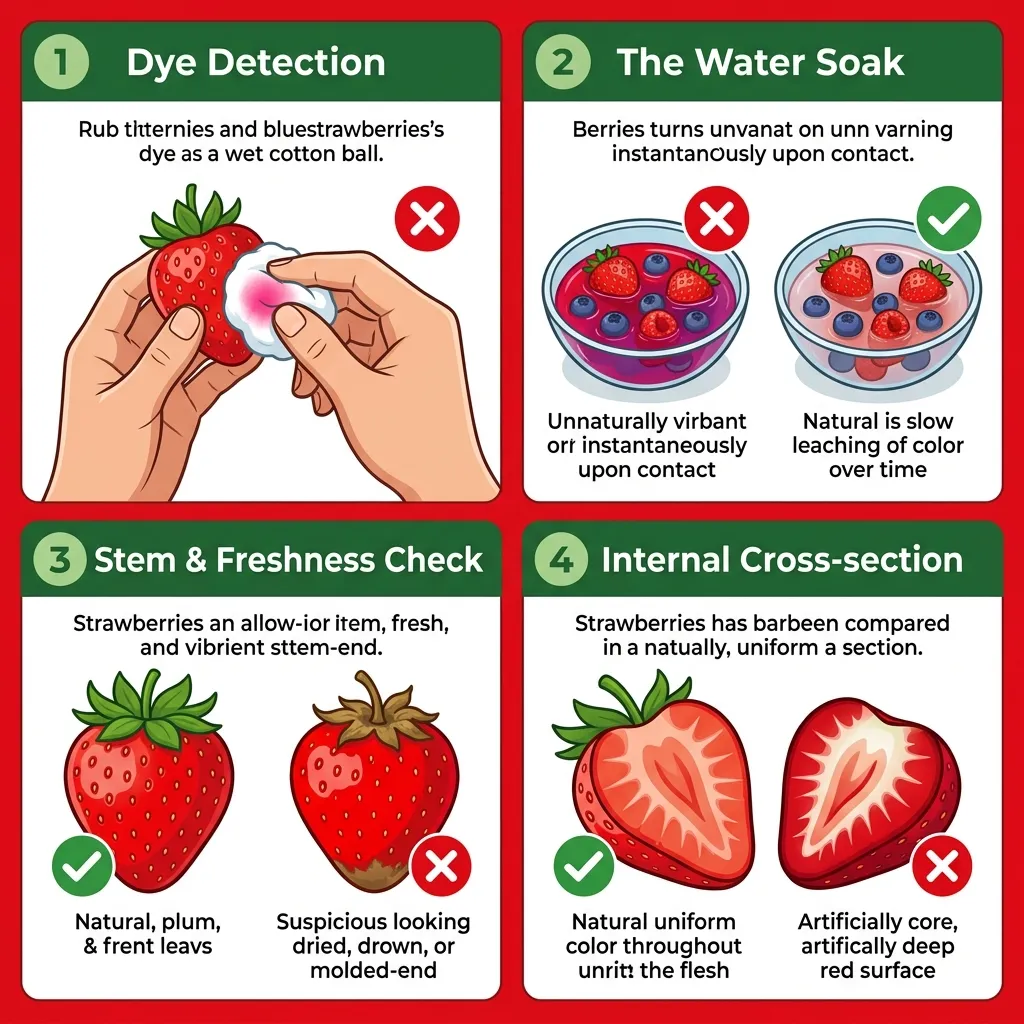
1. O teste de esfregar algodão (detecção de corante):
Esfregue suavemente uma bola de algodão branco seco ou uma toalha de papel na superfície da casca da fruta. ✅ Bagas naturais têm pigmentos presos nas células da pele e não sangram a menos que sejam esmagadas. ❌ Uma mancha rosa brilhante, vermelha ou azul deixada no algodão devido à fricção leve indica tratamentos de tintura cosmética pulverizados na fruta.
2. O teste de imersão em água (sangramento de cor):
Coloque um punhado de frutas vermelhas em um copo de água morna e deixe descansar por 10 minutos. ✅ Os pigmentos naturais de antocianina lixiviam muito lentamente. ❌ Água que fica vermelha, rosa ou azul vibrante indica imediatamente coloração artificial.
3. Verificação de haste e penugem (detecção de mofo):
Observe atentamente a área ao redor do caule e o fundo do recipiente. ✅ Bagas frescas e limpas são secas e firmes. ❌ Quaisquer manchas finas brancas, cinza ou azuis indicam Botrytis (mofo cinza). Como os esporos de mofo se espalham rapidamente pela polpa macia da fruta, se uma fruta estiver mofada, inspecione cuidadosamente as que estão ao redor e descarte qualquer uma que tenha contato direto.
4. A verificação de aroma e textura:
✅ Bagas frescas têm aroma doce, floral e natural. ❌ Um odor químico semelhante ao de laboratório ou uma completa falta de perfume sugerem tratamentos pesados com conservantes. Descarte frutas moles, vazando ou fermentando.
Quick Safety Tips
- Realize o teste de toalha de papel ou algodão para detectar corantes alimentares cosméticos
- Nunca consuma frutas com mofo difuso visível - as micotoxinas se espalham rapidamente na polpa macia
- Escolha frutos silvestres firmes com aroma forte, natural e doce
- Mergulhe as frutas em uma solução de vinagre e água (1 parte de vinagre para 3 partes de água) por 5 minutos e depois enxágue para remover resíduos superficiais e esporos
Primary Chemical Concerns
Health Risks & Impacts
Multilingual Local Names
Common Storage Pests
Fruit Flies (Drosophila)
low riskSmall flies attracted to the high sugar content of ripening berries.
Detection
- Small hovering insects around the package
- Soft, leaking fruit
Prevention
- Refrigerate immediately
- Wash and dry before storing
Corrective Action: What to do?
Discard leaking or moldy fruit; wash the remaining berries in vinegar-water.
Regulatory Corner: US FDA (21 CFR 172.510 / Compliance Policy Guides Sec. 570.425) / FSSAI (Food Products Standards) Reg. 2.3.1
Regulation: FDA Compliance Policy Guides Sec. 570.425 (Berries) & FSSAI (Food Products Standards) Regulations 2011
Legal Limit:Synthetic artificial colorants: Prohibited on raw whole berries (0.0 ppm); Patulin mycotoxin: Max 50 ppb; Boscalid fungicide MRL: Max 5.0 ppm; Fludioxonil MRL: Max 3.0 ppm
Report Adulteration to US FDA (21 CFR 172.510 / Compliance Policy Guides Sec. 570.425) / FSSAI (Food Products Standards) Reg. 2.3.1