
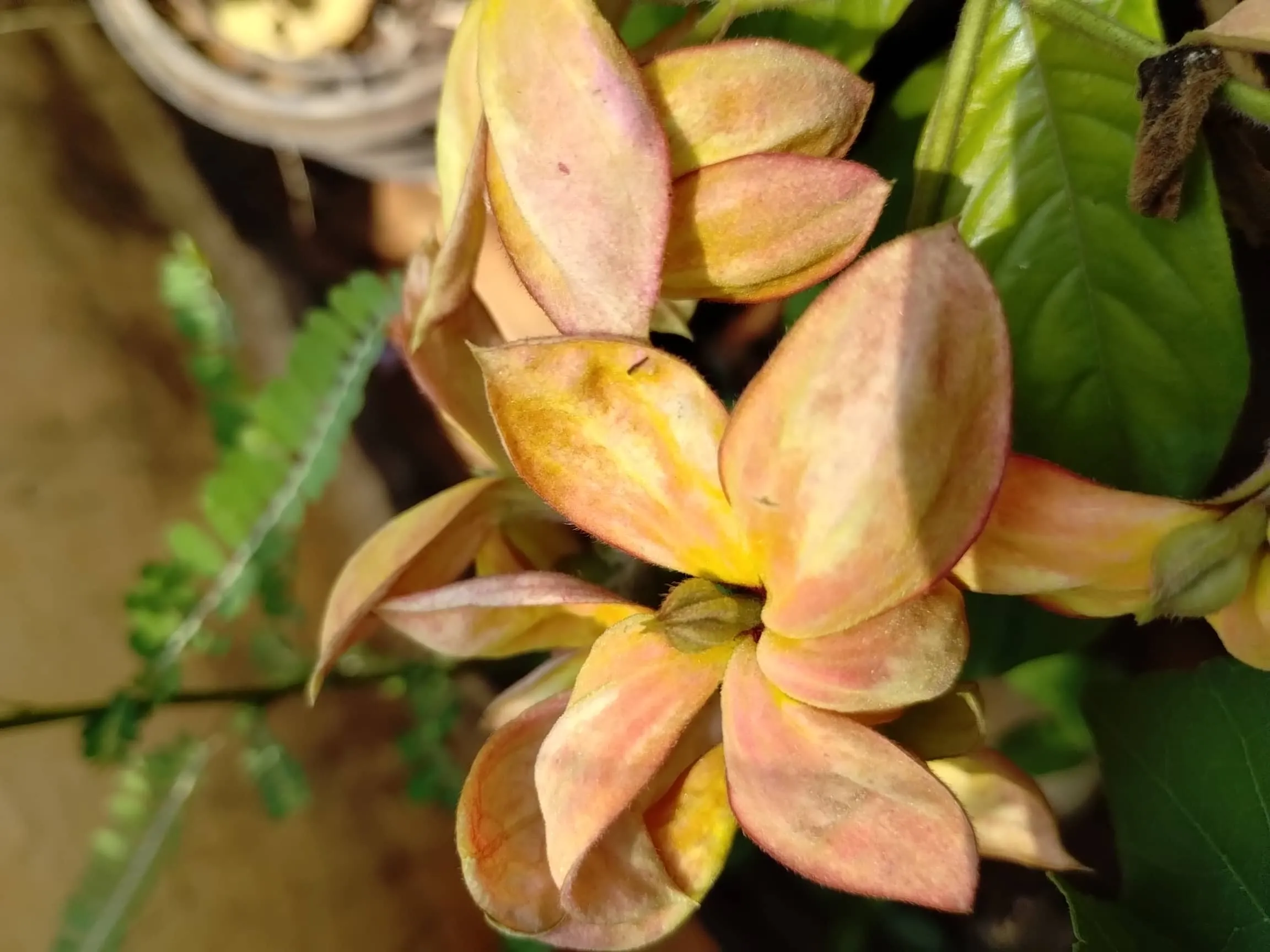
Mussaenda
Mussaenda erythrophylla
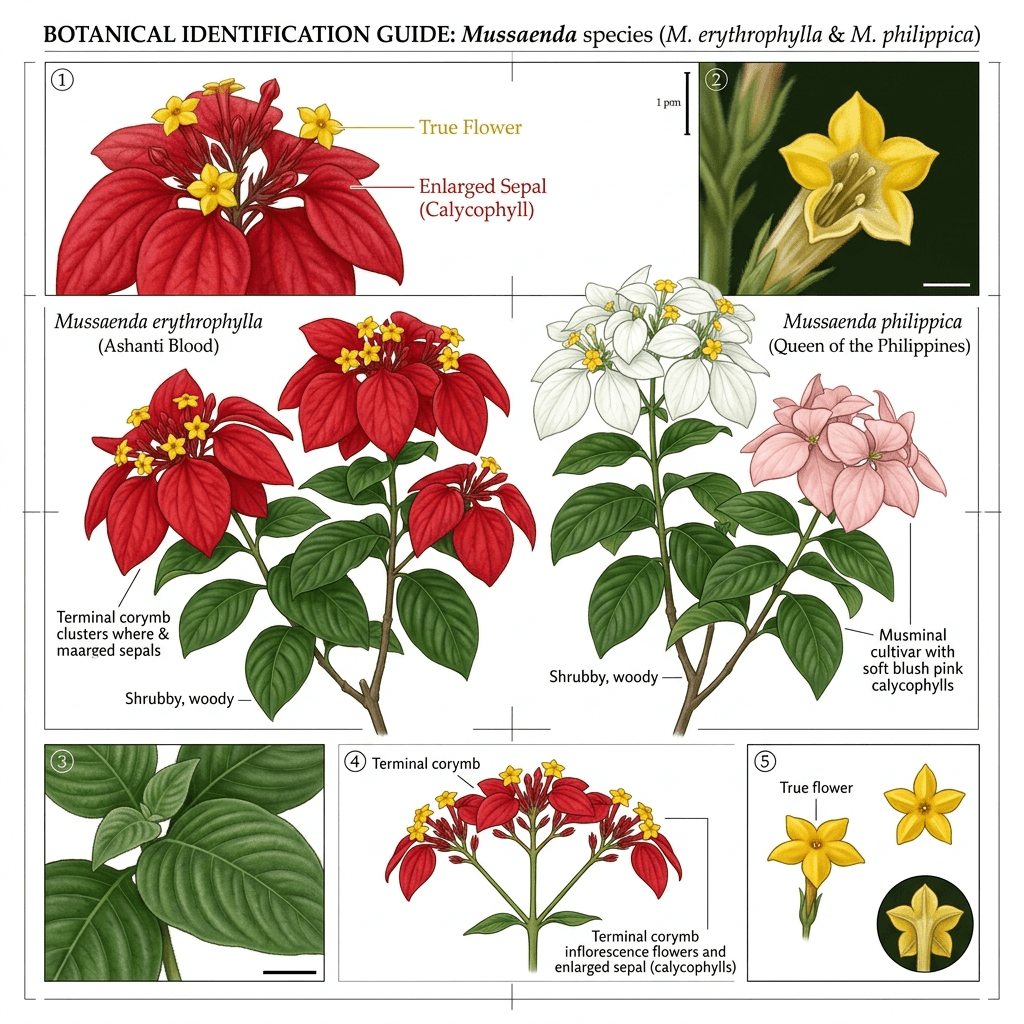
How to Identify Mussaenda
NON-TOXIC. 100% safe for cats, dogs, and horses. Provides a highly dramatic, colorful, and completely pet-safe background planting or border hedge.
A detailed guide to identifying Mussaenda (Mussaenda erythrophylla, M. philippica, and M. frondosa) by its distinctive botanical characteristics:
- Massive Petaloid Sepals (Calycophylls): The most conspicuous visual feature of Mussaenda is not its true petals, but one (or several) dramatically enlarged, showy, leaf-like calyx lobes (calycophylls) measuring 2 to 4 inches long. These velvety, colorful bract-sepals appear in glowing scarlet-red, blush pink, soft salmon, cream, or pure white.
- Small Star-Shaped True Flowers: Nestled tightly in the center of the flamboyant colorful sepals are the tiny, true tubular flowers (corollas), featuring five spreading, star-shaped yellow, orange, or white lobes measuring barely 1/2 to 1 inch across.
- Softly Pubescent (Velvety) Foliage: Broadly elliptic to ovate leaves arranged in neat opposite pairs along the stems. The foliage is covered in fine, soft hairs that produce a distinctive velvety texture, with prominent, deeply impressed arching veins.
- Terminal Corymb Inflorescence: Flowers and their colorful calycophylls are produced in dense, branching terminal clusters (corymbs) at the tips of new leafy shoots, creating heavy colorful mounds.
- Scrambling Shrubby Habit: Woody evergreen shrub to scrambling climber growing 6 to 12 feet tall in tropical landscapes, featuring arching branches with pale brown, lenticellate bark.
Types & Cultivars of Mussaenda
Mussaendas are horticultural royalty, classified primarily by sepal coloration and cultivar origins:
- By Sepal Color & Cultivar Series:
- Red Mussaenda ('Ashanti Blood' / M. erythrophylla): Features single enlarged, intense velvety blood-red calycophylls framing vibrant star-yellow floral throats.
- Pink Mussaenda ('Queen Sirikit' / 'Doña Luz'): Spectacular hybrid with multiple expanded calycophylls per bloom cluster, forming heavy, cascading rosettes in soft rose-pink with deeper pink margins.
- White Mussaenda ('Doña Aurora' / M. philippica var. aurorae): Cultivar where all five calyx lobes expand into crisp, papery, pure-white calycophylls, creating shimmering white mounds often called 'Virgin Tree'.
- Wild / Yellow-Bracted Mussaenda (Mussaenda frondosa): Native South Asian wild species displaying pure white solitary enlarged sepals contrasting with golden-orange star flowers.
- By Growth Habit:
- Compact Bush Cultivars: Modern selections maintained at 4 to 6 feet tall, ideal for prominent patio containers and specimen shrub borders.
- Vining / Scrambling Forms: Vigorous tropical climbers reaching up to 15 feet when trained against walls, fences, or sturdy pergolas.
Care & Growing Guide
Mussaenda Care & Growing Guide:
- Light: Full direct sunlight to light dappled afternoon shade (at least 5 to 6 hours of sun daily). Full sunshine produces the richest, most vibrant sepal coloration and prolific blooming.
- Watering: Consistent, generous moisture. Water thoroughly whenever the top 1 to 2 inches of soil feel dry to the touch. Avoid letting the root ball dry out completely, as water stress causes immediate sepal and bud drop.
- Soil & pH: Rich, fertile, humus-heavy, and well-draining acidic soil with a pH between 5.5 and 6.5. Amend dense soils with organic compost and peat moss.
- Temperature & Hardiness: Hardy in USDA Zones 10 through 12. Extremely frost-sensitive; temperatures below 50°F (10°C) cause leaf shedding, and sub-freezing temperatures kill top growth.
- Fertilization: Feed every 3 to 4 weeks during the active spring and summer blooming season with a balanced, slow-release fertilizer rich in micronutrients (like iron and magnesium) or high-phosphorus bloom booster.
- Pruning & Maintenance: Prune hard in late winter or early spring before new seasonal flush begins to control size, shape the woody framework, and stimulate vigorous new blooming shoots.
Seasonal Blooming & Hardiness
Seasonal Blooming Calendar (US Hardiness Zones 10-12 / Tropical & Subtropical Climates):
- Peak Bloom: Summer through mid-autumn (typically May through November).
- Year-Round Potential: In warm frost-free equatorial and tropical landscapes, Mussaenda produces intermittent flushes of colorful calycophylls year-round.
- Pruning Window: Best pruned hard in late winter (February to early March) just before the arrival of warm spring temperatures.
Bloom Timeline
About Mussaenda
Mussaenda, botanically designated as Mussaenda erythrophylla and commonly known as the Ashanti Blood, Red Flag Bush, or Bangkok Rose, is an exceptionally striking, high-impact tropical evergreen shrub or sprawling semi-climber. Belonging to the family Rubiaceae (the coffee or madder family, tribe Mussaendeae), this exotic landscape plant is native to the warm, highly humid rainforest understories, coastal scrublands, and riverbanks of tropical West Africa (including Ghana and Nigeria) and tropical East Asia.
This robust evergreen typically grows 5 to 15 feet (1.5 to 4.5 meters) tall and spreads 4 to 8 feet wide, forming a dense, rounded, and branching specimen. It carries opposite, oval-shaped leaves of a vibrant dark green, heavily accented with deeply impressed parallel veins and covered in soft, velvety hairs on both surfaces. It is globally celebrated for its spectacular floral display which is characterized not by petals, but by massive, colorful, leaf-like bracts measuring 2 to 6 inches (5 to 15 cm) long.
These showy bracts are actually highly enlarged, modified calyx lobes (sepals)—known as calycophyllums—that can remain vibrant and colorful for several months. They appear in intense, velvety shades of crimson-red, pastel pink (famed in the hybrid 'Queen Sirikit'), snow-white, and warm cream. The true flowers are tiny, star-shaped, and measure a mere 0.5 inches across, showcasing brilliant golden-yellow or orange petals that sit in clusters at the center of the massive, showy bracts.
The radially symmetrical reproductive morphology of Mussaenda is represented by the family-specific floral formula Br ⊕ ⚥ K(5) C(5) A5 G(2). This formula states that the flowers are bracteate (supported by showy bracts), actinomorphic, and bisexual. The calyx is composed of 5 sepals, where uniquely, exactly 1 sepal is enormously expanded into the massive, colorful petaloid bract. The corolla has 5 fused petals forming a long, narrow tubular throat opening into a 5-pointed star. The 5 stamens are fused to the corolla tube, and the 2 fused carpels form an inferior ovary.
The genus name Mussaenda is derived from the Sinhalese local name 'Mussenda' in Sri Lanka. Famed in Sanskrit as Shrivati (श्रीवाटी) or Shriparnah (श्रीपर्णः) and in Hindi as Bedina (बेदिना) or Lal Patti (लाल पत्ती), white-bracted varieties are whimsically called 'Dhobi Tree' (laundry tree) because the fluttering white sepals resemble fresh laundry drying in the sun, while yellow-flowered white-bracted species are known as 'Buddha's Lamp.'
For pet owners and veterinarians, the Mussaenda represents an exceptionally safe, low-risk, and pet-safe tropical shrub choice. Mussaenda erythrophylla is classified as completely NON-TOXIC to cats, dogs, and horses by major global animal safety databases, including the ASPCA. If a pet brushes against its velvety branches or accidentally nibbles on its leathery green foliage or large colorful sepals, there is absolutely no risk of toxic chemical poisoning. To explore more safe tropical garden choices, visit our general Pet Guard page.
Mussaenda is occasionally confused with Poinsettias or Tropical Dogwoods due to its large, colorful bracts. It is easily distinguished because true Mussaenda produces velvety leaves in opposite pairs and tiny star-shaped yellow flowers with exactly one highly enlarged, colorful sepal, whereas poinsettias have smooth, lobed leaves and cyathia flowers. It pairs beautifully with other tropical favorites like Allamanda or Canna Lily. To discover more bold rainforest shrubs, browse our Flower Identifier.
For more botanical profiles and flower identification features, see our guides on Mexican Petunia and Orange Dahlia.
Floral Formula & Features
Bracteate (showy bracts), radially symmetrical, bisexual, 5 fused sepals (one enlarged as bract), 5 fused petals forming tube, 5 stamens, 2 fused carpels with inferior ovary
- Scientific Name & Classification: Mussaenda erythrophylla (Rubiaceae). Globally famed as Mussaenda, Ashanti Blood, Red Flag Bush, and Bangkok Rose.
- Identification Markers: Opposite velvety green leaves, cluster of small star-shaped yellow flowers, and massive 2-6 inch waxy petal-like sepals in red, pink, or white.
- Floral Formula (Br ⊕ ⚥ K(5) C(5) A5 G(2)): Radially symmetrical, bisexual flowers with 5 sepals (one highly enlarged into a colorful bract), 5 fused petals, 5 stamens, and inferior ovary.
- Growing Requirements: Full direct sun to partial dappled shade; rich, organic, humus-heavy, wet-to-moist, highly well-draining soils. Thrives in high humidity (Zones 10-12).
- Cultural Significance: Sinhalese name origin. White variety called 'Dhobi Tree' (laundry tree). Famed in Sanskrit as 'Shrivati.' Pink hybrids named in honor of Queen Sirikit of Thailand.
- Safety & Toxicity: NON-TOXIC. 100% safe for cats, dogs, and horses. Provides a highly dramatic, colorful, and completely pet-safe background planting or border hedge.
- Common Look-alikes: Confused with Poinsettias or Tropical Dogwood, but easily distinguished by its opposite velvety leaves and star-shaped yellow petals nested in a single giant sepal.
- Internal Links: Creates a beautiful, layered tropical backdrop when planted alongside other moisture-loving, sun-loving specimens like Allamanda or Canna Lily; find more in our Flower Identifier.
Names in Different Languages
Botanical Classification: Mussaenda belongs to the Rubiaceae family. Learn how to identify its floral symmetry, stamen arrangement, and structural formulas in our Botanical Family Classification Guide.
Toxicity & Safety
Frequently Asked Questions
What is Floral Formula?
A floral formula is a symbolic representation of a flower's structure using letters, numbers, and special symbols. It provides a concise way to describe the arrangement and number of floral parts.
This formula describes the flower's symmetry, sepals, petals, stamens, and carpels in a standardized format.
Formula Sequence
- Bract: Br or Ebr
- Bracteole: Brl or Ebrl
- Symmetry: % (Radial) or ⊕ (Bilateral)
- Sex: ♀ (Female), ♂ (Male), or ⚥ (Bisexual)
- Calyx/Sepal: K<number> (Free or Fused)
- Corolla/Petal: C<number> (Free or Fused)
- Androecium: A<number> (Free or Fused)
- Gynaecium: G<number> (Superior or Inferior Ovary)
Symbol Meanings
- Numbers: Indicate quantity of parts
- Parentheses (): Parts are fused together
- Plus (+): Parts in different whorls
- Underline: Superior ovary position
- Overline: Inferior ovary position
- ∞: Numerous parts (too many to count)
Understanding floral formulas helps botanists quickly identify and classify flowers based on their structural characteristics.
Similar Flowers
Discover flowers that share botanical characteristics
Same Family
2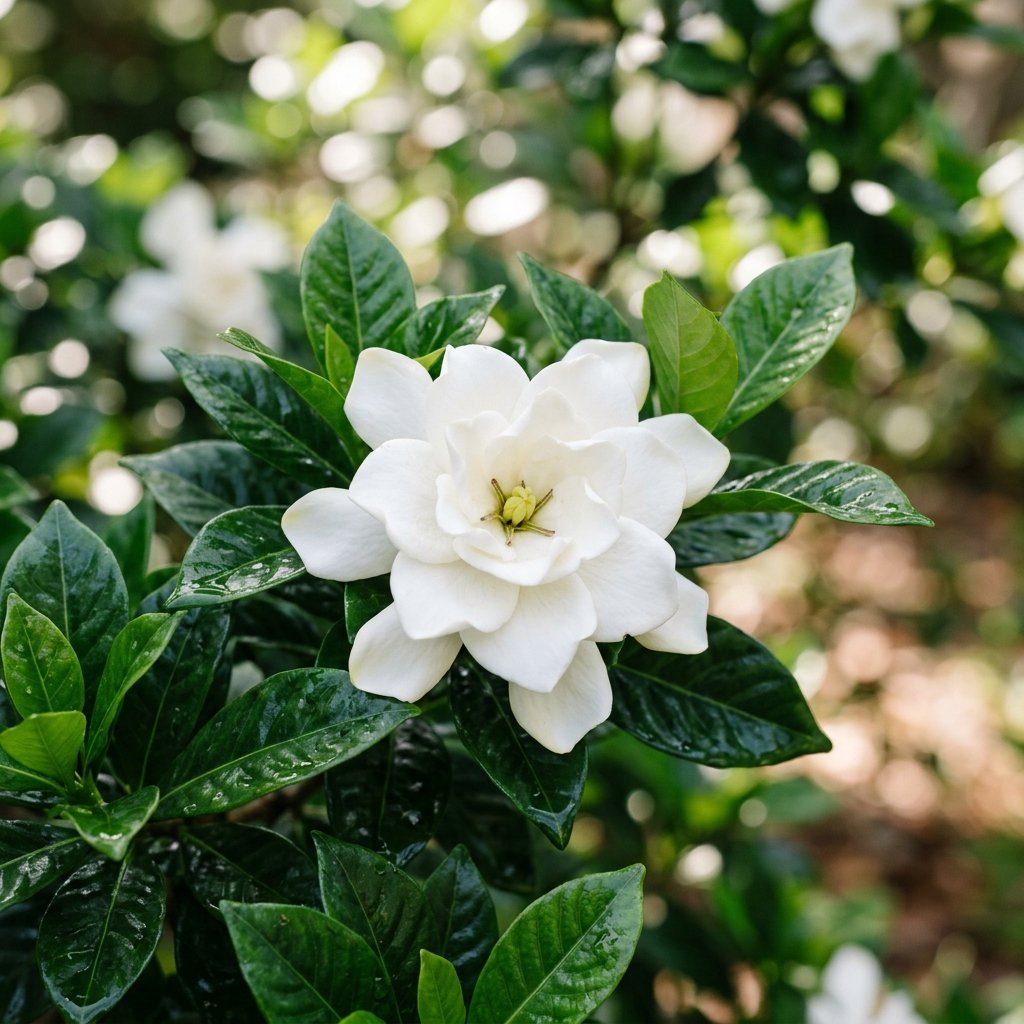
Gardenia
Gardenia jasminoides
Gardenia, botanically classified as Gardenia jasminoides and commonly known as Cape Jasmine, is an exceptionally popular evergreen shrub in the coffee family, Rubiaceae. Native to the subtropical regions of East Asia, it is celebrated worldwide for its waxy, creamy-white blossoms and sweet, intox...
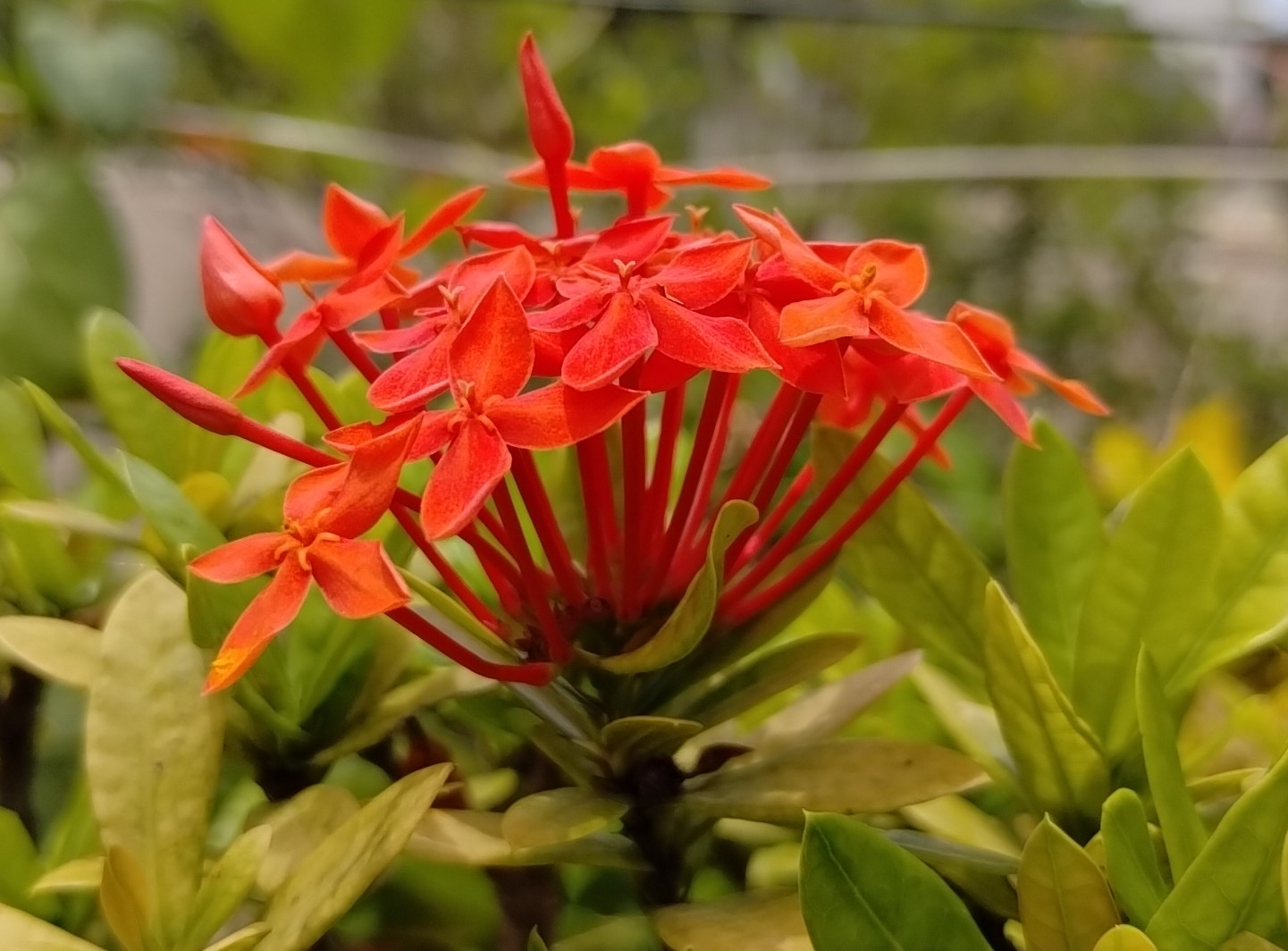
Ixora
Ixora coccinea
Ixora, botanically classified as Ixora coccinea and colloquially celebrated as the Jungle Flame or Flame of the Woods, is an exceptionally vibrant, evergreen flowering shrub belonging to the Rubiaceae (madder or coffee) family. Native to the damp tropical forests, rocky hillsides, and coastal scr...
Similar Characteristics
4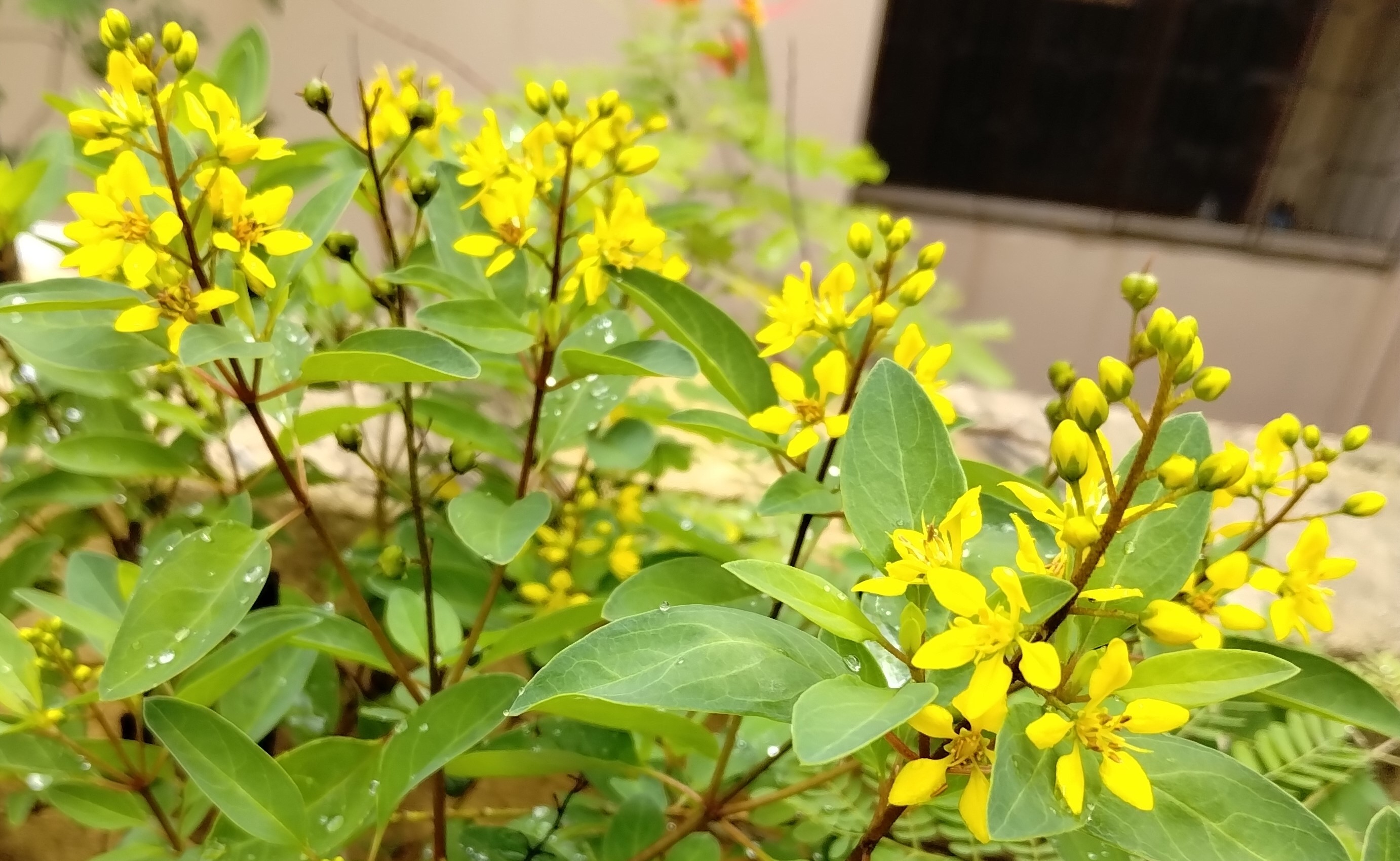
Golden Thryallis
Galphimia gracilis
The Golden Thryallis, botanically designated as *Galphimia gracilis* (previously confused with *Thryallis glauca*, commonly known as Gold Shower, Rain-of-Gold, or Slender Goldshower), is an exceptionally cheerful, fast-growing tropical evergreen shrub. Belonging to the family Malpighiaceae (the a...
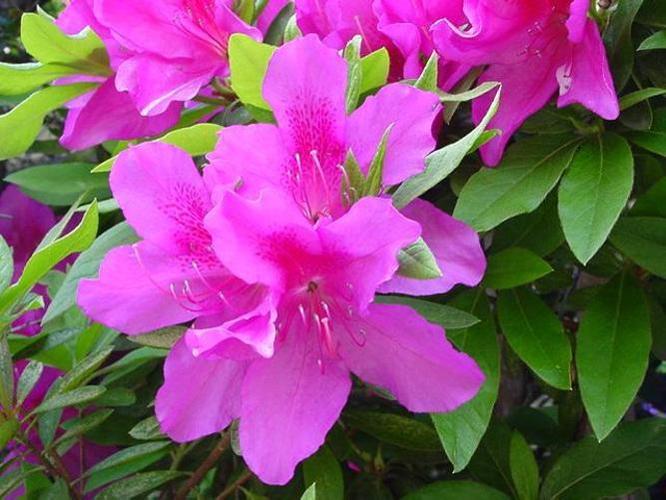
Azalea
Rhododendron (subgenus Tsutsusi)
The Azalea, botanically classified as Rhododendron (specifically under the subgenera Tsutsusi and Pentanthera) and belonging to the family Ericaceae (the heath family), is an exceptionally spectacular, heavy-blooming woody perennial shrub. Native primarily to the cool, damp woodlands, mountain sl...
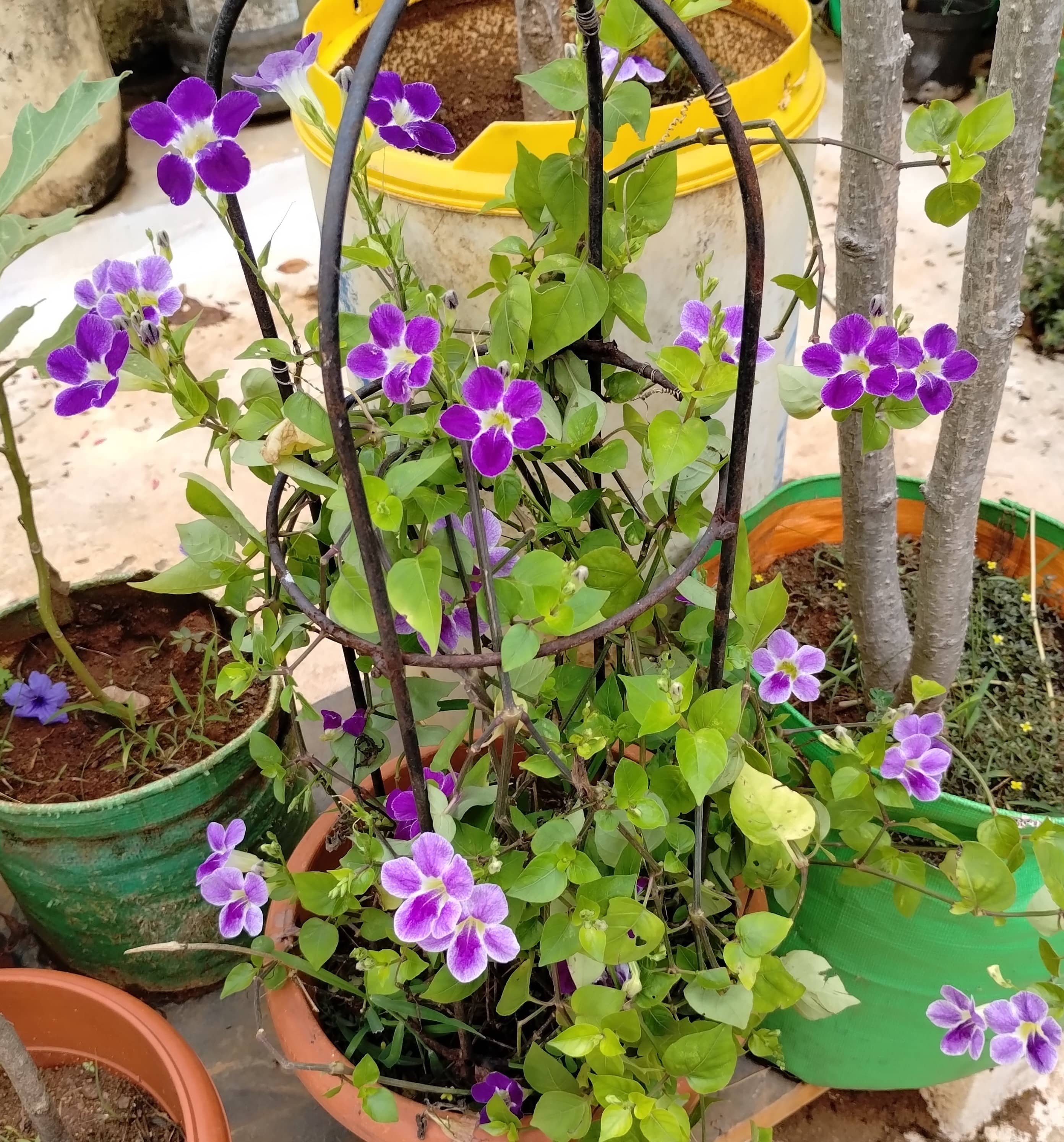
Thunbergia (King's Mantle)
Thunbergia erecta
Thunbergia erecta, popularly known as the "King's Mantle" or "Bush Clock Vine," is a sophisticated and regal tropical shrub that brings a touch of aristocratic elegance to any garden. A member of the Acanthaceae family, this evergreen species is native to the coastal regions of western Africa, fr...
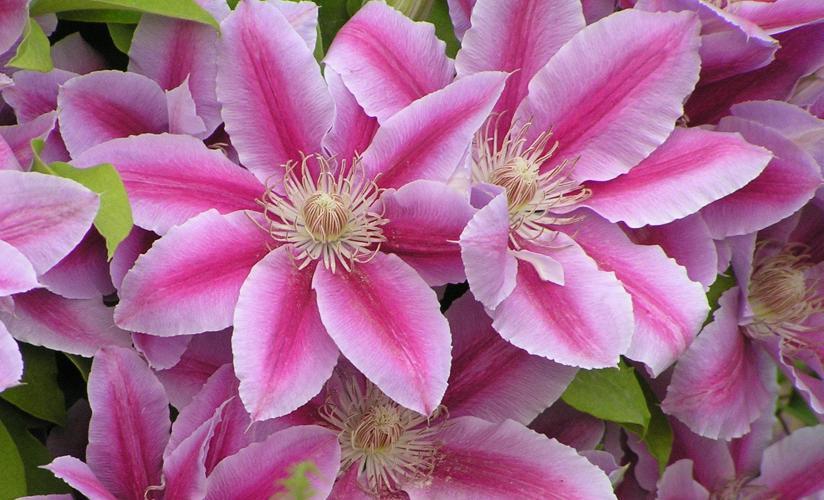
Clematis
Clematis
The Clematis, belonging to the genus Clematis within the family Ranunculaceae (the buttercup family), is a spectacular genus of perennial climbing vines widely hailed as the 'Queen of the Climbers.' Native to the temperate woodlands, rocky hillsides, and river hedgerows across the Northern Hemisp...