
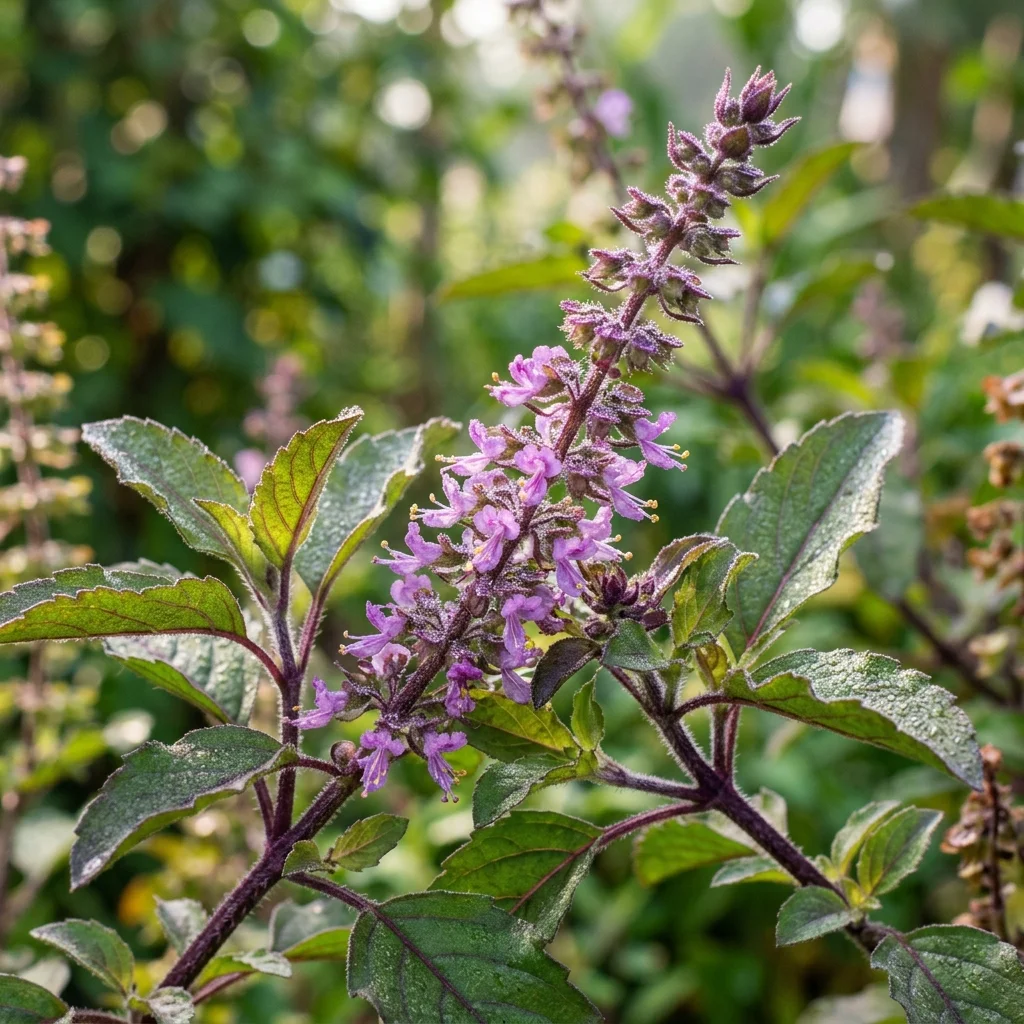
Holy Basil (Tulsi)
Ocimum tenuiflorum
How to Identify Holy Basil (Tulsi)
NON-TOXIC. 100% pet-safe for cats, dogs, and horses. Safe for household cultivation, courtyard altars, and kitchen herbal tea gardens.
A botanical field guide to identifying Holy Basil (Ocimum tenuiflorum / Tulsi) by its key taxonomic markers:
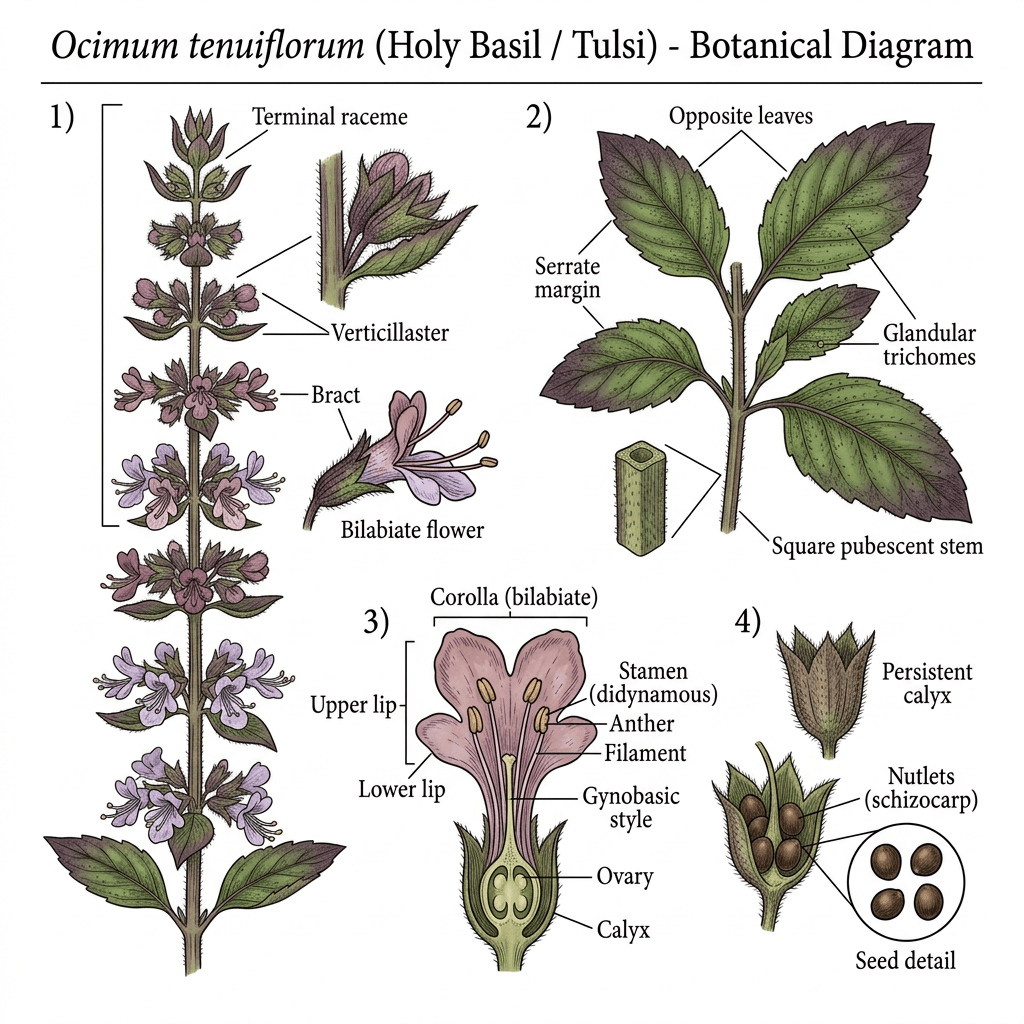
- Slender Terminal Spikes (Racemes): Upright flowering spires (4 to 8 inches long) bearing close tiers of tiny two-lipped flowers in whorls of six.
- Tiny Bilabiate Blossoms: Pale lilac, violet, or pinkish-purple flowers with an upright 4-lobed upper petal lip and extended, slender stamens.
- Square Hairy Stems: Distinctly 4-sided quadrangular stems clothed in short, velvety white hairs with purple coloration at the nodes and upper branches.
- Opposite Serrated Leaves: Oval to elliptic leaves (1 to 2 inches long) with shallowly serrate margins and visible glandular dots holding fragrant essential oils.
- Pungent Clove-Herbal Aroma: Brushing or crushing any part of the leaf or stem releases a strong, unmistakable peppery clove fragrance distinct from sweet culinary basil.
Botanical Forms & Regional Variations
- By Cultivar Type:
- Rama Tulsi (Green Leaf): Light green foliage with white-to-light purple flower spikes; milder, sweeter fragrance; highly popular across North India.
- Krishna / Shyama Tulsi (Purple Leaf): Rich purple-bronze leaves, dark purple stems, and deep violet flower spikes; intensely pungent clove aroma; highly prized in Ayurvedic medicine.
- By Growth Habit:
- Subshrub Form: Multi-year woody-based subshrub in frost-free tropical climates reaching up to 3 feet in height.
- Container Form: Compact potted specimen frequently maintained in household courtyards, altars, and sunny balconies.
Care & Growing Guide
Holy Basil (Tulsi) Care & Growing Guide:
- Light: Full direct sunlight (at least 6 hours of sun daily). Plentiful sun maximizes essential oil production and compact bushy growth.
- Soil: Rich, loose, loamy soil with excellent drainage (pH 6.0 to 7.5). Avoid heavy, dense, soggy clay soils.
- Watering: Water thoroughly when the top inch of soil feels dry. Do not let roots sit in standing water, as it can cause root rot; water early in the morning.
- Pruning & Maintenance: Regularly pinch off the young flowering spires (unless harvesting seeds) to encourage dense branching and lush leaf production.
Seasonal Blooming & Hardiness
Seasonal Blooming Calendar (Tropical & Warm Temperate Zones):
- Peak Bloom: Mid-summer through late autumn (July through November in temperate zones; almost continuous year-round flowering in warm tropical zones 10-11).
- Sowing & Propagation: Sow seeds in warm soil in spring; germination occurs within 7 to 14 days at 70°F (21°C).
- Life Cycle: Short-lived perennial subshrub in warm tropical climates, cultivated as an annual in frost-prone regions.
Bloom Timeline
About Holy Basil (Tulsi)
Holy Basil, botanically classified as Ocimum tenuiflorum (synonymous with Ocimum sanctum) and universally revered throughout India and the Eastern world as Tulsi (the 'Incomparable One'), is a profoundly sacred, highly aromatic, and therapeutically celebrated perennial subshrub. Belonging to the mint family Lamiaceae (tribe Ocimeae), this revered botanical is native to the Indian subcontinent, Sri Lanka, Southeast Asia, and tropical northern Australia, where it has been cultivated for over five millennia in temple courtyards, home gardens, and medicinal groves.
The plant typically grows 1 to 3 feet (30 to 90 cm) tall with an erect, highly branched, bushy architecture. It is easily recognized by the characteristic quadrangular, square-shaped stems of the mint family, which are purplish-green and clothed in fine, soft hairs (pubescence). Its opposite, simple ovate-to-elliptic leaves measure 1 to 2 inches long with shallowly toothed (serrate-dentate) margins, displaying a rich green to deep purplish-bronze coloration. When touched or crushed, the foliage releases an intensely pungent, warm, and uplifting clove-peppery aroma driven by rich concentrations of essential oil compounds like eugenol, caryophyllene, and camphor.
Throughout the warmer months and tropical dry season, Holy Basil produces numerous slender, upright terminal and axillary flowering racemes measuring 4 to 8 inches in length. The tiny, delicate bilabiate (two-lipped) blossoms emerge in tight whorls of 6 flowers (verticillasters) subtended by small concave bracts. Ranging in color from pale lavender and soft lilac to deep magenta-purple, these nectar-rich flowers continuously attract honeybees, native pollinators, and butterflies to the garden.
The zygomorphic reproductive morphology of Ocimum tenuiflorum is represented by the family-specific floral formula Br % ⚥ K(1+4) C(4+1) A4 G(2). This formula explains that each flower is supported by a small bract (Br), is bisexual, and exhibits bilateral symmetry (zygomorphic). The tubular calyx is distinctly two-lipped, with a broad, rounded upper lip and a lower lip featuring 4 sharp, needle-like teeth. The bilabiate corolla features 5 fused petals: an upright 4-lobed upper lip and a flat, boat-shaped lower lip. The 4 stamens are didynamous with long exserted filaments, and the superior ovary is deeply 4-lobed with a gynobasic style terminating in a bifid stigma.
In Hindu tradition, Tulsi is regarded as the earthly manifestation of the goddess Vrinda (an avatar of Lakshmi) and the supreme botanical consort of Lord Vishnu. A central fixture in traditional Indian courtyards housed in ornate brick altars (Tulsi Vrindavan), it is worshipped daily at dawn. In Ayurvedic medicine, Tulsi is crowned as the 'Queen of Herbs' and classified as an adaptogen—revered for harmonizing bodily energies, purifying the blood, easing coughs and asthma, reducing stress, and boosting immune resilience.
For pet owners and veterinarians, Holy Basil represents a reassuringly safe, non-toxic, and pet-friendly garden herb. Ocimum tenuiflorum is classified as NON-TOXIC to cats, dogs, and horses by veterinary poison databases. Its aromatic volatile oils (such as eugenol) are safe in garden settings, and its spicy, pungent scent naturally discourages cats and dogs from chewing on the plant. To explore more safe culinary and sacred herbs, browse our general Pet Guard guide.
Holy Basil is distinguished from Sweet Italian Basil (Ocimum basilicum) by its smaller, velvety, serrated leaves, woody branching base, purplish flower spires, and sharp clove-musk scent, whereas Sweet Basil has broad, smooth, sweeter licorice-scented foliage. It harmonizes wonderfully in herbal borders and sacred plantings with Thumbai (Leucas Aspera), Bee Balm, Salvia, Lavender, and Marigold. Explore our Flower Identifier to discover more aromatic botanicals.
For more detailed botanical identification guides and medicinal plant features, see our articles on Leucas Aspera (Thumbai), Bee Balm (Horse Mint), and Salvia.
Floral Formula & Features
Bracteate, zygomorphic (bilaterally symmetrical), bisexual, calyx 2-lipped with upper lip rounded and lower lip 4-toothed, corolla 2-lipped with 4-lobed upper lip and entire lower lip, 4 didynamous stamens with protruding filaments, 4-lobed ovary with gynobasic style and bifid stigma, 4 single-seeded nutlets
- Scientific Name & Classification: Ocimum tenuiflorum / Ocimum sanctum (Lamiaceae). Revered as Holy Basil, Tulsi, Sacred Basil, and the Queen of Herbs.
- Identification Markers: Square hairy stems, opposite serrated aromatic leaves with clove scent, slender terminal spires of tiny lavender-purple bilabiate flowers in whorls of 6.
- Floral Formula (Br % ⚥ K(1+4) C(4+1) A4 G(2)): Zygomorphic, bisexual flowers with two-lipped calyx, two-lipped corolla (4-lobed upper lip), 4 didynamous exserted stamens, and 4-lobed superior ovary.
- Growing Requirements: Full direct sun (6+ hours daily); light, fertile, well-draining loamy soil with neutral to slightly acidic pH; moderate watering (Zones 10-11 as perennial; warm annual elsewhere).
- Cultural Significance: Famed as the botanical manifestation of Goddess Lakshmi; central sacred plant in Hindu courtyards; celebrated in Ayurveda as the premier adaptogen and longevity elixir.
- Safety & Toxicity: NON-TOXIC. 100% pet-safe for cats, dogs, and horses. Safe for household cultivation, courtyard altars, and kitchen herbal tea gardens.
- Common Look-alikes: Distinguished from Sweet Culinary Basil by its smaller hairy leaves and clove-like scent, and from Thai Basil by its purple floral spikes and rounder calyx lobes.
- Internal Links: Pairs sacredly and botanically in wellness and cottage gardens beside Thumbai (Leucas Aspera), Bee Balm, Salvia, Lavender, and Marigold; browse our Flower Identifier.
Names in Different Languages
Botanical Classification: Holy Basil (Tulsi) belongs to the Lamiaceae family. Learn how to identify its floral symmetry, stamen arrangement, and structural formulas in our Botanical Family Classification Guide.
Toxicity & Safety
Frequently Asked Questions
What is Floral Formula?
A floral formula is a symbolic representation of a flower's structure using letters, numbers, and special symbols. It provides a concise way to describe the arrangement and number of floral parts.
This formula describes the flower's symmetry, sepals, petals, stamens, and carpels in a standardized format.
Formula Sequence
- Bract: Br or Ebr
- Bracteole: Brl or Ebrl
- Symmetry: % (Radial) or ⊕ (Bilateral)
- Sex: ♀ (Female), ♂ (Male), or ⚥ (Bisexual)
- Calyx/Sepal: K<number> (Free or Fused)
- Corolla/Petal: C<number> (Free or Fused)
- Androecium: A<number> (Free or Fused)
- Gynaecium: G<number> (Superior or Inferior Ovary)
Symbol Meanings
- Numbers: Indicate quantity of parts
- Parentheses (): Parts are fused together
- Plus (+): Parts in different whorls
- Underline: Superior ovary position
- Overline: Inferior ovary position
- ∞: Numerous parts (too many to count)
Understanding floral formulas helps botanists quickly identify and classify flowers based on their structural characteristics.
Similar Flowers
Discover flowers that share botanical characteristics
Same Family
4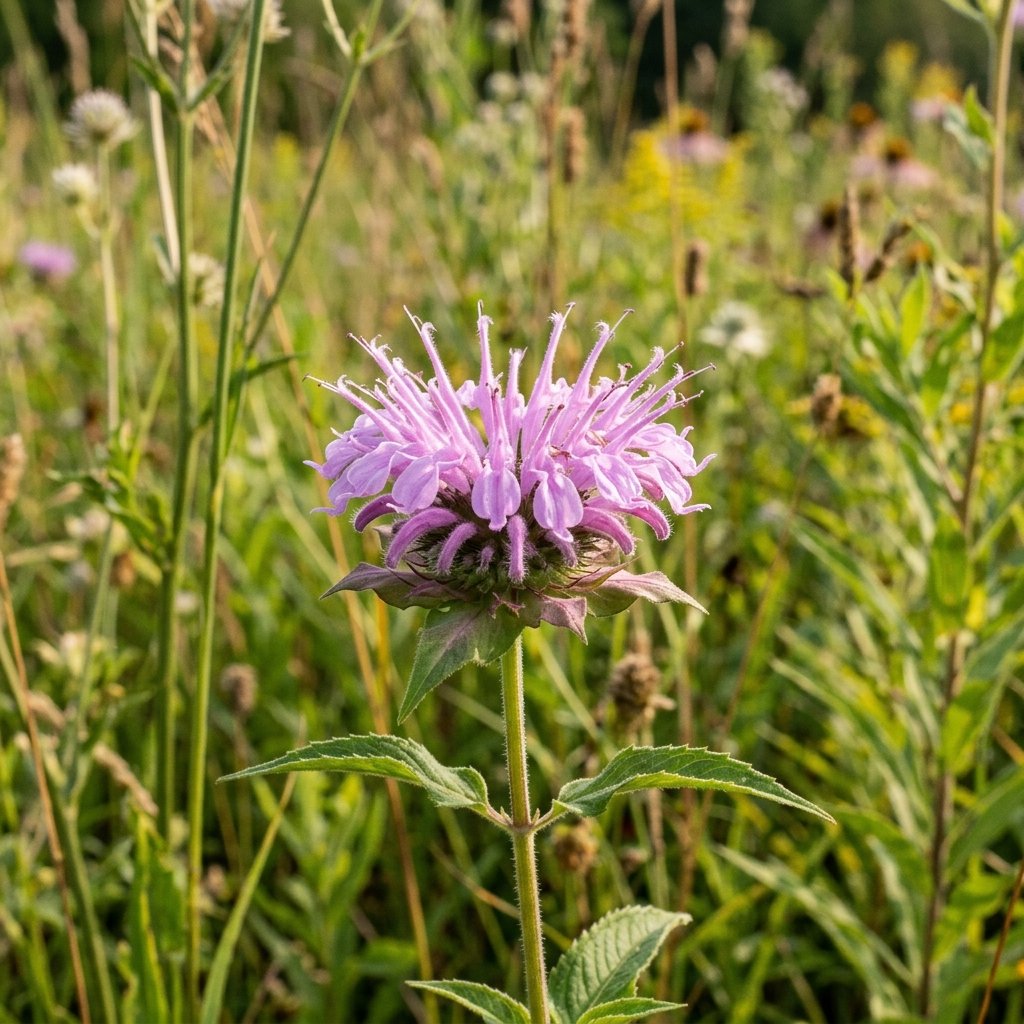
Wild Bergamot
Monarda fistulosa
Wild Bergamot (*Monarda fistulosa*) is one of the most important and widely distributed native wildflowers and medicinal herbs of North America, producing shaggy, globe-shaped heads of tubular lavender to pale pink flowers on sturdy, square stems throughout summer. A member of the mint family (La...
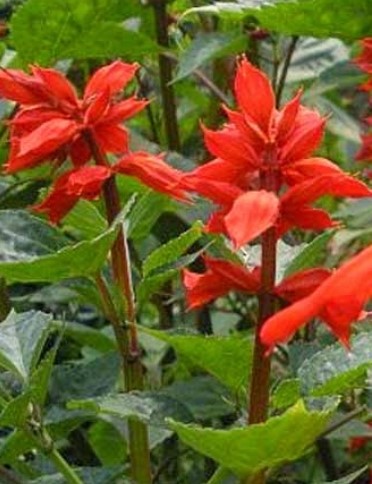
Salvia
Salvia
Salvia, botanically classified under the genus Salvia and commonly known as Sage, is an exceptionally diverse, versatile, and highly valuable plant genus. Belonging to the family Lamiaceae (the mint family, tribe Mentheae), this massive genus comprises nearly 1,000 distinct species distributed ac...
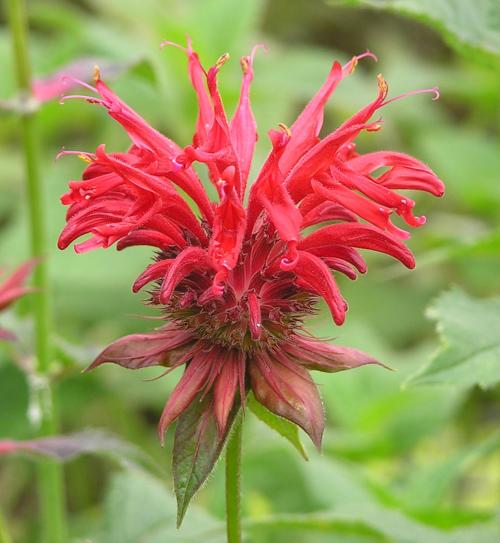
Beebalm
Monarda didyma, Monarda fistulosa
Bee Balm, botanically classified under the genus Monarda within the family Lamiaceae (the mint family), is a spectacular and highly aromatic clump-forming herbaceous perennial. Native to the rich floodplains, moist meadows, woodland margins, and stream banks of eastern North America—ranging from...
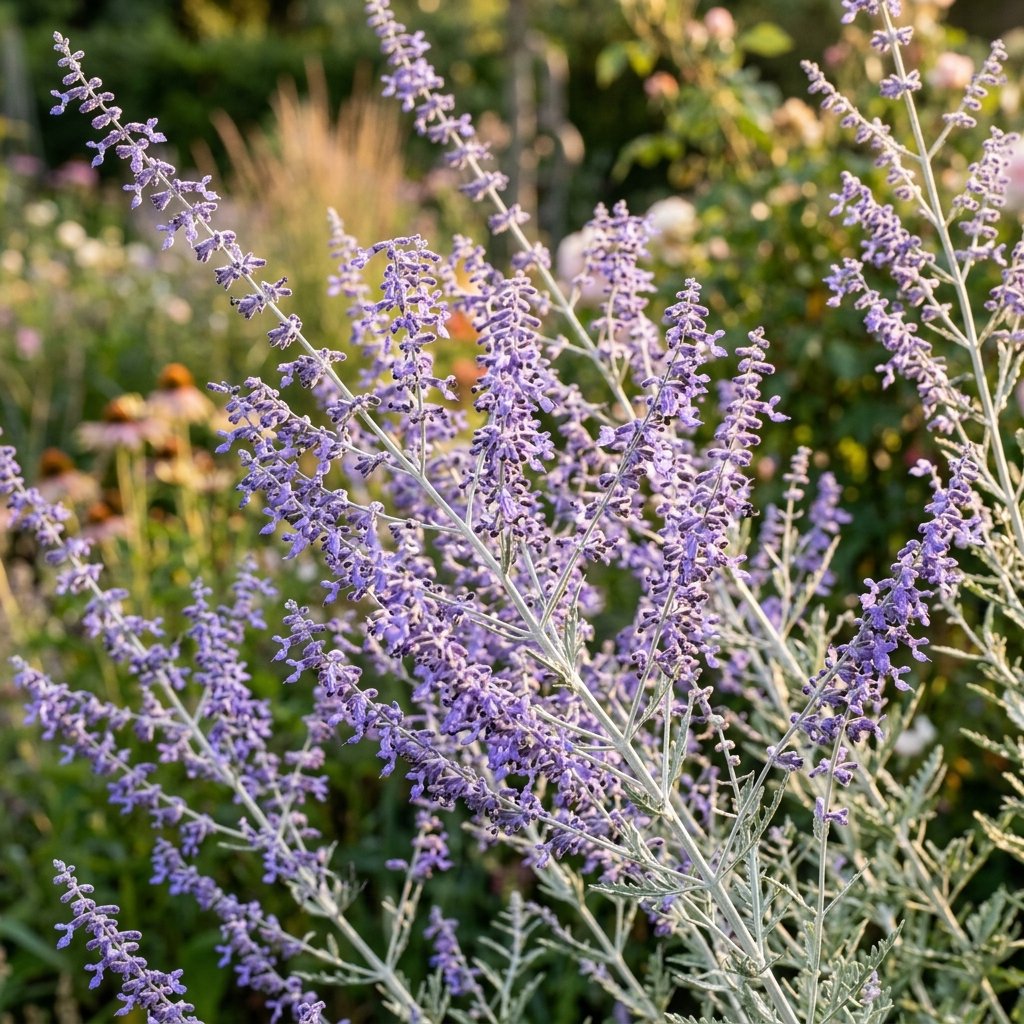
Russian Sage
Salvia yangii
Russian Sage, botanically reclassified as *Salvia yangii* (long celebrated under its classic horticultural synonym *Perovskia atriplicifolia*), is an exceptionally drought-tolerant, graceful, and cloud-like deciduous perennial subshrub. Belonging to the mint family Lamiaceae (tribe Mentheae), thi...
Similar Characteristics
4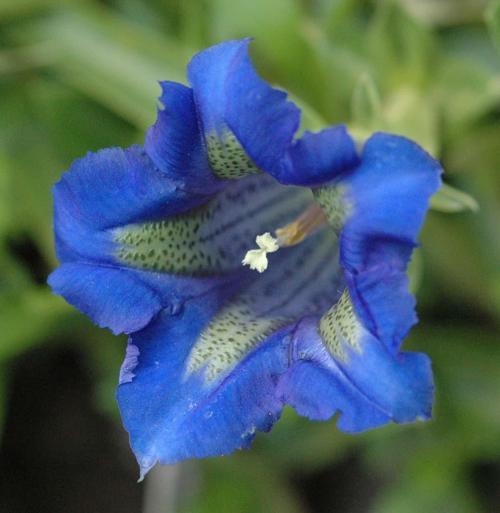
Stemless Gentian
Gentiana acaulis
The Stemless Gentian, botanically classified as Gentiana acaulis and commonly known as the Trumpet Gentian, Large-flowered Gentian, or Gentianella, is an exceptionally exquisite, low-growing alpine perennial. Belonging to the family Gentianaceae (the gentian family, tribe Gentianeae), this high-a...
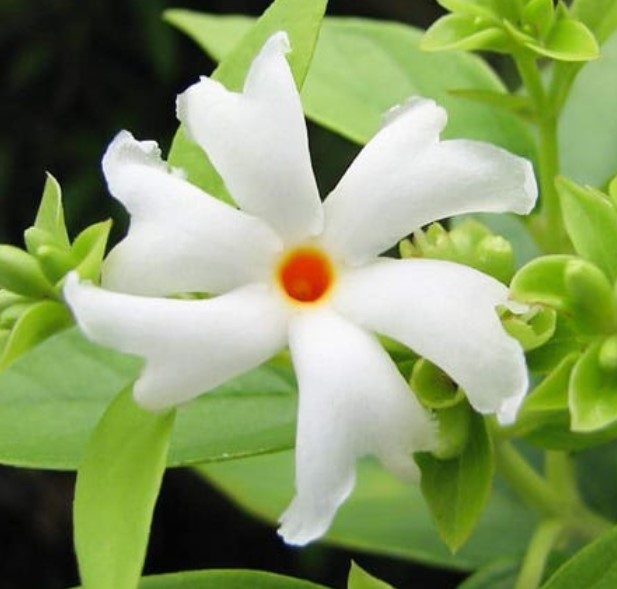
Night Jasmine (Coral Jasmine)
Nyctanthes arbor-tristis
Nyctanthes arbor-tristis, profoundly known as Parijat, Night-Blooming Jasmine, or Coral Jasmine, is a botanical treasure that holds a sacred place in the heart of South Asian culture. Belonging to the Oleaceae (Olive) family, this small tree or large shrub is celebrated not just for its physical...
Beebalm
Monarda didyma, Monarda fistulosa
Bee Balm, botanically classified under the genus Monarda within the family Lamiaceae (the mint family), is a spectacular and highly aromatic clump-forming herbaceous perennial. Native to the rich floodplains, moist meadows, woodland margins, and stream banks of eastern North America—ranging from...
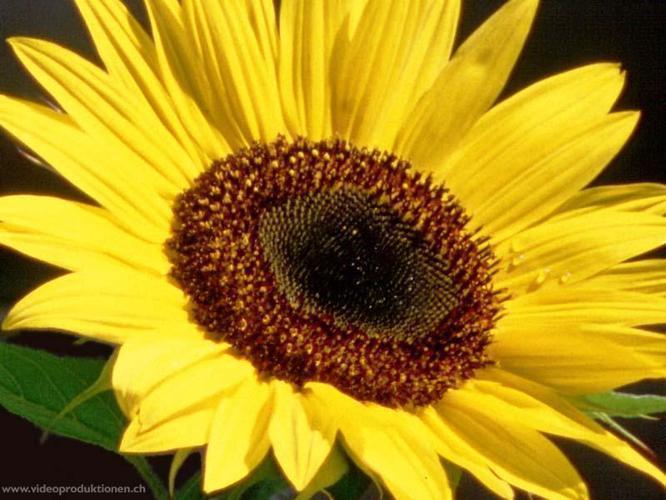
Sunflower
Helianthus annuus
The Sunflower, botanically classified as Helianthus annuus and commonly known as the Common Sunflower, is an exceptionally iconic, robust, and fast-growing annual plant. Belonging to the family Asteraceae (the daisy, aster, or composite family), this famous wildflower is native to the fertile pra...