
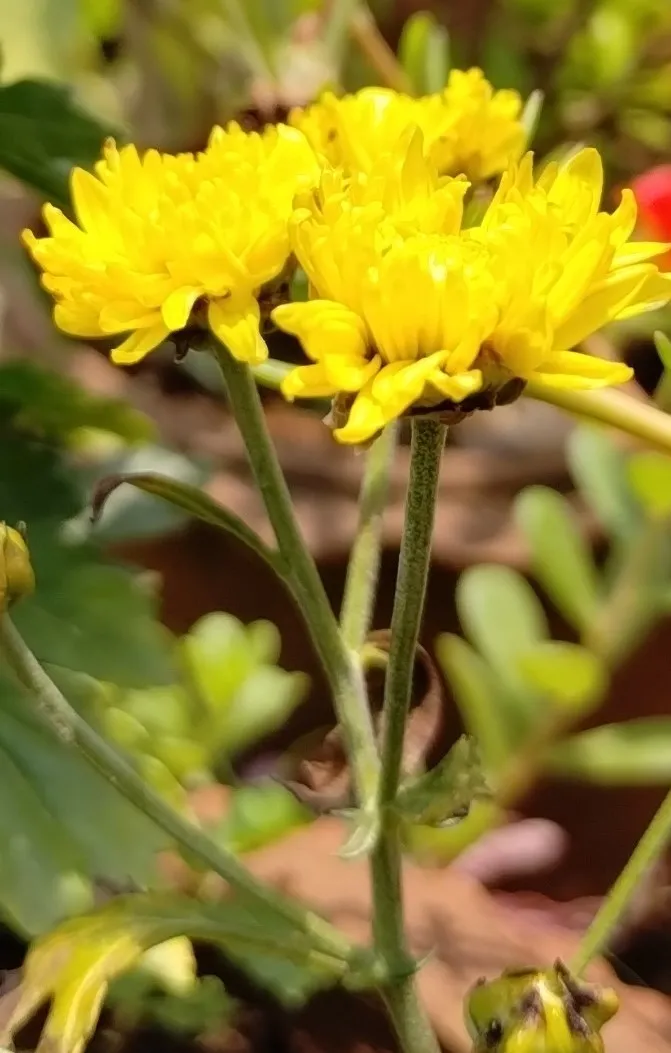
Chrysanthemum
Chrysanthemum morifolium
How to Identify Chrysanthemum
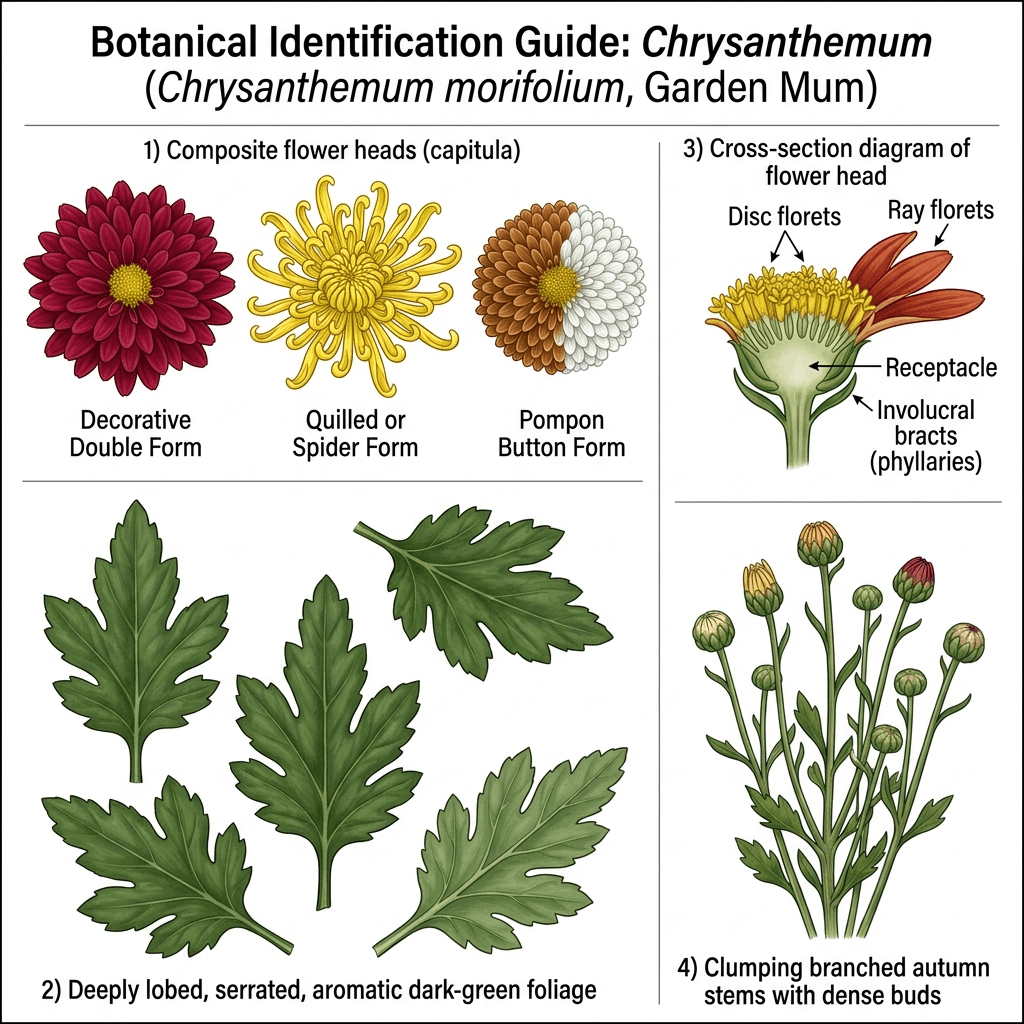
A detailed guide to identifying Chrysanthemums (Chrysanthemum morifolium / Garden Mums) by their botanical characteristics:
- Composite Capitulum Bloom Structure: Typical of Asteraceae, each chrysanthemum "flower" is actually a composite head (capitulum) packed with hundreds of tiny individual florets: flat or tubular ray florets on the outer perimeter, surrounding dense, fertile central disc florets.
- Deeply Lobed Aromatic Foliage: Alternate, grayish-green to dark emerald leaves that are deeply pinnatifid or 5-lobed with coarsely toothed margins. The foliage releases a distinctive, pungent, sharp herbal scent when rubbed or brushed.
- Multilayered Involucral Bracts (Phyllaries): The underside of each flower head is supported by an overlapping cup of small, green, scale-like involucral bracts (phyllaries) with membranous edges.
- Photoperiodic Bud Setting: Buds form specifically as daylight hours decrease in late summer and early autumn (short-day plants), leading to massive synchronized flowering displays in autumn.
- Dense Clumping Herbaceous Stems: Woody-based herbaceous perennials forming tight, dome-shaped mounds ranging from 1 to 3 feet in height and spread, covered in dozens of terminal flower buds.
Types & Cultivars of Chrysanthemums
Chrysanthemums are classified into horticultural divisions based on ray floret geometry and flower head architecture:
- By Flower Form & Petal Architecture:
- Decorative / Double Blooms: Flattened flower heads densely packed with overlapping ray florets that completely conceal the central disc florets.
- Quilled & Spider Mums: Features elongated, slender, hollow tubular ray petals that flare, twist, or hook at the tips like spider legs.
- Pompon & Button Mums: Compact, spherical, ball-shaped flower heads composed of tight, incurved florets forming neat floral globes.
- Single & Daisy-like Forms: Features one or two neat outer rows of spreading ray florets encircling a visible, flat golden-yellow central disc.
- Incurve & Reflex Mums: Exhibition varieties with petals curving either inward toward the center (incurve) or arching downward toward the stem (reflex).
- By Horticultural Purpose:
- Garden Mums (Hardy Mums): Tough garden cultivars with extensive underground stolons and high winter cold-hardiness (Zones 5-9).
- Florist Mums (Exhibition): Greenhouse-grown cultivars cultivated for huge individual show blooms or floristry arrangements; less cold-hardy.
Care & Growing Guide
Chrysanthemum Care & Growing Guide:
- Light: Full direct sunlight (at least 6 hours of direct sun daily). Maximum light exposure ensures strong, sturdy vertical stems, dense bud counts, and prevents leggy, floppy growth.
- Watering: Consistent, even moisture. Water at the base of the plant into the soil; avoid wetting the dense foliage overhead to prevent powdery mildew and fungal leaf blight.
- Soil & pH: Fertile, rich, well-draining loamy soil with plenty of organic matter and a slightly acidic to neutral pH (6.2 to 6.8). Poorly drained winter soil leads to root rot.
- Temperature & Hardiness: Hardy in USDA Zones 5 through 9. Mulch crowns heavily in late autumn after frost to insulate roots through freezing winter temperatures.
- Fertilization: Feed every 2 to 3 weeks during spring and summer active growth with a balanced 10-10-10 liquid fertilizer. Cease feeding once flower buds show color in late summer.
- Pinching & Pruning: Pinch back stem tips by 1 inch every 3 to 4 weeks starting in late spring until July 4th. This "pinching" encourages bushiness and doubles bud count for autumn.
Seasonal Blooming & Hardiness
Seasonal Blooming Calendar (US Hardiness Zones 5-9 / Temperate Climates):
- Peak Bloom: Autumn (typically September through November until hard frost).
- Secondary / Early Bloom: Selected early-season cultivars begin blooming in late August.
- Pinching Window: Pinch terminal shoots between mid-spring and early July; stop pinching by early July to allow flower buds to initiate as days shorten.
Bloom Timeline
About Chrysanthemum
The Chrysanthemum, botanically classified as Chrysanthemum morifolium and affectionately known as the 'Mum,' is a magnificent, late-season flowering perennial belonging to the Asteraceae (sunflower) family. Native to East Asia, primarily China, where it has been cultivated and revered for over 3,000 years, this iconic species is the undisputed queen of the autumn garden. Famed for its ability to produce dense, dome-like mounds of spectacular blooms when most other garden plants have faded, it represents one of the most culturally significant and commercially successful floriculture crops worldwide.
Growing in robust, branching clumps that reach 1 to 3 feet in height and width, Chrysanthemum morifolium features deeply lobed, aromatic dark grey-green leaves arranged alternately on stiff, semi-woody stems. In late summer and fall, the plants are covered in composite flower heads measuring 1 to 6 inches across. The blooms display an incredible diversity of forms classified into distinct categories—including perfectly spherical pompons, narrow spiky spider mums, flat daisy-like singles, and massive ruffled decoratives—offering an endless color palette of yellows, bronzes, deep reds, pinks, and pure whites.
The reproductive architecture of the Chrysanthemum is complex, containing two distinct types of florets represented by the formulas EBr ⊕ ⚿ K0 C(5) A(5) G̅(2) (for central disc florets) and EBr % ♀ K0 C(5) A0 G̅(2) (for outer ray florets). The outer ray florets are female and feature long, strap-shaped, colorful petals that create the visual display. The central disc florets are bisexual, tubular, and radially symmetrical, featuring 5 fused petals, 5 stamens with fused anthers forming a tube around the style, and a 2-carpellate inferior ovary typical of the Asteraceae family.
Mums are short-day plants, meaning their flowering mechanism is triggered by the naturally elongating nights of late summer and autumn. They thrive in full, direct morning and midday sun, requiring at least 5 to 6 hours of daily exposure to bloom profusely. They demand rich, humusy, consistently moist, and highly permeable soils, as their shallow fibrous root systems are extremely sensitive to both drying out and waterlogging. Pinching back the growing tips until mid-July is a standard gardening practice to promote a compact, heavily budded growth habit in USDA zones 5 through 9.
The name Chrysanthemum is derived from the Greek words 'chrysos' (gold) and 'anthemon' (flower), highlighting its ancient, wild golden form. In China, it is called 'ju hua' (菊花) and represents one of the 'Four Gentlemen' in classical art, symbolizing nobility, resilience, and retirement. In Japan, it was adopted as the Imperial Seal (the Throne of the Chrysanthemum) and is celebrated annually during the Festival of Happiness. On the Indian subcontinent, it is known as शेवंती (Shevanti) in Marathi, சாமந்தி (Saamandhi) in Tamil, and गुलदाउदी (Guldaudi) in Hindi.
While Chrysanthemums are a visual feast, pet owners must practice strict caution. All parts of Chrysanthemum morifolium are TOXIC to dogs, cats, and horses due to the presence of sesquiterpene lactones, pyrethrins, and other gastrointestinal irritants. Ingestion of the leaves or flowers causes immediate drooling, vomiting, diarrhea, lack of coordination, and severe skin irritation (dermatitis) if pets touch crushed foliage. To learn how to safely isolate these beautiful autumn blooms or find safe, pet-safe seasonal alternatives, please browse our Pet Guard catalog.
Chrysanthemums are occasionally confused with autumn-blooming Asters or Marigolds (Tagetes). They are easily distinguished because mums feature highly aromatic, deeply lobed leaves and unique, structurally complex flower shapes (like spiders or pompons), whereas asters have simple lance-shaped leaves and open, daisy-like heads. Mums pair beautifully in container groupings alongside other autumn favorites; we suggest placing them with colorful Kalanchoe or classic Dianthus. To explore the full diversity of autumn-blooming composites, visit our Flower Identifier.
Culturally, the Chrysanthemum holds dramatic contrasts across the globe. While celebrated as Japan's Imperial Seal and an emblem of longevity in China, chrysanthemums are strictly designated as funeral and cemetery flowers across France, Italy, Spain, and Central Europe—bringing them to a host's home is considered a grave insult. Discover the full cultural history and gifting rules in our Global Flower Etiquette Guide.
Floral Formula & Features
Disc Florets - Radially symmetrical, bisexual, no sepals, 5 fused petals, 5 fused stamens, 2 fused carpels with inferior ovary. Ray Florets - Bilaterally symmetrical, female, no stamens, 5 fused petals forming a decorative strap
- Scientific Name & Classification: Chrysanthemum morifolium (Asteraceae). Universally known as Mum, Chrysanth, Florist's Daisy, and Guldaudi.
- Identification Markers: Branching, dome-like clumps with deeply lobed, highly aromatic dark-green foliage. Dense autumn displays of composite flower heads in diverse forms.
- Floral Formula (EBr ⊕ ⚿ K0 C(5) A(5) G̅(2) / EBr % ♀ K0 C(5) A0 G̅(2)): Complex head of female outer ray florets and bisexual, tubular central disc florets with inferior ovaries.
- Growing Requirements: Full sun (5-6 hours); requires fertile, consistently moist, and well-draining loamy soil. Prone to root rot in heavy, waterlogged clay (Zones 5-9).
- Cultural Significance: Celebrated as the imperial symbol of Japan and one of the Four Gentlemen in Chinese art. Symbol of longevity, autumn beauty, and nobility.
- Safety & Toxicity: TOXIC TO PETS. Contains pyrethrins and sesquiterpene lactones. Causes drooling, vomiting, loss of coordination, and dermatitis if eaten.
- Common Look-alikes: Confused with late-season Asters or Marigolds, but distinguished by deeply divided, highly scented leaves and specialized petal forms.
- Internal Links: Create stunning autumn potted displays beside vibrant Kalanchoe or sturdy, colorful Dianthus; find more autumn choices in our Flower Identifier.
Names in Different Languages
Tip: Need to buy or identify flowers in regional markets? Check our complete South Indian Flower Names Guide mapping 30+ flowers across Tamil, Telugu, Hindi, Kannada, and Malayalam.
Cultural Etiquette & Gifting: Planning to gift or decorate with Chrysanthemum? Discover its symbolic meanings, festival traditions, and crucial cultural faux pas across 20+ countries in our comprehensive Global Flower Etiquette Guide.
Botanical Classification: Chrysanthemum belongs to the Asteraceae family. Learn how to identify its floral symmetry, stamen arrangement, and structural formulas in our Botanical Family Classification Guide.
Toxicity & Safety
Always keep toxic plants out of reach of children and pets. Consult a veterinarian or medical professional immediately if ingestion is suspected.
Pet Safety Guide: For detailed toxicity symptoms, first-aid measures, and safe garden alternatives, see our full Pet Guard Profile for Chrysanthemum.
Frequently Asked Questions
What is Floral Formula?
A floral formula is a symbolic representation of a flower's structure using letters, numbers, and special symbols. It provides a concise way to describe the arrangement and number of floral parts.
This formula describes the flower's symmetry, sepals, petals, stamens, and carpels in a standardized format.
Formula Sequence
- Bract: Br or Ebr
- Bracteole: Brl or Ebrl
- Symmetry: % (Radial) or ⊕ (Bilateral)
- Sex: ♀ (Female), ♂ (Male), or ⚥ (Bisexual)
- Calyx/Sepal: K<number> (Free or Fused)
- Corolla/Petal: C<number> (Free or Fused)
- Androecium: A<number> (Free or Fused)
- Gynaecium: G<number> (Superior or Inferior Ovary)
Symbol Meanings
- Numbers: Indicate quantity of parts
- Parentheses (): Parts are fused together
- Plus (+): Parts in different whorls
- Underline: Superior ovary position
- Overline: Inferior ovary position
- ∞: Numerous parts (too many to count)
Understanding floral formulas helps botanists quickly identify and classify flowers based on their structural characteristics.
Similar Flowers
Discover flowers that share botanical characteristics
Same Family
4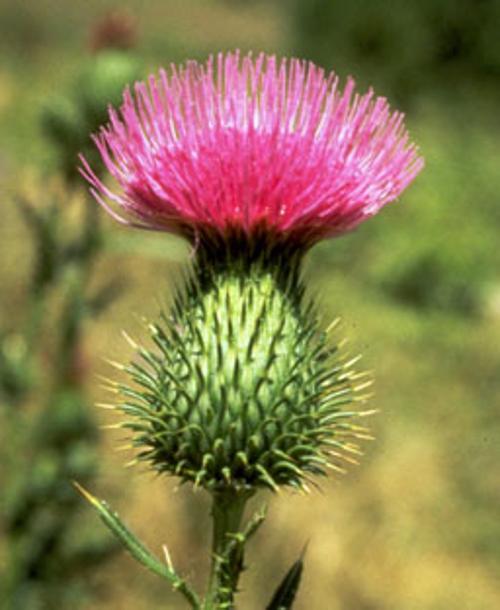
Spear Thistle (Bull Thistle)
Cirsium vulgare
The Spear Thistle, botanically designated as Cirsium vulgare (and commonly referred to as the Bull Thistle), is a robust and highly spiny biennial herb belonging to the family Asteraceae (the daisy or composite family). Native to the meadows, forest edges, and rocky valleys of Europe, western Asi...
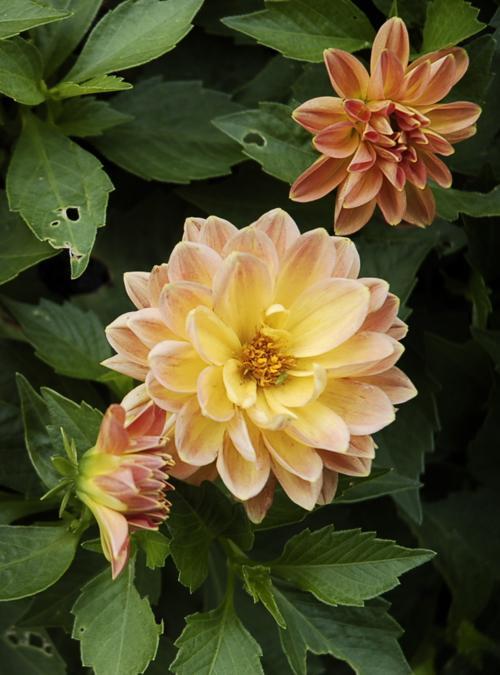
Pink-Yellow Dahlia
Dahlia pinnata (Hybrid)
The Pink-Yellow Dahlia is a spectacular, tuberous herbaceous perennial belonging to the vast Asteraceae family. Native to the mountainous highlands of Mexico and Central America, Dahlias have been heavily hybridized by botanists to produce an astonishing variety of geometric forms and vivid color...
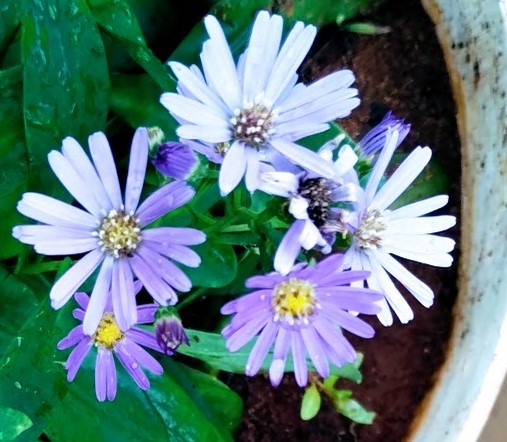
Aster (Michaelmas Daisy)
Symphyotrichum (formerly Aster)
The Aster, commonly known as the Michaelmas Daisy, is a quintessential late-summer and autumn bloomer belonging to the vast Asteraceae family. Native primarily to North America and Eurasia, these resilient perennials are absolute magnets for pollinators. Earning their name from the ancient Greek...
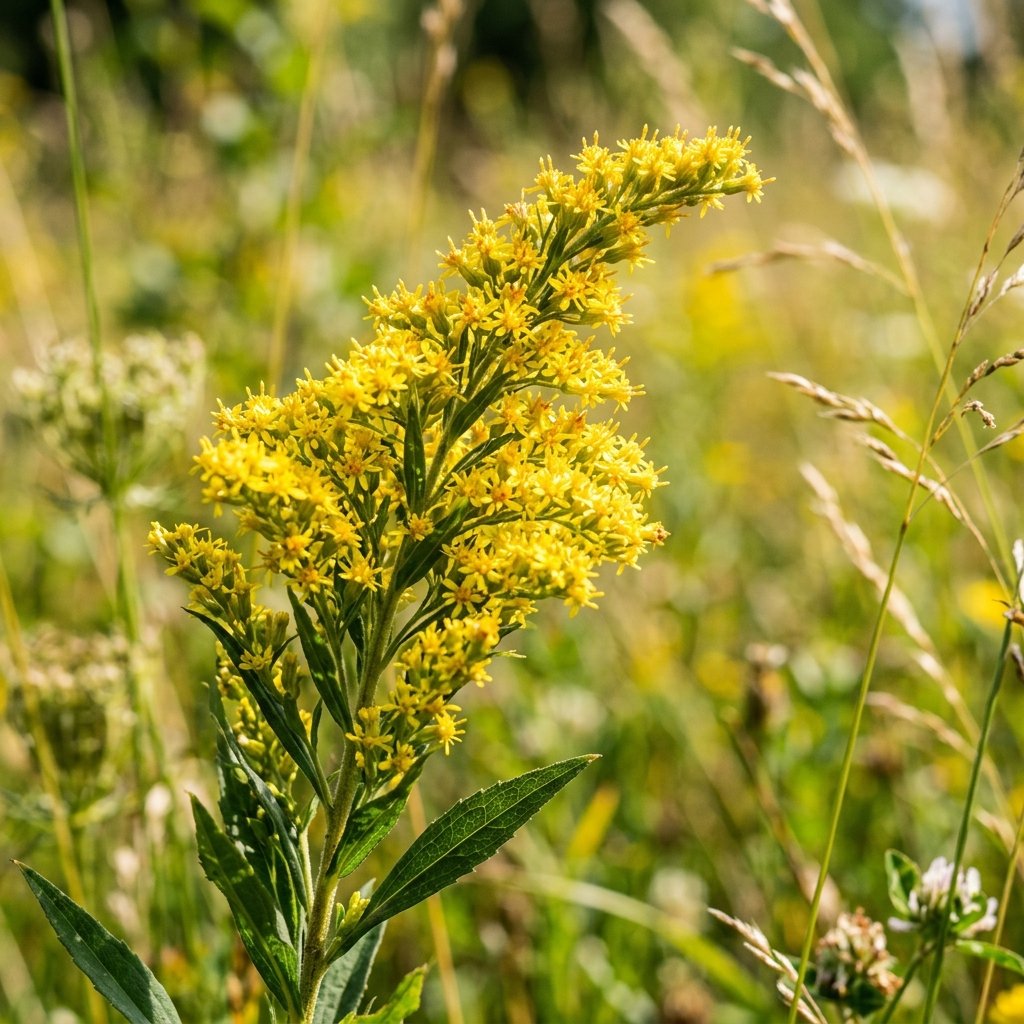
Goldenrod
Solidago canadensis
Goldenrod (*Solidago* spp.) is one of the most ecologically important and visually spectacular native wildflowers of North America, producing brilliant cascading plumes of tiny golden-yellow flowers from late summer through autumn. With over 100 species native to the Americas (most concentrated i...
Similar Characteristics
4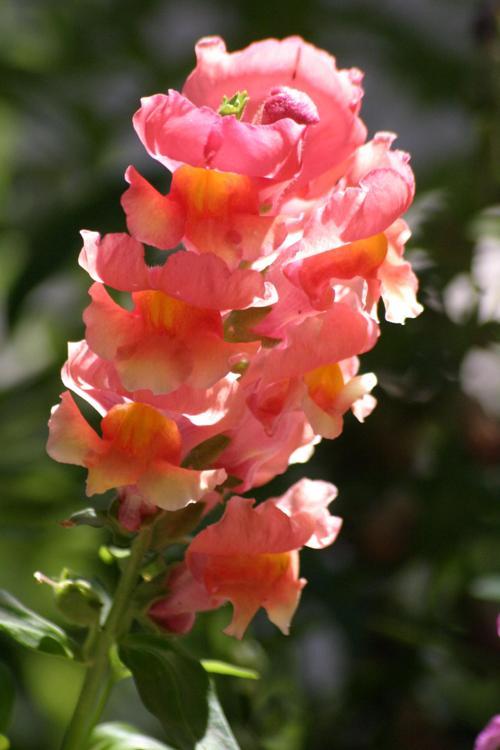
Antirrhinum
Antirrhinum
The Snapdragon, botanically designated as Antirrhinum majus and belonging to the family Plantaginaceae (the plantain family, formerly grouped under Scrophulariaceae), is an exceptionally charming and iconic herbaceous perennial. Native to the rocky screes, ancient ruins, and coastal cliffs of the...
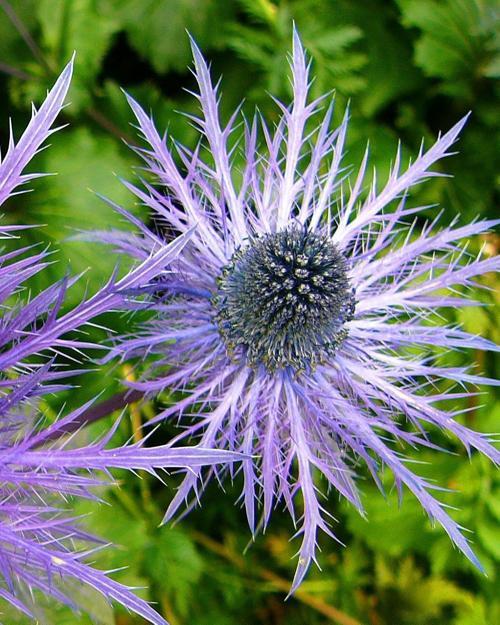
Alpine Sea Holly
Eryngium alpinum
The Alpine Sea Holly, botanically known as *Eryngium alpinum* and widely celebrated as the 'Queen of the Alps,' is an extraordinarily striking, architectural herbaceous perennial. Belonging to the family Apiaceae (the carrot or parsley family, tribe Saniculeae), this alpine masterpiece is native...
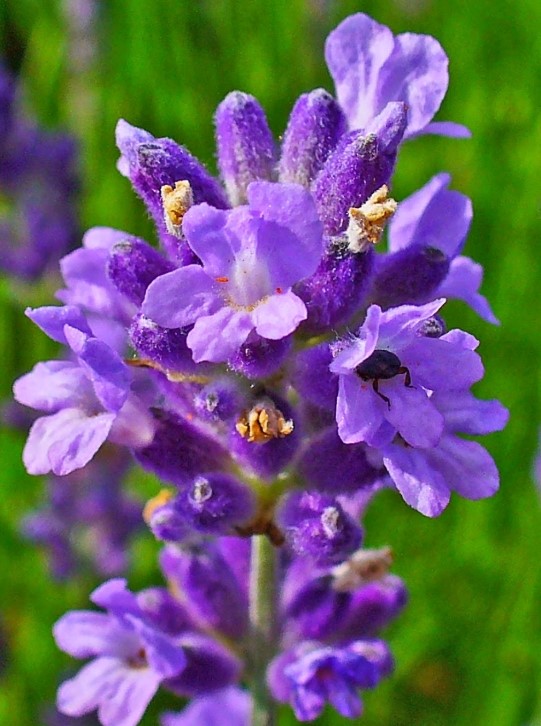
Lavender
Lavandula angustifolia
Lavender, botanically designated under the genus Lavandula and most widely represented by Lavandula angustifolia (English Lavender), is an exceptionally famous, highly aromatic evergreen perennial shrub belonging to the Lamiaceae (mint) family. Native to the sun-baked, rocky limestone hillsides a...
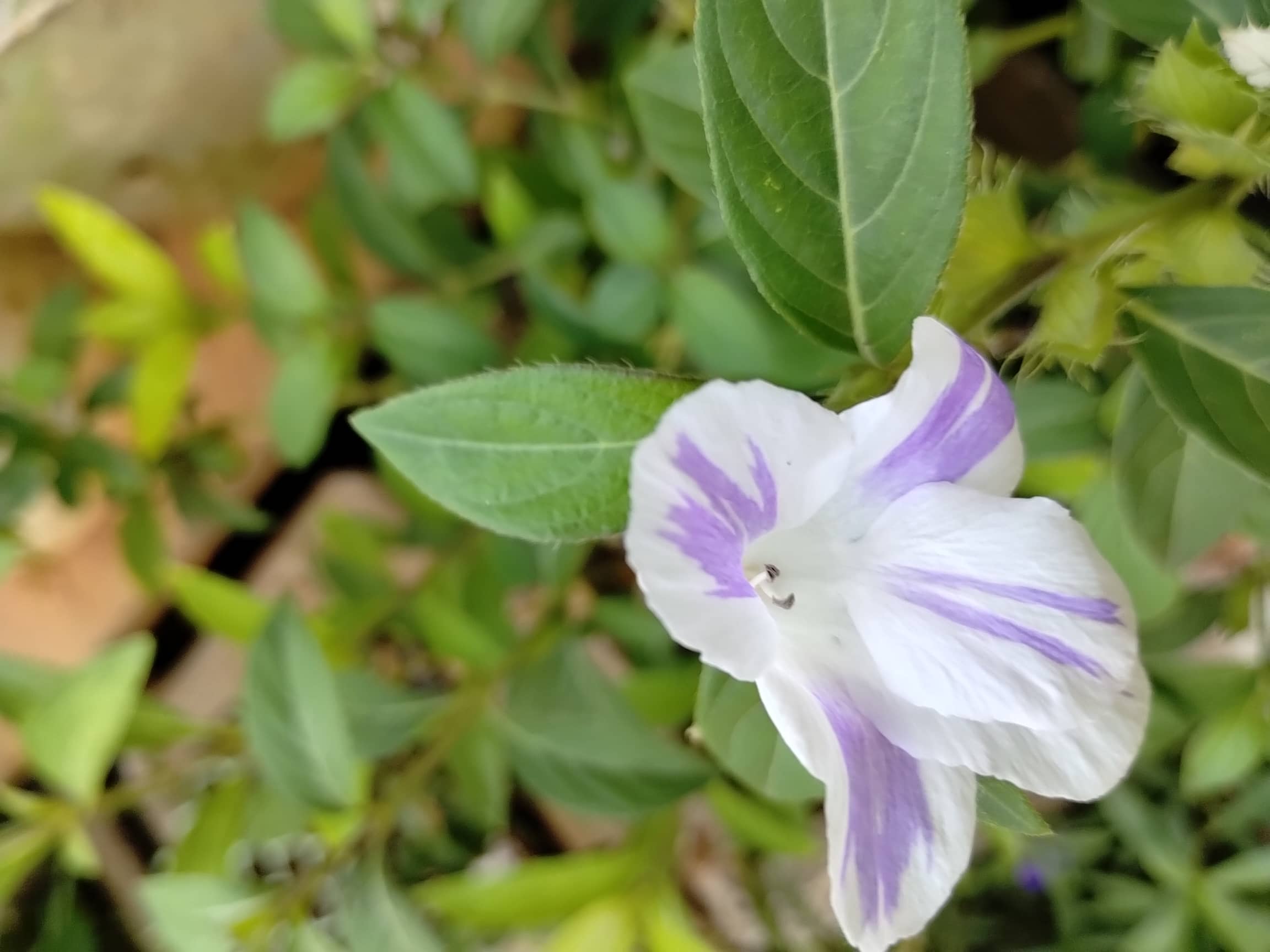
December
Barleria Cristata, Barleria prionitis
The December Flower, botanically classified under the genus Barleria within the family Acanthaceae (the acanthus family), is a highly attractive, fast-growing evergreen tropical shrub. Native to the sunny forest edges, dry riverbanks, and open scrublands of tropical Asia—spanning India, Myanmar,...