
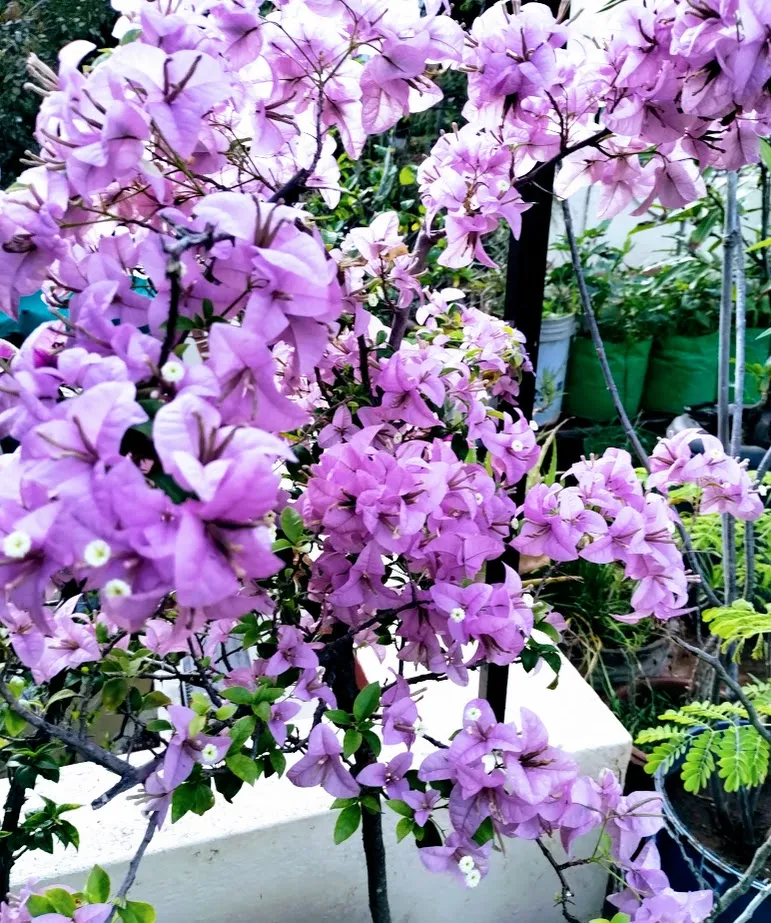
Bougainvillea
Bougainvillea spectabilis
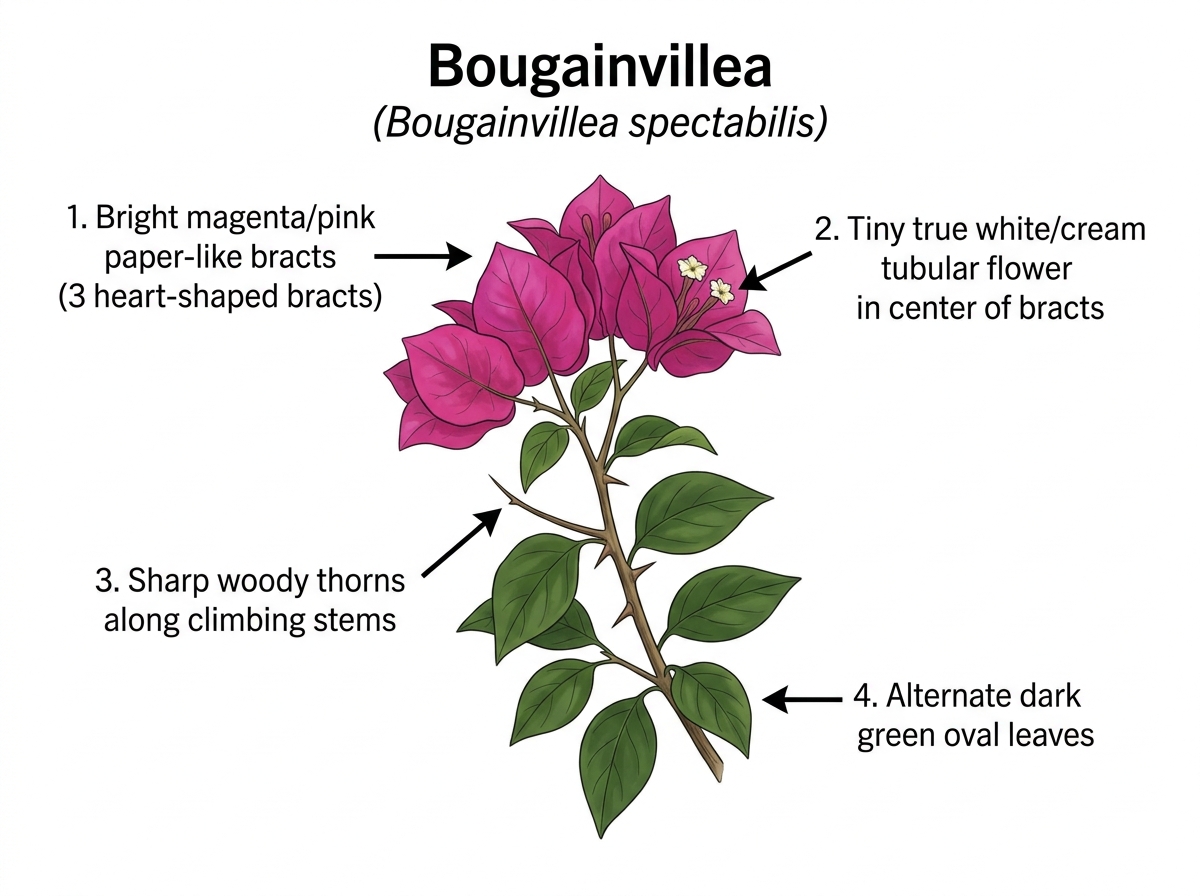
How to Identify Bougainvillea
NON-TOXIC. 100% safe for cats, dogs, and horses. Provides a magnificent, high-color vertical screening option that is completely free of chemical toxicity.
Care & Growing Guide
Seasonal Blooming & Hardiness
Seasonal Blooming Calendar:
- Peak Bloom: Late summer to autumn (August through October).
- Planting Time: Sow seeds directly outdoors in early spring after the last frost, or transplant nursery starts in late spring.
Bloom Timeline
About Bougainvillea
The Bougainvillea, botanically designated as Bougainvillea spectabilis (and including the closely related Bougainvillea glabra), is an exceptionally spectacular, highly vigorous woody and thorny evergreen climbing vine. Belonging to the family Nyctaginaceae (the four o'clock family, tribe Bougainvilleae), this iconic tropical plant is native to the dry, rocky scrublands, coastal forests, and warm hills of South America—particularly Brazil, Peru, and Argentina—and has naturalized as a global landscape favorite across frost-free regions.
This robust climber can easily reach heights of 15 to 40 feet (4.5 to 12 meters) with vertical support, climbing by means of sharp, stout, and curved woody thorns situated along its mature branches. It features alternate, bright dark green, and oval-to-lanceolate leaves with a smooth or slightly velvety surface. It is globally celebrated for its breathtaking, highly colorful, and paper-like bracts. These showy bracts are actually modified leaves that surround the small, inconspicuous true flowers.
Appearing in dense, cascading clusters, the showy bracts measure 1 to 2 inches (2.5 to 5 cm) long, carrying a delicate, dry, and papery texture. They showcase a dazzling spectrum of glowing colors—including deep magenta, royal purple, scarlet-red, brilliant orange, warm peach-yellow, and pure white. The true flowers are tiny, tubular, and cream-colored, sitting in groups of three at the center of the three showy bracts and lasting for several weeks.
The zygomorphic reproductive morphology of the tiny true flowers is represented by the family-specific floral formula % ⚥ K(5) C0 A(5+5) G(1). This formula states that individual flowers are bilaterally symmetrical, bisexual, and completely lack true petals (C0). The calyx consists of 5 fused, colorful, and tubular sepals (which resemble petals). The androecium contains 10 stamens arranged in two whorls of 5, and the gynoecium contains a single carpel with a superior ovary that matures into a small, dry, ribbed achene.
Named in honor of the French navigator and explorer Louis Antoine de Bougainville, who encountered the plant in Brazil in 1768. Famed in Sanskrit as Buganbel (बूगनबेल्) or Kaagajeephul (कागाजीफूल) and in Hindi as Boganveliya (बोगनवेलिया) or Kagaz ka phool (कागज़ का फूल, 'paper flower'), it represents welcoming warmth, passion, and vibrant endurance. Because its bracts retain their color even after falling, they are widely used in traditional decorations.
For pet owners and veterinarians, the Bougainvillea represents an exceptionally safe, non-toxic garden climbing selection. Bougainvillea spectabilis is classified as completely NON-TOXIC to cats, dogs, and horses by major global animal safety databases, including the ASPCA. If a pet brushes against its branches or accidentally nibbles on its colorful papery bracts, there is absolutely no risk of chemical poisoning. However, the vine's sharp curved thorns can cause physical scratches, and its sap can cause mild skin irritation in highly sensitive pets. For safety guidelines, visit our general Pet Guard page.
Bougainvillea is occasionally confused with other flowering climbers like Mandevilla or Trumpet Vine. It is easily distinguished by its sharp woody thorns and its three-fold, dry, papery bracts surrounding tiny cream-colored stars. It is an outstanding choice for scrambling over high fences or retaining walls, especially when paired with groundcovers like Wedelia-sphagneticola_trilobata-creeping_daisy or climbers like Allamanda. To explore more tropical climbers, browse our Flower Identifier. Explore related species in our botanical profile for Russelia Coral Fountain.
Floral Formula & Features
Bilaterally symmetrical, bisexual, 5 fused sepals (colorful), no petals, 10 stamens in 2 whorls of 5, 1 carpel with superior ovary. Formula describes tiny true flower, not showy bracts
- Scientific Name & Classification: Bougainvillea spectabilis (Nyctaginaceae). Globally famed as Paper Flower, Great Bougainvillea, Lesser Bougainvillea, and Paperflower.
- Identification Markers: Vigorous woody stems with sharp curved thorns, alternate oval leaves, and dense clusters of 1-2 inch papery colorful bracts surrounding tiny cream flowers.
- Floral Formula (% ⚥ K(5) C0 A(5+5) G(1)): Bilaterally symmetrical, bisexual true flowers with 5 fused colorful sepals, no petals, 10 stamens in two whorls of 5, and a superior ovary.
- Growing Requirements: Full direct sun (6-8 hours daily); poor, sandy, exceptionally fast-draining soils. Highly drought-resistant and extremely heat and salt-tolerant (Zones 9-11).
- Cultural Significance: Named after French navigator Louis Antoine de Bougainville. Famed in Sanskrit as 'Kaagajeephul' and in Hindi as 'Kagaz ka phool' (paper flower).
- Safety & Toxicity: NON-TOXIC. 100% safe for cats, dogs, and horses. Provides a magnificent, high-color vertical screening option that is completely free of chemical toxicity.
- Common Look-alikes: Confused with Mandevilla or Trumpet Vine, but easily distinguished by its sharp woody thorns and dry, paper-textured three-fold bract clusters.
- Internal Links: Scrambles gracefully over high pergolas, fences, and rocky banks above groundcovers like Wedelia-sphagneticola_trilobata-creeping_daisy or beside Allamanda; find more in our Flower Identifier.
- Internal Links: Compare key differences in our Bougainvillea vs Hibiscus comparison, or try our instant Flower Identifier.
Names in Different Languages
Botanical Classification: Bougainvillea belongs to the Nyctaginaceae family. Learn how to identify its floral symmetry, stamen arrangement, and structural formulas in our Botanical Family Classification Guide.
Toxicity & Safety
Frequently Asked Questions
What is Floral Formula?
A floral formula is a symbolic representation of a flower's structure using letters, numbers, and special symbols. It provides a concise way to describe the arrangement and number of floral parts.
This formula describes the flower's symmetry, sepals, petals, stamens, and carpels in a standardized format.
Formula Sequence
- Bract: Br or Ebr
- Bracteole: Brl or Ebrl
- Symmetry: % (Radial) or ⊕ (Bilateral)
- Sex: ♀ (Female), ♂ (Male), or ⚥ (Bisexual)
- Calyx/Sepal: K<number> (Free or Fused)
- Corolla/Petal: C<number> (Free or Fused)
- Androecium: A<number> (Free or Fused)
- Gynaecium: G<number> (Superior or Inferior Ovary)
Symbol Meanings
- Numbers: Indicate quantity of parts
- Parentheses (): Parts are fused together
- Plus (+): Parts in different whorls
- Underline: Superior ovary position
- Overline: Inferior ovary position
- ∞: Numerous parts (too many to count)
Understanding floral formulas helps botanists quickly identify and classify flowers based on their structural characteristics.
Similar Flowers
Discover flowers that share botanical characteristics
Similar Characteristics
4
Ball Moss
Tillandsia recurvata
Ball Moss, botanically known as Tillandsia recurvata, is a highly adapted, rootless epiphytic perennial belonging to the Bromeliaceae (pineapple) family. Native to the warm, humid regions of the southern United States (particularly Texas, Florida, and Louisiana), Mexico, Central America, and nort...
Pincushion
Scabiosa
The Pincushion Flower, botanically designated under the genus *Scabiosa* (particularly *Scabiosa atropurpurea*, known as the Sweet Scabious or Pincushion Flower), is an exceptionally charming, airy herbaceous perennial or annual. Belonging to the family Caprifoliaceae (the honeysuckle family, tri...
Bearded Iris
Iris germanica
The Bearded Iris, botanically designated under the genus *Iris* (particularly *Iris germanica*), is an exceptionally elegant, highly popular hardy perennial. Belonging to the family Iridaceae (the iris family, tribe Irideae), this spectacular garden favorite is native to the dry, sunny slopes and...
Peruvian Lily
Alstroemeria
The Peruvian Lily, botanically classified under the genus Alstroemeria and belonging to the family Alstroemeriaceae (the peruvian lily family), is an exceptionally showy, long-blooming, and popular herbaceous perennial. Native to the cool mountain valleys, forest edges, and coastal scrublands of...