
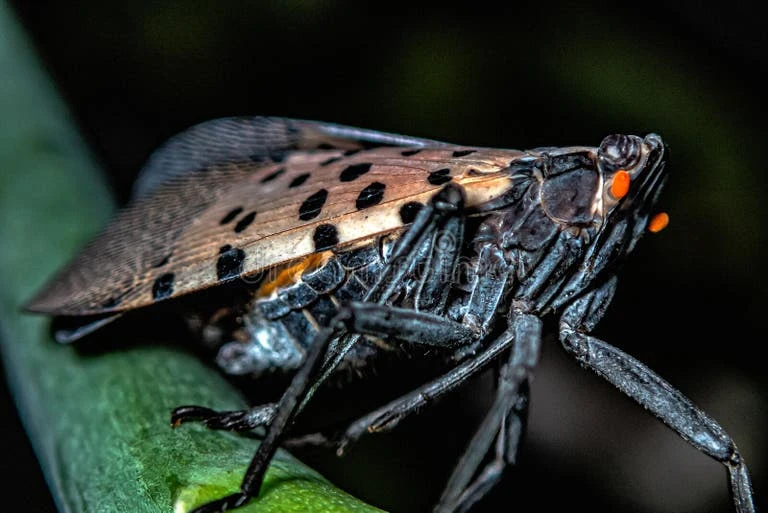
Spotted Lanternfly
Lycorma delicatula
About Spotted Lanternfly
The Spotted Lanternfly (*Lycorma delicatula*), belonging to the planthopper family *Fulgoridae* under the order *Hemiptera*, is a highly invasive and economically damaging sucking pest native to China, India, and Vietnam. Accidentally introduced to North America in 2014, it has rapidly become a major threat to agriculture and forestry. The planthopper acts as a phloem-feeding pest, using its piercing-sucking mouthparts to drain plant sap from woody stems, branches, and trunks. If left uncontrolled, large SLF populations can severely stress hosts, leading to branch dieback, oozing sap wounds, and eventual plant death, particularly in vineyards and orchards.
Identifying the spotted lanternfly early relies on recognizing its distinct life stages and visual marks. The adult is a large, striking planthopper about 2.5 cm long, displaying pinkish-grey forewings with black spots, and bold hindwings with patches of scarlet-red, black, and white (highly visible during flight). Nymphs transition from black with white spots (early stages) to a bright crimson-red with white spots before emerging as adults in late summer. Infested trees show 'weeping' sap wounds on trunks that exude a fermenting odor and attract other insects. A major diagnostic sign is the presence of grey, mud-like egg masses smeared on tree bark, outdoor furniture, or vehicles.
While the invasive 'Tree of Heaven' (*Ailanthus altissima*) is its preferred host, SLF is a generalist feeder that attacks over 70 host plants.
| Affected Crops / Plants | Severity Rating | Damage Symptoms |
|---|---|---|
| Grapes & Vineyards | Extreme (⭐⭐⭐) | Vascular depletion, cane dieback, winter survival failure, up to 100% yield loss |
| Apples, Peaches, Stone Fruits | High (⭐⭐) | Severe shoot wilting, honeydew excretion, secondary black sooty mold covering fruit |
| Maples, Oaks, Hardwood Trees | Medium (⭐) | Oozing trunk sap, localized branch dieback, cosmetic mold accumulations |
The spotted lanternfly completes one generation per year, overwintering as egg masses from autumn to late spring. The eggs hatch into active nymphs that crawl up plants to feed, eventually maturing into adults in mid-summer. Females secrete a sticky, sugary liquid called 'honeydew' that coats leaves and trunks, fueling the growth of black sooty mold. Organic control focuses on scraping egg masses into alcohol, using circle traps on trunks, and applying neem oil or horticultural soaps. Chemical treatments include systemic contact insecticides like dinotefuran or bifenthrin. For containment support, check our Plant Disease Identifier Hub, or explore similar sucking pest profiles like Scale Insect, Aphid, and Japanese Beetle.
Taxonomy & Features
- Invasive Planthopper Origin: Native to Asia, accidentally introduced to North America in 2014 and has become a high-priority agricultural threat.
- Vivid Scarlet Hindwings: Adults feature a highly recognizable wing pattern with pinkish-grey spotted forewings and brilliant scarlet-red hindwings.
- Mud-Like Egg Smears: Egg masses are coated in a grey waxy fluid that dries to look exactly like smudges of cracked mud on vehicles or bark.
- Sugary Honeydew Excretion: Secretes massive volumes of sticky honeydew that coats leaves, causing severe blockages via black sooty mold.
- Tree of Heaven Affinity: Prefers the invasive tree Ailanthus altissima (Tree of Heaven) as its primary breeding and feeding host plant.
- Severe Vine Dehydration: Swarms drain grapevines of carbohydrates so intensely that the canes fail to survive cold winter temperatures.
Seasonal Outbreak Calendar
Outbreak risk and activity timeline for Spotted Lanternfly based on seasonal climate patterns:
Names in Different Languages
Affected Plant Species
Vegetables & Crops
- Hops (Humulus lupulus)
- Cucumber
- Basil
Flowers & Ornamentals
- Rose
- Lilac
- Hibiscus
- Clematis
Fruits & Berries
- Grape (Primary agricultural host)
- Apple
- Peach
- Plum
- Cherry
- Blueberry
Prevention & Cure
Natural & Organic Methods
- Egg Scraping: Locate and scrape mud-like egg masses from bark, stones, and vehicles using a card, sealing them in hand sanitizer or isopropyl alcohol.
- Circle Trapping: Install trunk-mounted circle traps on Ailanthus trees to capture climbing nymphs as they migrate upwards.
- Host Tree Removal: Eradicate wild invasive Ailanthus altissima (Tree of Heaven) trees on property borders to eliminate the primary breeding host.
- Horticultural Oil: Apply 2% light horticultural oil sprays to target nymph stages on low branches in early summer.
Chemical & Professional Control
- Systemic Dinotefuran: Apply systemic dinotefuran bark sprays in mid-summer to poison adult SLF as they feed on sap.
- Bifenthrin Contact Spray: Spray contact bifenthrin or carbaryl to achieve rapid knockdown of dense swarms on trunks.
- Insect Growth Regulators: Apply growth regulators like buprofezin to disrupt nymph molting cycles in late spring.
Frequently Asked Questions
Can the spotted lanternfly bite or sting humans or pets?
No. Spotted lanternflies do not bite, sting, or carry disease vectors harmful to humans or domestic pets. They are strictly plant-feeding insects, though their sticky honeydew can be messy and attract stinging wasps.
How does the spotted lanternfly kill grapevines?
Lanternflies feed in massive swarms on grape canes. They drain large volumes of carbohydrates and sap, severely dehydrating the vine. This prevents the grapevine from storing enough energy reserves in its roots, making it highly susceptible to freezing and dying during winter.
Why are SLF egg masses so hard to find?
The females cover their eggs with a greyish-brown waxy secretion that dries to look exactly like a smudge of dried mud or cracked mortar. They lay these masses on bark crevices, rocks, outdoor furniture, wheel wells, and undersides of vehicles, making them highly camouflaged.
Recommended diagnostics based on crop family and symptoms:
Remedy Disclaimer & Safety Notice
This disease guide is for educational screening purposes only. Pathogen behavior, severity, and host susceptibility can vary dramatically based on seed variety, weather conditions, and regional microclimates. Chemical pesticides and organic treatments are subject to strict regional environmental regulations and registration mandates. Please verify all chemical registrations and review manufacturer safety labels carefully with local certified agronomists or agricultural extension service offices before applying.