
Boron Deficiency
Boron Deficientia
How to Identify Boron Deficiency on Onion

Visible Symptoms
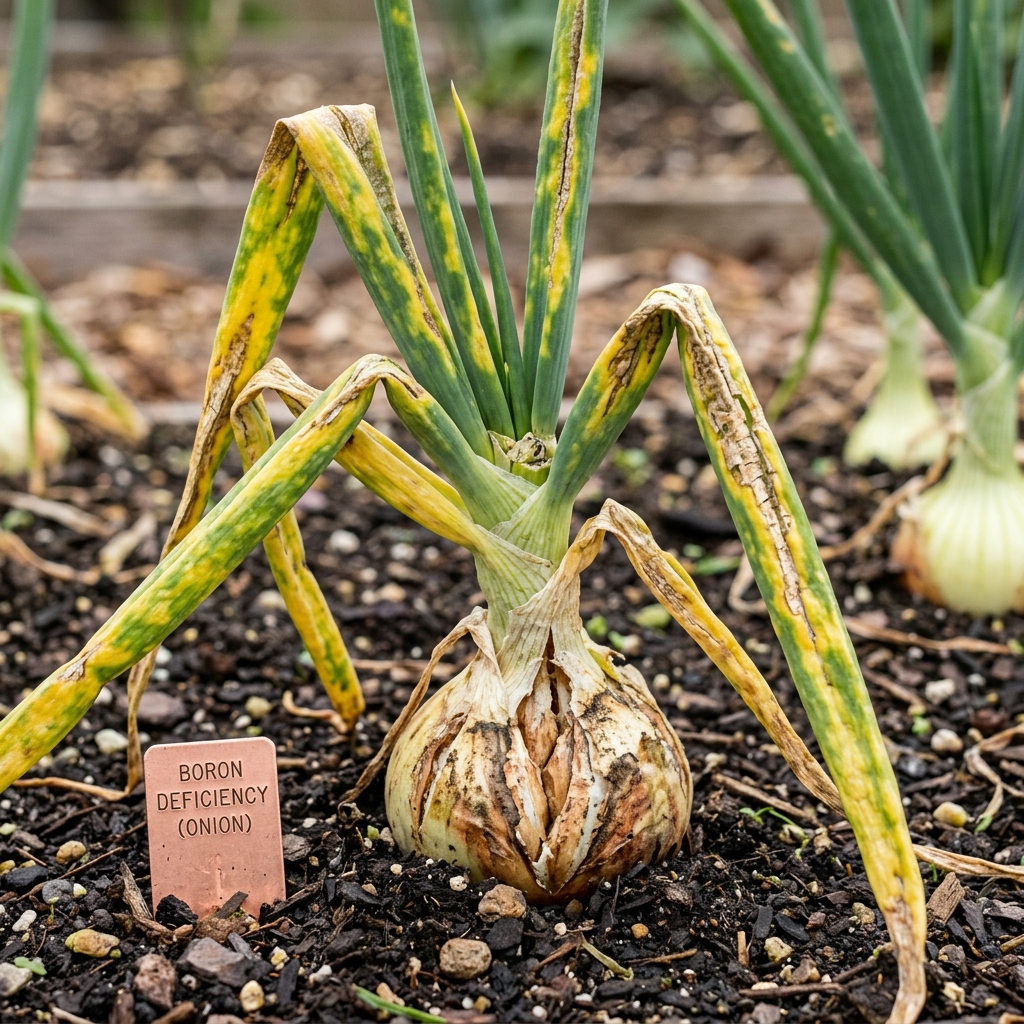
Young leaves emerge distorted, twisted, and brittle. Slicing open harvested bulbs reveals hollow, corky, dry brown center cores.
About Boron Deficiency
Boron deficiency in onions leads to twisted leaves and structural center breakdown in bulbs, resulting in hollow, corky center tissues that rot easily during storage.
Nutrient Role & Deficiency Cause
Boron deficiency in onions leads to twisted leaves and structural center breakdown in bulbs, resulting in hollow, corky center tissues that rot easily during storage.
Seasonal Outbreak Calendar
Outbreak risk and activity timeline for Boron Deficiency based on seasonal climate patterns:
Treatment & Correction Guide
Natural & Organic Methods
Chemical & Professional Control
Frequently Asked Questions
Why are my onion leaves twisting and cracking at the neck?
Twisted, brittle inner leaves accompanied by corky horizontal cracking along the neck are classic symptoms of boron deficiency. Boron is vital for cell wall cross-linking; without it, expanding cells rupture and deform.
What causes hollow centers or split scales in onions?
Boron deficiency impairs cell division and pectin synthesis in expanding bulb tissue, leading to internal cell wall collapse, hollow cavities in the bulb core, and split fleshy scales.
How much Borax should I apply per acre for onions?
Apply 4 to 5 kg of Agricultural Borax (10.5% B) per acre during basal land preparation. Always blend it thoroughly with compost or dry sand before broadcasting to avoid localized toxicity spots.
What is the recommended foliar spray dose for Solubor on onions?
Dissolve 1.0 to 1.5 grams of Solubor (20% B) per Liter of water (0.1–0.15% solution). Spray at 30 and 50 days after transplanting. Never exceed 2 g/L, as boron has a very narrow safety margin between sufficiency and toxicity.
Does soil pH affect boron availability in onions?
Yes. Boron availability drops sharply in alkaline soils (pH > 7.0) and heavily limed soils because borate ions adsorb tightly to clay and calcium carbonate surfaces. Acid to slightly acidic soils (pH 6.0–6.5) optimize boron availability.
Recommended diagnostics based on crop family and symptoms:
Remedy Disclaimer & Safety Notice
This disease guide is for educational screening purposes only. Pathogen behavior, severity, and host susceptibility can vary dramatically based on seed variety, weather conditions, and regional microclimates. Chemical pesticides and organic treatments are subject to strict regional environmental regulations and registration mandates. Please verify all chemical registrations and review manufacturer safety labels carefully with local certified agronomists or agricultural extension service offices before applying.