How to Test Tamarind for Adulteration (Coal Tar Dyes, Excess Salt, Dirt/Insect Filth)
⚡ Quick 60-Second Tamarind Purity & Seed Filler Verdict
Excessive Seed / Fiber Weight Loading & Acid Adulteration: Commercial tamarind blocks are often bulked with up to 40% excess non-edible seeds, heavy fibrous rind, and adulterated with cheap sulfuric acid washes to mask decaying pulp.
Weigh 50g from a commercial block and separate pulp from seeds and fibers. By FSSAI standards, seed content must never exceed 5% in seeded pulp blocks, and 0% in seedless paste.
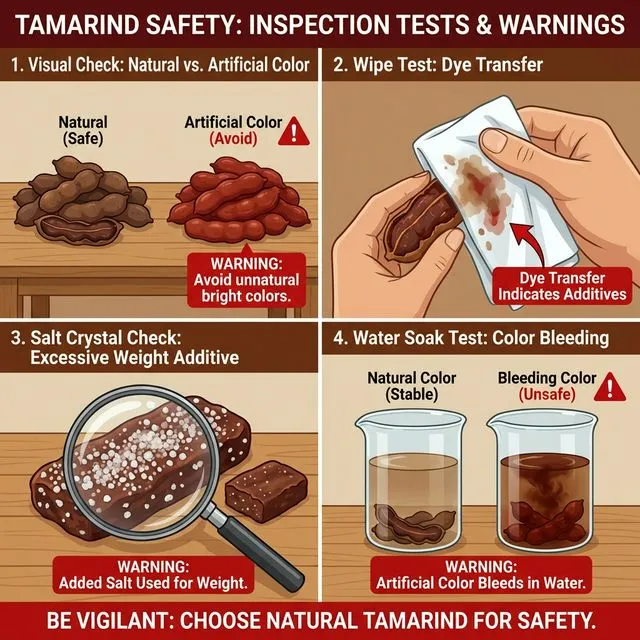
Rub a damp white tissue over the tamarind pulp. Pure tamarind produces a light reddish-brown water tint; vibrant neon red/orange staining indicates added synthetic coal-tar dye.
Pure tamarind has a clean, natural tartness from organic tartaric acid. A sharp, chemical sting that irritates the tongue or a burnt sugar aroma suggests industrial acid or burnt molasses treatment.
To learn more about food safety tests and home adulteration detection, read our guides on Cardamom (Elaichi) and Henna (Mehendi).
Drop Tamarind photo here to test purity
or click to browse • Supports JPG, PNG, WEBP • Paste with Ctrl+V
Inspection Guide
Click to enlarge
Tamarind Quality & Dye Audit
Tamarind is often treated with coal tar dyes to look dark and "aged" or loaded with excessive salt and seeds to increase weight.
1. The Water Bleed Test:
Take a small piece of tamarind and place it in a glass of water. Natural tamarind will gradually release a brownish tint. If the water turns bright red, orange, or yellow almost instantly, it contains artificial coal tar dyes.
2. The Salt Crystal Check:
Examine the block of tamarind for white crystalline deposits. While some salt is natural for preservation, excessive "rock salt" hidden inside the block is a sign of weight fraud.
3. The Seed Ratio:
High-quality tamarind is "seedless." If the block is more than 30% seeds and fibers by weight, it is poor quality.
4. The Stickiness Test:
Natural tamarind should be tacky but not "slimy." A slimy texture may indicate improper processing or the use of cheap liquid sweeteners as fillers.
Quick Safety Tips
- Check for rapid color release in water - indicates dye
- Soak and strain to remove hidden dirt or insect filth
- Look for excessive salt crystals used as fillers
- Avoid tamarind that feels unnaturally slimy
Primary Chemical Concerns
Health Risks & Impacts
Multilingual Local Names
Common Storage Pests
Tamarind Weevil (Sitophilus linearis)
medium riskSpecialized weevils that lay eggs in tamarind fruit and seeds.
Detection
- Small round exit holes in the pulp
- Adult weevils visible in the package
Prevention
- Store in airtight containers
- Keep in a cool, dry place; refrigeration is ideal
Corrective Action: What to do?
Heavily infested tamarind should be discarded. Lightly affected tamarind can be soaked and seeds/insects strained out.
Regulatory Corner: FSSAI (Food Safety and Standards Authority of India)
Regulation: Food Safety and Standards (Food Products Standards and Food Additives) Regulations 2011, Clause 2.9.24: Tamarind Pulp and Concentrate
Legal Limit:Tartaric acid (Natural acidity): Min 8.0% m/m; Total solids: Min 55.0%; Seed content: Max 33.0% (unseeded pulp) / 5.0% (seeded paste); Heavy metal (Lead): Max 2.5 ppm; Artificial non-permitted coal-tar dyes: 0.0%
Report Adulteration to FSSAI (Food Safety and Standards Authority of India)