How to Test Guava for Adulteration (Malachite Green, Pesticide, Heavy Metals)
⚡ Quick 60-Second Guava Fruit Fly & Chemical Greening Verdict
Fruit Fly Larvae (Bactrocera correcta) & Copper Sulfate Wash: Immature guavas are washed with toxic copper sulfate to give them an unnatural glossy green hue, while ripe fruit is prone to internal fruit fly maggots.
Inspect the skin carefully under bright light. Look for tiny brown pinpoint punctures surrounded by a soft, bruised halo. This indicates fruit fly oviposition; cut open to check for maggots.
Rub the skin with a cotton swab moistened in dilute vinegar. If the cotton turns faint blue-green, copper sulfate washing has been used to artificially preserve bright green color.
Sniff the blossom end. Naturally ripe guava emits an intoxicating, sweet, musky perfume. Artificially preserved guavas lack aroma or have a faint metallic chemical smell.
To learn more about food safety tests and home adulteration detection, read our guides on Pomegranate and Mixed Berries (Strawberry/Blueberry).
Drop Guava photo here to test purity
or click to browse • Supports JPG, PNG, WEBP • Paste with Ctrl+V
Inspection Guide
Click to enlarge
Guava Purity & Dye Audit
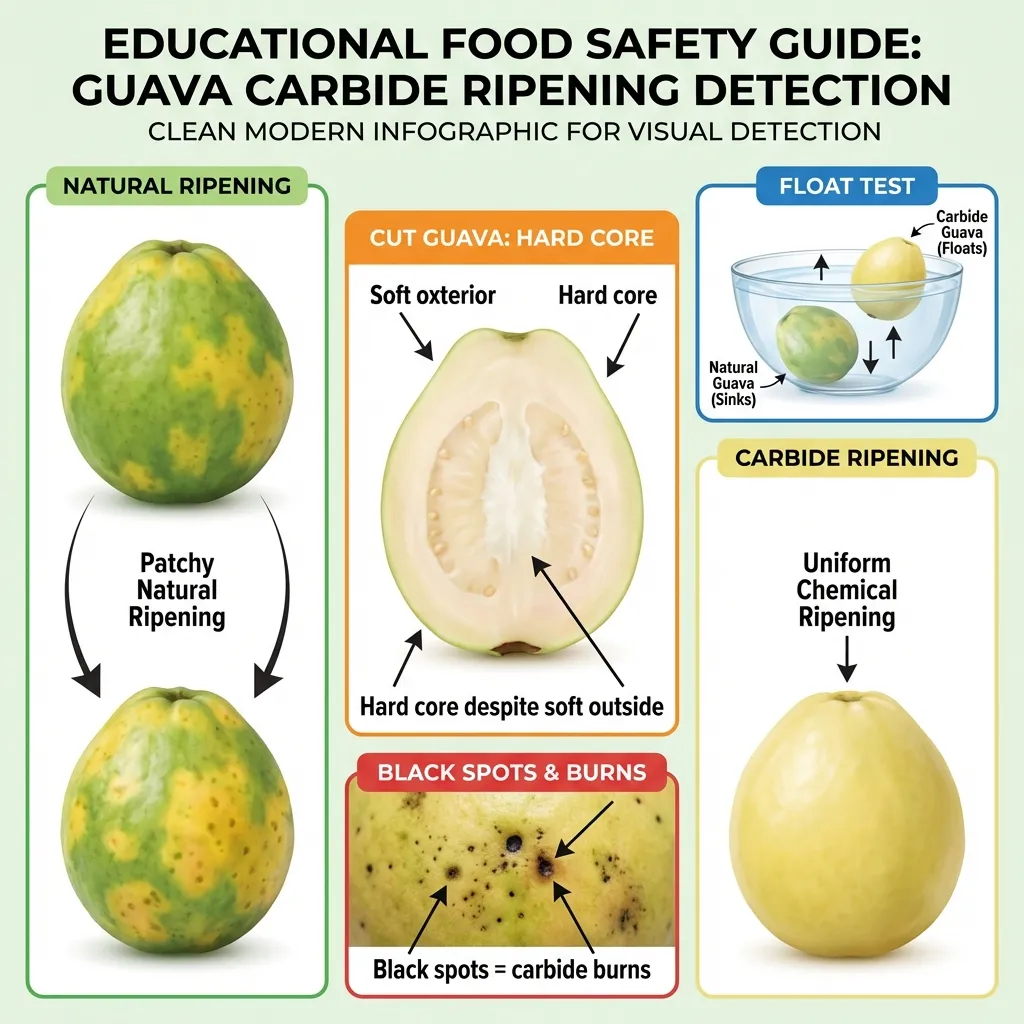
Guavas are often treated with Malachite Green to look fresh and "just-picked" or washed with chlorine to prevent the rapid browning common in tropical fruits.
1. The Cotton Rub Test (Skin Dye):
Rub a wet cotton ball on the green skin of the guava. If the cotton picks up a green or bluish-green color, artificial dye has been applied. Natural guava color is stable and does not rub off.
2. The Internal Freshness Check:
Cut the guava in half. The flesh should be creamy-white or pink throughout and have a fresh, floral aroma. If the core looks greyish or "watery" while the exterior is bright green, suspect chemical preservation.
3. The Water Wash (Color Bleed):
Soak guavas in warm water for 15 minutes. If the water turns green or bluish, artificial coloring is confirmed. Natural chlorophyll does not leach easily.
4. The Squeeze Test:
Fresh guavas are firm. If a guava feels "squishy" or has soft brown spots despite a vibrant green exterior, it is old stock chemically refreshed to hide its age.
Quick Safety Tips
- Perform the cotton rub test for Malachite Green detection
- Avoid guavas with an unnaturally "neon" green color
- Select guavas with a strong, natural floral aroma
- Wash thoroughly with a brush and soak in salt water to reduce surface pesticides
Primary Chemical Concerns
Health Risks & Impacts
Multilingual Local Names
Common Storage Pests
Guava Fruit Fly
medium riskSmall flies whose larvae feed on the internal flesh of the guava.
Detection
- Small entry holes on the skin
- Internal browning and presence of tiny larvae
Prevention
- Inspect each fruit before buying
- Store in a cool, ventilated place
Corrective Action: What to do?
Discard infested guavas as the rot inside can contain harmful bacteria and fungi.
Ash Weevil (Myllocerus subfasciatus)
medium riskSmall grey snout beetles that chew scalloped leaf margins and shelter under the green fruit calyx caps in harvest crates.
Detection
- Adult ash-grey weevils hiding beneath the green calyx cap
- Small feeding wounds and surface rot on the fruit shoulder
Prevention
- Inspect and wipe calyx caps before storing in mesh crates
- Store produce in cool, well-ventilated areas (10°C to 12°C)
Corrective Action: What to do?
Remove and discard calyx; trim any surface feeding marks before cooking.
Regulatory Corner: FSSAI (Food Safety and Standards Authority of India)
Regulation: Food Safety and Standards (Contaminants, Toxins and Residues) Regulations 2011, Schedule 2: Tropical Fruits
Legal Limit:Dimethoate / Malathion pesticide residues: Max 0.5 ppm; Copper sulfate artificial greening: 0.0%; Maggot/larval-infested fruit: Max 1.0%
Report Adulteration to FSSAI (Food Safety and Standards Authority of India)