How to Test Dragon Fruit for Adulteration (Erythrosine, Nitrates, Ethrel)
⚡ Quick 60-Second Dragon Fruit (Pitaya) Ripening & Dye Verdict
Scale Dyeing & Growth Regulator Ripening: Immature dragon fruits are sprayed with synthetic red dyes on the bract scales and treated with Ethephon to force red coloration before interior sugars form.
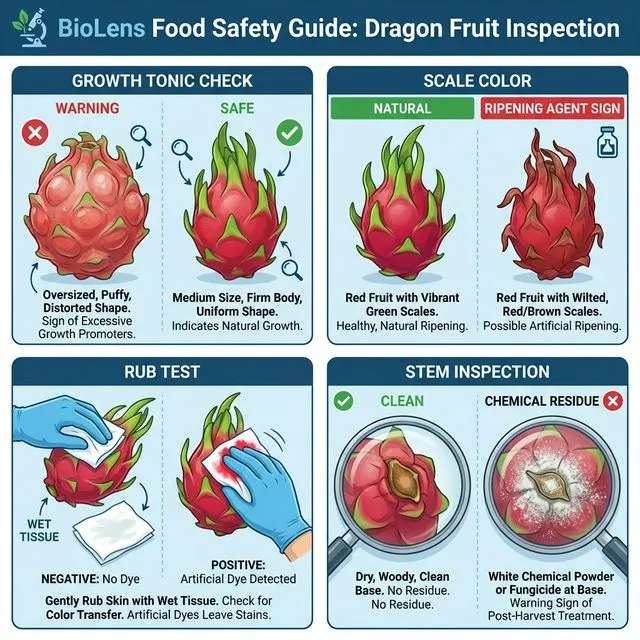
Rub the fleshy scale edges and tips with a damp white paper towel. Artificial red dyes (Rhodamine B / Red 40) rub off immediately onto the tissue. Natural pink pigments do not transfer.
Inspect the scale tips. Naturally tree-ripened pitaya has vibrant, tender greenish-yellow scale tips. Fruits ripened prematurely with chemicals have withered, brittle, dark brown scale tips with mottled red skin.
Slice the fruit open. Naturally ripened dragon fruit has a sweet, mildly floral flavor with crunchy black seeds embedded in translucent pulp. Forced unripe fruit tastes bland, sour, and unpleasantly rubbery.
To learn more about food safety tests and home adulteration detection, read our guides on Orange and Fig (Anjeer).
Drop Dragon Fruit photo here to test purity
or click to browse • Supports JPG, PNG, WEBP • Paste with Ctrl+V
Inspection Guide
Click to enlarge
Dragon Fruit Purity & Dye Audit
Dragon fruit, especially the red-fleshed variety, is sometimes enhanced with artificial red dyes (Erythrosine) to make the interior look more vibrant and premium.
1. The Cotton Rub Test (Internal):
Cut the dragon fruit and rub a wet cotton ball on the red flesh. If the cotton picks up a bright pink or red tint instantly, suspect artificial coloring. Natural dragon fruit color (Betacyanin) is stable and leaches slowly.
2. The Water Dissolution:
Place a small cube of the red flesh in a glass of cold water. If the water turns bright pink or red immediately, artificial dyes have been used. Natural color leaches very slowly and turns the water a pale pink.
3. The Scaly "Wing" Health:
Examine the green "wings" (scales) on the skin. In a naturally fresh fruit, these should be vibrant green or slightly yellow. If the fruit is bright red but the wings are dark brown, dry, or shriveled, it indicates old stock or chemical "refreshing."
4. The Taste Integrity:
Natural red dragon fruit has a mild, earthy sweetness. If the fruit is vibrant red but tasteless, watery, or has a chemical after-taste, it has likely been artificially ripened and colored.
Quick Safety Tips
- Perform the internal rub test for red dyes
- Avoid fruits with brown/shriveled "wings" despite a bright red skin
- Select fruits that feel heavy for their size (indicates juiciness)
- Wash the outer skin thoroughly before cutting to avoid surface chemical transfer
Primary Chemical Concerns
Health Risks & Impacts
Multilingual Local Names
Common Storage Pests
Fruit Flies
low riskSmall flies that can lay eggs in the soft skin or entry points.
Detection
- Small soft spots on the skin
- Tiny insects around the fruit
Prevention
- Store in a cool, well-ventilated area
- Keep dry
Corrective Action: What to do?
Cut away soft spots; discard if internal rot is visible.
Regulatory Corner: FSSAI (Food Safety and Standards Authority of India) / Codex Alimentarius (Codex Stan 237-2003)
Regulation: Food Safety and Standards (Food Products Standards and Food Additives) Regulations 2011, Clause 2.3.1 & Codex Stan 237
Legal Limit:Ethephon MRL: Max 2.0 ppm; Synthetic artificial food colors: Prohibited (0.0 ppm - Zero tolerance); Heavy metals (Lead): Max 0.1 ppm; Cadmium: Max 0.05 ppm
Report Adulteration to FSSAI (Food Safety and Standards Authority of India) / Codex Alimentarius (Codex Stan 237-2003)